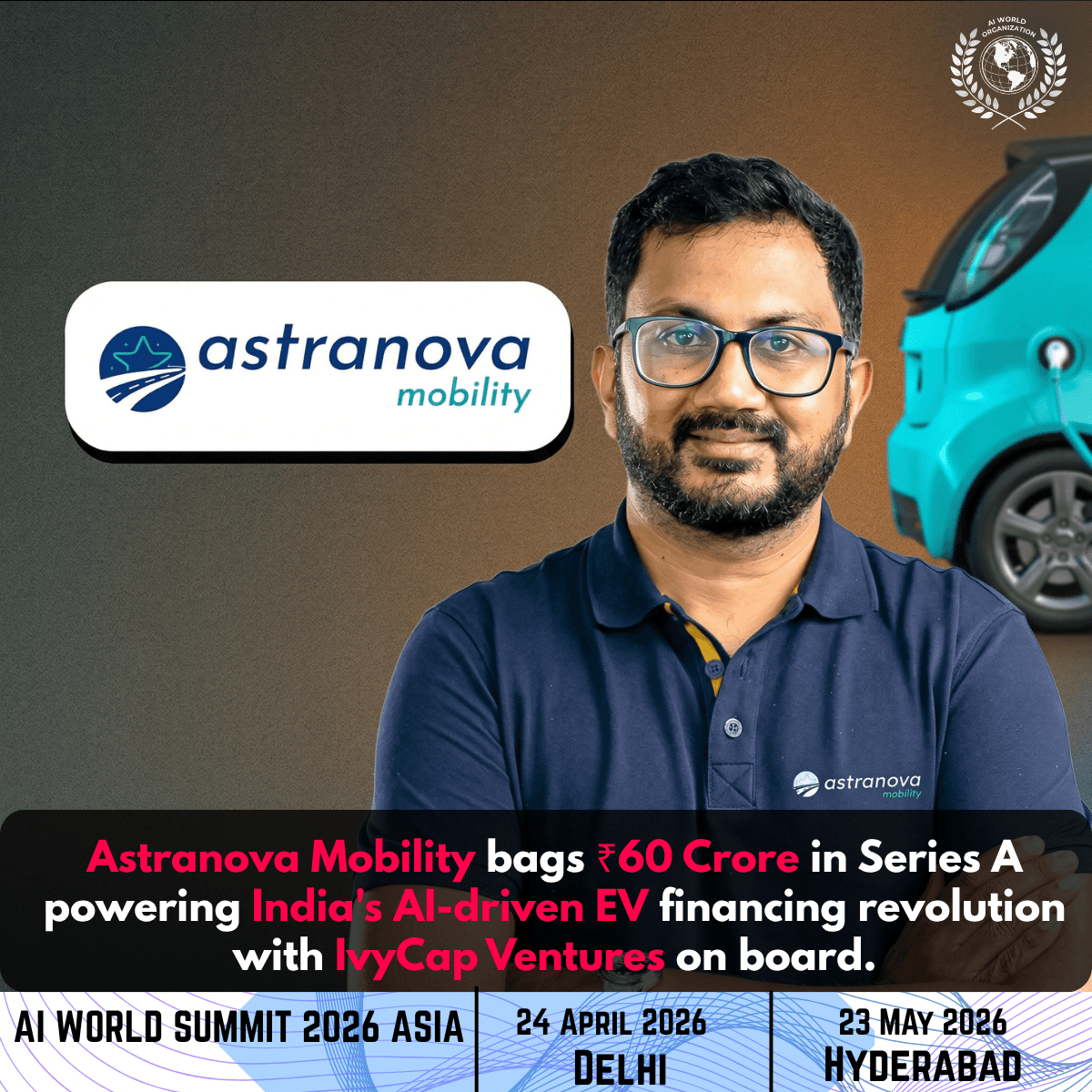
Astranova Mobility Raises Rs 60 Cr Series A Round
Astranova Mobility secures Rs 60 Cr Series A led by IvyCap Ventures to scale AI-powered EV financing and deploy 25,000+ electric vehicles across India.
TL;DR
Astranova Mobility, a Gurugram-based EV financing and asset management startup, has raised Rs 60 crore in a Series A round led by IvyCap Ventures, with participation from Trucks Venture Capital and the Asian Development Bank. The fresh capital will be used to scale its AI-powered fleet management platform, double EV deployments in the next 18 months, and push toward its ambitious $1 billion asset target by 2030.
Astranova Mobility Secures Rs 60 Crore in Series A Round Led by IvyCap Ventures to Accelerate EV Financing and AI Capabilities
India's electric vehicle (EV) financing and asset management landscape received a major boost this week as Astranova Mobility, a Gurugram-based full-stack EV platform, successfully closed a Rs 60 crore (approximately $6.4 million) Series A funding round. The round was spearheaded by IvyCap Ventures, one of India's leading homegrown venture capital firms managing over ₹5,000 crore in assets under management. This latest development in AI funding news has caught the attention of investors and clean-tech enthusiasts alike, especially as the startup moves to integrate advanced artificial intelligence and data engineering at the core of its operations. The participation in this round didn't stop at IvyCap — it also saw strong backing from Trucks Venture Capital, a Silicon Valley-based autotech fund, alongside returning investors Asian Development Bank (ADB) and Advantedge Founders. Together, this diverse and formidable investor group underscores the growing institutional confidence in India's EV financing ecosystem.
Founded in 2023 by Kunal Mundra, a former CEO of Cars24, and Nikhil Aggarwal, co-founder of Grip Invest, Astranova Mobility was initially launched under the name Electrifi Mobility. The company was rebranded to Astranova Mobility in March 2025, reflecting a broader strategic shift toward enabling not just electric vehicle adoption, but also exploring future technologies like hydrogen-powered mobility for heavy-duty transportation. The fresh round of AI funding will help the company solidify its position as a technology-first platform that is as much about smart data and artificial intelligence as it is about green transportation. This is a story not just about capital — it is about the convergence of clean energy, intelligent financing, and the transformative power of AI-driven asset management.
What Astranova Mobility Does: A Full-Stack EV Platform
Astranova Mobility operates as a comprehensive, full-stack platform for commercial EV financing and asset management. Unlike traditional financiers who simply provide loans, Astranova has built an integrated solution that takes care of the entire lifecycle of an EV asset — from financing and leasing to maintenance, post-sales support, refurbishment, and eventual redeployment. This end-to-end approach has made the startup an attractive partner for fleet operators and original equipment manufacturers (OEMs) who need more than just capital — they need operational expertise and technological support to make the transition to electric mobility sustainable and profitable.
The company's platform serves a wide variety of vehicle categories, including two-wheelers, passenger cars, buses, and heavy-duty trucks. This cross-segment presence is one of Astranova's defining strengths, allowing it to cater to the vastly different operational and financial needs of each vehicle category. Fleet operators working with Astranova benefit from proprietary data dashboards and technology-driven insights that help them monitor vehicle performance, track asset utilization, and optimize costs. These tools, powered by the company's in-house data stack and AI capabilities, provide a level of operational visibility that is otherwise difficult to achieve in India's fragmented commercial EV market. As one of the rising names in AI funding news within the EV sector, Astranova is demonstrating that intelligent financing is the next frontier in India's electric mobility story.
With the new Series A capital in hand, Astranova intends to double down on its technology infrastructure. CEO Kunal Mundra confirmed that a significant portion of the funds will be channeled into strengthening the company's engineering capabilities, expanding its data stack, and scaling its AI systems. The goal is to build a platform that is smarter, faster, and more responsive to the evolving needs of commercial EV fleet operators across India. This focus on AI and data-driven decision-making aligns well with the broader narrative in the AI funding space, where intelligent platforms are increasingly attracting capital from global investors who see long-term value in combining artificial intelligence with real-world asset management.
Investors Who Backed the Round: A Global Coalition for Clean Tech
The composition of this funding round tells a compelling story about the kind of institutional faith being placed in Astranova Mobility. IvyCap Ventures, the lead investor, is a well-established Indian VC firm that has consistently backed technology-driven, innovation-led startups across sectors such as DeepTech, FinTech, HealthTech, EdTech, and SaaS. The firm's decision to lead this round signals its belief in the commercial EV financing space as a high-growth opportunity in India's evolving technology-driven economy. For a platform like The AI World, which tracks AI funding news and technology investment trends, it is noteworthy that IvyCap's portfolio strategy aligns closely with companies that are using AI and data as competitive moats — which is precisely what Astranova represents.
Trucks Venture Capital, a Silicon Valley-based autotech fund, brings a different dimension to this round. Its participation gives Astranova access to the global automotive technology ecosystem of the United States, opening up opportunities for cross-border technical collaboration, knowledge sharing, and potentially global partnerships in the future. This is especially significant as India looks to establish itself as a global leader in sustainable mobility solutions. The involvement of a US-based fund in an Indian EV startup also reflects a growing trend in international AI funding and deep-tech investment, where capital is crossing borders to back scalable, impact-driven technology companies.
The Asian Development Bank's continued support as a returning investor adds yet another layer of credibility to Astranova's story. ADB has historically backed startups and initiatives that are aligned with sustainable development goals, and Astranova's mission to reduce carbon emissions by enabling large-scale EV adoption sits squarely within this mandate. Advantedge Founders, another returning investor, similarly reflects confidence in the founding team's ability to execute on an ambitious roadmap. Collectively, this investor consortium gives Astranova not just capital, but also a network of strategic allies who can open doors across geographies, sectors, and policy corridors.
Astranova's Track Record: 25,000 EVs and Counting
Before diving into the future, it is worth pausing to appreciate what Astranova Mobility has already built in just a little over two years since its founding. The company has enabled the financing and deployment of over 25,000 electric vehicles, with the total asset value of these deployments crossing INR 3.6 billion. These aren't just numbers on a spreadsheet — they represent tens of thousands of commercial vehicles that are now running on clean energy, reducing India's dependence on fossil fuels and cutting down on vehicular carbon emissions. Astranova has worked alongside more than 50 fleet operators, together collectively covering over 2 million green kilometres and achieving an estimated reduction of 40,000 tonnes of CO₂ emissions annually.
The company's journey has been marked by deliberate, strategic fundraising. In January 2024, Astranova raised ₹25 crore in a seed funding round, with ₹16 crore as equity and the remainder as debt capital. By March 2025, it had secured an additional $3 million from investors including AdvantEdge, Asian Development Bank, and Alteria Capital. Each of these rounds helped the company refine its product, scale its operations, and gather the kind of data insights that are now powering its AI and analytics engine. In the context of broader AI funding news, Astranova's trajectory demonstrates how consistent capital infusion, when directed toward technology-building, can compound exponentially in terms of operational capability and market impact.
The company's rebranding from Electrifi Mobility to Astranova Mobility in March 2025 was more than a cosmetic change — it was a strategic declaration. Mundra articulated the vision clearly when the rebrand was announced, stating that the company wanted to be at the forefront of enabling the adoption of any new sustainable transportation technology that enters the market, including hydrogen for large vehicles like buses and trucks. This forward-looking positioning is what separates Astranova from narrow EV-only players and places it in the company of those rare startups that are building not just for today's opportunity but for the transportation infrastructure of tomorrow.
The Road Ahead: 5x Growth and a $1 Billion Vision
Perhaps the most exciting aspect of this funding round is the bold vision it is meant to power. Kunal Mundra has publicly committed to growing Astranova's scale fivefold over the next 18 months. This aggressive expansion plan will be driven by a combination of increased financing activity, deeper penetration into new EV segments, geographical expansion, and the rollout of enhanced AI-powered tools for fleet operators and OEMs. The company is also targeting a long-term milestone of enabling USD 1 billion in EV asset deployments over the next four years — a figure that, if achieved, would make Astranova one of the most consequential players in India's EV financing landscape.
In tandem with the equity raise, Astranova has also announced that this round has unlocked significant additional debt capital, which will be used to finance new EV deployments at scale. This combination of equity and debt is a smart financial strategy that allows the company to grow its balance sheet without diluting equity excessively, while also ensuring that it has the liquidity to serve the increasing demand from fleet operators looking to transition to electric vehicles. The use of AI funding to strengthen data and engineering systems further ensures that this growth will be both scalable and sustainable — not just rapid for the sake of headlines.
For stakeholders following AI funding news, the Astranova story is emblematic of a broader shift happening in India's startup ecosystem — where AI is no longer just the domain of software companies but is increasingly being embedded into physical-world industries like transportation, logistics, and infrastructure. Platforms like The AI World have been closely tracking this convergence, recognizing that some of the most impactful applications of artificial intelligence are happening not in tech labs but in the operational realities of fleet management, asset optimization, and sustainable finance. Astranova's use of AI to power smarter financing decisions, predictive maintenance schedules, and real-time asset tracking represents exactly this kind of high-impact, ground-level intelligence.
India's EV Financing Gap: Why Astranova's Mission Matters
To fully appreciate the significance of this funding round, one must understand the structural challenge that Astranova is trying to solve. India's commercial EV market has enormous growth potential, but one of its most persistent bottlenecks has been access to financing. Traditional banks and NBFCs have been hesitant to lend against EV assets due to uncertainty around residual values, the nascent state of the secondary market, and a lack of performance data for commercial EVs at scale. This financing gap has slowed down fleet electrification efforts and kept many operators locked into diesel and CNG vehicles even when they want to switch to electric.
Astranova has directly addressed this problem by building a data-driven platform that generates the kind of real-world performance and utilization data that lenders need to feel confident about EV assets. By deploying over 25,000 EVs and aggregating data from every vehicle it manages, Astranova has created a proprietary dataset that is invaluable — both for its own AI models and for the broader lending ecosystem. This approach is why the company has been able to attract backing from development finance institutions like the Asian Development Bank, which is keenly interested in accelerating sustainable finance mechanisms in emerging markets.
The involvement of Trucks Venture Capital also brings a uniquely American perspective to this challenge. In the United States, commercial EV adoption has been accelerated by sophisticated financing mechanisms, government incentives, and a mature technology ecosystem. Trucks VC's expertise in this domain could prove invaluable as Astranova looks to benchmark its practices against global standards and potentially explore partnerships with US-based EV technology companies. This cross-pollination of ideas and capital — a defining feature of the current AI funding news cycle — is what enables startups like Astranova to leapfrog traditional development timelines and scale faster than anyone might have imagined just a few years ago.
As India accelerates toward its net-zero transportation goals, and as the global conversation around sustainable mobility intensifies, companies like Astranova Mobility are becoming central characters in one of the most important industrial transitions of our time. With Rs 60 crore of fresh capital, a formidable investor coalition, and an AI-powered platform built on real-world data, Astranova is well-positioned to lead the next chapter of India's EV financing revolution.


