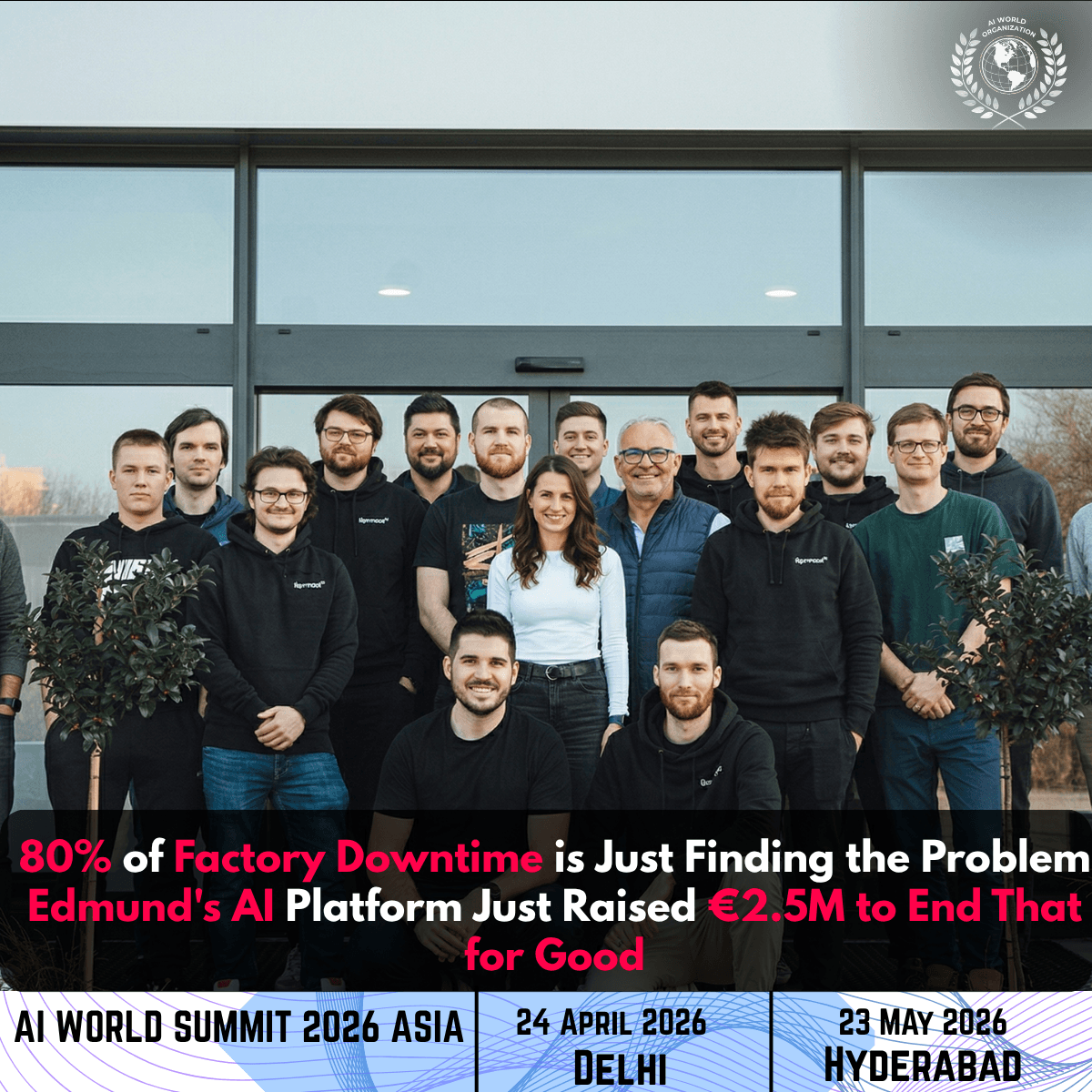
Edmund Raises €2.5M to Power Factory AI
Edmund secures €2.5M in AI funding to build a three-layer factory intelligence platform that cuts diagnostic downtime by up to 90% across European manufacturing.
TL;DR
Prague-based startup Edmund has raised €2.5M led by FORWARD.one to help factories stop losing critical expertise as experienced engineers retire. Its platform connects machine hardware, technical manuals, and live sensor data to cut fault diagnosis time by up to 90%. Early adopters like Amcor Flexibles have already saved hundreds of man-hours annually.
Edmund Secures €2.5M in AI Funding to Tackle Manufacturing's Growing Knowledge Crisis
The manufacturing industry is facing a silent but deeply consequential crisis — one that has nothing to do with supply chains, raw material costs, or geopolitical disruptions. It is a knowledge crisis. Across factories in Europe and beyond, an entire generation of highly skilled engineers and technicians is inching closer to retirement, and with them, decades of hands-on expertise, diagnostic instinct, and operational memory are at risk of disappearing forever. Traditional systems, no matter how advanced they may appear on paper, have proven largely ineffective at capturing and transferring this irreplaceable institutional knowledge. Into this widening gap steps Edmund, a Prague-based industrial AI startup that has just announced a significant €2.5 million funding raise to change the way factories diagnose failures, retain expertise, and prepare for the future of work. This latest AI funding news is turning heads across the European tech and industrial sectors, and for very good reason.
Edmund was founded in Prague in 2023 with a singular, urgent mission: to build a factory intelligence platform that doesn't just collect data but actually understands the full picture of how a manufacturing environment operates. The funding round was led by FORWARD.one, a prominent European venture capital firm known for backing industrial and deep tech startups, and joined by University2Ventures and Tensor Ventures. The capital injection will be directed toward enhancing Edmund's AI capabilities, scaling its commercial operations, and expanding its reach across the European manufacturing landscape. With interest already building from the United States, this AI funding milestone could well mark the beginning of a much larger global story.
The Brain Drain Crisis No One Is Talking About
According to industry research, roughly 20% of the entire industrial workforce is expected to retire within the next decade. That is not just a headcount problem — it is a knowledge catastrophe in slow motion. Each retiring engineer carries with them years, sometimes decades, of accumulated insight into how specific machines behave, what certain vibrations mean, how to trace a fault through layers of interconnected systems, and how to make the right call under pressure. This tacit knowledge — the kind that never makes it into manuals or documentation — is extraordinarily difficult to digitize or transfer through conventional training methods.
What makes this situation even more frustrating for factory operators is that modern manufacturing facilities are, in many ways, drowning in data. Sensors are embedded everywhere. Digital twins simulate entire production environments. Predictive maintenance platforms promise to flag failures before they happen. Yet despite all this technological investment, equipment breakdowns continue to cause costly, prolonged shutdowns. The fundamental problem, as Edmund's founding team identified early on, is not the absence of data — it is the absence of context. Raw sensor readings mean very little without understanding the physical component they are attached to, the documentation that describes how that component should behave, and the historical knowledge of how it has behaved in the past. That gap between data and context is precisely where Edmund is building its solution, and this AI funding round is the fuel to make it scale.
Three Layers, One Unified Intelligence Platform
At the heart of Edmund's approach is a deceptively simple but technically sophisticated insight: most factory diagnostic platforms operate in silos. Some work with hardware data. Others focus on documentation. A few specialize in live sensor outputs. But none of them connect all three in a meaningful, actionable way. Edmund's platform is built to do exactly that — and it does so in a manner that is genuinely unique in the market.
The platform integrates three distinct but deeply interdependent layers of factory information. The first is physical hardware — the actual machines, components, and equipment on the factory floor. The second is technical documentation — the schematics, manuals, maintenance logs, and procedural guides that describe how those machines are supposed to work. The third is live sensor data — the real-time stream of operational readings being generated by those machines every second of every day. The connective tissue between these layers is PLC (Programmable Logic Controller) software, the industrial control systems that govern production lines. By mapping sensor data through PLC logic all the way to specific physical components and their associated documentation, Edmund creates a unified diagnostic intelligence that no other platform currently offers.
Jakub Szlaur, Edmund's Founder and CEO, has articulated this distinction clearly and confidently. Speaking about what sets Edmund apart from the competition, he emphasized that Edmund is the only platform capable of tracking a sensor through the PLC software all the way to the data it generates — on a one-to-one basis — and then providing exact, step-by-step instructions for what to do in any given situation. This is not a minor technical improvement over existing tools. It is a fundamentally different way of thinking about factory intelligence. And with this latest round of AI funding, Edmund is now well-positioned to bring this vision to fruition at scale.
Cutting Downtime by 90%: The Real Business Case
The practical business case for Edmund's platform is compelling and grounded in real-world numbers. According to Szlaur, when a machine fails on the factory floor, engineers spend approximately 80% of their total downtime not on the repair itself, but on diagnosing the root cause. They scroll through outdated schematics, wait for specialist engineers to arrive, make phone calls, dig through filing cabinets, and retrace the same steps repeatedly — all before a single spanner is turned. This diagnostic phase is where productivity is lost, where production targets are missed, and where costs quietly balloon.
Edmund's AI agents are designed to collapse this diagnostic phase dramatically. By analyzing failures across all three connected layers simultaneously — cross-referencing live sensor anomalies with PLC logic and pulling up the most relevant sections of technical documentation in real time — Edmund's system can reduce the analysis phase by up to 90%. That is not a projected figure based on laboratory conditions. It is a reduction grounded in the platform's actual operational architecture. The implications for factory operators are enormous. A problem that might have kept a production line offline for eight hours could potentially be diagnosed and resolved in under one.
The competitive landscape in this space includes established players such as Augmentir, Parsable, Cognite, and SymphonyAI. However, as Szlaur has pointed out, each of these competitors primarily works with a single data source. None of them connect all three layers — hardware, documentation, and live data — into a single diagnostic workflow. This gap in the market is not just Edmund's commercial opportunity; it is the reason its investors moved with conviction. Even after conducting extensive due diligence, the team at FORWARD.one and its co-investors could not identify a debugging platform that links all three layers. That absence of a true competitor, combined with the urgency of the manufacturing knowledge crisis, was a compelling enough signal to back the company.
Early Customers Are Already Seeing Results
Edmund's claims are not merely theoretical. The company has already deployed its platform with real manufacturing customers and is beginning to accumulate a body of evidence that supports its value proposition. One of the most telling early results comes from Amcor Flexibles, a global packaging company that integrated Edmund's platform into its operations. After deployment, Amcor Flexibles achieved a 26% reduction in average repair times, which translated to approximately 440 man-hours saved per factory per year. For a company operating multiple manufacturing sites, that figure compounds significantly across its portfolio.
Even more encouraging for Edmund's long-term growth story is the performance of Model Group, currently its largest customer. Model Group has already rolled out the Edmund platform across four factories in the Czech Republic and is actively exploring further expansion into Central Europe. This is precisely the kind of land-and-expand dynamic that successful industrial software companies are built on. Once a platform proves its value in one factory within a large industrial group, the barrier to expanding across the group's network drops considerably — especially in an industry where switching costs are high and trust is built slowly.
The momentum behind this AI funding news is not just about a startup raising money. It is about a platform that is already working in live factory environments, reducing real downtime, saving real man-hours, and helping real companies prepare for the workforce transition that is already underway. That kind of early validation is rare and valuable, and it speaks to the strength of Edmund's underlying technology.
Europe First, Then the World
Edmund's go-to-market strategy reflects a disciplined, focused approach that is well-suited to the industrial software sector. Rather than attempting a broad geographic expansion from the outset, the company is prioritizing Europe — and for good reason. Europe is home to a significant concentration of advanced manufacturing, a highly skilled but aging industrial workforce, and a business culture that values proven results before making large-scale technology commitments. These characteristics align perfectly with Edmund's platform and its current stage of development.
The strategy involves establishing a strong beachhead in a single factory within a large industrial group, demonstrating clear and measurable value, and then leveraging that proof point to expand through the group's broader network. This approach is not only commercially sensible — it is also strategically defensible. Once Edmund's platform is embedded in an industrial client's operations, the data integrations, custom mappings, and institutional knowledge encoded within the system make it deeply sticky. Competitors cannot simply offer a comparable product; they would need to replicate years of customer-specific configuration and learning.
While Europe remains the primary focus for the near term, there are already early signals of demand from the United States. Conversations with US-based manufacturers are underway, and the team is keeping a close eye on opportunities in that market. However, Szlaur has been clear that international expansion will only happen once a solid, repeatable commercial foundation has been established in Europe. This AI funding round of €2.5 million is the engine for that European phase of growth — and the milestones achieved here will likely determine the scale and timing of what comes next.
The company also has a series of events lined up in Prague, Brno, Berlin, and Warsaw — cities that sit at the heart of Central European manufacturing. These events will serve both as demonstration opportunities for prospective customers and as platforms to engage the broader industrial AI community. For anyone tracking AI funding news out of Europe's deep tech ecosystem, Edmund's upcoming presence at these industry events is worth noting closely.
What This Means for the Future of Industrial AI
Edmund's €2.5 million AI funding raise is more than a funding milestone for a single company. It is a signal about where the industrial AI sector is heading and what kinds of problems are finally beginning to attract serious investment attention. For years, the narrative around AI in manufacturing has been dominated by large-scale automation projects, robotics investments, and broad digital transformation initiatives. While those trends remain important, Edmund represents a different kind of industrial AI — one that is deeply embedded in the operational reality of the factory floor, focused on the human-AI collaboration that will define the next decade of manufacturing work.
The retiring workforce problem is real, it is accelerating, and it will not be solved by dashboards or generic data analytics platforms. It requires a system that understands the physical, the documented, and the live — all at once, and all in context. Edmund has built that system. Its investors have recognized its potential. And its early customers are already experiencing its impact. As AI funding news continues to pour in from across Europe's industrial tech ecosystem, Edmund stands out not just for the size of its raise, but for the clarity of its mission and the precision of its solution.
At The AI World Organisation, we believe that the most transformative AI is not the kind that replaces human expertise entirely, but the kind that preserves, amplifies, and democratizes it. Edmund's platform embodies that philosophy in a way that is both commercially compelling and genuinely meaningful. As this AI funding story continues to unfold, it will be well worth watching how a small but focused team in Prague takes on one of the most persistent and underappreciated challenges in the global manufacturing industry.


