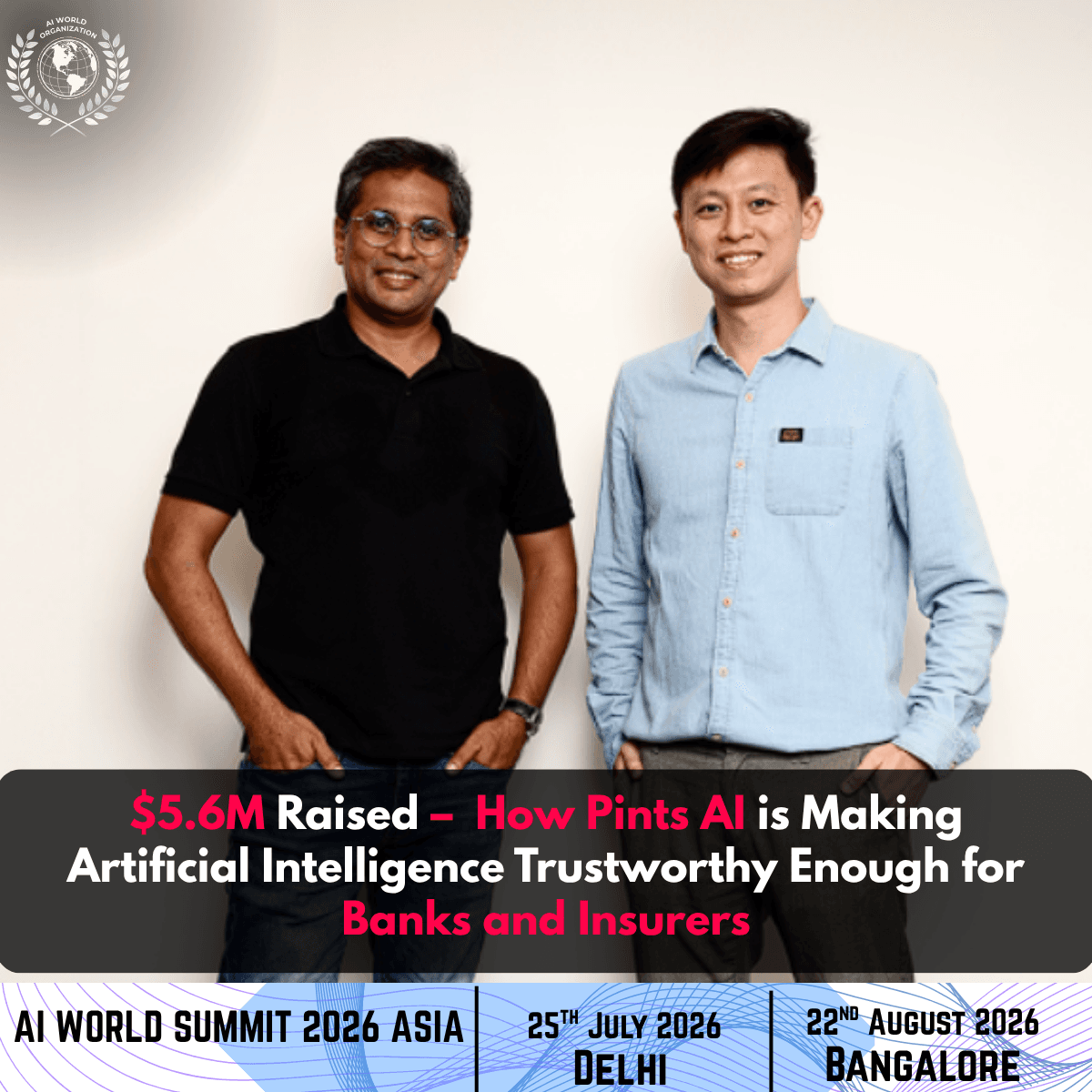
Pints AI Raises $5.6M to Scale Auditable AI in Finance
Pints AI closes a $5.6M pre-Series A round led by Tin Men Capital to expand its Autothought platform for auditable AI in regulated financial institutions across APAC.
TL;DR
Singapore-based Pints AI has raised $5.6M in a pre-Series A round led by Tin Men Capital and co-led by SBI Ven Capital. The startup's platform, Autothought, automates underwriting, claims, and onboarding for banks and insurers — with a full audit trail built in. Twelve institutions across four countries have already saved a combined $10M using it. Fresh capital will go toward engineering hires, compliance capabilities, and a new developer toolset called Autothought Studio.
Pints AI Secures $5.6M Pre-Series A Funding Led by Tin Men Capital to Bring Auditable AI to Regulated Financial Institutions
There is a quiet but significant transformation happening inside some of the most heavily regulated financial institutions across Asia Pacific and the Middle East. The change isn't driven by flashy consumer apps or viral chatbot products — it is being powered by a much more deliberate, compliance-first approach to artificial intelligence. At the center of this shift is a Singapore-based enterprise AI startup called Pints AI, which has just closed a US$5.6 million pre-Series A funding round to accelerate its mission of making AI not just intelligent, but genuinely trustworthy within the corridors of banks and insurance companies.
The round was led by Singapore-based venture capital firm Tin Men Capital, with SBI Ven Capital stepping in as co-lead. The funding also attracted participation from a strong group of institutional backers including SEEDS, NTUitive, SUTD Venture Fund, and Tenity — a lineup that reflects the growing conviction among serious technology investors that enterprise AI, particularly within regulated sectors, is where the most enduring value will be created in the years ahead. The announcement, made on Monday June 15, 2026, comes at a time when financial institutions globally are actively looking beyond the experimentation phase of AI adoption and seeking deployments that actually meet the compliance expectations of regulators.
For Pints AI, this moment is not simply a fundraising milestone — it is confirmation that what the company has been building quietly over the past two years is solving a problem that the financial world genuinely cares about. While much of the mainstream AI narrative has been dominated by large language models, generative tools, and billion-dollar valuations in the consumer and software-as-a-service space, Pints AI has taken a different path — one rooted in practicality, auditability, and operational reliability. The result is a platform that has already delivered measurable, verifiable results for real institutions operating in highly constrained regulatory environments, and the $5.6 million in fresh capital is set to push that further.
At The AI World, we have been closely following the evolution of enterprise AI across emerging and growth markets, and this latest development reinforces something we have argued for some time: the next defining chapter of AI adoption will not be written by the most technically impressive models alone, but by the companies that can make AI work reliably in the world's most demanding institutional environments. Pints AI and the investors backing it appear to understand this deeply.
The Autothought Platform — Redefining How Banks and Insurers Use AI
To understand what Pints AI has built, you have to start with its core product: a platform called Autothought. Unlike generic AI tools that are retrofitted onto existing workflows through APIs or chatbot interfaces, Autothought is designed from the ground up to connect directly to the core operating systems of financial institutions. This is a technically ambitious approach, and it is precisely what makes it so relevant for banks and insurance companies that cannot afford the kind of ambiguity or opacity that comes with many off-the-shelf AI solutions.
The platform targets three specific and highly process-intensive functions within financial institutions: underwriting, claims management, and client onboarding. Each of these areas is traditionally dependent on large volumes of structured and unstructured data, significant human judgment, and a paper trail that can withstand regulatory scrutiny. Autothought steps into these workflows and automates the decision-support layer while simultaneously generating a complete audit trail for every single AI-assisted decision made within the system. This means that when a bank's compliance officer or an external regulator asks how a particular underwriting decision was reached, the answer is not a black box — it is a transparent, documented, traceable record.
This is not a trivial technical achievement. Building AI systems that can not only process complex financial data but also explain their reasoning in a format acceptable to regulators is one of the harder problems in applied machine learning. Many AI vendors have attempted versions of this and struggled, either because their models lack interpretability or because the audit infrastructure is bolted on as an afterthought rather than built into the system's core architecture. What Pints AI claims to have done — and the early numbers seem to support this — is embed the governance layer into the product itself, making accountability a feature rather than a compliance checkbox.
The results have been striking. In under two years of active deployment, Pints AI's Autothought platform has been adopted by twelve financial institutions across four countries. Collectively, those institutions have reported combined savings of approximately ten million US dollars, a figure that speaks to the kind of operational efficiencies that AI can deliver when it is implemented thoughtfully and with genuine integration into core systems. For a startup still in the pre-Series A stage of its funding journey, that scale of real-world impact is exceptional and goes a long way toward explaining why investors of the calibre involved in this round chose to back the company.
A Strategic Coalition of Investors Signals Growing Confidence in Compliance-First AI
The composition of the investor group behind this funding round is worth examining closely because it tells its own story about where the smart money is moving in the enterprise AI landscape. Tin Men Capital, which led the round, has become one of the most recognised venture firms in Southeast Asia's technology ecosystem, with a consistent track record of backing B2B software companies that solve structural problems in sectors like financial services, logistics, and enterprise infrastructure. Their decision to lead this round is not incidental — it reflects a deliberate thesis about where durable value will be created in the coming years.
Murli Ravi, Co-founder and Managing Partner at Tin Men Capital, made the firm's reasoning clear in public comments following the announcement. He pointed to Pints AI's track record of deploying auditable AI inside live financial institutions and delivering measurable savings for clients as evidence of the kind of value creation that will define the next phase of AI adoption globally. That framing is important: Ravi is not talking about the promise of AI or its theoretical potential — he is talking about AI that is already working, already saving money, and already meeting the kind of governance standards that regulated industries demand. That is a different conversation from most of what the venture capital world has been having about artificial intelligence, and it reflects a maturity of thinking that is increasingly evident among Southeast Asia's leading investors.
SBI Ven Capital, the Japanese financial group's venture arm that co-led the round, added its own signal of confidence. Eiichiro So, CEO of SBI Ven Capital, noted that Pints AI has a rare and genuine understanding of what compliance-first deployment actually means in practice. The CEO specifically highlighted that Autothought reflects what regulated institutions actually need to trust live AI operations — a pointed observation that distinguishes the company from the many AI startups that promise enterprise readiness but struggle to deliver it when faced with real regulatory expectations. For SBI Ven Capital, which operates across Asia with deep exposure to Japan's highly regulated financial sector, that kind of credibility is not a minor consideration.
The participation of SEEDS, NTUitive, and the SUTD Venture Fund — all institutions with close ties to Singapore's academic and innovation infrastructure — adds another dimension to the investor coalition. It connects Pints AI to the broader research and talent pipeline that Singapore has been building deliberately over the past decade. NTUitive is the innovation and enterprise company of Nanyang Technological University, one of Asia's leading research institutions, while SUTD Venture Fund operates out of the Singapore University of Technology and Design. Their involvement suggests that Pints AI is not only commercially attractive but is seen as the kind of company that deepens Singapore's identity as a hub for serious, technically grounded enterprise AI development. Tenity, a fintech-focused accelerator and fund with a pan-Asian presence, rounds out the group and brings its own network of financial services relationships to the table.
How the $5.6 Million Will Be Put to Work
With fresh capital secured, Pints AI has outlined a clear plan for how the funding will be deployed, and the priorities reveal a company that is thinking carefully about sustainable and responsible growth rather than pure speed. Three areas have been identified for investment: expanding the engineering team, building governance and audit capabilities for new regulatory environments, and developing a new product called Autothought Studio.
The decision to prioritise engineering talent is straightforward — scaling an AI platform that integrates directly with the core systems of financial institutions requires deep technical expertise, and the demand for that expertise is fierce. But what is more telling is the explicit commitment to building governance and audit capabilities for new regulatory environments. This signals that Pints AI is not simply trying to do more of what it already does — it is actively preparing to enter new markets with different and potentially more complex regulatory requirements. As the company looks to expand its footprint across Asia Pacific and the Middle East, the ability to adapt its compliance framework to meet the specific demands of different national regulators will be a significant competitive differentiator.
Autothought Studio, meanwhile, represents the most forward-looking of the three investment priorities. Described as a set of tools that will allow institutions' own engineering teams to build on top of the Autothought platform, the Studio concept points toward a productisation strategy that goes beyond Pints AI simply providing a service to its clients. Instead, the company appears to be moving toward creating an ecosystem — one where financial institutions become active builders on the Autothought infrastructure, customising and extending it to meet their own specific needs. This kind of platform strategy, if executed well, dramatically increases the stickiness of the product and the depth of the relationship with institutional clients. It also opens the door to a more scalable revenue model that does not require Pints AI to be the sole implementer of every workflow built on the platform.
This combination of engineering capacity, regulatory adaptability, and platform extensibility paints the picture of a company that is building not just for its current clients or its current markets, but for the next several years of growth as AI adoption in regulated industries continues to deepen. The strategic logic is sound: establish trust and deliver results in the most demanding environments first, then build the infrastructure that allows others to replicate and extend that success at scale.
Southeast Asia's AI Ecosystem and the Rise of Regulation-Ready Startups
The Pints AI funding round does not exist in isolation — it is part of a broader and accelerating story about Southeast Asia's evolution as a serious hub for enterprise technology and artificial intelligence. The region has long been recognised for producing strong consumer technology companies, particularly in e-commerce, ride-hailing, and digital payments. But what is becoming increasingly clear in 2026 is that the region's startup ecosystem has matured to the point where it is now producing companies that can compete on the global stage in deeply technical, high-stakes domains like enterprise AI for regulated industries.
Singapore, in particular, has positioned itself aggressively as the region's AI capital, investing heavily in research infrastructure, talent development, and regulatory clarity around the use of artificial intelligence in financial services. The Monetary Authority of Singapore has been one of the most proactive financial regulators in the world when it comes to establishing frameworks for responsible AI deployment, and that regulatory sophistication has created a fertile environment for companies like Pints AI that are building compliance into their products from the start rather than treating it as an afterthought. In a very real sense, Singapore's regulatory environment has become a competitive advantage for its AI startups — if you can build an AI product that meets the MAS's standards, you have already done much of the work needed to meet the standards of regulators in other sophisticated markets.
Globally, the AI funding landscape in 2026 has been characterised by a significant bifurcation. At the very top end, a small number of frontier model companies and infrastructure providers have attracted enormous rounds that have captured the majority of headlines and capital. But below that tier, the market has become more selective and, in many ways, more sophisticated. Investors are increasingly looking past growth metrics alone and asking harder questions about defensibility, regulatory compliance, and real-world business impact. In that environment, a company like Pints AI — with documented results across twelve institutions and a clear value proposition in one of the most defensible niches in enterprise software — is exactly the kind of business that disciplined, sector-focused investors want to back.
The geographic expansion ambitions of Pints AI — targeting Asia Pacific and the Middle East — are particularly well-timed. Both regions are experiencing rapid growth in financial services digitalisation, and both have regulatory bodies that are actively working to establish AI governance frameworks that balance innovation with institutional stability. For a company that has already proven its ability to operate within demanding regulatory constraints, these are natural and attractive expansion markets where the compliance-first value proposition should resonate strongly with prospective clients.
What the Future of Enterprise AI in Financial Services Looks Like
The story of Pints AI and its $5.6 million funding round points toward something larger about the direction that enterprise AI is taking across regulated industries. For years, much of the conversation about AI in financial services was dominated by two extremes: on one side, breathless enthusiasm about how AI would transform everything; on the other, deep institutional caution about the risks of deploying systems that could not be explained, audited, or controlled. Pints AI represents a third path — one that takes the real operational potential of AI seriously without ignoring the equally real governance requirements that financial institutions must meet.
This compliance-native approach to AI is not just a market niche — it is arguably the design philosophy that enterprise AI needs to adopt more broadly if it is going to fulfil its potential in sectors that matter most to the global economy. Healthcare, legal services, insurance, and banking are all industries where decisions have serious consequences for people's lives and financial wellbeing, and where the ability to explain and audit automated decisions is not optional. The companies that figure out how to make AI work reliably and transparently in these environments are not just building good products — they are building the trust infrastructure that the entire enterprise AI ecosystem needs.
At The AI World, we see Pints AI's trajectory as a model worth watching closely. The combination of deep technical execution, a clear and defensible product strategy, a well-chosen investor coalition, and a track record of real-world results is the kind of foundation that durable technology companies are built on. The pre-Series A stage is, in many ways, the most important inflection point in a startup's journey — the moment when early product-market fit must be converted into scalable growth. With $5.6 million in fresh capital, a platform that is already delivering tens of millions of dollars in client savings, and an expanding addressable market across two of the world's most dynamic financial services regions, Pints AI enters that inflection point with considerable momentum.
The broader enterprise AI sector would do well to take note. In a landscape where it is all too easy to build impressive-sounding AI products that cannot survive contact with real regulatory and institutional requirements, Pints AI has demonstrated that the harder path — building compliance and auditability into the core of the product — is also the more valuable one. As the financial services industry continues its digital transformation and as regulators around the world continue to develop more sophisticated AI governance frameworks, the demand for what Pints AI offers is only going to grow.
The $5.6 million raised today is not just capital — it is a validation of the idea that AI can be both genuinely intelligent and genuinely trustworthy. In financial services, and in regulated industries more broadly, that combination is not a luxury. It is the entire point.
The AI World is a leading platform covering artificial intelligence innovation, enterprise technology, and the global AI ecosystem. We report on the people, companies, and ideas shaping the future of intelligence across industries, borders, and disciplines.


