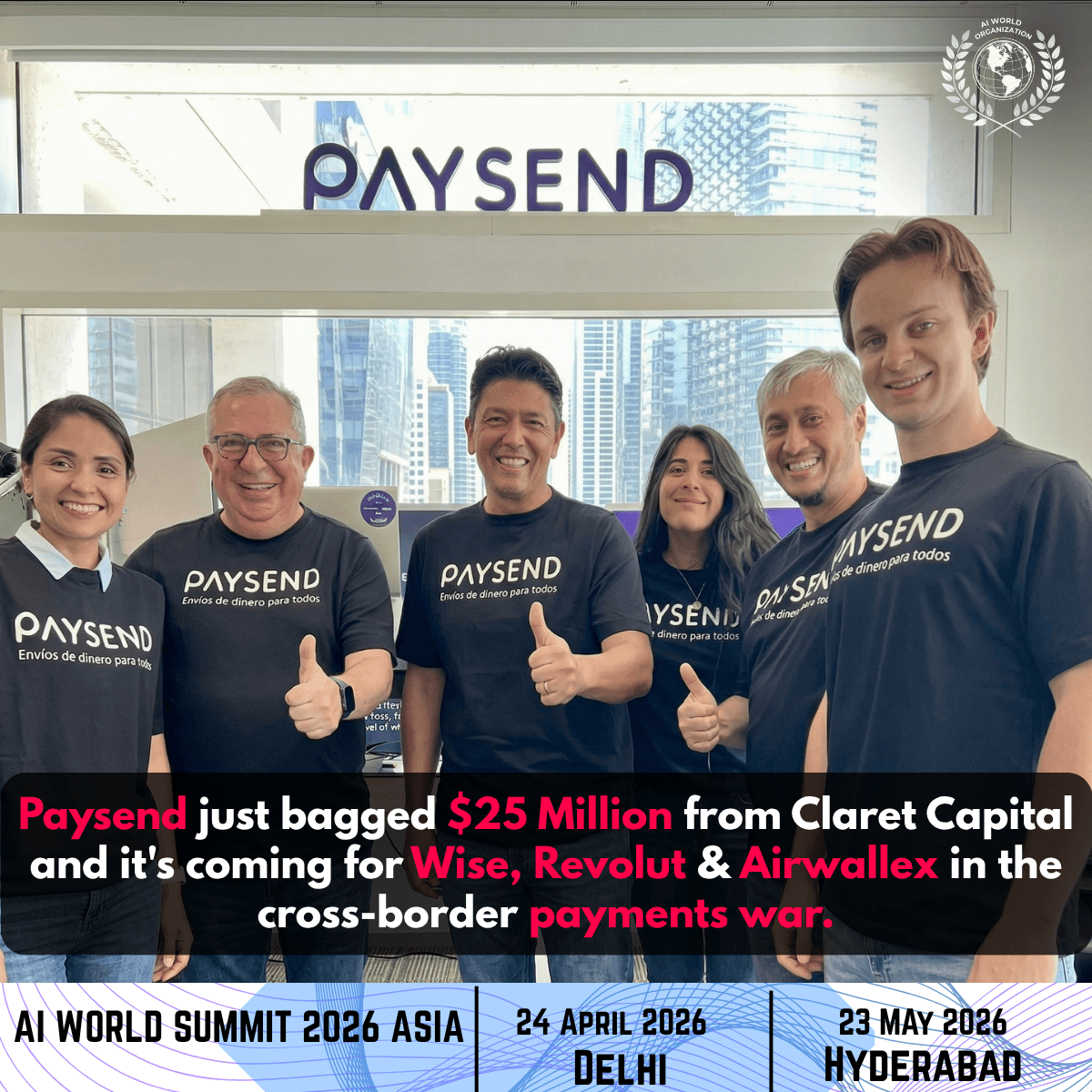
Paysend Raises $25M from Claret Capital for Global Expansion
Paysend secures $25M from Claret Capital to expand its cross-border payment network across 170 countries, competing with Wise, Revolut, and Airwallex.
TL;DR
Paysend, a London-based global payments company serving 12M+ users across 170 countries, has raised $25M in follow-on funding from long-time backer Claret Capital. The capital will drive international expansion and new product development as Paysend battles it out with Wise, Revolut, and Airwallex in the booming cross-border payments space.
Paysend Locks In $25 Million from Claret Capital to Fuel Its Global Cross-Border Payments Push
The global fintech space is no stranger to bold capital moves, but this week, London-headquartered payments company Paysend made headlines for a different kind of confidence — the kind that comes not from a splashy new backer, but from a long-standing investor doubling down. Paysend has secured $25 million in follow-on growth funding from Claret Capital Partners, a London-based independent growth debt fund manager with a decade-long track record of backing Europe's most ambitious tech businesses. In an era where AI funding news dominates the investment conversation, this deal is a timely reminder that the companies quietly building the backbone of the global financial system continue to attract serious, conviction-driven capital.
The funding will be directed toward Paysend's continued international expansion and the development of new products sitting atop its existing payments infrastructure — an infrastructure that the company has spent nearly a decade constructing with patience and precision. While the round may appear modest in comparison to the billion-dollar headlines that dominate AI funding cycles, the strategic weight behind this investment is anything but small. Claret Capital's decision to write a follow-on cheque to Paysend — extending a relationship that traces back to October 2020 — represents a form of institutional conviction that speaks louder than any first-time investment could.
A Long-Standing Partnership That Continues to Deepen
The relationship between Paysend and Claret Capital Partners is one of the more telling aspects of this funding announcement. Claret first invested in Paysend in October 2020, and the follow-on nature of this $25 million round reflects a relationship that has survived market volatility, leadership changes, and the seismic shifts that have reshaped the fintech landscape over the past several years. In growth investing, follow-on rounds from existing backers carry a particular kind of signal — they indicate that the investor has had a ringside seat to the company's operations and has chosen, with full knowledge of the challenges, to invest more.
Claret Capital Partners was established in 2013 and has since deployed over €1.2 billion into more than 195 portfolio companies across Europe, spanning technology, life sciences, and climate tech sectors. The firm's current flagship vehicle, Fund IV, has raised over €350 million with total assets under management crossing $1 billion. Claret's investment mandate centers on providing non-dilutive growth debt ranging from €1 million to €50 million to high-growth European companies — making Paysend's $25 million round a natural fit within this framework. Non-dilutive capital is a particularly strategic choice for a company like Paysend, which has already achieved meaningful scale and does not need to give up equity to fuel its next phase of growth.
What makes this round even more significant is the broader context of AI funding news that has dominated financial media in recent months. While generative AI startups have been pulling in hundreds of millions in capital, Claret's renewed bet on Paysend underscores the sustained investor appetite for fintech infrastructure businesses — companies that may not carry the buzz of an AI funding news headline, but generate real revenue, serve millions of customers, and sit at the center of how money flows around the world.
From a 2017 Startup to a Global Payments Powerhouse
Paysend's journey is one of the more quietly impressive stories in European fintech. The company was founded in 2017 by Abdul Abdulkerimov and Ronald Millar, two entrepreneurs who identified a clear gap in the market: international money transfers were too slow, too expensive, and too inaccessible for a large segment of the global population. Their founding thesis was straightforward — build a payment network that makes cross-border money movement as easy, cheap, and fast as possible, and serve corridors that traditional banks had largely ignored.
From those early days as a consumer-focused remittance platform, Paysend has grown into something considerably more expansive. The company now operates a fully integrated global payment platform serving both individual consumers and businesses, across more than 170 countries. It generates over $100 million in annual revenue and has accumulated a customer base of more than 12 million users globally — a scale that places it firmly in the tier of serious, revenue-generating fintech companies rather than growth-stage startups burning through investor capital.
A notable inflection point in Paysend's recent history came in September 2025, when Ben Chisell stepped into the role of Chief Executive Officer. Leadership transitions of this nature rarely happen in a vacuum — they typically accompany a strategic pivot, a sharpening of focus, or preparation for a new phase of growth. In this case, Chisell's appointment came just months before the Claret follow-on round was announced, suggesting that the new leadership team was actively working to position the company for its next chapter. The timing strongly implies that the $25 million raise is not merely a maintenance capital event but rather the beginning of a more deliberate push into new markets and enterprise customer segments.
Navigating a Fiercely Competitive Cross-Border Payments Market
To truly appreciate what Paysend is up against — and why this funding matters — it is essential to understand just how competitive the cross-border payments arena has become. According to data from Mordor Intelligence, the global cross-border payments market is expected to reach $238 billion in 2026, with projections pointing to further expansion to approximately $336 billion by 2031. The growth is being driven by a confluence of forces: the modernization of correspondent banking relationships, the rise of real-time settlement infrastructure, and a generation of fintech companies that have collectively slashed foreign exchange spreads by as much as 80% compared to the rates that traditional banks have historically charged.
The companies that lead this market today are formidable competitors with deep pockets and global brand recognition. Airwallex, one of the most watched names in the space, raised $330 million in December 2025 at a valuation of $8 billion — a round that attracted significant AI funding news coverage given the company's integration of intelligent FX management tools into its platform. Wise, the London-born giant known for its obsessive focus on fee transparency, processed $185 billion in cross-border transactions during its fiscal year 2025, a figure that illustrates the volume of money flowing through best-in-class payment infrastructure. Revolut, with its sprawling financial super-app ecosystem, continues to attract capital and expand aggressively across Asia, Latin America, and beyond.
Other significant players include Remitly, Payoneer, Stripe, and Nium — each pursuing slightly different angles on the same fundamental problem of moving money efficiently and cheaply across borders. In this crowded, well-funded field, standing out requires more than competitive pricing or a polished consumer app. It requires a clear and defensible strategic position, and Paysend has made a considered choice about where it wants to plant its flag.
Unlike most of its competitors, Paysend is not making fee transparency or consumer-facing simplicity its primary selling point. Instead, the company has chosen to compete on the breadth and depth of its underlying network — the number of endpoints it can reach and the quality of its integrations with those endpoints. This infrastructure-first strategy is not as instantly legible as "lowest fees" or "fastest transfers," but it creates a competitive moat that is far harder to displace once established.
The Infrastructure Advantage That Sets Paysend Apart
At the heart of Paysend's value proposition is a payment network of remarkable scope. The company's platform connects to more than 25 billion endpoints across 170 countries, spanning credit and debit cards, bank accounts, digital wallets, and mobile devices. These connections are not just volumetric — they are also qualitative, reflecting years of work building direct integrations with Mastercard, Visa, China UnionPay, local card networks in dozens of markets, instant payment systems, and local ACH rails that are critical for efficient money movement in specific geographies.
Building a network of this scale is not something that can be replicated quickly or cheaply. It requires sustained investment in compliance, licensing, technical integration, and relationship management across hundreds of banking and payments partners worldwide. This accumulated infrastructure is precisely the kind of durable competitive advantage that attracts growth debt investors like Claret Capital — it is not easily copied, it generates recurring revenue, and it becomes more valuable as more volume flows through it. In the context of current AI funding news cycles, which tend to reward innovation and novelty, it is worth noting that Paysend's competitive position is built on years of unglamorous infrastructure work that quietly compounds in value over time.
The enterprise dimension of Paysend's strategy is particularly worth watching as the company deploys its new capital. Multinational businesses, logistics companies, e-commerce platforms, and financial institutions that need to make payments across dozens of markets simultaneously are not well-served by consumer-focused platforms built for the individual remittance use case. What they need is the kind of deep, reliable, compliant infrastructure that Paysend has been building — something that can route payments through the optimal channel in any given corridor, minimize foreign exchange costs at scale, and operate within the regulatory frameworks of dozens of jurisdictions simultaneously.
Paysend also supports more than 40 payment methods for online SMEs, which positions it well in the rapidly growing cross-border e-commerce segment. As global online retail continues to blur geographic boundaries — with consumers purchasing from merchants on other continents and businesses sourcing talent and services from across the world — the demand for flexible, affordable, and deeply connected payment infrastructure is only going to grow.
What This Means for the Future of Fintech and Global Finance
Zooming out, the Paysend funding round offers a useful lens through which to view the broader fintech investment landscape in 2026. The conversation around AI funding news has been all-consuming for much of the past two years — with generative AI companies, agentic workflow tools, and AI infrastructure providers absorbing the lion's share of available capital. In this environment, it would be easy to overlook the continued investment activity in fintech infrastructure, but doing so would be a mistake.
The companies building the plumbing of global finance — the payment rails, the compliance engines, the multi-currency routing systems — are not going anywhere. In fact, as AI-powered financial tools become more prevalent, the value of having robust, deeply connected payment infrastructure underneath them only increases. An AI-powered treasury management system is only as good as the payment rails it sits on. An AI-driven cross-border billing platform needs a network that can actually reach the endpoints where money needs to flow. This is precisely the kind of foundational work that Paysend is doing, and this AI funding news era is, paradoxically, making that work more important rather than less.
For the global fintech community, Paysend's $25 million raise from Claret Capital is a reminder that infrastructure businesses with strong fundamentals — real revenue, millions of customers, and genuinely differentiated technical capabilities — continue to attract serious capital even when the spotlight is pointing elsewhere. As the cross-border payments market charges toward $336 billion by 2031, the companies that have invested in their infrastructure foundations will be best positioned to capture the growth that lies ahead. Paysend, with its newly reinforced financial runway and nearly a decade of network-building behind it, is making a credible case that it intends to be one of them.
At The AI World, we closely follow developments at the intersection of artificial intelligence, fintech, and global technology investment — because these are the domains where the most consequential innovation of the coming decade is taking shape. The Paysend-Claret deal is a compelling data point in that broader story, and it is one worth tracking carefully as both the AI funding landscape and the payments infrastructure space continue to evolve.


