Oxford Quantum Circuits Raises €301M Series C
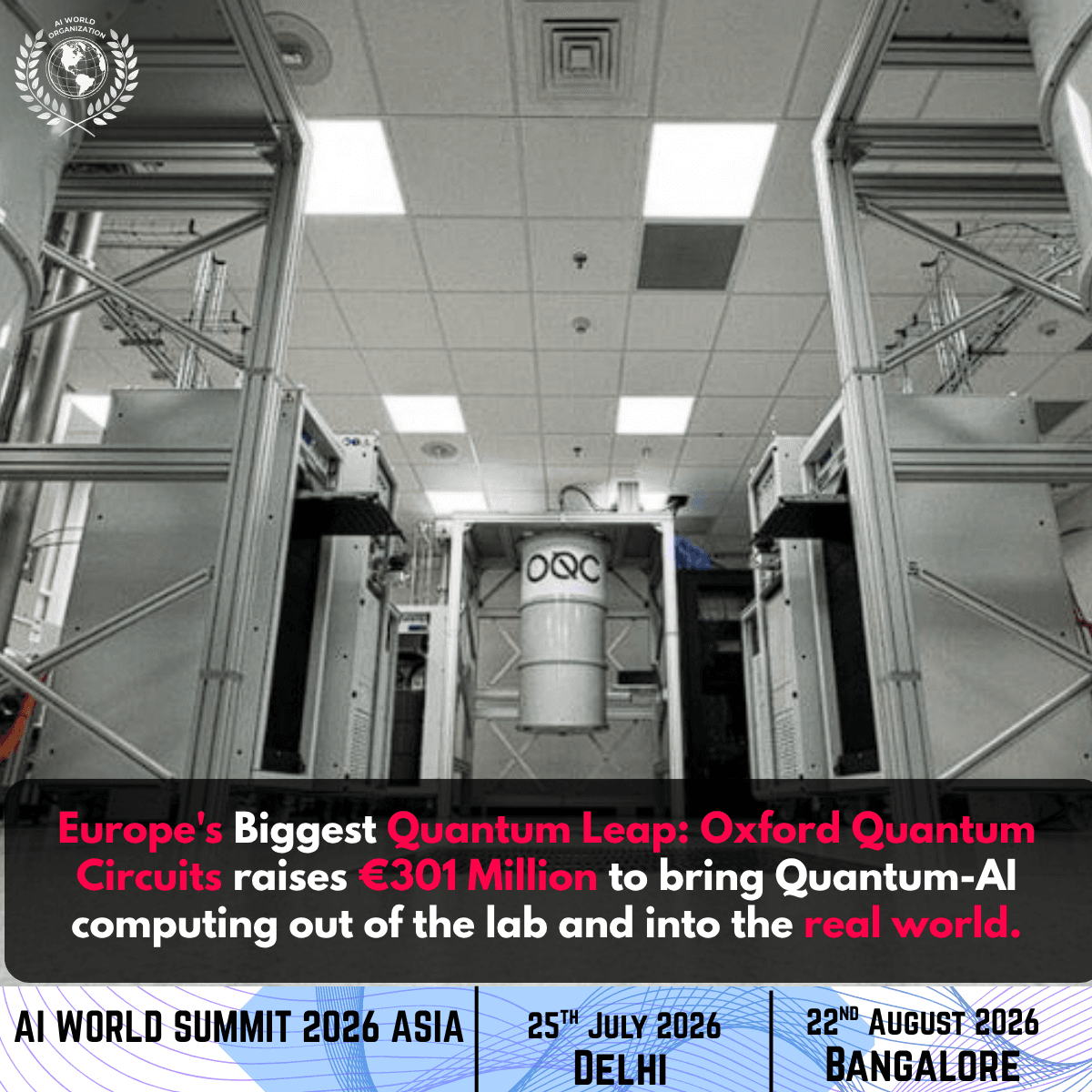
Oxford Quantum Circuits secures €301M in Europe's largest-ever quantum computing funding round to scale its Quantum-AI data-centre platform globally.
TL;DR
Oxford Quantum Circuits has raised €301 million — Europe's largest-ever private quantum computing funding round. The UK-based company builds quantum computers designed for real commercial data centres, not just labs, and will use the capital to expand globally and push toward fault-tolerant quantum systems capable of solving problems that classical computers simply cannot handle.
Oxford Quantum Circuits Raises €301 Million in Europe's Biggest-Ever Quantum Computing Round
Something significant just happened in the world of quantum computing, and it didn't come out of Silicon Valley or a well-funded American lab. It came from the UK. Oxford Quantum Circuits, widely known in the industry as OQC, has just closed a €301 million Series C funding round — a number that, by any measure, is staggering for a quantum computing company operating in Europe. The round was oversubscribed, which tells you something important: the appetite among investors for serious, infrastructure-grade quantum technology has moved well beyond theoretical interest. People with real capital are now placing large, confident bets on the commercial future of quantum computing, and OQC appears to be at the very centre of that shift.
At The AI World, we've been closely watching the convergence of artificial intelligence and quantum technologies for some time now. What makes this particular funding announcement so noteworthy isn't just the headline figure — though €301 million, equivalent to roughly £260 million or $350 million, is undeniably hard to ignore. What makes it genuinely significant is what it signals about where the quantum computing market is heading and why a company like OQC, with its very specific approach to building and deploying quantum systems, has attracted so much institutional confidence at this precise moment in time.
A Landmark Round That Puts British Quantum Computing on the Global Stage
OQC has described this as Europe's largest-ever private funding round for a quantum computing company, and there's no reason to dispute that claim. For context, the company's first notable raise — the first close of its Series A back in 2022 — came in at around €44 million. The jump from there to a €301 million Series C is not simply incremental growth; it represents a wholesale revaluation of what quantum computing companies are believed to be worth and what near-term commercial prospects actually look like for this sector.
Gerald Mullally, who serves as CEO of OQC, described the moment with a candour that resonated with many in the industry. He called it "a coming-of-age moment for British quantum computing," and went on to say that it demonstrates British companies can play a leading role in a technology that will shape all our futures. What struck many observers about his statement, though, was the broader point he made about the market itself. He framed this as representing a clear shift — from long-term promise to near-term delivery in quantum computing. That phrase matters a great deal. For years, critics of the sector have pointed to the gap between the theoretical power of quantum systems and their practical utility in real commercial environments. Mullally's framing suggests that gap is now closing, and closing fast enough that major investors are willing to commit nine-figure sums to help accelerate it.
For OQC specifically, the capital will be used to scale internationally, advance the company's technology roadmap, and respond to what Mullally described as increasing demand from customers seeking secure, scalable access to quantum computing infrastructure. These aren't speculative future customers — they're enterprise and government organisations in sectors like financial services, defence, and security that are already knocking on OQC's door because classical computing simply cannot handle the complexity of the problems they're trying to solve.
What OQC Actually Builds — And Why the Approach Is Different
To understand why this funding round matters beyond the numbers, it helps to understand what OQC actually does — because the company's approach is genuinely distinct from most of its competitors. Founded in 2017, OQC develops and operates superconducting quantum computers that are specifically engineered for deployment in data-centre environments. That might sound like a technical detail, but it's actually the core of everything the company has built its strategy around.
Most quantum computing efforts, even among well-funded players, have focused almost exclusively on advancing qubit counts or reducing error rates in laboratory conditions. OQC has certainly done that work too, but the company made an early and consequential decision to think about quantum computing as infrastructure rather than as a research instrument. The result is what OQC calls a Quantum-AI data-centre platform — a system designed not for physicists in research environments, but for enterprises and governments that want to actually use quantum computing as part of their existing technology stack, today, in production environments.
OQC claims to be Europe's first Quantum-Compute-as-a-Service provider, and importantly, it also claims to be the only company in the world that integrates quantum computers directly into commercial data centres. That second claim is particularly significant for enterprise customers, because it means they don't have to build bespoke infrastructure or rely on remote, laboratory-based systems with all the latency and security challenges that entails. OQC's quantum systems sit inside the same kind of trusted, enterprise-grade data-centre environment that organisations already use for their most sensitive workloads.
The company refers to its technology approach as Application Optimised Compute — a philosophy that moves away from general-purpose quantum hardware and towards quantum computers that are specifically engineered for the commercial advantage era. The idea is to build systems where first quantum applications can already deliver real, measurable business value to customers, rather than waiting for fault-tolerant, universal quantum computers that may still be years away from practical deployment. It's a pragmatic approach, and clearly one that resonates with the enterprise customers OQC is targeting.
Dr. Peter Leek, who founded OQC and serves as its Chief Scientific Officer, framed the technical mission clearly. He noted that OQC was founded on the principle of using innovative quantum circuit designs to build engineered systems that scale as simply as possible. That simplicity-of-scaling goal is deceptively ambitious in the quantum world, where adding qubits often introduces exponentially more complexity and error. Dr. Leek expressed pride in the team's progress toward that goal, and underscored that this new investment will support the next stage of their work: advancing system performance and reliability while continuing to integrate quantum computers into the trusted infrastructure that customers depend on. Those are the words of someone thinking about engineering challenges in production, not just breakthroughs in a lab.
The Investors Behind the Deal — and What Their Participation Says
The composition of this funding round is worth examining carefully, because it reflects a maturation in how the investment community is approaching quantum computing. The round was led by Bullhound Capital, a growth equity firm known for identifying European technology companies at inflection points. Per Roman, Bullhound Capital's founder and Managing Partner, made his view on OQC's position unambiguous. He described OQC as building one of the most compelling quantum computing platforms globally, with the technology, infrastructure, and customer focus required to scale. He added that as quantum computing moves into global infrastructure, OQC is positioned to shape that transition — a sentiment that positions this not as a bet on future science, but as a bet on present-day market leadership.
Beyond Bullhound Capital, the breadth of investors participating in this round is striking. The British Business Bank's involvement carries institutional significance, reflecting a degree of state-backed confidence in OQC's strategic importance to the UK's technology ecosystem. COFIDES, a Spanish public finance institution, also participated — suggesting that OQC's presence in Spain is being taken seriously at a government level. On the private side, participants included Fynveur (advised by Invus), Alpha Edison, Fulcrum Asset Management, Pentland Ventures, Magdalen College Oxford, Adaptive Capital Partners, Firgun Ventures, 18 West, and Oxford Capital.
The continued participation of existing investors is equally telling. Oxford Science Enterprises, SBI, Chevron Technology Ventures, The University of Tokyo Edge Capital Partners, and OTIF Ventures all doubled down on their positions in this round. When existing investors reinvest at a significantly larger scale, it generally indicates that they've seen evidence — real traction, customer wins, technical progress — that validates the thesis they originally backed. The fact that this round was oversubscribed adds another layer to that story: there was apparently more capital available than OQC needed or chose to take, which is a position of significant negotiating strength and market confidence.
The geographic diversity of the investor base also reflects OQC's own global ambitions. With investors from the UK, Europe, the US, and Japan, the company has built a network of institutional backers that mirrors its operational footprint — and that will presumably help facilitate further expansion in each of those markets.
Quantum-AI Integration at the Data-Centre Level: The Platform the Market Has Been Waiting For
One of the most important aspects of OQC's story — and one that is directly relevant to the broader conversation happening across The AI World's community — is the deliberate integration of quantum computing with artificial intelligence infrastructure. This isn't a company that treats quantum and AI as parallel, separate tracks. OQC's platform is explicitly designed to combine quantum computing with trusted infrastructure and AI supercomputing, with the goal of accelerating breakthroughs across both science and industry.
This integration at the data-centre level is a genuinely novel proposition. The quantum computing industry has long been divided between those who see quantum as a replacement for classical AI hardware and those who see it as a complement. OQC has clearly landed on the complementary view — and more importantly, has built an infrastructure model that makes that complementarity operationally real rather than just theoretically plausible. By sitting quantum systems alongside classical AI supercomputing resources in the same data-centre environment, OQC enables hybrid workflows where the right computational resource handles the right part of each problem. That kind of architectural thinking is exactly what enterprise customers need, because their problems are rarely purely quantum or purely classical; they're mixed, and they need infrastructure that reflects that.
The sectors driving demand for OQC's systems — financial services, defence, and security — are not early adopters in the experimental sense. These are organisations with extremely high bars for security, reliability, and provable performance. The fact that they are already engaging with OQC's platform speaks to the genuine commercial readiness of what the company has built. Financial institutions, in particular, have been watching quantum computing closely for years given its potential implications for optimisation, risk modelling, and, further down the road, cryptography. The ability to access quantum computing through trusted, data-centre-integrated infrastructure rather than through a remote cloud service is likely a key factor in their willingness to engage with OQC at a production level.
OQC currently operates a global quantum computing platform with systems deployed in the UK, the United States, Japan, and Spain. That's a meaningful geographic footprint for a company that was barely eight years old at the time of this funding announcement. The combination of European, North American, and Asian deployments positions OQC as a genuinely global operator rather than a nationally focused technology company — and it gives the company a presence in three of the world's most significant quantum computing markets simultaneously.
What Comes Next — For OQC, and for the Quantum Industry at Large
With €301 million now in hand, OQC has laid out two primary areas of focus for the capital. The first is international expansion — growing the company's operational presence in priority markets to meet the demand that is already building from enterprise and government customers. The second, and perhaps more technically significant, is accelerating the roadmap toward commercially useful, fault-tolerant quantum computing. Those two words — fault-tolerant — carry enormous weight in the quantum world. Fault tolerance refers to the ability of a quantum computer to correct errors as they occur, which is widely regarded as the threshold at which quantum computers become capable of tackling the most complex, commercially transformative problems at scale. Getting there remains one of the grand engineering challenges of the field, and OQC is now better resourced than ever to push that frontier forward.
It's worth stepping back and considering what this moment represents for the broader quantum computing landscape in Europe. For a long time, the perception — not entirely unfair — was that serious quantum investment and serious quantum ambition were concentrated in the United States, with China making rapid strides and Europe trailing behind. OQC's Series C round challenges that narrative in a meaningful way. A €301 million round, led by European investors and backed by public institutions across the UK and Spain, demonstrates that Europe has both the capital and the institutional will to build globally competitive quantum infrastructure.
At The AI World, we believe this is precisely the kind of development that the global AI and emerging technology community should be paying close attention to. The intersection of quantum computing and artificial intelligence is not a distant, speculative future — it is being built right now, in real data centres, by real companies with real customers. OQC's funding milestone is a clear indicator that this convergence is accelerating, and that the organisations which position themselves to understand and engage with it early will have a material advantage in the years ahead. Whether you're a technology leader in financial services, a policy maker thinking about national competitiveness in deep tech, or a researcher watching the frontier of computational science, what OQC is building — and what this investment enables — is something worth watching very closely indeed.
The quantum-accelerated world that OQC has set as its mission to build is no longer a slogan. With this funding, it's becoming an engineering project with a timeline.