OurMind Raises €2.1M to Fight Healthcare Burnout with AI
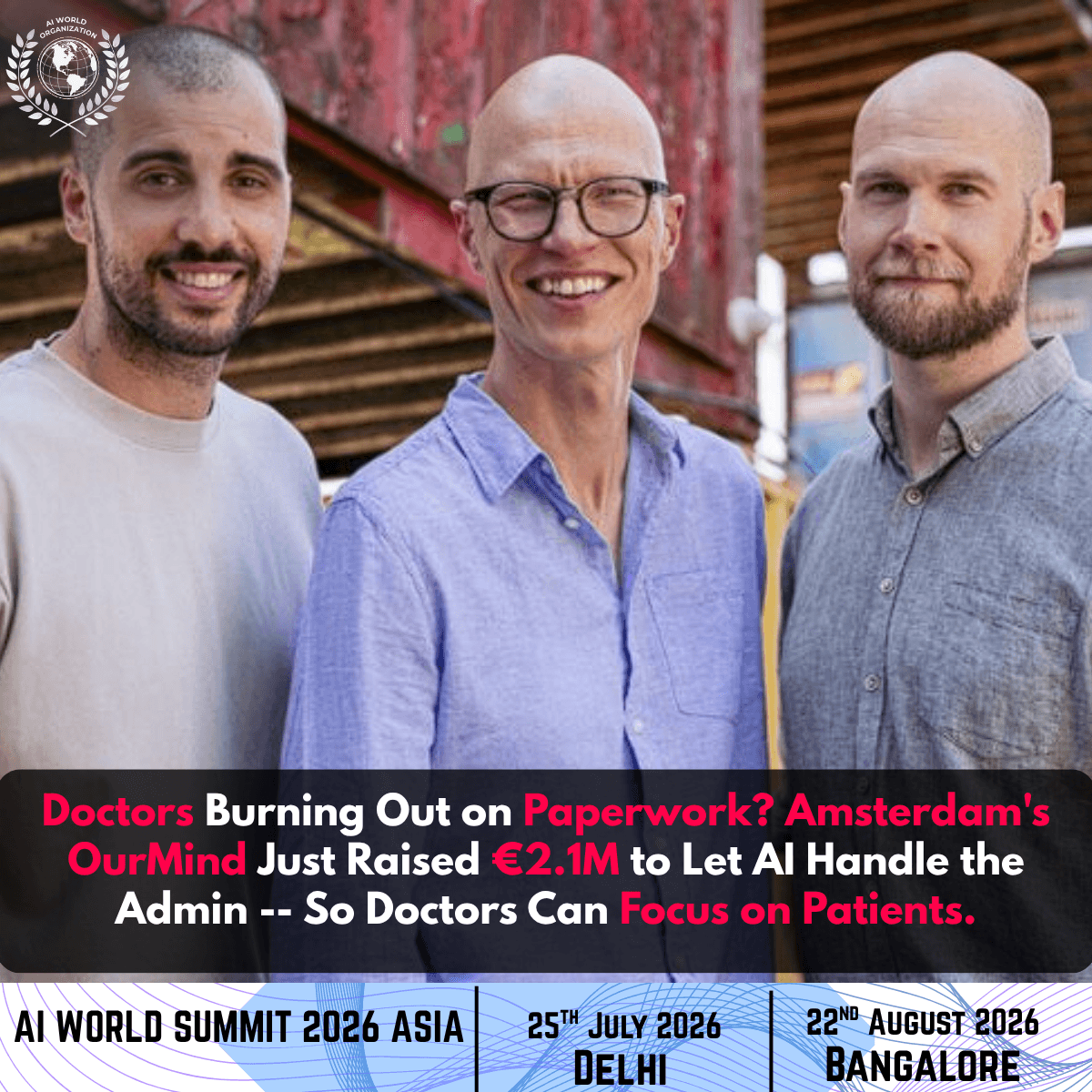
Amsterdam's OurMind secures €2.1M to deploy AI tools that cut healthcare admin burden, reduce doctor burnout, and improve patient care across Dutch hospitals.
TL;DR
Amsterdam's OurMind just closed a €2.1 million funding round to help burned-out doctors spend less time on paperwork and more time with patients. With over 300 clinics and 14 hospitals already on board, the startup is turning a very real workforce crisis in Dutch healthcare into a solvable problem — one consultation note at a time. Backed by 4impact capital and a group of doctors who put in their own money, OurMind is building something healthcare genuinely needs right now.
OurMind Raises €2.1 Million to Tackle Healthcare's Burnout Crisis with AI
The healthcare industry has been quietly fighting a war on two fronts for years — one against disease, and another against itself. Paperwork, administrative overload, and an ever-shrinking workforce have pushed doctors, nurses, and hospital staff to their absolute limits. In the Netherlands, this crisis has become especially acute. Waiting lists are piling up. Emergency rooms are stretched beyond capacity. And perhaps most alarmingly, a growing number of doctors — many of them early in their careers — are hitting a wall. They didn't sign up to be data entry clerks. They signed up to care for people. And that disconnect is costing the healthcare system dearly.
Into this urgent and complicated landscape steps OurMind, an Amsterdam-based health technology startup with a clear and compelling mission: use artificial intelligence to give healthcare professionals their time back. The company has just announced the successful close of a €2.1 million funding round, backed primarily by Dutch venture capital fund 4impact capital, alongside a notable group of general practitioners and medical specialists who came on board as investors. This milestone marks not just a financial achievement for a two-year-old startup, but signals something bigger — a growing conviction across the European health sector that AI-driven administrative tools are no longer optional. They are essential.
At The AI World, we have been tracking the intersection of artificial intelligence and human welfare across industries, and the story of OurMind stands out as a genuinely important development — not because of the size of the funding round, but because of what it represents for the future of healthcare delivery and the role AI plays in making that future sustainable.
The Burnout Epidemic That Nobody Is Talking About Enough
To understand why OurMind matters, you have to understand just how serious the burnout problem in Dutch healthcare — and European healthcare more broadly — has become. According to research cited by OurMind itself, a staggering one in four young doctors in the Netherlands is currently experiencing symptoms of burnout. That number comes from a study by De Jonge Specialist, an organisation that represents younger medical professionals, and it paints a troubling picture of a generation of doctors entering the workforce already exhausted and disillusioned.
The reasons behind this are not hard to identify. Doctors today are spending enormous amounts of time on tasks that have nothing to do with medicine. Preparing consultation notes, filling in administrative forms, responding to patient correspondence, updating electronic health records — these are tasks that demand attention to detail but do not require the years of medical training that a physician has undergone. Yet in most hospital and clinic settings, these tasks fall on the shoulders of the very professionals who should be focused entirely on diagnosis and treatment. The result is that physicians are routinely spending two to three hours every single day — often in the evenings, after already finishing a full clinical day — catching up on documentation and admin work. That is time taken away from rest, from family, from the kind of mental recovery that prevents burnout from setting in.
What makes the Dutch situation particularly striking is the scale of the workforce challenge ahead. Today, one in every seven workers in the Netherlands is employed in the healthcare sector. That is already a remarkably high proportion. But projections from the Scientific Council for Government Policy, known as the WRR, suggest that if current trends continue, by 2040 the country will need one in four workers to be engaged in healthcare just to maintain current service levels. That trajectory is simply not sustainable — economically, socially, or humanly. Something has to change, and AI-powered tools that remove administrative friction from the system are increasingly seen as one of the most realistic and scalable solutions available.
What OurMind Has Built — and Why Hospitals Are Paying Attention
OurMind was founded in 2024 by a team that brings together both technical expertise and deep first-hand knowledge of what it actually feels like to work inside a hospital. Paul Koning, one of the company's founders, is a former orthopaedic surgeon — meaning he is not a technologist who looked at healthcare from the outside and decided to build something for it. He is someone who lived the problem. He understood personally what it meant to spend hours on documentation that should have taken minutes, and he built OurMind with that lived experience at its core. Joining him are co-founders Marco Ferraz, Renan Sales Barros, and Fredrik Gustafsson, forming a founding team that combines clinical credibility with the technical capability needed to build AI solutions that actually work in real-world medical environments.
The company started with a product called Notes — an AI-powered software tool that listens to conversations during patient consultations and automatically converts them into structured medical documentation. The significance of this is hard to overstate. A consultation that previously generated thirty minutes of additional documentation work after the fact can now be captured, organised, and filed in a fraction of the time. The doctor remains fully present with the patient during the appointment, and the time-consuming write-up happens automatically. It sounds simple, but in practice it represents a profound shift in how a working day feels for a clinician.
From that starting point, OurMind has expanded its platform considerably. Today, the startup offers capabilities spanning consultation preparation — meaning doctors can review relevant patient history and notes before a meeting without having to manually trawl through records — as well as broader administrative support, patient communication tools, and a growing range of additional functionalities designed to integrate AI assistance throughout the daily workflow of a medical professional. The platform is designed to be personal, meaning it learns from the individual user over time and becomes increasingly effective the more it is used. This is not a generic AI assistant applied to a healthcare context. It is a tool built specifically for the rhythms and requirements of clinical work, and it grows with the user rather than remaining static.
The uptake has been meaningful. Currently, more than 300 general practices and 14 hospitals across the Netherlands are using the OurMind platform. That is a significant base of real-world deployment for a company that is barely two years old, and it speaks to the genuine demand that exists among healthcare professionals for tools that make their working lives more manageable. These are not pilot programmes or experimental deployments — these are active users who have integrated OurMind into how they work every day.
Voices from the Front Line: Why Clinicians Themselves Are Investing
One of the most telling aspects of this funding round is not the headline number, but who provided it. Alongside 4impact capital as lead investor, a significant portion of the €2.1 million came from general practitioners and medical specialists. Doctors investing in a healthcare AI startup is not just good optics — it is a powerful signal about where clinical opinion is heading. These are busy professionals with a direct stake in whether tools like OurMind actually deliver what they promise. Their willingness to back the company with their own capital suggests a level of confidence that goes beyond marketing enthusiasm.
The perspective of Bart Driesen, a cardiologist and Chief Medical Information Officer at Maasziekenhuis Pantein, offers a particularly grounded view of why tools like OurMind have become so urgently necessary. He describes a situation that will resonate with anyone who has tried to access specialist medical care in recent years. Over 150 patients with new referrals are currently sitting on his waiting list, unable to get an appointment at all. The system, as he describes it, is simply not sustainable in its current form. His point is not that AI is an exciting new technology to be embraced for its own sake — it is that without structural support for doctors, the system will continue to degrade. He envisions an AI layer woven across the entire hospital infrastructure, one that can absorb the preparatory and administrative work so that clinicians can spend their limited time doing what only they can do.
The framing that Paul Koning himself uses is equally revealing. In his view, this investment is not really about AI at all. It is about the question of whether a society can continue delivering high-quality healthcare with the same number of people, given that the population is ageing and the number of qualified professionals entering the field is not keeping pace with demand. AI is the mechanism through which that challenge becomes addressable — but the goal is human. It is about preserving the job satisfaction of healthcare workers, preventing burnout, and keeping experienced professionals in the profession rather than watching them leave because the administrative burden has simply become too heavy to bear.
The Investment Case: 4impact Capital and the Broader Vision
The lead investor in this round, 4impact capital, is a Dutch venture capital fund with a clear focus on companies solving large-scale societal challenges. Their portfolio is anchored in areas like energy transition, sustainability, and digital transformation — sectors where technology can create measurable social as well as financial returns. The decision to back OurMind represents the fund's first investment in the health technology space, and it reflects a broadening of that societal mission into one of the most pressing challenges facing developed economies — how to maintain quality healthcare in an era of demographic pressure and workforce scarcity.
What makes the fund's involvement particularly interesting is the model they bring to the table. Victor Straatman, a partner at 4impact, was explicit about this: theirs is not a classic private equity arrangement designed to extract value from the business. Everything OurMind earns stays in the company to fund further development. That is a deliberately growth-oriented approach, reflecting a belief that the platform has significant runway ahead of it and that the priority right now is scaling — getting the technology into more hospitals, building out more features, and expanding the team — rather than generating returns for shareholders. The fund also emphasises its role as an active partner, bringing network access, strategic guidance, and sector expertise alongside the capital itself.
The round also carries institutional backing through Invest-NL and the European Union's InvestEU Fund, which gives OurMind a degree of credibility and resource access that extends well beyond a typical seed-stage startup. Invest-NL is the national development financing institution of the Netherlands, focused specifically on transitions and innovations that the private market alone cannot adequately fund. Its involvement signals recognition at a national level that AI solutions addressing the healthcare workforce shortage are a strategic priority, not just a commercial opportunity.
From a compliance and trust perspective, OurMind has made a point of meeting the highest available standards in the European healthcare data landscape. The platform is fully GDPR compliant, holds ISO 27001 certification for information security management, and is also certified to NEN 7510, the Dutch national standard for information security in healthcare. For hospital boards and clinical decision-makers considering whether to adopt AI tools in sensitive patient-facing environments, these certifications matter enormously. They represent not just regulatory compliance but a genuine commitment to handling patient data with the care and security it demands.
AI in Healthcare: The Bigger Picture and What Comes Next
The story of OurMind sits within a much larger shift happening across European healthcare systems. Administrators, clinicians, and policymakers are increasingly recognising that the traditional model of healthcare delivery — in which highly trained professionals spend significant portions of their working hours on tasks that do not require their expertise — is both inefficient and unsustainable. The question is no longer whether AI will play a role in addressing this problem. It already is, in hospitals and clinics across the continent. The question now is which solutions are being built with enough rigour, clinical grounding, and user focus to actually make a lasting difference.
What OurMind is attempting is not to replace doctors with algorithms. That framing, which continues to dominate some public conversations about AI in medicine, fundamentally misunderstands what is actually happening at the practical level. The aim is considerably more modest and considerably more valuable: to take the non-clinical work off the plate of clinical professionals, so that the human expertise those professionals spent years developing can be directed entirely at the patients who need it. In that sense, OurMind is less a replacement for human judgement and more a support structure that makes human judgement possible when it would otherwise be crowded out by administrative noise.
The expansion that this funding enables will be watched closely — not just by investors, but by the broader European health technology community. If OurMind can demonstrate at scale that AI-assisted documentation and consultation preparation materially reduces burnout rates and improves patient outcomes, that evidence base will have implications far beyond the Netherlands. The healthcare systems of Germany, France, the United Kingdom, and every other ageing European society face structurally similar challenges. A solution proven in the Dutch context is a solution with a continent-wide market.
At The AI World, we believe the most important AI stories are not always those involving the largest funding rounds or the most technically complex systems. They are often stories about people — about whether the technology being built is genuinely making human work and human life better. OurMind's story is one of those. A team of people, some of them doctors who understood the problem from the inside, decided to use artificial intelligence not to disrupt an industry but to heal it. And with €2.1 million, a growing roster of hospital clients, and a set of investors who believe in the vision, they are now in a considerably stronger position to do exactly that.
The AI revolution in healthcare is not waiting for the future. In over 300 clinics and 14 hospitals across the Netherlands, it is already quietly changing what it feels like to be a doctor — and that is worth paying very close attention to.