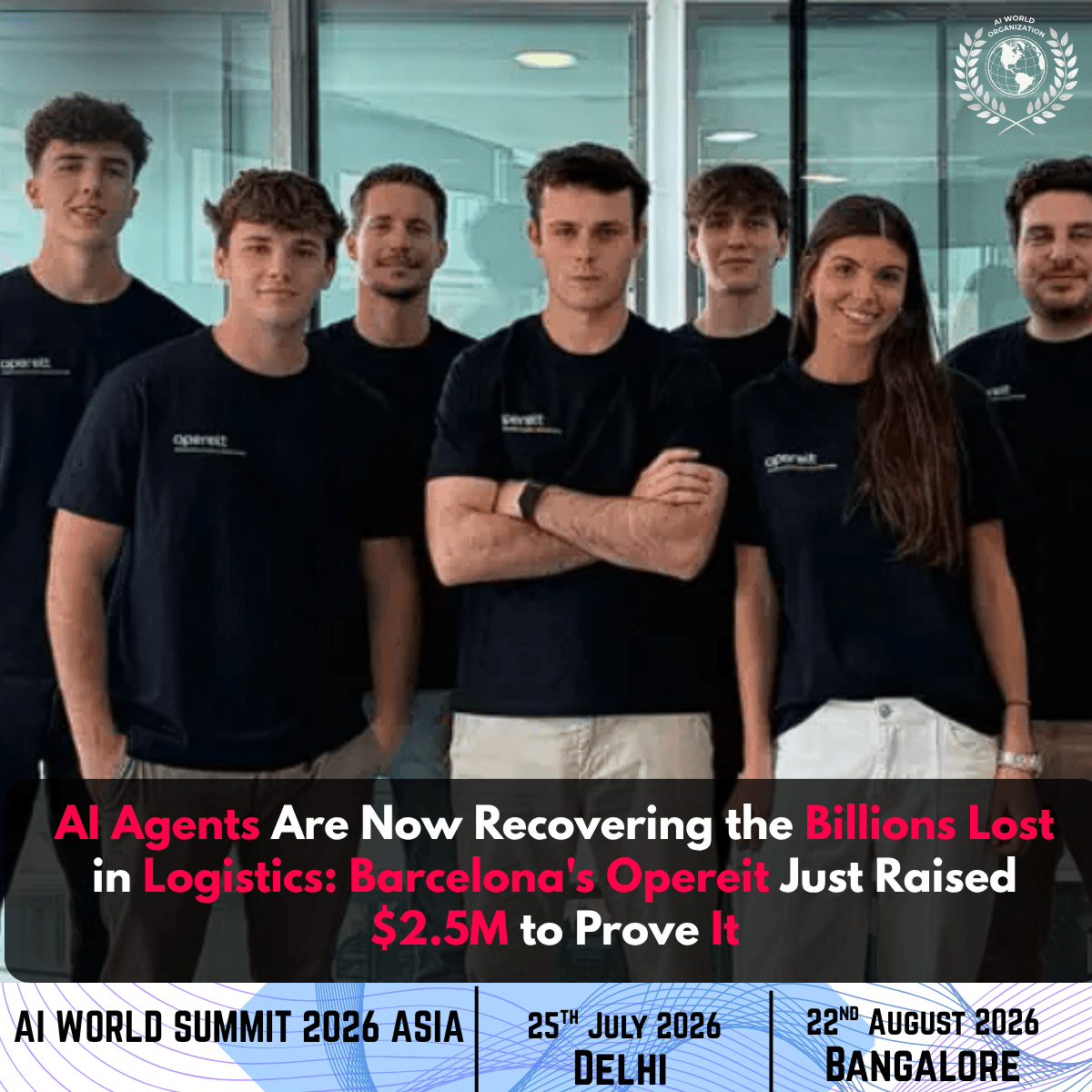
Opereit Raises $2.5M to Fix Logistics with AI Agents
Barcelona startup Opereit secures $2.5M pre-seed funding to deploy AI agents that recover transport losses, fix invoice errors, and automate carrier claims at scale.
TL;DR
Barcelona-based Opereit has raised $2.5M just weeks after launch, backed by Seedcamp and the founders of Glovo. The startup uses AI agents to catch overcharged invoices, chase unresolved carrier claims, and recover money that logistics companies silently lose every month — turning one of the industry's most stubborn back-office problems into a steady stream of recovered revenue.
Opereit Secures $2.5M Pre-Seed to Deploy AI Agents Across Broken Logistics Operations
Every single day, warehouses hum, trucks roll, and aircraft cargo holds fill up as the global logistics machine moves along. And yet, for all its scale and complexity, the industry quietly bleeds billions. Not through dramatic failures or headline-grabbing disasters — but through something far more mundane and far more persistent: paperwork. Overcharged invoices, unresolved carrier claims, lost shipments with no one chasing them down. These are not edge cases. They are the daily reality for hundreds of thousands of logistics operations worldwide, and they quietly eat into margins that companies simply cannot afford to keep losing.
Opereit, a Barcelona-based artificial intelligence startup, has decided that this problem deserves a proper technological answer. Just weeks after formally launching, the company has closed a $2.5 million pre-seed funding round — a remarkably fast vote of confidence from some of Europe's most respected early-stage investors. The round was co-led by Seedcamp, the London-based pan-European venture fund, and Yellow, the investment vehicle founded by Glovo co-creators Oscar Pierre and Sacha Michaud. Additional backing came from Baobab Ventures, Kima Ventures, Enzo Ventures, OPRTRS, Masia, and a collection of international angel investors who clearly saw something worth backing even at the earliest stage. For a startup that had barely had time to print business cards, raising at this pace says a great deal about how seriously the investment community is taking logistics AI right now.
At The AI World, we track AI funding stories across every sector, and what makes Opereit stand out is not just the cheque size or the speed of the raise — it is the specificity of the problem the company is targeting. This is not a broad platform promising to "transform supply chains." It is a sharply focused AI deployment aimed at one of the least glamorous but most economically significant failure points in global commerce. And that precision is exactly what makes it interesting.
The €9 Trillion Industry With a Back-Office Problem Nobody Fixed
To understand why Opereit exists, you first need to appreciate the sheer scale of what is at stake. The global logistics sector processes more than €9 trillion worth of goods movement every year. That is not a niche market — it is one of the foundational pillars of how the world's economy functions. Yet despite decades of technological investment in route optimisation, warehouse automation, and delivery tracking, one critical layer of logistics operations has remained almost entirely manual: the financial reconciliation that happens after goods actually move.
When a shipment goes out, it triggers a chain of financial events — invoicing from carriers, charges for fuel surcharges or dimensional weight adjustments, claims processes for damage or loss, credit notes that may or may not arrive. In large-scale logistics operations, this can involve hundreds or even thousands of individual transactions per month, each requiring someone to check, validate, dispute, and resolve. At most companies, this process is handled by small teams working through spreadsheets, email chains, and phone calls to carrier customer service lines. The inefficiency is structural, not incidental. And the financial leakage it causes is, by most industry estimates, substantial enough to materially affect profitability — particularly for retailers and third-party logistics providers operating on already-thin margins.
The frustrating truth is that most companies know this is happening. They know invoices are sometimes wrong. They know claims are being left unfiled because no one has time to chase them. They know shipments occasionally disappear into administrative grey zones where the carrier denies liability and the retailer lacks the documentation to push back. The problem is not awareness — it is capacity. Most businesses simply do not have the people or the systems to manage this at the volume and speed the modern logistics environment demands. That gap between awareness and action is precisely where Opereit has positioned itself.
How a YC-Backed Returns Platform Gave Birth to a New Kind of AI Company
The origin story behind Opereit is one of those rare cases where firsthand exposure to a problem leads directly to a mission-driven solution. Pablo Cousin, the company's founder, did not arrive at this idea through market research or investor feedback. He lived it.
Before founding Opereit, Cousin was a core member of the founding team at REVER, a Y Combinator-backed returns management platform that works closely with retailers and logistics providers across Europe. In that role, he spent years watching the same financial wound open up again and again. Carriers would overcharge clients on invoices and those discrepancies would go unnoticed or unchallenged. Claims for lost or damaged goods would sit in queues for months, slowly expiring, with no systematic follow-up. Financial reports would show losses in transportation costs that nobody could fully explain or attribute, because the visibility simply was not there.
"Every month we saw the same black hole — carriers overcharging, claims impossible to track, and money lost in processes with little visibility," Cousin has noted in describing what drove him to build the company. What started as an operational observation within the returns space quickly revealed itself to be a much wider industry truth. The problem was not unique to REVER's customers. It was everywhere. Every retailer, every logistics provider, every brand managing its own shipping operations was dealing with the same erosion. It was just buried deep enough in back-office workflows that most leadership teams had stopped expecting it to be fixed.
That realisation — that the problem was both enormous and largely unaddressed by existing technology — led Cousin to step out and build Opereit in 2025. The timing proved excellent. AI agent capabilities had matured sufficiently to make genuine end-to-end automation of these workflows practical for the first time, and the appetite among logistics operators for solutions that could do more than simply display data had never been higher. By the time the company was ready to raise, investors were not just interested — they moved quickly.
What Opereit's AI Agents Actually Do - And Why That Matters
The distinction Opereit makes in its positioning is worth dwelling on, because it cuts to the heart of why AI agents are increasingly being seen as transformative across operational domains rather than just analytical ones.
There is no shortage of logistics software that promises visibility. Dashboards, tracking portals, reporting tools — the market is full of platforms that will show you what is happening in your supply chain with varying degrees of detail. What has historically been missing is software that not only shows you the problem but actively goes and resolves it. Opereit's platform is built around AI agents that do exactly that.
When connected to a company's logistics data, the platform's agents continuously monitor incoming carrier invoices and automatically flag discrepancies against contracted rates. They identify shipments that have been lost or damaged and have not yet had claims filed against them. They initiate those claims, follow up on outstanding recoveries, and manage the entire administrative process through to resolution — without a human needing to intervene at any stage. Companies are reportedly able to onboard in as little than 48 hours and begin seeing previously invisible cost savings essentially from day one.
This matters for several reasons beyond the obvious operational convenience. First, it means that the financial recovery the platform enables scales with the volume of transactions, not with the size of the team managing them. A company shipping ten thousand parcels a month captures value from the platform at a similar level of effort as one shipping a hundred thousand. The bottleneck of human capacity is removed. Second, it means the data that emerges from the process — which carriers are overcharging most frequently, which routes generate the most damage claims, which product categories are most at risk — begins to feed back into operational decisions rather than simply sitting in a reconciliation spreadsheet that nobody looks at after the claim is filed.
Opereit's early customers speak to the real-world impact. Amphora Logistics, fashion label Nude Project, and sustainable clothing brand Ecoalf have all come on board in the platform's initial phase. Raquel Jiménez, who oversees operations and customer experience at Nude Project, has been candid about what changed after the company began using the platform. The team had lacked genuine visibility into the financial damage being done by transport incidents, and with Opereit in place, they were able to detect and respond to claims far more quickly than before. For a fast-growing fashion brand managing a complex logistics network, that kind of recovery speed translates directly into cash flow and margin improvement.
The Investor Perspective: Why Logistics Operations AI Is Having a Moment
The backing from Yellow is worth examining in particular, because Oscar Pierre is not simply a financial investor in logistics — he is one of Europe's most experienced operators in the space. As co-founder of Glovo, which built one of the continent's largest on-demand delivery networks before being acquired by Delivery Hero, Pierre spent years dealing with exactly the kinds of operational inefficiencies that Opereit is now targeting. He brings not just capital but a visceral understanding of the pain the platform is designed to address.
In speaking about the investment, Pierre has been direct about what caught his attention. Despite the enormous advances in logistics technology over the past decade, claims processes had remained stubbornly unoptimised — a surprisingly resilient pocket of inefficiency in an industry that had otherwise embraced digital transformation fairly aggressively. What Opereit brought to the table was a combination of genuine AI-native architecture, a founding team with direct operational experience in the sector, and a problem large enough to build a significant business around. That combination, in Pierre's view, made the investment straightforward.
Seedcamp's involvement reinforces the broader European investor thesis that agentic AI — AI systems designed not just to reason but to act autonomously on behalf of users — represents a generational shift in how operational workflows can be structured. Where the first wave of enterprise software gave companies information, and the second wave gave them integration, the current wave is beginning to give them execution. The difference is not trivial. A platform that executes does not need a human to read its output and then perform a downstream action. It closes the loop itself, turning insight directly into recovered value.
This is the narrative that is driving significant capital into logistics AI right now, and Opereit is arriving at precisely the right moment to benefit from it. The competitive landscape includes well-capitalised players — Sennder has raised in excess of $400 million to digitise freight operations across Europe, while delivery network startups like Packfleet and Relay have raised tens of millions to improve last-mile efficiency and customer experience. But none of these companies are targeting the specific financial recovery and claims automation niche that Opereit has staked out, which gives the Barcelona startup a genuine white space to occupy in the near term.
What This Funding Round Signals for AI in Logistics: And the Road Ahead
There is a pattern emerging across multiple industries right now that Opereit's story illustrates particularly well. Artificial intelligence is not only disrupting the front-end, customer-facing elements of businesses — it is increasingly penetrating the unglamorous back-office workflows where an enormous amount of economic value gets quietly destroyed every day. Invoice reconciliation, claims management, compliance verification, regulatory reporting — these are not the kinds of functions that feature in company press releases or investor day presentations. But they are functions that, when poorly managed, can represent the difference between a profitable operation and one that is perpetually underperforming its own potential.
Opereit's $2.5 million raise is not large by the standards of late-stage AI funding rounds, but it does not need to be at this stage. What it signals is that serious investors with deep logistics domain knowledge believe that the problem is real, the technical approach is sound, and the timing is right. The next phase for the company will involve expanding its customer base beyond the early adopters already on the platform, deepening the sophistication of its AI agents to handle increasingly complex claim types and carrier relationships, and building out the data infrastructure that will ultimately allow the platform to deliver not just reactive recovery but proactive risk identification.
For the broader logistics industry, the signal here is an important one. The era of accepting transport-related financial leakage as an unavoidable cost of doing business is ending. AI systems capable of identifying, chasing, and recovering those losses autonomously are no longer a futuristic prospect — they are a present-day commercial reality. And as adoption grows, the competitive pressure on companies that have not yet addressed this problem will only intensify.
At The AI World, we will be watching Opereit's trajectory closely. The convergence of agentic AI capabilities with the deeply practical operational needs of an industry as large and complex as logistics is one of the most compelling stories in the enterprise AI space right now. Opereit's early momentum — a strong founding narrative, credible investors, notable early customers, and a clearly defined problem — puts it in a strong position to become one of the defining companies of this particular wave. Whether it ultimately delivers on that potential will depend on execution, but the foundation being laid looks solid.