OpenAI Raises $122B to Accelerate AI
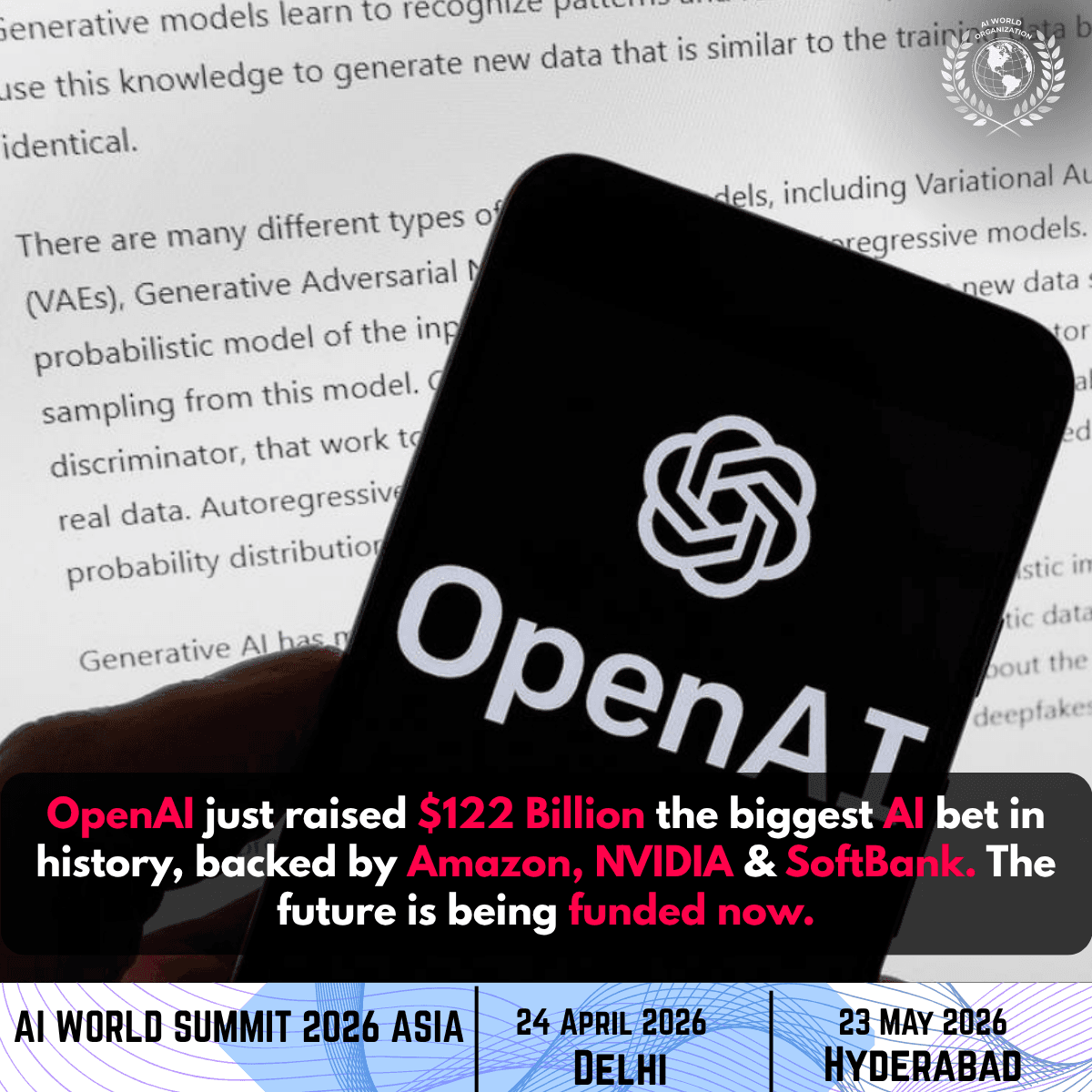
OpenAI raises $122 billion in AI funding at an $852B valuation, backed by Amazon, NVIDIA, SoftBank & global institutions. Here's what it means for the AI era.
TL;DR
OpenAI has raised $122 billion in its latest funding round, pushing its valuation to $852 billion. Backed by Amazon, NVIDIA, SoftBank, BlackRock, and dozens of global institutions, the capital will go toward expanding compute infrastructure and product development. With nearly 1 billion weekly users and $2 billion in monthly revenue, OpenAI is no longer just a tech startup — it's becoming the backbone of how the world works with intelligence.
OpenAI Secures $122 Billion in Funding to Accelerate the Next Phase of Artificial Intelligence
The artificial intelligence industry has just witnessed one of the most significant financial milestones in its history. OpenAI has officially closed its latest funding round with a staggering $122 billion in committed capital, arriving at a post-money valuation of $852 billion. This landmark AI funding development, announced on March 31, 2026, signals not just the maturation of one company, but the broader recognition by global capital markets that artificial intelligence is no longer an emerging technology — it is the foundational infrastructure of the modern economy. For those following AI funding news closely, this round redefines what is possible in terms of private capital deployment in the technology sector and sets a new benchmark for how seriously the world's largest financial institutions view the AI revolution.
What makes this round especially extraordinary is not just the dollar figure, but the sheer breadth and depth of investor confidence. From sovereign wealth funds and trillion-dollar asset managers to individual retail investors accessing the round through bank channels for the very first time, the capital base behind OpenAI is now as diversified as any public company. The message from global markets is unmistakably clear: the AI era is here, and the race to build the intelligence layer of the world economy is only accelerating.
A Flywheel of Consumer, Enterprise, and Compute Scale
To understand why this AI funding round attracted such extraordinary global capital, one must understand the compounding flywheel that OpenAI has built over the past few years. The company was the fastest technology platform to reach 10 million users, then 100 million users, and is now rapidly approaching 1 billion weekly active users. Within just one year of launching ChatGPT, revenues crossed the $1 billion mark. By the close of 2024, the company was generating $1 billion every quarter. Today, OpenAI is generating $2 billion in revenue every single month — a pace that outstrips the growth trajectories of companies like Alphabet and Meta during their most explosive years of expansion.
This is not simply a consumer success story. Enterprise adoption is accelerating at an equally impressive rate, with the business segment now accounting for more than 40% of total revenues and projected to reach parity with the consumer segment by the end of 2026. The company's APIs are processing more than 15 billion tokens per minute, a figure that would have seemed inconceivable just two years ago. Codex, OpenAI's flagship coding agent, now serves over 2 million weekly active users — a figure that has grown five times in the past three months alone, with month-over-month usage climbing more than 70%. For investors tracking AI funding news, these metrics represent the kind of operating leverage that makes a $122 billion investment round not just justifiable, but arguably prudent given the scale of the opportunity ahead.
The reinforcing nature of this flywheel is central to understanding OpenAI's long-term strategy. Consumer adoption feeds enterprise deployment. Enterprise revenue funds compute expansion. Better compute drives more capable models. More capable models improve product quality, which deepens consumer and enterprise engagement. Each layer feeds the next, creating a self-sustaining cycle of capability growth and revenue generation that compounds with every passing quarter.
Global Investors Back the Infrastructure of Intelligence
The composition of this AI funding round reads like a who's who of global institutional capital, and that diversity is itself a strategic statement. The round was anchored by Amazon, NVIDIA, and SoftBank as strategic partners, with Microsoft continuing its long-standing commitment to the company. SoftBank co-led the investment alongside Andreessen Horowitz (a16z), D. E. Shaw Ventures, MGX, TPG, and accounts managed by T. Rowe Price Associates.
Beyond the headline co-leads, the round attracted a remarkable array of global institutions. Altimeter, Appaloosa LP, ARK Invest, affiliated funds of BlackRock, Blackstone, Coatue, D1 Capital Partners, Dragoneer, Fidelity Management & Research Company, Goanna Capital, Insight Partners, The Paragon Group, Sands Capital, Sequoia Capital, Sound Ventures, Temasek, Thrive Capital, UC Investments from the University of California, and Winslow Capital all participated — a coalition of capital that spans every major investment style, geography, and time horizon.
Perhaps the most democratically significant element of this AI funding news is the extension of the round to individual investors through bank channels, raising over $3 billion from retail participants. This marks the first time OpenAI has offered access at this level, a deliberate move to broaden the ownership of AI's economic upside. Additionally, OpenAI will be included in several exchange-traded funds managed by ARK Invest, making it possible for everyday investors to hold a stake in what is arguably the defining technology platform of this generation. Complementing this, the company has also expanded its revolving credit facility to approximately $4.7 billion, supported by a global syndicate of leading financial institutions including JPMorgan Chase, Citigroup, Goldman Sachs, Morgan Stanley, Wells Fargo, Mizuho, Royal Bank of Canada, SMBC, UBS, HSBC, and Santander.
Compute as the Strategic Backbone of AI Leadership
One of the most technically significant aspects of this AI funding announcement is how the capital is intended to be deployed. Compute — the raw processing power required to train and run AI models — is increasingly the decisive competitive advantage in the AI industry, and OpenAI's infrastructure strategy reflects a sophisticated understanding of this reality. The company has deliberately expanded beyond dependence on a small number of infrastructure providers to build a resilient, multi-cloud, multi-chip architecture capable of meeting the demands of global AI deployment.
The current infrastructure strategy spans an impressive range of partnerships. On the cloud side, OpenAI works with Microsoft, Oracle, Amazon Web Services, CoreWeave, and Google Cloud. On the silicon front, the company leverages NVIDIA GPUs — which remain the foundation of both training and the majority of its inference stack — alongside AMD, AWS Trainium, Cerebras, and a proprietary chip being developed in partnership with Broadcom. Data center infrastructure is supported through partnerships with Oracle, SBE, and SoftBank. This multi-vendor, multi-architecture approach is not just risk diversification; it is a recognition that the diversity of AI workloads requires diversity of compute solutions.
The logic of this approach is elegant. Better infrastructure enables more capable model training. More capable models reduce the cost per token of intelligent output. Lower costs per token make AI accessible for increasingly complex and higher-value workflows. Higher-value workflows increase usage and enterprise revenue. More revenue funds deeper infrastructure investment. This compounding dynamic is why OpenAI's leadership frames compute as a strategic flywheel rather than simply a cost center. For the AI funding ecosystem as a whole, this shift in thinking — from AI as software to AI as infrastructure — marks a fundamental evolution in how the industry is being built and funded.
The Vision for an AI Superapp and What It Means for the Future
Beyond the immediate financial news, this AI funding round is perhaps most significant for what it will enable in terms of product vision. OpenAI has been explicit about its ambition to build a unified AI superapp — a single, integrated experience that brings together ChatGPT, Codex, browsing capabilities, and the company's broader suite of agentic tools into one coherent, agent-first interface. The thinking here is that as AI models become more capable, the primary barrier to adoption shifts from raw intelligence to usability. Users, whether consumers or enterprise employees, do not want a fragmented toolkit. They want a system that understands what they need, takes action, and operates seamlessly across their applications, data, and workflows.
This superapp vision is simultaneously a product strategy and a distribution strategy. By unifying its surfaces, OpenAI can translate improvements in model capability directly into user engagement. The familiarity that hundreds of millions of people have built with ChatGPT in their personal lives becomes the on-ramp for enterprise adoption. A unified product surface also enables faster iteration, more coherent product development, and stronger capture of the economic value created by agentic workflows — automated sequences of tasks that AI agents can complete on behalf of users without constant human input.
The recently launched GPT-5.4, which the company describes as its most capable model to date with meaningful improvements in both intelligence and workflow performance, is already showing the impact of this direction. ChatGPT now has more than 900 million weekly active users and over 50 million paid subscribers. Search usage within the platform has nearly tripled in the past year, and an early advertising pilot crossed $100 million in annualized recurring revenue in under six weeks. These are not incremental improvements — they are indicators of a platform that is rapidly becoming a primary interface through which people engage with information, productivity tools, and decision-making across all aspects of their lives.
What This Means for the Global AI Ecosystem
From the perspective of AI funding news and the broader investment landscape, OpenAI's $122 billion round carries implications that extend well beyond one company. It validates the thesis that foundation model companies with strong consumer distribution, enterprise traction, and proprietary compute strategies can scale into durable, high-margin businesses — not just research labs burning through venture capital. It also raises the competitive stakes for every other player in the AI space, from hyperscalers building their own models to startups carving out verticalized niches.
The involvement of such a wide range of institutional investors — sovereign wealth funds, university endowments, hedge funds, mutual funds, and retail bank channels — signals that AI has crossed a threshold from speculative technology investment to core portfolio allocation. This is the kind of investor consensus that historically precedes large-scale structural economic transformation, analogous to the capital flows that built out the electricity grid, the interstate highway system, or the commercial internet.
At The AI World, we have been closely tracking the trajectory of global AI funding, and this development represents a watershed moment not just in funding volume but in signal quality. The diversity of capital, the breadth of infrastructure ambition, the product maturity evidenced by current metrics, and the clarity of the long-term vision all point to a company — and an industry — operating with a level of confidence and coherence that is genuinely new. The capital being deployed today is not chasing hype; it is building the intelligence infrastructure that will underpin economic activity for decades to come. As OpenAI itself put it, moments like this do not come often — and the organizations, investors, and builders who recognize that are positioning themselves to shape what comes next.