OpenAI Appoints Kiran Mani to Lead APAC Operations
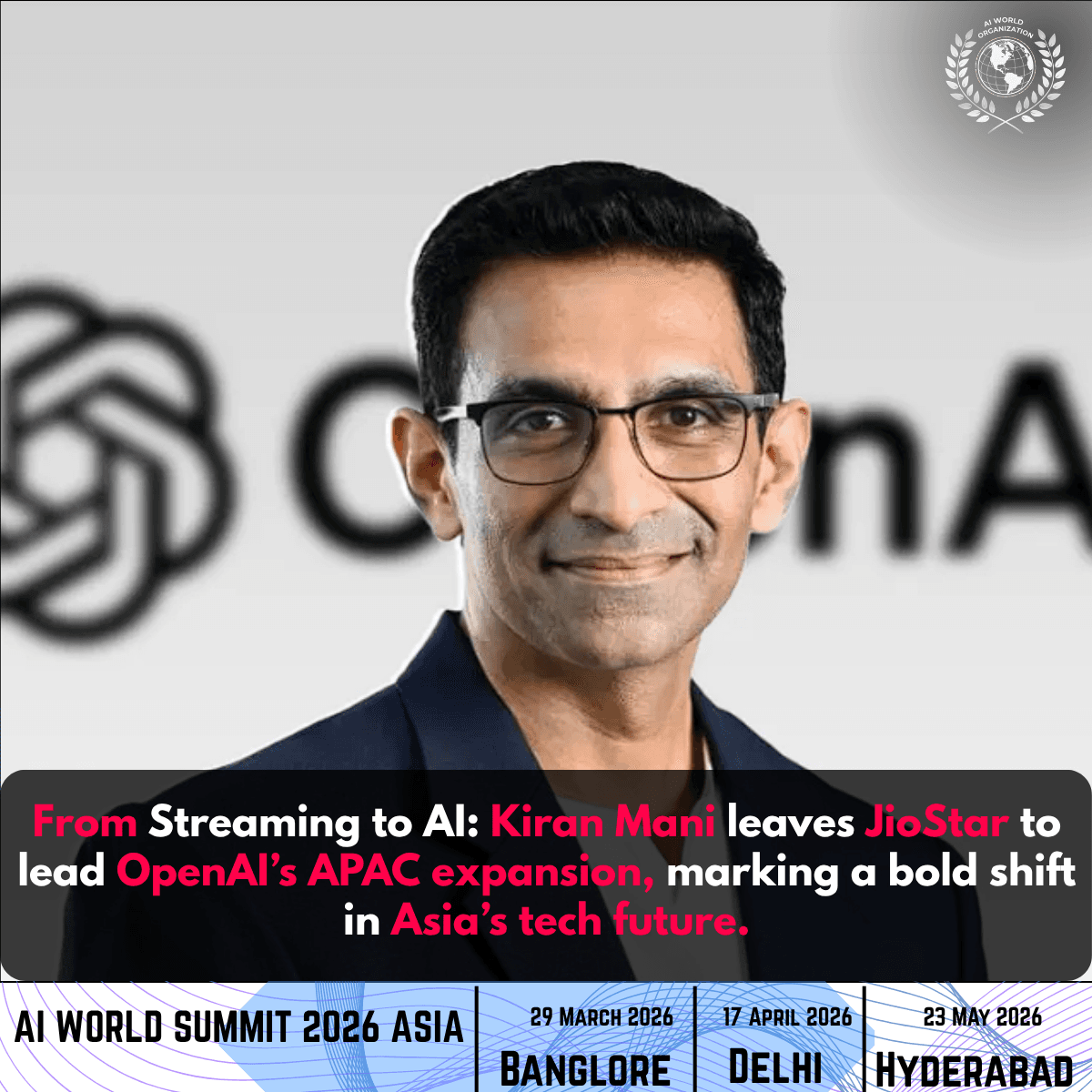
OpenAI hires JioStar's Kiran Mani as APAC Managing Director to drive AI expansion across India, Singapore, and Asia-Pacific markets in 2026.
TL;DR
Kiran Mani has left his role as CEO – Digital at JioStar to join OpenAI as Managing Director for Asia-Pacific. Based out of Singapore and reporting to Chief Strategy Officer Jason Kwon, he takes charge in June 2026. His appointment signals OpenAI's serious push into APAC, especially India, where it already counts over 100 million weekly ChatGPT users.
Kiran Mani Quits JioStar to Join OpenAI as APAC Managing Director: A Strategic Power Move in the Global AI Race
In a landmark leadership move that is already sending waves across the global technology industry, Kiran Mani has officially stepped down from his position as CEO – Digital at JioStar to take on a newly created senior executive role at OpenAI. Mani will serve as the Managing Director for Asia-Pacific (APAC), becoming one of the most senior regional leaders in the world's most talked-about artificial intelligence company. This appointment reflects a clear and unmistakable signal: OpenAI is no longer treating Asia-Pacific as a peripheral market — it is now front and centre of the company's most ambitious global expansion strategy. For those following AI funding news, this executive transition represents far more than a leadership shuffle; it is a statement of intent about where the biggest AI investments and business growth opportunities will unfold in the coming decade.
The move, first confirmed through a Bloomberg report, places Mani at the helm of OpenAI's operations across one of the world's most dynamic and digitally active regions. He is expected to assume his new position in June 2026 and will relocate to Singapore, which serves as OpenAI's official regional hub for Asia-Pacific. In his new capacity, Mani will report directly to Jason Kwon, OpenAI's Chief Strategy Officer — a reporting structure that underscores the strategic weight that OpenAI places on APAC growth. JioStar, meanwhile, has not yet named a replacement for the departing executive, leaving a significant leadership gap at one of India's most prominent streaming platforms.
A Veteran Executive with a Global Technology Pedigree
Kiran Mani is not simply a well-known name in India's digital media landscape — he is a deeply experienced technology executive whose career spans some of the most influential corporations in the global tech industry. With more than two decades of professional experience across technology and digital ecosystems, Mani brings a wealth of knowledge about scaling platforms, building strategic partnerships, and leading high-performance teams in complex, multi-market environments.
Before taking on the digital leadership role at JioStar, Mani spent over 13 years at Google, one of the world's largest technology companies. During his time at Google, he rose to the position of General Manager for Android and Google Play across Asia-Pacific and Japan — a role that gave him unparalleled exposure to the dynamics of the APAC technology market and a deep understanding of how global platforms localise and scale across diverse regulatory and cultural environments. Earlier in his career, he held senior positions at both Microsoft and IBM, two institutions that have shaped the modern enterprise technology world. This combination of experience — from consumer technology to enterprise software, from streaming media to regional platform strategy — makes Mani uniquely positioned to lead OpenAI's APAC operations.
At JioStar, Mani had been instrumental in driving the platform's digital strategy, managing product development, and overseeing the end-to-end operations of one of India's most-watched streaming ecosystems. His departure marks the end of a significant chapter, both for the platform and for India's broader media and entertainment industry. But for OpenAI, his arrival marks the beginning of what could be one of the most consequential regional leadership tenures in the company's history.
OpenAI's Asia-Pacific Vision: Building the Next Frontier of AI Adoption
The appointment of Mani is not an isolated hiring decision — it is part of a much larger, meticulously planned strategy that OpenAI has been quietly assembling over the past year. The company has been steadily increasing its footprint across Asia-Pacific, identifying the region as a critical driver of the next wave of global AI adoption. Markets such as India, Japan, South Korea, Southeast Asia, and Australia are already showing strong and accelerating demand for AI tools and platforms across enterprises, developer communities, and government agencies alike.
In his new role, Mani is expected to oversee business strategy, build and deepen partnerships, and drive market expansion across this vast and diverse geography. OpenAI has been witnessing unprecedented demand for its AI models from organisations looking to deploy generative AI for a wide range of applications — from coding and software development to customer support automation, content creation, and back-end operational efficiency. Mani's mandate will be to harness this demand and channel it into structured, long-term commercial growth.
From an AI funding news perspective, this expansion is backed by serious capital commitment. OpenAI has been one of the most well-funded AI companies in the world, and its Asia-Pacific ambitions are aligned with the broader trend of AI funding flowing into regional markets. Enterprises and governments across APAC are increasingly willing to invest in AI infrastructure, and OpenAI wants to be the primary beneficiary of that spending. Mani's commercial instincts and regional relationships are seen as critical to achieving that goal.
OpenAI's decision to appoint dedicated, senior regional leadership rather than continuing to manage Asia-Pacific operations from the United States is itself a significant strategic shift. It reflects a maturation in how the company views international markets — not as extensions of its American business, but as distinct and vital regions with their own growth narratives, competitive dynamics, and regulatory considerations.
OpenAI's Deepening Commitment to India: Infrastructure, Partnerships, and AI Funding
India occupies a particularly special place in OpenAI's Asia-Pacific strategy, and the appointment of Kiran Mani — one of India's most respected digital executives — is in many ways a direct reflection of that priority. As of early 2026, India has already emerged as one of the largest user bases for ChatGPT globally, with over 100 million weekly users drawn from students, developers, teachers, entrepreneurs, and enterprise professionals. This staggering user base makes India not just a growth market — it makes it a foundational pillar of OpenAI's global ambitions.
Earlier this year, OpenAI launched the "OpenAI for India" initiative at the India AI Impact Summit 2026, held in New Delhi. This nationwide programme is designed to expand access to artificial intelligence across the country by building local infrastructure, supporting Indian start-ups and developers, and accelerating enterprise adoption of AI tools. The initiative was announced in partnership with the Tata Group — one of India's largest and most respected conglomerates — marking one of the most significant enterprise AI collaborations in the country's history. Under this partnership, OpenAI became the first customer of Tata Consultancy Services' HyperVault data centre business, starting with 100 MW of capacity and with the potential to scale up to an extraordinary 1 gigawatt in the future.
The AI funding dimensions of this partnership are substantial and far-reaching. Tata Group has also committed to deploying ChatGPT Enterprise across hundreds of thousands of its employees — in what is shaping up to be one of the largest enterprise AI deployments anywhere in the world. TCS additionally intends to use OpenAI's Codex platform to standardise AI-native software development across its global teams. These commitments represent not just a business relationship, but a signal to the entire Indian corporate ecosystem that AI adoption at scale is both feasible and imminent.
Beyond the Tata partnership, OpenAI has also announced plans to open new offices in Mumbai and Bengaluru later in 2026, supplementing its existing presence in New Delhi. These expansions are part of a broader physical infrastructure build-out designed to ensure that OpenAI's most advanced AI models can run securely within India, enabling lower latency, meeting data residency requirements, and addressing compliance mandates for both government and enterprise workloads. This kind of infrastructure investment is critical in a market like India, where data sovereignty and regulatory compliance are increasingly important considerations for organisations deploying AI at scale.
OpenAI first hired its initial employee in India as recently as 2024 — a government relations specialist who helped lay the groundwork for the company's regulatory and policy engagements in the country. Since then, the company has rapidly scaled its India team and is now positioning itself to be a dominant force in what is widely considered the world's most exciting AI growth market. The appointment of Kiran Mani as APAC Managing Director can be seen as the culmination of this phase of growth — and the beginning of an even more ambitious chapter.
The Competitive Landscape: Why APAC Is the New Battleground for Global AI Dominance
OpenAI's move to strengthen its Asia-Pacific leadership comes at a time of intensifying competition among the world's top AI companies. Rivals including Google, Anthropic, and several Chinese AI firms are all investing heavily in APAC markets, recognising that the region represents the largest untapped opportunity for AI adoption at scale. Governments across the region are developing their own national AI strategies, and enterprises in sectors ranging from banking and healthcare to manufacturing and retail are accelerating their AI transformation journeys.
In this fiercely competitive environment, having the right regional leader can make an enormous difference. Mani's deep familiarity with the technology and digital landscape across India and APAC, combined with his ability to engage with both global enterprises and local partners, makes him a powerful asset for OpenAI. His experience building and scaling platforms across diverse markets gives him an instinctive understanding of what it takes to win in environments that are very different from Silicon Valley — and that understanding will be critical as OpenAI navigates the regulatory, cultural, and commercial complexity of Asia-Pacific. From an AI funding perspective, the stakes are enormous: Asia-Pacific is expected to account for an increasingly large share of global AI investment and revenue over the next five years, and the company that builds the strongest regional leadership today will be best positioned to capture that opportunity tomorrow.
OpenAI is also in the midst of a major global workforce expansion, with plans to scale to approximately 8,000 employees by the end of 2026 — nearly double its current headcount. Much of this growth is being channelled into international markets, with new offices established in London, Dublin, Tokyo, and now Singapore serving as the springboard for Asia-Pacific operations. The Singapore office, which will serve as Mani's base, is not just a logistical convenience — it is a strategic statement about where OpenAI sees the future of its global business unfolding. Singapore's position as a regional financial and technology hub, combined with its pro-innovation regulatory environment, makes it an ideal command centre for overseeing operations across the extraordinarily diverse markets of Asia-Pacific.
For the global AI community and those tracking AI funding news, OpenAI's moves in APAC represent one of the most significant regional investment stories of 2026. The combination of senior executive hires, large-scale infrastructure partnerships, and a formal regional initiative in India demonstrates that OpenAI is not just thinking about Asia-Pacific — it is acting with urgency and conviction. The region is no longer a future priority; it is a present-tense strategic imperative.
What This Means for the Broader AI Ecosystem in Asia-Pacific
The significance of Kiran Mani's appointment extends well beyond the boardroom dynamics of a single company. His move from one of India's largest digital media businesses to the world's leading AI platform is a powerful indicator of how the career calculus for senior technology executives is changing. The AI industry — flush with AI funding and driven by breakneck innovation — is now attractive enough to lure top talent away from established and prestigious roles in traditional tech and media companies. This trend is likely to accelerate as AI companies continue to expand globally and seek regional leadership with deep local knowledge and strong relationship networks.
For India's digital ecosystem in particular, this development carries important implications. It reinforces the country's growing status as a critical market for global AI platforms and signals that the next wave of technology leadership in India will be increasingly shaped by the intersection of AI, enterprise transformation, and regional strategy. Start-ups, developers, enterprises, and policymakers across the region will be watching Mani's tenure at OpenAI closely — both as a bellwether for OpenAI's regional ambitions and as a signal of the broader direction of AI adoption and AI funding across Asia-Pacific.
At The AI World Organisation, we recognise this development as a defining moment in the evolution of the global AI landscape. OpenAI's commitment to building dedicated regional leadership reflects exactly the kind of strategic thinking that will separate the AI leaders of tomorrow from the organisations that fail to seize the moment today. As the global AI community continues to expand, events like the AI World Summit and related initiatives serve as vital forums where these conversations about regional strategy, AI funding, enterprise adoption, and responsible innovation can take shape. The appointment of Kiran Mani is, in every sense, a story about the future of AI — and that future is being built, in large part, right here in Asia-Pacific.