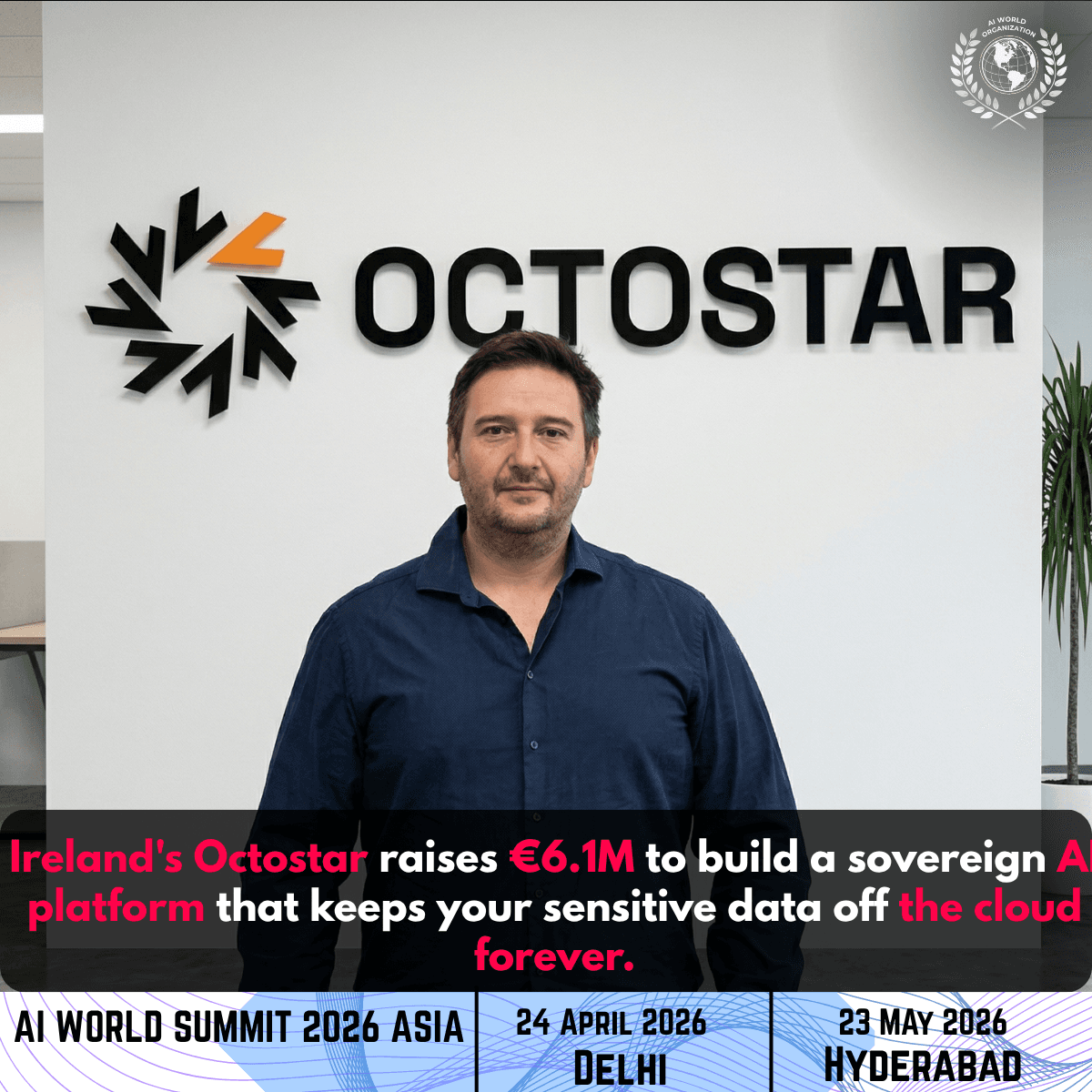
Octostar Raises €6.1M for Sovereign AI Platform
Ireland's Octostar closes a €6.1M Seed extension to expand its sovereign AI-native intelligence platform for law enforcement and national security.
TL;DR
Ireland's Octostar has closed a €6.1M Seed extension to scale its sovereign, air-gapped AI intelligence platform built for law enforcement, national security, and financial institutions. With three EU deployments already live in Q1 2026, a BAE Systems tie-up, and expansion underway in the UK, Middle East, and US this is one of the more grounded and operationally proven AI funding stories out of Europe this year.
Ireland's Octostar Raises €6.1 Million in Seed Extension to Power Its Sovereign AI-Native Intelligence Platform
Dublin-based Octostar has officially closed an extension to its Seed funding round, bringing its total raised capital to €6.1 million (approximately $7 million USD). The company, which builds AI-native intelligence software for national security agencies, law enforcement bodies, and financial institutions, announced the development as one of the most noteworthy AI funding events in the European deep-tech sector this quarter. The round attracted participation from both existing strategic and venture capital backers, along with the addition of Milan-based venture capital firm The Techshop and a cluster of new national institutional investors. This milestone places Octostar firmly on the map as one of Europe's most compelling sovereign AI plays — and signals that the global appetite for secure, data-sovereign AI platforms is no longer a niche conversation, but a mainstream investment priority.
The announcement adds to an expanding catalogue of AI funding news coming out of Ireland and the broader European startup ecosystem in 2026. As governments and critical institutions increasingly demand operational independence from Big Tech infrastructure, companies like Octostar are stepping into a growing vacuum — and investors are clearly taking notice.
What Is Octostar and Why Does It Matter
Founded in 2023 by Dr. Giovanni Tummarello, Robert Fuller, Simone Scarduzio, and Varun Sharma, Octostar was built from the ground up to solve a problem that traditional intelligence and analytical platforms have long struggled with: how do you provide enterprise-grade, AI-powered investigative capabilities without compromising data sovereignty? The founding team brings with it nearly a decade of collective experience in building investigative intelligence software — a depth of domain expertise that has been central to attracting investor confidence and early institutional clients alike.
At its core, Octostar is an investigative and decision intelligence platform. It is designed to fuse petabyte-scale structured and unstructured data from multiple sources into unified virtual knowledge graphs, enabling analysts, investigators, and decision-makers to work collaboratively while leveraging advanced AI capabilities. What makes Octostar distinctly different from legacy platforms in this space — including the likes of Palantir, which relies heavily on cloud infrastructure — is its architectural philosophy. Octostar's platform is fully Kubernetes-deployable and can operate entirely in what the company describes as No Cloud/No Internet environments, commonly referred to in the intelligence community as air-gapped environments. This means that sensitive data never has to leave a client's controlled perimeter, which is a non-negotiable requirement for the types of agencies and institutions Octostar serves.
The platform supports intelligence-grade Attribute-Based Access Control (ABAC) and Role-Based Access Control (RBAC) mechanisms, giving clients granular control over who can access what data, at what level, and under what conditions. It also integrates link analysis, communications intelligence (COMINT), document intelligence, and Generative AI-powered agents — all within a sovereign, extensible architecture that clients can customise to their own workflows, data sources, and compliance requirements without ever requiring vendor intervention. This principle of "use-case sovereignty" is not just a marketing term for Octostar; it is the philosophical cornerstone of every architectural decision the company has made since its inception.
The Octobox: A Tactical Leap in Deployable AI Intelligence
Alongside its flagship intelligence platform, Octostar has also unveiled one of its most operationally significant product innovations — the Octobox. Described as a purpose-built tactical appliance, the Octobox ships as a pre-configured "cluster in a box," ready to deploy and use without requiring any cloud connectivity or external data exposure. In practical terms, this means a law enforcement unit or national security team can receive a physical device, plug it in, and begin running AI-powered intelligence operations almost immediately — without needing to connect it to an external network, without waiting for cloud provisioning, and without exposing any operational data to third-party infrastructure.
This kind of hardware-software integration represents a significant leap in accessibility for sensitive government and law enforcement environments where traditional IT procurement cycles are lengthy, infrastructure constraints are real, and operational security is paramount. The Octobox effectively brings the full power of Octostar's AI platform to the tactical edge — whether that's a mobile command centre, a border security facility, a judicial body, or a financial crimes investigation unit. For agencies operating in regions with limited digital infrastructure, or those bound by strict data localisation laws, the Octobox offers a compelling deployment model that no major cloud-native competitor can currently match.
The launch of Octobox also reinforces one of the strongest narratives in contemporary AI funding news — that the next frontier of enterprise AI is not just about building smarter models, but about deploying those models in ways that respect operational, legal, and security boundaries. Octostar's approach strongly resonates with this trend, and the Octobox is the most tangible expression of that vision.
Investor Confidence and the Growing Case for Sovereign AI
The €6.1 million Seed extension was not merely a financial transaction — it was a strong endorsement of Octostar's thesis by a diverse group of investors who see sovereign AI as one of the defining infrastructure challenges of this decade. Gianluca D'Agostino of The Techshop, the Milan-based venture capital firm that came on board as a new investor in this round, publicly praised the founding team's decade-long experience in building investigative intelligence software, calling out their relentless drive for innovation. D'Agostino further stated that Octostar is one of the very few companies effectively meeting the fast-growing global demand for sovereign AI-native platforms — a statement that speaks to the competitive scarcity of what Octostar has built.
This is an important moment in the broader landscape of AI funding. Historically, AI investment has been dominated by firms building general-purpose large language models, consumer-facing generative AI tools, or cloud-based enterprise platforms. But a new wave of AI funding news is emerging — one focused on secure, mission-critical, and sovereignty-compliant AI infrastructure for governments, law enforcement, and regulated industries. Octostar sits squarely at the centre of this emerging investment category, and the participation of national institutional investors alongside traditional VCs suggests that the Irish and broader European government ecosystem is beginning to align its capital deployment with this strategic priority.
The addition of new national institutional investors is also a reflection of the increased willingness of European governments to back domestic alternatives to US-based technology giants in sensitive sectors. This trend is being driven not just by geopolitical considerations, but by the very practical need to comply with evolving data localisation and digital sovereignty regulations across the EU and beyond. Octostar, with its air-gapped architecture and use-case sovereignty model, is uniquely positioned to benefit from this regulatory tailwind.
Market Traction and International Expansion Plans
Perhaps the most impressive aspect of Octostar's story is not the funding it has raised, but the deployments it has already secured. In the first quarter of 2026 alone, Octostar completed three new deployments with EU national law enforcement and judicial bodies — a remarkable pace for a company that was only founded in 2023. The company has set an ambitious target of completing over fifteen deployments by year-end, signalling strong pipeline visibility and growing institutional adoption across Europe.
Beyond Europe, Octostar's reach is already extending globally. The company has active national security projects underway in both the Middle East and the Asia-Pacific region, reflecting the universal demand for sovereign intelligence platforms that transcends European borders. It has also entered into a joint collaboration with BAE Systems, one of the world's largest and most respected defence and security technology firms — a partnership that not only validates Octostar's technical capabilities but also dramatically expands its potential customer reach across BAE's existing government and defence client base.
To support its UK market ambitions, Octostar has opened a new London sales office, led by Lee Hannaford under the banner of Octostar UK. The London office represents a strategic bridgehead into one of the world's largest and most mature markets for national security and law enforcement technology. The United States is also firmly in the company's crosshairs, with the fresh capital earmarked in part to support expansion efforts into the US market — a move that could significantly accelerate Octostar's growth trajectory and revenue scale in the coming years.
The AI funding that has flowed into Octostar via this Seed extension will also be used to continue building out the company's product capabilities — including its Generative AI copilot features, which the company claims can deliver between 2x and 100x speedups on investigative tasks without replacing the human investigator. This last point is significant. Octostar's design philosophy is explicitly augmentative rather than substitutive — the platform is built to make investigators faster, sharper, and more effective, not to automate them out of the picture. In sensitive, high-stakes domains like national security and law enforcement, this approach is not just ethically sound; it is operationally essential.
A European Alternative to Palantir — and a Vision for the Future
One of the most notable accolades that has accompanied Octostar's rise is its recognition as a key European alternative to Palantir Technologies, the US-based data analytics giant that has long dominated the government intelligence and national security markets. This comparison is both telling and strategically significant. Palantir's model, while powerful, has attracted criticism in European contexts for its reliance on cloud infrastructure, its US-centric data governance approach, and its perceived opacity — concerns that are particularly acute for EU member states operating under GDPR and other data sovereignty frameworks.
Octostar's architecture directly addresses these concerns. By offering a platform that is fully air-gappable, uses an open and customisable ontology model rather than proprietary black-box systems, and enables clients to define their own data access controls and workflows, Octostar provides European and global institutions with an intelligence platform they can genuinely own, operate, and govern on their own terms. This is not just a competitive differentiator; it is a fundamentally different value proposition.
As the conversation around AI sovereignty grows louder — driven by geopolitical tensions, regulatory evolution, and growing institutional distrust of centralised cloud infrastructure — Octostar's moment is clearly arriving. The company's trajectory from a 2023 founding to €6.1 million in total AI funding, three EU law enforcement deployments in a single quarter, a joint project with BAE Systems, and active engagements across the Middle East and Asia-Pacific in less than three years is a testament to the strength of its team, the clarity of its vision, and the urgency of the problem it is solving.
For those tracking AI funding news across the European deep-tech landscape, Octostar represents exactly the kind of company the continent needs more of — technically rigorous, sovereignty-first, operationally proven, and internationally ambitious. As global institutions accelerate their search for secure, adaptable AI infrastructure that does not compromise their data independence, Octostar appears to be not just ready for this moment, but uniquely built for it. The €6.1 million Seed extension is not just a funding milestone — it is the starting gun for what could be a transformative chapter in sovereign intelligence technology.


