NVIDIA's $2B Marvell Deal Reshapes AI Infrastructure
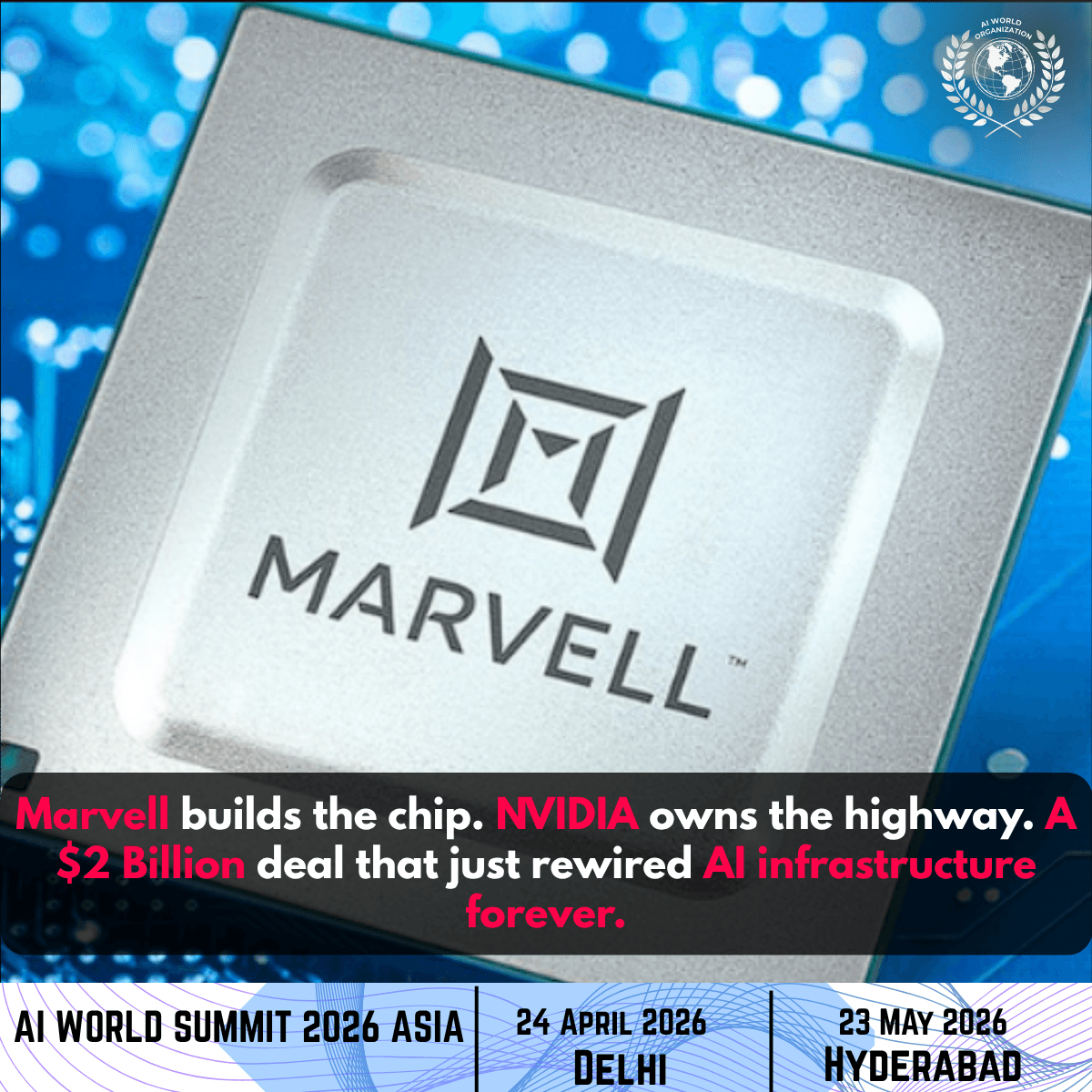
NVIDIA invests $2 billion in Marvell via NVLink Fusion to lock in AI data center infrastructure. Here's what this AI funding deal means for the future of AI.
TL;DR
NVIDIA has poured $2 billion into Marvell Technology, tying the chipmaker into its NVLink Fusion interconnect ecosystem. The deal means every Marvell custom AI chip deployed will still require an NVIDIA component alongside it securing NVIDIA's revenue regardless of who builds the accelerator. With optical photonics and 5G AI-RAN also in the mix, this is less a partnership and more a quiet infrastructure takeover.
NVIDIA's $2 Billion Bet on Marvell: How NVLink Fusion Is Quietly Locking In the Future of AI Infrastructure
In one of the most consequential moves in recent AI funding news, NVIDIA has announced a $2 billion strategic investment in Marvell Technology, pulling one of the world's leading custom chip designers firmly into its own interconnect ecosystem. The deal, announced on March 31, 2026, goes far beyond a routine partnership or vendor agreement. It represents a calculated, long-term play by NVIDIA to ensure that as AI data center architecture evolves — shifting toward custom silicon, optical interconnects, and hyperscaler-built accelerators — the company's infrastructure remains at the very heart of it all. For the AI industry, this isn't just another headline about AI funding. This is the story of how a platform company quietly becomes indispensable.
At its core, this investment is built around NVLink Fusion, a rack-scale connectivity platform that NVIDIA launched in May 2025. NVLink Fusion allows third-party chips — including custom accelerators and application-specific integrated circuits (ASICs) built by companies like Marvell — to connect directly into NVIDIA's proprietary high-speed interconnect fabric. What makes this significant is the deliberate design of the platform: every NVLink Fusion deployment requires at least one NVIDIA component, whether that be a Vera CPU, a GPU, a ConnectX NIC, a BlueField DPU, or a Spectrum-X switch. In other words, even as Marvell brings its own custom XPUs to the table, NVIDIA still earns revenue every time one of those chips goes into production. It is, by any definition, a masterclass in ecosystem engineering — and it is reshaping how the global AI computing stack gets built.
NVLink Fusion: The Architecture Behind NVIDIA's Masterplan
To understand why this AI funding move matters so much, you have to understand what NVLink Fusion actually does and why it was created in the first place. For years, NVIDIA's dominance in AI infrastructure relied primarily on its GPUs — the H100, the A100, and now the Blackwell series. But the landscape is changing. Large cloud providers such as Google, Amazon, and Microsoft have been steadily building their own custom silicon to reduce dependency on any single vendor. Google has its TPUs, Amazon has Trainium and Inferentia, and Microsoft is developing its own AI chips through the Maia program. These hyperscalers have enormous engineering resources and the motivation to cut both costs and vendor reliance over time.
NVIDIA's response to this threat was not to try to block custom silicon development — that would be neither practical nor commercially viable. Instead, the company launched NVLink Fusion as a strategic middle ground. Rather than forcing hyperscalers to choose between NVIDIA's GPUs and their own custom chips, NVLink Fusion allows both to coexist within the same rack-scale infrastructure, connected through NVIDIA's high-bandwidth interconnect. The catch, of course, is that the interconnect itself belongs to NVIDIA. Samsung Foundry joined the NVLink Fusion ecosystem in October 2025, offering design-to-manufacturing support for NVLink-compatible custom chips on its 3nm and 2nm nodes. Arm followed in November, enabling its licensees to build CPUs with native NVLink connectivity — opening the door for hyperscalers to integrate NVLink directly into their own Arm-based SoCs. Now Marvell, arguably the most important addition yet, has joined the ecosystem, bringing not just chip design capabilities but also cutting-edge optical networking technology into the fold.
The significance of the Marvell addition cannot be overstated in the broader context of AI funding and infrastructure development. Under the terms of the partnership, Marvell will provide custom XPUs and NVLink Fusion-compatible scale-up networking, while NVIDIA will supply the surrounding stack including Vera CPUs, ConnectX NICs, BlueField DPUs, the NVLink interconnect itself, and Spectrum-X switches. This creates a tightly integrated system where NVIDIA controls the connective tissue even as Marvell delivers the custom compute muscle. For enterprise customers and hyperscalers, the deal means more design flexibility without sacrificing interoperability. For NVIDIA, it means revenue streams that persist regardless of which company's accelerator ends up inside a given AI data center rack.
Marvell's Strategic Value: Custom Silicon Meets Optical Connectivity
Marvell's entry into the NVLink Fusion ecosystem is not happening in isolation — it comes on the back of one of the most strategically timed acquisitions in the semiconductor industry. In early 2026, Marvell completed its acquisition of Celestial AI for a deal valued at up to $5.5 billion, adding Celestial AI's Photonic Fabric™ technology to its portfolio. This acquisition gave Marvell a major leg up in optical interconnect technology, which is rapidly emerging as the defining infrastructure challenge for large-scale AI deployments. As AI clusters continue to grow in size — scaling to hundreds of thousands of chips working in tight coordination — electrical signals simply cannot carry data fast enough or far enough. The physics of copper wiring imposes hard limits, and optical interconnects, which use light rather than electricity to transmit data, are the industry's most viable path forward.
Matt Murphy, chairman and CEO of Marvell, captured the partnership's essence well when he noted that it reflects "the growing importance of high-speed connectivity, optical interconnect, and accelerated infrastructure in scaling AI." By bringing Marvell's leadership in high-performance analog, optical DSP, silicon photonics, and custom silicon into NVIDIA's ecosystem through NVLink Fusion, the companies are positioning themselves to serve the next generation of AI infrastructure demands together. The collaboration includes joint development work on silicon photonics technology, aiming to push data transfer speeds to 1.6 terabits per second while significantly improving power efficiency across large-scale AI deployments — a critical consideration as AI data centers consume increasingly enormous amounts of energy.
What makes this silicon photonics collaboration particularly noteworthy in the context of current AI funding news is the scale of the opportunity. Analysts project the photonics interconnect market to grow by 8 to 10 times by 2034, making it one of the most lucrative segments of the broader AI infrastructure ecosystem. NVIDIA has been advancing co-packaged optics through its Quantum-X and Spectrum-X Photonics platforms, both of which are designed to reduce power consumption by up to 3.5 times compared to traditional pluggable architectures. The joint work between NVIDIA and Marvell aims to build on this foundation, creating optical interconnect solutions that can reshape how data moves within AI factories at rack, pod, and cluster scales. For organizations building at hyperscale, this could represent a fundamental shift in the economics and physical layout of AI infrastructure.
The Battle for AI Interconnect Supremacy: NVLink Fusion vs. UALink
No story about NVIDIA's NVLink Fusion strategy would be complete without addressing the competitive landscape, and specifically the challenge posed by UALink — the Ultra Accelerator Link consortium that represents the industry's open-standards alternative. UALink was formed with backing from AMD, Intel, Broadcom, and a coalition of other industry players who were, frankly, concerned about NVIDIA's growing stranglehold on AI infrastructure. The consortium's pitch is straightforward: an open, vendor-neutral interconnect standard that allows hyperscalers and enterprises to mix and match chips from different manufacturers without being locked into any single company's ecosystem. UALink's 1.0 specification supports up to 1,024 GPUs with data transfer rates of 200 gigatransfers per second, which represents meaningful performance on paper.
However, the gap between specification and deployment has proven to be UALink's most significant weakness. While NVLink is already deployed at scale inside NVIDIA's Blackwell NVL72 racks — powering some of the world's most advanced AI data centers today — UALink has yet to ship in production hardware. That timing gap is not trivial. By the time UALink reaches commercial deployment at meaningful scale, NVIDIA will have had months or potentially years to deepen its ecosystem relationships, sign long-term supply agreements, and ensure that the world's most important AI infrastructure is built on NVLink-compatible architecture. The Marvell deal accelerates this dynamic considerably, as Marvell was itself a participant in UALink discussions, making its decision to join NVLink Fusion a significant signal about where the industry believes the real AI funding and infrastructure momentum is heading.
Broadcom, NVIDIA's most direct competitor in the custom ASIC space, finds itself in an increasingly isolated position as a result of these developments. Broadcom is notably absent from the NVLink Fusion ecosystem, despite being the dominant player in custom silicon for hyperscalers — Google's TPUs are built with Broadcom's technology, and the company has long argued that large cloud providers would eventually push back against NVIDIA's closed approach. That thesis isn't wrong in principle, but NVIDIA's strategic moves have been consistently faster and more comprehensive. By securing Marvell — the other half of what analysts had called the custom ASIC duopoly alongside Broadcom — NVIDIA has effectively reshaped the competitive terrain. AMD's own recent decisions, including its partnership with Intel on x86-based AI processors that incorporate NVIDIA GPU chiplets, further suggest that the industry's efforts to build an alternative to NVIDIA-centric infrastructure are fragmenting rather than consolidating.
Supply Chain Dominance: NVIDIA's Broader AI Funding Investment Offensive
The $2 billion AI funding commitment to Marvell is not a standalone event — it is part of a broader, deliberate investment campaign that NVIDIA has been executing across its entire supply chain. Earlier in March 2026, NVIDIA made similar $2 billion investments in both Lumentum and Coherent, two of the world's leading manufacturers of laser components used in co-packaged optics for its Quantum-X InfiniBand and Spectrum-X switching platforms. These investments in laser production capacity are not glamorous headline-grabbers in the way that a major AI model launch might be, but they reflect a sophisticated understanding of where infrastructure bottlenecks will emerge as the AI industry scales. By securing laser supply well in advance of demand, NVIDIA ensures that its networking platforms can scale without being constrained by component shortages — a lesson the entire semiconductor industry learned painfully during the supply chain crises of 2021 and 2022.
Taken together, these investments paint a picture of a company that is methodically investing across every layer of the AI computing stack — from compute to networking, from switching to optics, and now from custom silicon to photonic interconnects. The AI funding news around NVIDIA in recent months consistently points to the same strategic logic: lock in the infrastructure before the industry's center of gravity shifts from raw GPU performance to connectivity and data movement. Jensen Huang, NVIDIA's CEO, has spoken repeatedly about the concept of the "AI factory" — the idea that modern AI infrastructure is not just a collection of chips but an integrated system where every component must work in harmony to deliver maximum throughput. The Marvell partnership, with its combination of custom XPUs, optical networking, and NVLink Fusion connectivity, is perhaps the clearest real-world expression of that philosophy yet.
The AI-RAN component of the Marvell deal also deserves attention, even if its near-term revenue contribution is limited. Under this aspect of the partnership, the two companies will collaborate on bringing NVLink Fusion-enabled computing into 5G and 6G base stations through NVIDIA's Aerial platform. The idea here is to extend AI infrastructure beyond the traditional hyperscaler data center and out into the world's telecommunications networks — turning base stations into distributed AI inference nodes that can support real-time applications in healthcare, autonomous vehicles, smart manufacturing, and more. While this is clearly a longer-term play, it represents a strategic expansion of NVIDIA's addressable market that could become a major source of AI funding-driven growth as 5G coverage deepens and 6G networks begin to take shape.
What This $2 Billion AI Funding Deal Means for the Future of AI Infrastructure
The market reacted to the NVIDIA-Marvell announcement with immediate enthusiasm. Marvell's stock rose nearly 13 percent on the day of the announcement, as investors recognized the significance of being formally embedded in NVIDIA's AI ecosystem. This kind of stock movement reflects not just optimism about near-term revenue but a broader reassessment of Marvell's competitive positioning in a world where AI infrastructure investment is accelerating rapidly. For AI World Organization, which tracks the pulse of global AI funding news and investment trends, this deal represents a pivotal moment in the maturation of the AI infrastructure market — a moment when the battle lines between open and proprietary standards are being drawn with real money and real strategic commitments.
For enterprises and hyperscalers evaluating their infrastructure strategies, the NVIDIA-Marvell partnership creates both opportunities and considerations worth examining closely. On the opportunity side, NVLink Fusion-based deployments offer the genuine benefit of custom silicon performance — tailored accelerators designed for specific AI workloads — combined with the compatibility and ecosystem richness of NVIDIA's platform. Marvell's ability to design application-specific chips means that customers can get accelerators optimized for large language model inference, recommendation systems, or scientific computing, all while remaining interoperable with NVIDIA's broader infrastructure stack. The photonics collaboration adds another layer of future-proofing, ensuring that as cluster sizes grow and optical interconnects become essential, these deployments will be positioned to scale without requiring wholesale architectural changes.
At the same time, the lock-in dynamics of NVLink Fusion are real and should be factored into long-term infrastructure planning. The requirement for at least one NVIDIA component in every deployment means that adopting NVLink Fusion is, functionally, a commitment to NVIDIA's ecosystem for as long as that infrastructure remains in service. For organizations that prioritize vendor independence and openness — values that UALink was explicitly designed to serve — this represents a meaningful constraint. The answer for many hyperscalers will likely be a hybrid approach: NVLink Fusion where NVIDIA's ecosystem offers the most compelling performance and integration benefits, and UALink or other open standards where flexibility and vendor neutrality are the priority. In that world, both NVIDIA and its competitors can find viable paths forward, even as NVIDIA's first-mover advantage in deployment scale continues to compound.
What is beyond doubt is that the era of AI infrastructure being defined by raw GPU performance alone is over. The race now is for connectivity, photonics, custom silicon, and the kind of deep ecosystem integration that this $2 billion AI funding commitment to Marvell represents. For anyone following AI funding news and the evolution of artificial intelligence infrastructure, the NVIDIA-Marvell partnership is not just a transaction — it is a window into the architecture of the AI-powered world being built right now.