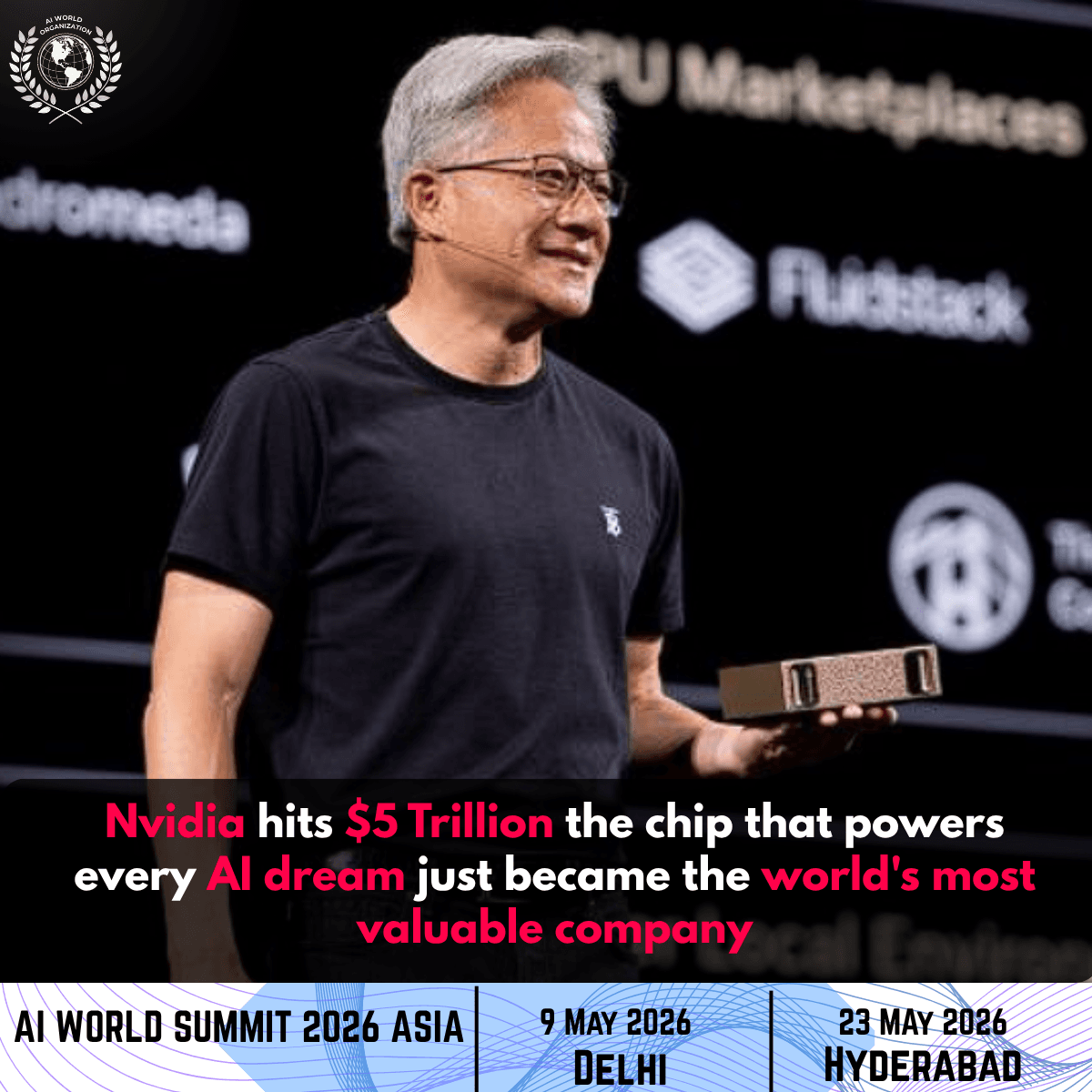
Nvidia Hits $5 Trillion Market Cap Milestone
Nvidia surpasses $5 trillion in market cap, becoming the world's most valuable company, fueled by AI chip demand and a semiconductor-wide rally.
TL;DR
Nvidia hit a $5 trillion market cap on April 24, 2026, becoming the world's most valuable company — surpassing Apple, Microsoft, and Alphabet. Fueled by relentless AI chip demand and Intel's blowout earnings, the stock closed at a record $208.27. The semiconductor index logged its 18th straight winning day, confirming the AI infrastructure boom is far from over.
There are moments in the history of financial markets that stop people mid-conversation — the kind of headlines that make even seasoned investors do a double-take. Nvidia crossing the $5 trillion market capitalization threshold on April 24, 2026, is one of those moments. In a single trading session, the chipmaker not only reclaimed a milestone it had first touched back in October 2025 but did so with the kind of conviction that tells a much larger story about where the global technology economy is headed. This is not just a story about a stock price. It is a story about artificial intelligence, the infrastructure race that is reshaping entire industries, and the extraordinary concentration of value that emerges when one company sits at the very center of a generational technology shift. For those tracking AI funding news and the broader capital flows into AI-driven infrastructure, Nvidia's latest milestone deserves a closer, more nuanced look.
The Record-Breaking Trading Session That Changed Everything
On the afternoon of April 24, 2026, Nvidia's shares climbed 4.3% to close at a record $208.27, pushing its total market valuation past $5 trillion for the first time since October. At its intraday peak, the stock touched $210.95, briefly pushing the company's market cap to $5.12 trillion — a number that, even a few years ago, would have seemed like the stuff of science fiction. To put this in perspective, this single trading day added more than $200 billion to Nvidia's market value. That is more than the total market capitalization of most Fortune 500 companies, created in the span of a few hours.
The closing price of $208.27 placed Nvidia just 2% below its all-time intraday high of $212.19, which it had set back in October 2025. What makes this rally even more striking is the context in which it happened. The broader market had been navigating uncertainty, yet the semiconductor sector was on fire. The Philadelphia Semiconductor Index, which tracks major chip companies, marked its 18th consecutive day of gains — the longest winning streak in the index's history — a signal that the AI chip rally was not a one-day wonder but a sustained institutional conviction. For anyone following AI funding news and tracking where the smart money is moving, this streak said everything.
Intel's Blockbuster Earnings Ignited a Sector-Wide Explosion
To understand why April 24 became such a landmark day for Nvidia, you need to look at what happened the evening before. After markets closed on Thursday, April 23, Intel released its first-quarter 2026 earnings results — and they were nothing short of spectacular. Intel reported non-GAAP earnings per share of $0.29, a figure that shattered analyst expectations of just $0.01 per share. Revenue came in at $13.6 billion, comfortably above the $12.42 billion consensus estimate, representing a 7% year-over-year growth. For an industry that had been quietly wondering whether the AI-driven semiconductor supercycle was beginning to cool, Intel's numbers were a shot of adrenaline directly into the market's bloodstream.
The ripple effect was immediate and powerful. AMD shares surged more than 14% to $349.54 in a single session. Qualcomm jumped over 8% to $144.85, even as the company continued to face its own set of challenges including Apple's growing ambitions in the modem space and softness in certain international markets. The entire semiconductor ecosystem moved in unison, and Nvidia — already the crown jewel of the AI chip world — led from the front. This is what AI funding news observers and market analysts had been anticipating: a validation moment that confirmed the underlying demand for AI computing infrastructure remained not just intact but accelerating.
What Intel's earnings essentially proved was that the AI buildout is not concentrated in one corner of the chip market. It is a broad, structural investment cycle that is lifting the entire semiconductor industry. When customers are spending this aggressively on AI compute, the companies building the chips, the tools, the servers, and the networks all benefit. Nvidia, sitting at the very top of the value chain as the dominant GPU supplier, naturally captured the lion's share of investor enthusiasm on that day.
The Paradox at the Heart of Nvidia's $5 Trillion Empire
Here is where the Nvidia story becomes genuinely fascinating — and a little counterintuitive. The companies that are spending the most money buying Nvidia's GPUs are the same companies working the hardest to make Nvidia obsolete. Google, Microsoft, Meta, and Amazon — the four largest hyperscalers in the world — are Nvidia's biggest customers. They collectively plan to spend approximately $700 billion on capital expenditures in 2026, and a significant chunk of that budget is heading straight to Nvidia's headquarters in Santa Clara, California. Google alone has committed up to $185 billion in capex this year, more than double what it spent in 2025. Meta, which spent $72 billion in 2025, has raised its 2026 budget to as much as $135 billion.
And yet, all four of these companies have active, well-funded programs to develop their own custom AI chips. Google has its TPUs, Microsoft is working on Maia chips, Meta is investing in its Meta Training and Inference Accelerator (MTIA), and Amazon has its Trainium and Inferentia chips. The explicit goal of all these in-house chip programs is to reduce dependence on Nvidia. So, in a deliciously ironic twist, every dollar these hyperscalers spend buying Nvidia GPUs today is partially funding the AI research, model training, and infrastructure development that could, someday, power a world where Nvidia faces meaningful competition from its own best customers.
This is the central paradox of Nvidia's dominance: it is simultaneously indispensable and threatened. But here is why investors are not particularly worried right now. Building competitive AI chips is extraordinarily difficult, and even with billions of dollars of investment, these custom chips remain largely complementary to Nvidia rather than genuine replacements. The hyperscalers use their own silicon for specific, optimized inference tasks, but they still come back to Nvidia for training and for tasks that demand the raw computational density that only Nvidia's H100, H200, and Blackwell chips can currently deliver. That is why, despite the competition narrative, the AI funding news cycle keeps circling back to Nvidia as the undisputed engine of the AI era.
From Graphics Cards to the Most Valuable Company on Earth
It is worth pausing to appreciate just how extraordinary Nvidia's transformation has been. At the close of 2022, Nvidia was a respected but not earth-shattering company, primarily known for making graphics processing units for gaming and professional visualization. Then came ChatGPT, the generative AI explosion, and the sudden, urgent realization across the technology industry that training large language models and running AI inference at scale required exactly the kind of parallel processing architecture that Nvidia had been quietly perfecting for two decades.
Since the end of 2022, Nvidia's stock has risen more than 14-fold — a gain of over 1,400% that has added more than $4.5 trillion to its market capitalization. No company in history has created this much value this quickly at this scale. Microsoft's rise through the 1990s, Google's ascent through the 2000s, Apple's decade of dominance — Nvidia's trajectory has compressed what typically takes a decade into roughly three years. As of April 24, 2026, Nvidia's $5 trillion market cap placed it $1 trillion ahead of Alphabet, its nearest rival. Apple sat at $3.97 trillion, Microsoft at $3.13 trillion, and Amazon at $2.82 trillion. Nvidia was not just ahead of the pack — it was in a different zip code.
From an AI funding and AI funding news perspective, this valuation tells a story about where institutional and retail capital alike believe the future of technology is being built. When markets assign $5 trillion in value to a single company, they are making a collective bet that the AI infrastructure wave is not a passing trend — it is a foundational restructuring of how computation itself is organized and delivered.
What This Means for the AI Industry and the Road Ahead
The broader implications of Nvidia's $5 trillion milestone extend well beyond the stock market. For startups, investors, policymakers, and researchers, this moment crystallizes something important: the AI infrastructure layer is the most valuable piece of the technology stack right now — more valuable than the applications built on top of it, more valuable than the data that feeds it, and more valuable than the models that run on it. The picks-and-shovels of the AI gold rush are worth more than the gold itself, at least for now.
From an AI funding news standpoint, the cascade of capital flowing into this sector shows no signs of slowing. Industry research indicates that hyperscalers alone are set to spend over $500 billion on AI infrastructure in 2026, with estimates from some analysts pushing the figure toward $600–$650 billion when you factor in secondary players like Oracle and tier-two cloud providers. Jensen Huang, Nvidia's CEO, has consistently argued that this is just the beginning. At a recent investor event, he made the case that the new model of AI-driven computation is "not going to go back," and that businesses will continue building out this capacity from this point forward. Given that some projections suggest hyperscaler capex could hit $2.8 trillion annually by 2028 if current growth rates continue, Huang's optimism appears well-grounded.
At The AI World Organisation, we have been closely monitoring how AI funding news shapes the strategic decisions of both established players and emerging challengers. What Nvidia's $5 trillion milestone signals is that the market has moved past the question of whether AI is a lasting technological transformation. That debate is settled. The question now is which companies, which chips, and which architectures will define the next phase — the phase where AI moves from training in massive data centers to inference at the edge, from research labs to enterprise workflows, from experimental to essential. Nvidia currently holds the most valuable position in that unfolding landscape, and the market, by assigning it the highest valuation in corporate history, is making its position very clear.
The semiconductor rally, Intel's unexpected earnings beat, the 18th consecutive day of gains for the Philadelphia Semiconductor Index, and AMD and Qualcomm's double-digit surges all point to the same conclusion: the AI investment supercycle is not entering a cooling phase. If anything, it is accelerating. For investors, technologists, policymakers, and anyone paying attention to AI funding news, April 24, 2026 is a date worth remembering — the day the market confirmed, with $5 trillion in conviction, that the age of AI infrastructure has truly arrived.