HrFlow.ai Raises €6M to Build Hiring AI Infrastructure
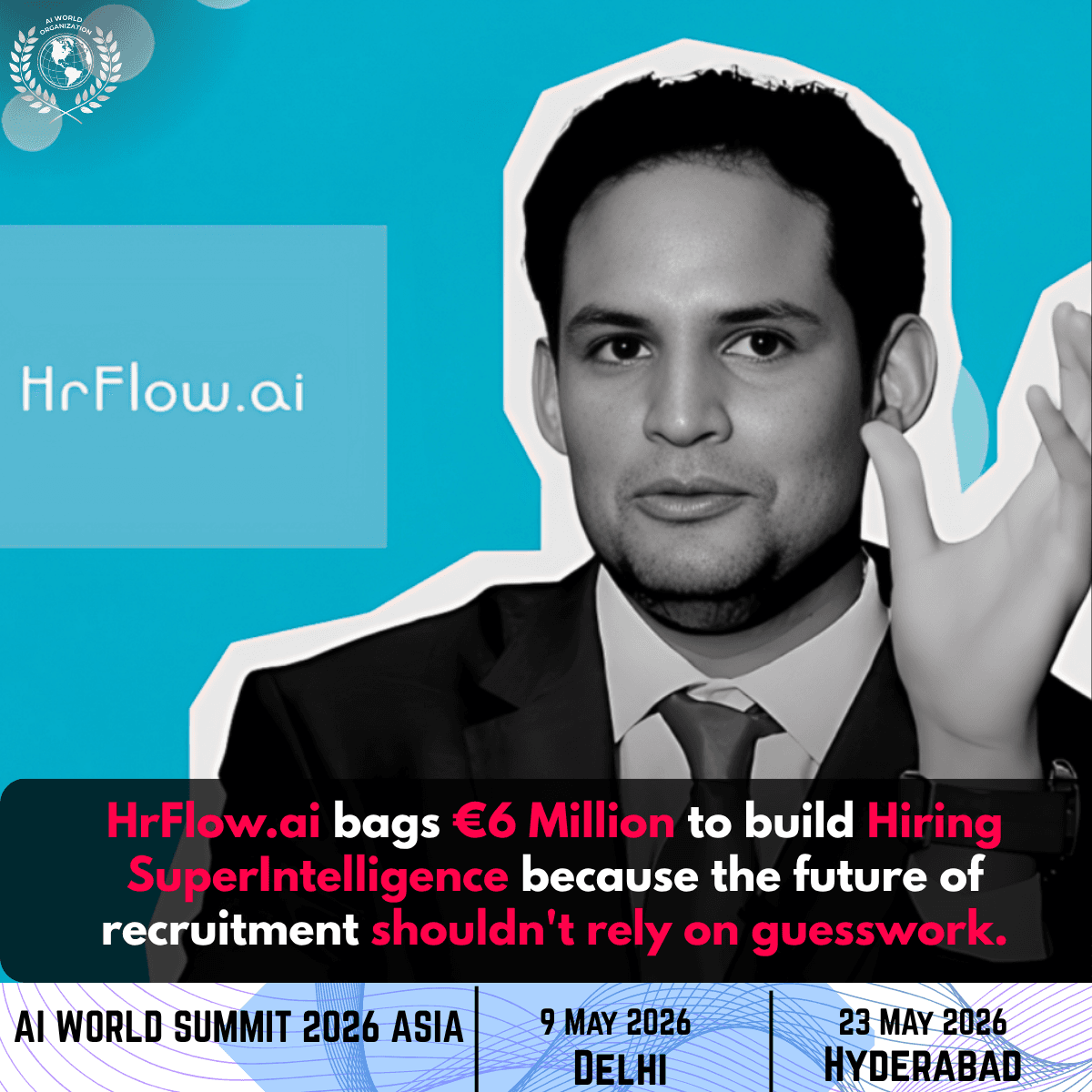
HrFlow.ai secures €6M pre-Series A funding to build Hiring SuperIntelligence, targeting global unemployment with cutting-edge AI infrastructure.
TL;DR
HrFlow.ai, a Paris-based hiring tech startup, has raised €6 million in a pre-Series A round led by 115K and EmergingTech Ventures. The company is building AI infrastructure that automates and improves recruitment at scale. With clients like Manpower, Sanofi, and the French Army already on board, the fresh capital will fuel expansion into the US and key European markets.
HrFlow.ai Raises €6 Million in Pre-Series A to Power the Future of Hiring with AI Infrastructure
Paris-based startup HrFlow.ai has officially closed a €6 million pre-Series A funding round, marking a significant milestone in the global AI funding landscape as the company pushes forward with its ambitious mission to build what it calls "Hiring SuperIntelligence" — a next-generation AI system designed to reduce unemployment and fundamentally reshape how the world hires talent. This latest AI funding news signals not just growth for a single company, but a broader shift in how investors are viewing artificial intelligence as the backbone of human resources transformation on a global scale.
The round was led by 115K, the investment arm of La Banque Postale, along with EmergingTech Ventures. Adding further weight to the round, prominent tech personalities including Xavier Niel, Jean-Baptiste Rudelle, and Romain Niccoli also participated as investors. With this raise, HrFlow.ai's total funding climbs to approximately €8.5 million — a figure that firmly establishes the company as one of the more well-backed AI infrastructure plays in the European HR technology sector. For those tracking AI funding news closely, this is a round worth paying attention to, not just for the numbers, but for what the company intends to build with it.
A Decade in the Making: The Problem HrFlow.ai Set Out to Solve
HrFlow.ai was founded back in 2016 by Mouhidine Seiv, long before artificial intelligence became the buzzword it is today. The company was built around a very specific pain point: the labour market, despite being one of the most critical engines of any economy, was running on outdated infrastructure. Recruiters were drowning in applications. Candidates in emerging economies were being overlooked despite being talented and available. And the systems meant to bridge the two were failing at the basic task of matching people with opportunities in any meaningful, consistent, or unbiased way.
From the very beginning, Seiv's vision was to treat labour market infrastructure the way we treat roads, electricity grids, or internet connectivity — as something that must be reliable, scalable, and universally accessible. If hiring was going to work at the pace that modern economies demand, it needed to be rebuilt from the ground up using machine learning, structured data, and explainable AI systems that could make decisions that humans could actually understand and trust. That philosophy has shaped every product the company has shipped and every partnership it has signed.
It took years of building quietly, but HrFlow.ai has now reached a point where that infrastructure is not just functional — it is being used by some of the biggest names in recruitment and enterprise talent management across multiple continents. The latest round of AI funding is what the company needs to take that infrastructure from regional relevance to true global scale.
Breaking Down "Hiring SuperIntelligence": What It Actually Means
The phrase "Hiring SuperIntelligence" might sound like classic startup marketing language, but HrFlow.ai uses it to describe something quite specific: a layered AI platform that handles the entire lifecycle of recruitment data — ingesting it, structuring it, enriching it, and ultimately activating it to make smarter decisions, faster. The platform is built around three core components that work together to form this intelligence layer.
The first is Data Studio, which serves as the central hub for all HR-related information. It connects to over 200 integrations, pulling data from applicant tracking systems, job boards, HR information systems, and various other enterprise tools. Most organisations deal with HR data that is scattered across multiple platforms, often in inconsistent formats, and deeply difficult to analyse in aggregate. Data Studio solves that by standardising and centralising everything into one coherent, queryable environment.
The second is AI Studio, which sits on top of the data layer and applies explainable AI models to make sense of it. This is where the actual intelligence lives — where candidate profiles are matched to job descriptions, where skills gaps are identified, where internal mobility opportunities are surfaced, and where hiring recommendations are generated. The emphasis on "explainable AI" here is deliberate. Unlike black-box systems that produce outputs without justification, HrFlow.ai's models are designed to give recruiters a clear rationale for every recommendation, which is critical in an industry where bias and fairness are under constant scrutiny.
The third is App Studio, which gives organisations the ability to build their own custom AI agents and workflow interfaces on top of HrFlow.ai's foundation. This is arguably the most forward-looking component of the platform — it turns HrFlow.ai from a product into a platform, allowing clients to extend and adapt the core intelligence to their specific hiring contexts without needing to rebuild from scratch. In a market where every company has unique recruitment challenges, that kind of flexibility is enormously valuable.
Together, these three tools create an end-to-end AI operating system for hiring — one that the company believes can serve as the underlying infrastructure for the entire labour ecosystem, from public employment services to staffing agencies, from enterprise corporations to recruiting process outsourcing firms.
Who Is Already Using It — and Why That Matters
One of the strongest validation signals for any AI startup is the quality of its existing customer base, and HrFlow.ai's roster is genuinely impressive for a company at the pre-Series A stage. The platform is already being actively used by Manpower, one of the world's largest staffing firms with operations in more than 75 countries. It is also deployed within Sanofi, the French pharmaceutical giant, which faces complex internal talent management challenges across a highly regulated, global workforce. Perhaps most notably, the French Army has adopted the platform — a client that demands the highest standards of data security, reliability, and precision.
The diversity of that client list — spanning staffing, pharmaceuticals, and the public sector — speaks to the versatility of the platform and its ability to adapt to very different hiring contexts. It also tells investors something important: this is not a product that only works in controlled conditions or niche verticals. It is being stress-tested in some of the most demanding environments imaginable, and it is holding up.
For the broader AI funding community, this client depth is the kind of proof of concept that de-risks a growth bet significantly. When an AI company can point to the French Army as a satisfied customer, the technology credibility question largely answers itself. This is part of what makes the current AI funding news around HrFlow.ai so significant — it is not speculative capital chasing a promising pitch, but growth capital being deployed into a system that has already demonstrated real-world performance.
The Global Expansion Playbook: Where the €6 Million Goes
With 35 employees currently on payroll — a team heavy on engineers, AI researchers, and data scientists — HrFlow.ai is now turning its attention toward aggressive international growth. The United States has been on the company's radar since 2022, and the new funding will allow it to deepen its presence there considerably. The US is the world's largest labour market and arguably the most competitive battleground for HR technology companies, so establishing a strong foothold there is both a commercial priority and a statement of ambition.
Beyond the US, the company is targeting key European markets where the labour market dynamics align well with its product offering. The UK, Germany, the Netherlands, and Italy are all named as priority expansion territories. Each of these markets has its own specific hiring challenges — the UK's post-Brexit talent dynamics, Germany's well-documented skilled worker shortage, the Netherlands' highly international job market, and Italy's evolving digital economy all present distinct opportunities for AI-powered hiring infrastructure to add real value.
Alongside geographic expansion, the funding will also be channelled into the next generation of HrFlow.ai's core AI platform. The company has been building foundational AI models trained on billions of interview outcomes and hiring decisions — models that the company says can now predict not just which candidates are qualified, but which ones are actually worth meeting, dramatically reducing the time managers spend on false positives during the screening process. This capability, if it performs as described, represents a meaningful leap forward even from what the platform already offers today.
The AI funding round thus serves a dual purpose: it fuels the commercial scaling of a product that already works, while simultaneously funding the R&D that will define what the product becomes in its next evolution.
Why This AI Funding News Reflects a Larger Trend in the Market
HrFlow.ai's raise does not exist in isolation — it is part of a broader wave of AI funding news flowing into the HR technology space globally. In January 2026 alone, four HR tech companies collectively raised $17.5 million, a number that underscores just how much investor appetite exists for AI-driven solutions that make the labour market function more efficiently. In December 2025, five companies raised a combined $25.7 million, reflecting a consistent and accelerating pattern of capital flowing into the sector.
What distinguishes HrFlow.ai from the broader crowd, however, is its positioning as infrastructure rather than application. Most HR tech startups build tools — resume parsers, interview schedulers, assessment platforms. HrFlow.ai is building the data layer beneath all of those tools, the connective tissue that makes the entire ecosystem function better. That is a harder problem, but it is also a more durable business. Infrastructure companies, when they get it right, tend to become embedded in their clients' operations in ways that are very difficult to displace.
From the perspective of those watching the AI funding landscape, HrFlow.ai represents the maturation of AI investment in HR tech — from surface-level automation tools to genuine intelligence infrastructure that can reshape how labour markets operate. The involvement of investors like Xavier Niel, one of France's most prominent tech entrepreneurs and the founder of Free, adds further credibility to the thesis that this is a company building for the long term.
At The AI World Organisation, we are tracking this shift closely. The integration of artificial intelligence into hiring infrastructure is not merely a productivity story — it is a socioeconomic one. If done right, AI-powered hiring systems can open up labour markets to people who have historically been overlooked, reduce structural unemployment, and create more efficient matches between human potential and economic opportunity. That is a vision worth backing, and the AI funding flowing into companies like HrFlow.ai is a clear signal that the investment community agrees.
What Comes Next for HrFlow.ai
Looking ahead, HrFlow.ai's immediate roadmap centres on three parallel tracks: growing its client base internationally, launching the next generation of its AI platform, and continuing to build out its team with the kind of deep AI research talent that can push the boundaries of what is currently possible in automated hiring intelligence. The company has stated that it views the labour market the way earlier technology companies viewed the internet — as a fundamental infrastructure problem that, once solved at scale, unlocks enormous economic value for everyone connected to it.
The founders believe that Hiring SuperIntelligence, if built responsibly and with a genuine focus on fairness and explainability, can become a public good of sorts — something that benefits not just the companies using it, but the candidates navigating the labour market and the economies that depend on effective talent allocation. That ambition, backed now by €8.5 million in total capital and a growing list of enterprise clients, puts HrFlow.ai in a genuinely interesting position as the HR tech landscape continues to evolve rapidly.
Whether or not the company fully realises the superintelligence vision it has set for itself, the infrastructure it is building is already solving real problems for real organisations. And in an industry as complex, high-stakes, and data-heavy as global recruitment, that is no small thing. The AI funding community will be watching HrFlow.ai's next chapter closely — and so will we.