Verda Raises €100M to Power AI Cloud Growth
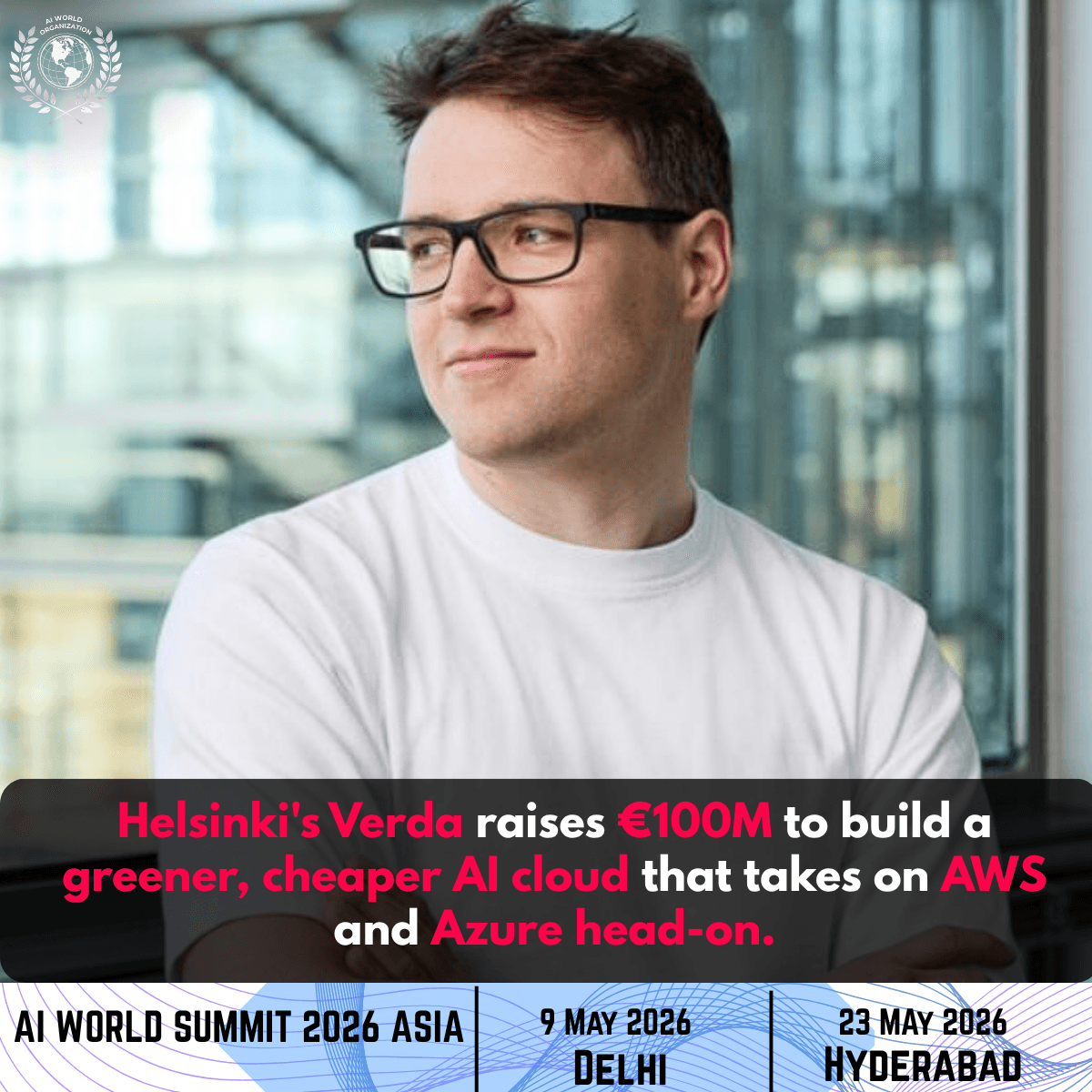
Helsinki's Verda secures €100M in fresh AI funding news, plans 100+ new hires and global expansion across the UK, US, and Asia in 2026.
TL;DR
Helsinki-based AI cloud company Verda has raised €100 million in fresh AI funding news, combining equity led by Lifeline Ventures and Nordic debt financing. Built on renewable energy and priced up to 90% cheaper than AWS or Azure, the company — formerly DataCrunch now targets the UK, US, and Asia while planning to onboard 100+ new employees before 2026 ends.
Finland's Verda Secures €100 Million in AI Funding to Build Europe's Boldest AI Cloud
A quiet but confident revolution has been brewing out of Helsinki. Verda, the Finnish AI cloud infrastructure company formerly known as DataCrunch, has just closed a funding round worth €100 million — roughly $117 million — marking one of the most significant AI funding news stories to emerge from Northern Europe in 2026. The company is not just stacking capital; it is outlining an ambitious roadmap that includes the hiring of more than 100 new employees by the end of this year, alongside aggressive expansions into the United Kingdom, the United States, and Asia. For anyone tracking AI funding trends closely, this is a development that deserves serious attention.
At The AI World Organisation, we have been closely watching how infrastructure-level investments are reshaping the global AI economy. Verda's latest funding round is a clear signal that Europe is no longer content with simply consuming AI tools built elsewhere — it is actively building the foundational layer upon which the next generation of AI applications will run. This round places Verda firmly in the conversation alongside some of the most well-capitalised cloud companies in the world, and the story behind it is one that blends entrepreneurial ambition, sustainable technology, and strategic vision in equal measure.
From DataCrunch to Verda: A Company That Has Been Growing Fast
To understand what this moment means, it helps to trace the journey that brought Verda to this point. The company was founded in 2020 by Ruben Bryon, a Belgian entrepreneur who recognised that AI developers were being chronically underserved by traditional cloud providers. The friction involved in procuring high-performance compute, the unpredictable costs, and the lack of developer-friendly tooling made it unnecessarily difficult for AI teams to get their work done. DataCrunch was his answer to that problem — a cloud platform built specifically for machine learning workloads, offering GPU instances at competitive prices with far less bureaucratic resistance than the hyperscalers.
The company spent its early years proving the model, raising a €12 million seed round in 2024 and then scaling significantly with a €55 million Series A in September 2025. That Series A was led by byFounders, Skaala, the Varma pension fund, and Tesi, reflecting growing institutional confidence in what the team was building. It was also around that time that the company made a notable branding decision: in November 2025, DataCrunch became Verda. The new name was not arbitrary. According to the company, "Verda" draws from the Spanish word for "true" and the Esperanto word for "green," a deliberate combination that anchors the company's identity in two core values — technological integrity and sustainable innovation. That rebranding now looks prescient, given the scale of the AI funding news surrounding its latest round.
The growth numbers support the narrative. By the first quarter of 2026, Verda reported that its annualised revenue had doubled to over €51.3 million — a remarkable trajectory that signals genuine market demand, not just investor enthusiasm. The company also noted that it is already operating with positive cash flow, which is far from a given for a startup at this stage of expansion. That financial discipline, combined with explosive top-line growth, is precisely the profile that serious investors look for in a company worth backing at scale.
What This €100 Million AI Funding Round Actually Looks Like
The structure of this funding round is worth unpacking because it tells you something important about how Verda has built its credibility. The round is a combination of equity and debt, which is a financing model increasingly favoured by capital-efficient tech companies. On the equity side, the round is led by Lifeline Ventures, one of the most respected early-stage investors in the Nordic startup ecosystem. Joining them are byFounders, Tesi, Varma, and a selection of other investors — several of whom participated in earlier rounds, which indicates continued conviction rather than opportunistic capital.
The debt component comes from a consortium of Nordic financial institutions, a detail that reflects Verda's standing as a credible, revenue-generating business rather than a speculative bet. Lenders at this level do not extend capital to companies that cannot demonstrate operational stability. Taken together, the equity and debt elements of this round give Verda not just capital, but a diversified financial structure that supports long-term planning. For those following AI funding news in Europe, this kind of structured round represents a maturation of the ecosystem — a move away from purely venture-backed bets toward more sustainable, blended financing.
Ruben Bryon, founder and CEO of Verda, did not mince words about what this capital means for the company's direction. "We're building the next generation of AI cloud infrastructure for pioneering teams across the globe. This funding allows us to double down on development and accelerate our expansion across Europe, the US and Asia. We're seeing very strong momentum and we're excited for what's ahead," he said. That statement reflects a company that is not merely growing — it is consciously choosing to become a global force in AI infrastructure at a time when demand for specialised compute has never been higher.
The Case for Verda Over Traditional Hyperscalers
One of the most striking aspects of Verda's positioning is how directly it takes on the established giants. AWS, Microsoft Azure, and Google Cloud have collectively defined what enterprise cloud computing looks like for the better part of two decades. They are deeply entrenched, broadly adopted, and trusted by organisations at every scale. And yet Verda is not shy about framing itself as the better alternative for AI workloads specifically — and the argument it makes is grounded in practical realities that many developers will recognise immediately.
The company claims that customers can save up to 90 percent compared to hyperscalers. That is a headline figure, but it points to a structural issue that many AI teams face: the major cloud providers were not originally designed with AI-first workloads in mind. Their pricing models, procurement processes, and infrastructure choices reflect a general-purpose compute paradigm that pre-dates the current wave of machine learning development. Verda, by contrast, has been built from the ground up to serve AI teams — with high availability of AI-optimised systems such as NVIDIA HGX servers, no sales delays, and a developer-first experience accessible through a cloud dashboard and APIs.
Verda's status as one of a select group of NVIDIA Preferred Partners globally gives it a meaningful hardware advantage that most emerging cloud providers simply cannot claim. This kind of relationship with NVIDIA — the company whose GPUs have become the indispensable substrate of modern AI development — signals that Verda is not just reselling compute; it is genuinely embedded in the supply chain at a level that supports serious, large-scale AI operations. Its client list reinforces this point. Nokia, 1X, ExpressVPN, and Freepik are not experimental early adopters — they are established companies making deliberate decisions about where to run their AI workloads.
What also distinguishes Verda from many of its competitors is its vertical integration. Bryon has been explicit about this: "A big part of our success comes from being vertically integrated, handling everything from physical infrastructure to the application layer. We have a dedicated AI Lab team that works directly with customers and uses those insights to drive our product decisions." That feedback loop between customer needs and product development is something that large cloud providers structurally struggle to replicate at the speed the market demands. For AI teams that need to move fast, this is a meaningful differentiator.
Sustainability, Nordic Advantages, and a Vision for Europe's AI Future
There is another dimension to Verda's story that deserves explicit recognition, especially as the environmental cost of AI compute becomes an increasingly pressing topic of conversation in both the tech industry and the broader public discourse. Verda's data centres in Finland run entirely on renewable energy. This is not a marketing gesture — it is a structural advantage born from Finland's geography and energy infrastructure. The Nordics offer some of the most competitive electricity prices in the world, combined with naturally cold climates that dramatically reduce the cost and complexity of cooling high-density computing facilities.
This sustainable infrastructure model positions Verda well ahead of the curve. As organisations face growing pressure — from regulators, investors, and their own stakeholders — to account for the carbon footprint of their technology choices, the ability to offer production-grade AI compute powered by clean energy becomes a genuine competitive differentiator, not just a nice-to-have. Verda is not simply meeting a standard here; it is building a model that could define what responsible AI infrastructure looks like for the next decade.
The AI World Organisation has consistently highlighted the importance of sustainable AI development as a core pillar of responsible innovation. Verda's approach — pairing high-performance compute with clean energy and vertically integrated operations — is exactly the kind of model that reflects what the future of AI infrastructure should aspire to. The company's ambition to become the first hyperscaler from the Nordics is not just a business goal; it is an argument about where the centre of gravity for European AI infrastructure should sit.
Expansion Plans, Hiring Goals, and What Comes Next
With €100 million now in hand, Verda is entering a decisively different phase of its development. The company has outlined a clear set of priorities for the year ahead, and each of them reflects a deliberate strategy rather than opportunistic spending. The plan to hire more than 100 people by the end of 2026 is significant not just in terms of scale, but in terms of what it signals about where the company is heading. A hiring drive of this magnitude, executed at speed, typically points to a company that has strong product-market fit and is racing to build the team capacity needed to serve a rapidly growing customer base.
The geographic expansion into the UK and the United States is equally telling. These are the two largest markets for AI infrastructure spend outside of Asia, and Verda's decision to enter both simultaneously reflects confidence in its competitive positioning. The US market in particular is dominated by the hyperscalers, but there is a growing cohort of AI companies — particularly startups and mid-size firms running intensive workloads — that are actively looking for alternatives that offer better economics and more responsive support. Verda, with its developer-first approach and proven cost advantages, is well-placed to capture a meaningful slice of that demand.
Asia represents a longer-term growth opportunity but a strategically important one. The region's AI investment is accelerating rapidly, and early mover advantage in establishing data centre presence and enterprise relationships there could prove highly valuable over a multi-year horizon. Verda's decision to include Asia in its expansion roadmap — even as it simultaneously targets the UK and the US — speaks to the ambition of a company that is thinking in terms of global infrastructure, not just regional scale.
This is the kind of AI funding news that matters not just for the company itself, but for the broader shape of the European tech ecosystem. Verda's trajectory — from a seed-stage startup in 2024 to a globally expanding AI cloud provider with over €50 million in annualised revenue just two years later — is a proof point that European companies can compete at the highest level in AI infrastructure. At The AI World Organisation, we will be watching closely as Verda moves into its next chapter, because the choices this company makes in the months ahead will have genuine implications for how AI compute is provisioned, priced, and powered across the world.