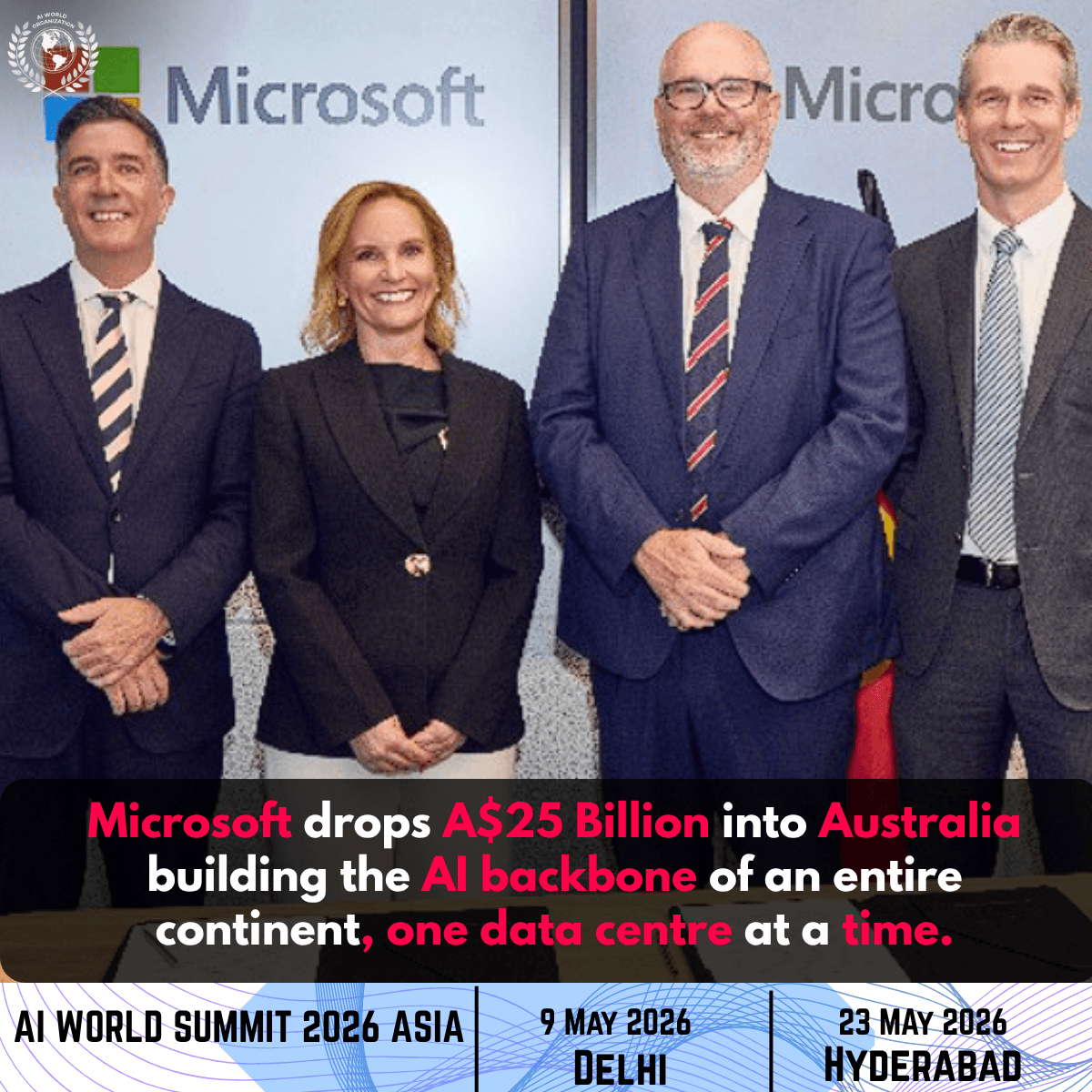
Microsoft Invests A$25B in Australia AI Infrastructure
Microsoft commits A$25 billion to expand Azure AI infrastructure, cybersecurity, and AI skills across Australia by 2029. Biggest-ever tech investment in the country.
TL;DR
Microsoft is pouring A$25 billion into Australia between now and 2029 — expanding its Azure data centres, strengthening national cybersecurity through its partnership with the Australian Signals Directorate, and committing to train three million Australians in AI skills. It is the biggest single technology investment Australia has ever seen, and it firmly positions the country as Microsoft's primary hub for cloud and AI growth across the Asia-Pacific region.
Microsoft Commits A$25 Billion to Australia's AI Infrastructure, Setting the Stage for Asia-Pacific Dominance
Microsoft has just made one of the most consequential bets in its global expansion playbook — and Australia is at the center of it. In a landmark announcement made alongside Australian Prime Minister Anthony Albanese, Microsoft Chairman and CEO Satya Nadella revealed that the company will invest A$25 billion (approximately USD 18 billion) into Australia's digital infrastructure, cybersecurity capabilities, and AI workforce development by the end of 2029. This is not merely a financial pledge — it is a calculated strategic repositioning that signals how seriously the world's largest technology companies are now treating the Asia-Pacific region as a frontline battleground in the global AI race. For anyone tracking AI funding news, this announcement is one of the most significant moves of 2026 so far.
The investment comes at a time when AI infrastructure is being treated with the same urgency as traditional national assets like ports, power grids, and transportation networks. Governments and enterprises alike are beginning to understand that access to high-quality, low-latency, and sovereign AI computing capacity is not a luxury — it is a competitive necessity. Microsoft's decision to plant its biggest flag yet in Australia reflects a deep understanding of where enterprise AI demand is heading and who is best positioned to meet it.
Why Australia? The Strategic Logic Behind the AI Funding Decision
To understand this investment, you need to look at Australia not just as a geography but as an opportunity gap. The country's enterprise AI market is projected to grow from $643 million in 2024 to $4.1 billion by 2030, representing an exceptional 37% compound annual growth rate. Yet for years, Australian businesses and government bodies have had to rely on data centres located in Singapore or on the US West Coast to access enterprise-grade cloud and AI services. That reliance introduces latency issues, data sovereignty concerns, and strategic vulnerabilities that a country as security-conscious as Australia simply cannot afford to ignore long-term.
Australia also brings something that many AI investment destinations cannot easily offer — a trifecta of political stability, a highly skilled English-speaking workforce, and access to abundant renewable energy resources. These three factors matter enormously when you are building AI supercomputing infrastructure that will run 24 hours a day, consume enormous amounts of electricity, and process data that may be subject to strict sovereignty requirements. For Microsoft, the calculus was straightforward: Australia is underserved relative to its potential, it is politically safe, it is energy-rich, and it is already home to a fast-growing appetite for AI-powered enterprise services. The AI funding decision, in that context, is less a gamble and more a calculated land grab before competitors can move in.
It is worth noting that Microsoft is not entering this space fresh. The company had already committed A$5 billion to Australia in October 2023, which helped grow its local data centre presence to 29 sites spread across three Azure regions in Sydney, Melbourne, and Canberra. That earlier investment was proof of concept. This new A$25 billion commitment is Microsoft's signal that the proof of concept worked — and it is now ready to scale aggressively.
Azure Expansion and the Infrastructure Backbone of the Investment
At the heart of this AI funding announcement is a massive infrastructure build-out. Microsoft has confirmed plans to expand its Azure cloud and AI supercomputing capacity across Australia by more than 140% by the end of 2029. This means new data centres, advanced GPU deployments, expanded AI processing infrastructure, and a level of computing density that would fundamentally change what Australian businesses can do locally without routing workloads overseas.
The investment will also advance Azure AI supercomputing capabilities — which refers to the high-performance computing clusters that large language models, generative AI applications, and enterprise AI workloads depend on. For Australian companies working in sectors like financial services, healthcare, mining technology, government services, and education, having access to this infrastructure locally means faster processing, better compliance with data residency laws, and reduced exposure to geopolitical risks that come with routing sensitive data through foreign jurisdictions.
This infrastructure buildout is being aligned explicitly with the Australian Government's formal expectations for data centres and AI infrastructure developers. Microsoft has committed to meeting these regulatory requirements, which signals a level of institutional cooperation that goes well beyond what a typical commercial cloud expansion would involve. The company is not just building servers in Australia — it is building a sovereign AI backbone that the Australian government has helped design and will rely upon. For the AI funding news landscape, this public-private partnership model could become a template that other nations and cloud providers follow in the years ahead.
Fortifying National Cybersecurity Through the Microsoft-ASD Cyber-Shield
One of the most distinctive elements of this AI funding package is its integration with Australia's national cybersecurity infrastructure. Microsoft has committed to expanding the Microsoft-ASD Cyber-Shield — a joint program developed in partnership with the Australian Signals Directorate — to cover additional government agencies and critical infrastructure operators. This is not a peripheral add-on to the investment. It is a core pillar of what makes this deal different from a standard cloud infrastructure announcement.
To understand the significance of the Cyber-Shield expansion, consider what it has already accomplished. The program has so far protected more than 38,000 government accounts and, crucially, identified 35 previously unknown cybersecurity vulnerabilities in Australian government systems. In an era where state-sponsored cyber threats are growing more sophisticated and AI tools are being weaponized for offensive cyber operations, a government that has 35 previously undetected vulnerabilities patched is a government that is meaningfully safer than it was before. Expanding this program to more agencies multiplies that protective effect across the entire public sector.
Microsoft will also deepen its collaboration with Australia's Department of Home Affairs on national resilience priorities. The company will work alongside the newly established Australian AI Safety Institute to ensure that AI deployment across the country advances in a manner that is safe, transparent, and aligned with national interests. This combination — infrastructure investment paired with cybersecurity reinforcement and AI safety governance — is what separates Microsoft's Australian strategy from a straightforward commercial expansion. It is a comprehensive national capability play, and it positions Microsoft as a long-term partner in Australia's sovereign digital future rather than simply a vendor.
Skilling Three Million Australians: The Human Side of This AI Funding Story
Perhaps the most ambitious component of this investment — and the one with the broadest long-term implications — is Microsoft's commitment to equip three million Australians with workforce-ready AI skills by 2028. This builds directly on an earlier pledge the company made to skill one million Australians and New Zealanders by 2025 — a target that Microsoft reportedly hit ahead of schedule, demonstrating that these are not empty commitments dressed up for a press release.
The skilling initiative is structured around three distinct target groups. The first is the future workforce — students in schools who will grow up in an AI-first economy and need foundational literacy in how these technologies work and how to use them safely and productively. As part of this effort, Microsoft plans to launch an AI-powered career coaching tool in up to 1,000 Australian schools, giving young people personalised guidance on career pathways that will remain relevant in an automated economy. The second group is the current workforce — professionals across every sector who need to become what Microsoft calls "frontier workers," people who combine deep domain expertise with AI fluency to drive real productivity gains in their industries.
The third group is the broader community, including people who may lack access to traditional educational channels and require culturally grounded, accessible learning experiences delivered through trusted local partners. This inclusive approach is significant because it acknowledges that the benefits of AI will not automatically distribute themselves equitably. Deliberate investment in community-level skilling is necessary to ensure that the economic gains from AI infrastructure do not simply flow to those who are already well-positioned to capture them. From an AI funding news perspective, the fact that a company of Microsoft's scale is treating human capital development as a core investment pillar — not an afterthought — represents a meaningful evolution in how technology giants approach national partnerships.
The Competitive Battlefield: Microsoft vs. AWS and Google Cloud in Asia-Pacific
No discussion of Microsoft's A$25 billion Australian commitment would be complete without acknowledging the competitive context in which it is being made. Microsoft is not operating in a vacuum. Both Amazon Web Services and Google Cloud are actively expanding their infrastructure footprints across the Asia-Pacific region, and Australia is squarely on their radar as a high-value market. The race to lead AI infrastructure in this part of the world is intensifying, and every major announcement from one player accelerates the urgency for others to respond.
Microsoft's strategic edge in this competition lies in the breadth of what it is offering. While AWS and Google Cloud are formidable commercial cloud providers, Microsoft's Australian package combines infrastructure, government cybersecurity partnerships, AI safety collaboration, and a massive workforce skilling program into a single integrated offering. That combination is harder to replicate quickly and creates multiple layers of institutional lock-in that go well beyond typical cloud service contracts. When a government agency's cybersecurity posture depends on a vendor, when its workforce training programs are delivered through that same vendor's platforms, and when its national AI infrastructure runs on that vendor's cloud, switching costs become existential rather than merely inconvenient.
This is the moat Microsoft is building in Australia — and it is a model that, if successful, the company is likely to replicate in other strategically important markets across Southeast Asia, the Middle East, and beyond. For those watching AI funding news globally, Australia is shaping up to be the blueprint for how large-scale sovereign AI infrastructure deals get structured in the post-2025 world. The stakes extend well beyond one country. They point to a new era in which AI infrastructure investment and national strategic interests are permanently, inseparably intertwined.


