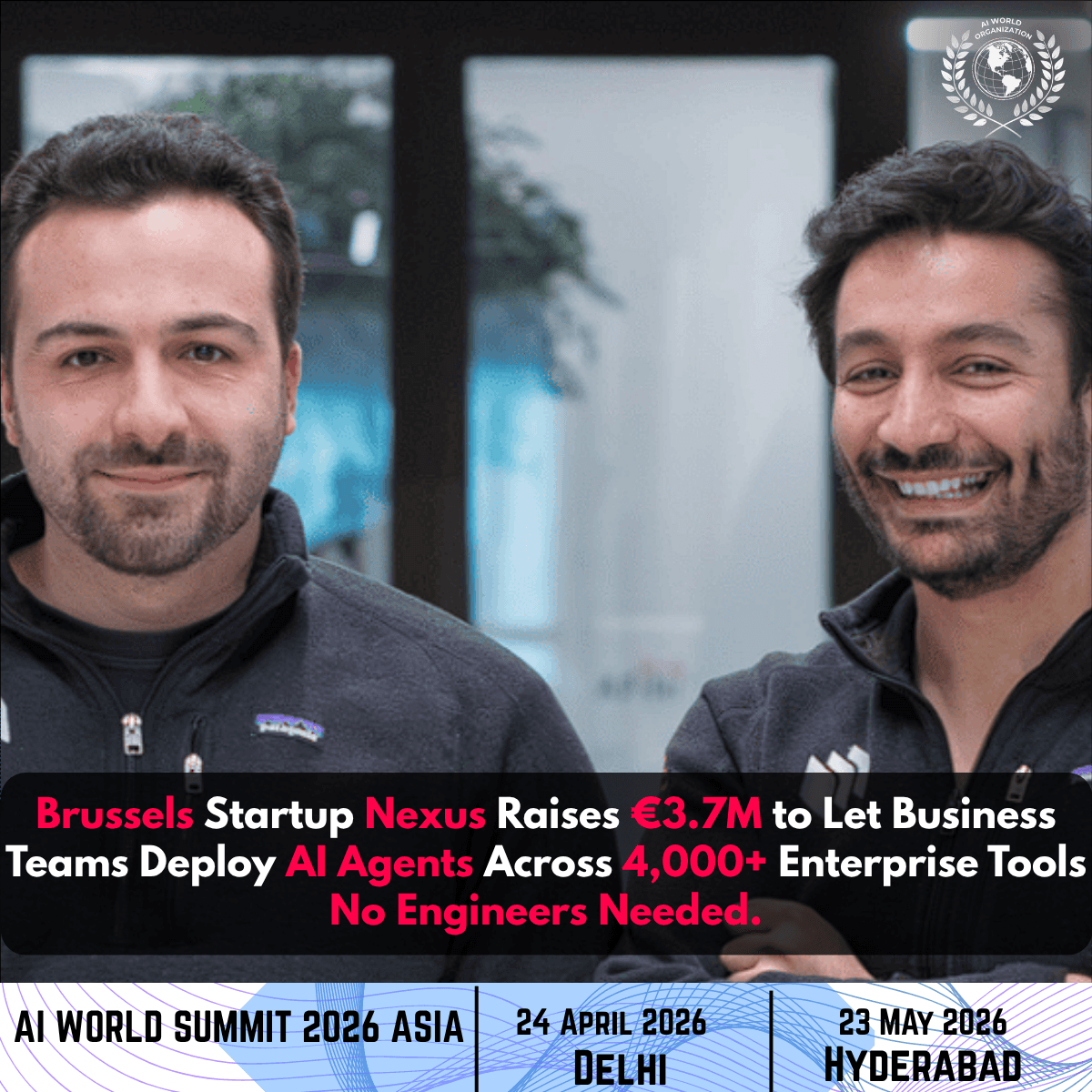
Nexus Raises €3.7M to Deploy Enterprise AI Agents
Brussels-based Nexus secures €3.7M seed funding led by General Catalyst to help enterprises deploy autonomous AI agents across 4,000+ systems in weeks.
TL;DR
Brussels-based startup Nexus has raised €3.7 million in seed funding, backed by General Catalyst and Y Combinator, to help enterprise business teams deploy autonomous AI agents without needing engineers. Already live at companies like Orange, where it boosted conversions by 50%, Nexus connects with 4,000+ business tools and gets teams up and running within weeks.
Brussels-Based Nexus Secures €3.7 Million in Seed Funding to Deploy AI Agents Across Core Enterprise Operations
In one of the most closely watched pieces of AI funding news to emerge from Europe this spring, Brussels-based startup Nexus has announced the successful closure of a €3.7 million (approximately $4.3 million) Seed funding round. The capital injection is set to accelerate the company's mission of making autonomous AI agents accessible to enterprise business teams — not just developers or data scientists — enabling organizations to move well beyond AI experimentation and into measurable, revenue-generating deployments. This announcement has quickly captured the attention of the global tech community, as it signals a maturing shift in how European startups are approaching enterprise artificial intelligence, with a clear focus on real-world impact over theoretical potential.
The round was led by General Catalyst, one of the most prominent venture capital firms in the global technology ecosystem, and saw participation from Y Combinator, Transpose Platform, Twenty Two Ventures, Phosphor Capital, and a notable roster of angel investors including Gokul Rajaram, Raphael Schaad, and Jake Mintz. The breadth and quality of investors backing this round reflects growing confidence — not just in Nexus as a company, but in the broader agentic AI deployment category as an emerging pillar of enterprise technology strategy. For those tracking AI funding trends across both the US and European markets, this deal represents a meaningful validation of the thesis that the next frontier of enterprise software lies in autonomous, workflow-integrated AI agents.
The Problem Nexus Was Built to Solve
Despite the enormous buzz surrounding artificial intelligence in corporate environments over the past few years, a frustrating reality has persisted for most enterprise teams: the gap between identifying a promising AI use case and actually having a working, production-ready deployment remains dauntingly wide. For most non-technical business teams — in sales, marketing, operations, customer success — the path to deploying an AI-powered workflow has historically run straight through a months-long engineering backlog. By the time a solution is finally live, business conditions may have changed, or the initial enthusiasm has long faded.
This is precisely the gap that Nexus was designed to bridge. Founded in 2024 by Assem Chammah, a former McKinsey consultant and aerospace engineer who serves as CEO, and Shady Al Shoha, an AI engineer with deep expertise in enterprise systems, the company was built around a deceptively simple but powerful idea: business teams should be able to describe a workflow in plain language and have an AI agent deployed across their existing systems within weeks, not months. Chammah has been vocal about the direction the market needs to go, stating: "Enterprises don't need another AI assistant, they need an AI agent that completes work reliably and delivers measurable results from the start."
This product philosophy has clearly resonated with both enterprise customers and top-tier investors. The company's rise through Y Combinator's F25 batch cemented its standing in the global startup ecosystem and gave it the network and credibility necessary to attract the caliber of investors it has now secured. As AI funding news continues to dominate technology headlines in 2026, Nexus stands out as a particularly grounded story — one rooted not just in lofty ambitions, but in production deployments already delivering quantifiable business results.
What the Nexus Platform Actually Does
At its core, Nexus is an enterprise-grade agentic AI platform that enables organizations of all types to design, deploy, and manage autonomous AI agents capable of executing complete business workflows end-to-end. What makes Nexus distinctive in an increasingly crowded landscape of AI tooling is its deliberate focus on non-technical accessibility, governance-first architecture, and deep enterprise integration.
The platform currently connects with more than 4,000 enterprise systems, spanning CRM tools, ERP platforms, communication systems like Slack and Microsoft Teams, and dozens of other core business applications. This integration breadth means that when a business team deploys an agent through Nexus, that agent doesn't operate in isolation — it works inside the same digital infrastructure the organization already relies on, pulling data, triggering actions, updating records, and communicating results in real time. The result is an AI agent that functions as a genuine, autonomous team member rather than a disconnected experiment.
Crucially, the platform is built with governance and compliance embedded at its foundation. Enterprise organizations — particularly those in regulated industries like telecommunications, automotive, and financial services — cannot afford to deploy AI systems that operate as black boxes. Nexus addresses this head-on by providing the oversight layers, audit trails, and compliance controls that enterprise risk and legal teams require. This combination of ease of use for business teams and guardrails for compliance teams is, in many ways, the key differentiator that separates Nexus from the many simpler AI automation tools flooding the market.
The company's "white-glove implementation" model is another defining feature. Rather than simply handing customers a software platform and leaving them to figure it out, Nexus works alongside enterprise teams from day one — co-designing agent workflows, configuring integrations, and measuring outcomes in the early weeks of deployment. This hands-on approach dramatically shortens the time to value and ensures that the agents deployed through its platform are producing real, measurable business results rather than sitting dormant after an initial demo.
Real-World Results: Orange, Lambda.ai, and Proximus Global
Perhaps the most compelling evidence that Nexus is onto something genuinely significant lies not in its fundraising milestone but in the results its enterprise customers are already reporting. In the current climate of AI funding announcements where many startups still lack production deployments, Nexus's ability to point to concrete, publicly disclosed outcomes is a meaningful differentiator.
Orange, one of the world's largest telecommunications operators, is among the most high-profile early customers. The company deployed a customer onboarding agent through the Nexus platform in just four weeks — a timeframe that would have been considered impossibly fast for most traditional enterprise software rollouts. The results were striking: Orange reported a 50% increase in conversion rates from this single agent and is now generating more than $6 million in annual lifetime value attributable directly to that deployment. For an enterprise the size of Orange, a four-week deployment timeline producing seven-figure annual value from a single AI agent is not just a success story — it's a proof point that fundamentally changes the way the company can think about scaling AI across its global operations.
Lambda.ai, a leading AI infrastructure company, represents another strong validation. Lambda uses Nexus to deploy agents across its sales and marketing functions, and the company reports that a single agent is saving hundreds to thousands of cumulative hours of work. In an organization where engineering and technical talent is among the most expensive and valuable resources, the ability to redirect those hours toward higher-order work represents a meaningful competitive advantage. Proximus Global, another enterprise customer with deep roots in the European telecommunications space, further underscores that Nexus is not a single-customer story but a repeatable, scalable solution across verticals.
These deployments collectively illustrate what the Nexus team has been arguing since the company's founding: the ROI on enterprise AI agents is real, it is measurable, and it is achievable on a timeline that makes business sense. As the broader AI funding news landscape continues to feature stories of large funding rounds attached to vague promises of future capability, Nexus offers something increasingly rare — verifiable outcomes already in production.
How the Seed Funding Will Be Deployed
With €3.7 million now secured, Nexus has outlined a clear and focused strategy for how it plans to put this capital to work. The primary areas of investment will span product development, go-to-market expansion, and scaling the implementation team that has been central to the company's white-glove delivery model.
On the product side, the funding will allow Nexus to deepen its platform capabilities, expand its library of integrations beyond the current 4,000+ enterprise systems, and invest in the underlying infrastructure needed to support the complex, multi-step workflows that larger enterprise deployments will require. As enterprises begin to operate not just one or two AI agents but potentially dozens across different business functions, the demands on agent orchestration, coordination, and monitoring grow exponentially. Nexus's engineering roadmap will need to stay well ahead of these demands to retain its position as the deployment layer of choice for enterprise customers.
The go-to-market expansion effort is equally important. Nexus currently operates from Brussels and San Francisco, and the new funding will support a broader push into new geographies and industry verticals. The company has already demonstrated strong traction in telecommunications, but the platform's architecture makes it well-suited for deployment across automotive, consulting, retail, and financial services — all sectors where workflow automation at scale represents a significant value opportunity. Expanding the sales and partnerships teams in both Europe and North America will be a key priority for the months ahead.
Growing the implementation team is perhaps the most strategically important use of the new capital. The white-glove implementation model that has driven Nexus's early customer success is inherently people-intensive, and scaling it without compromising the quality that has made it so effective requires deliberate investment in talent. The company will need to hire specialists who can work deeply with enterprise clients, understand their workflows, and translate business requirements into well-governed, production-ready AI agent deployments.
Nexus and the Broader Agentic AI Market in 2026
The timing of this AI funding round is notable. The agentic AI deployment space has become one of the fastest-growing and most competitive segments in enterprise technology. Dozens of platforms now claim to make enterprise AI agents easy to deploy, but the vast majority are still early-stage tools that lack the governance infrastructure, integration breadth, and hands-on implementation support that large enterprises actually require.
What sets Nexus apart in this crowded landscape is the combination of a Y Combinator pedigree, General Catalyst backing, and — most importantly — a track record of production deployments at named enterprise customers delivering documented financial results. In a market where investor enthusiasm for AI often outpaces actual enterprise adoption, Nexus has found a way to close that gap with a model that prioritizes outcomes over promises.
For the European tech ecosystem in particular, this raise is a meaningful signal. Brussels has not historically been synonymous with high-growth AI startups, but Nexus is part of a broader wave of European founders building category-defining AI companies with global ambitions. The company's dual presence in Brussels and San Francisco reflects a deliberately international strategy — rooted in Europe's deep enterprise customer base while leveraging Silicon Valley's capital markets and talent ecosystem.
The AI World Organisation, which closely tracks developments in AI funding news and enterprise AI deployment trends, views this funding round as a strong indicator of where the enterprise AI market is heading. The shift from AI experimentation — isolated pilot projects with limited organizational impact — to AI deployment at scale, embedded in core business operations and tied directly to revenue outcomes, is the defining trend of 2026. Nexus is not just participating in that trend; it is actively accelerating it.
As enterprises globally face increasing pressure to demonstrate returns on their AI investments, the demand for platforms like Nexus — that can take a business team from idea to production AI agent in a matter of weeks, with compliance and governance built in — will only grow. The €3.7 million raised today is, in all likelihood, just the beginning of a much larger growth story for one of Europe's most promising AI startups.