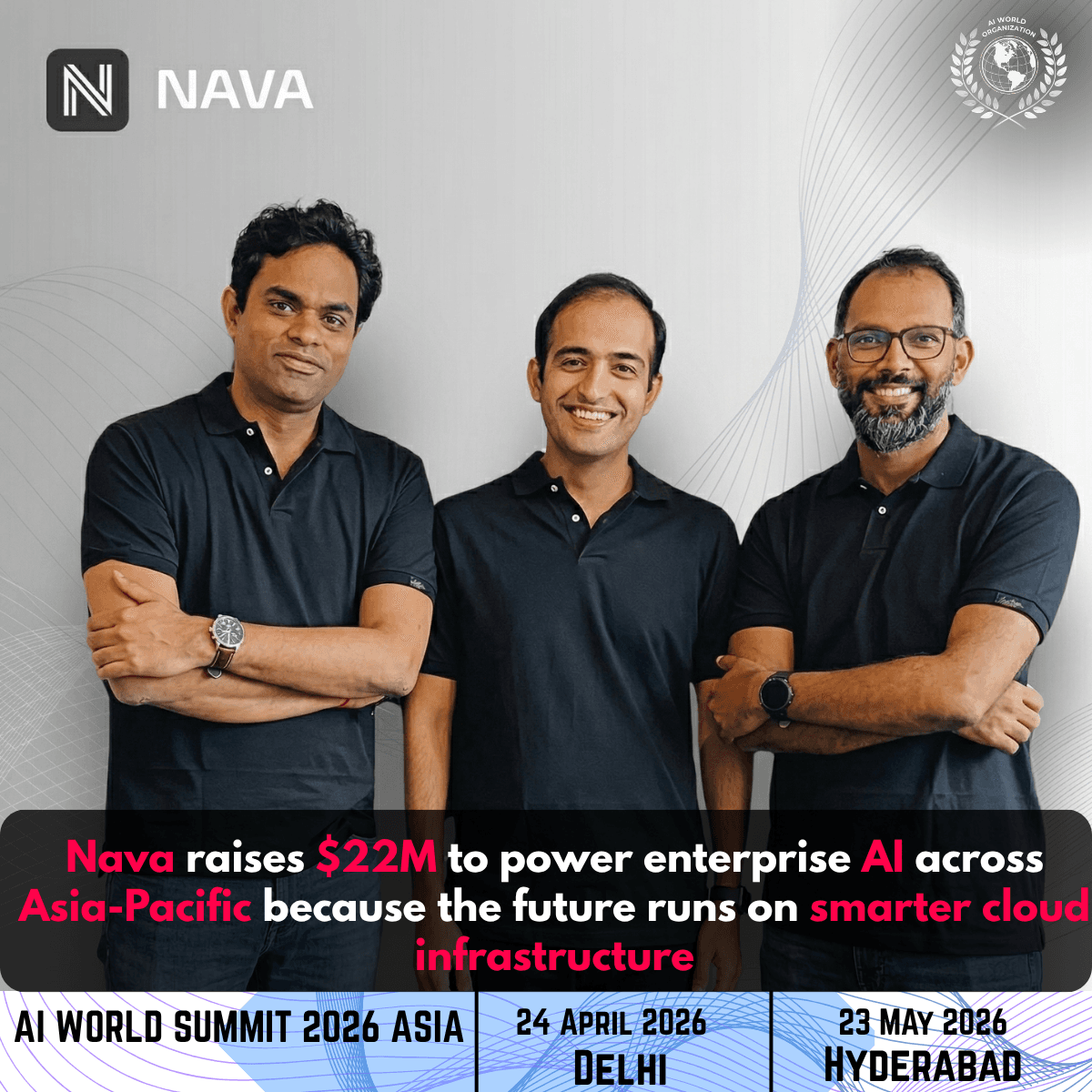
Nava Raises $22M in AI Funding for Cloud Growth
Enterprise AI startup Nava secures $22M led by Greenoaks Capital to build a full-stack AI cloud infrastructure platform across Asia-Pacific.
TL;DR
Nava, formerly known as Kluisz, has raised $22M led by Greenoaks Capital to build an AI-native private cloud platform for enterprises across Asia-Pacific. Founded by ex-OYO COO Abhinav Sinha, the startup helps businesses deploy AI workloads across hybrid, edge, and sovereign cloud setups without the usual infrastructure headaches. Total funding now stands at $31M+.
Nava Secures $22 Million in Fresh AI Funding Led by Greenoaks Capital to Build Full-Stack AI Cloud Infrastructure Across Asia-Pacific
In one of the more significant pieces of AI funding news to emerge from the Asia-Pacific technology ecosystem this week, enterprise AI startup Nava has successfully closed a $22 million funding round led by prominent growth equity firm Greenoaks Capital. The round also saw continued backing from early investor RTP Global, along with participation from Unicorn India Ventures — signalling strong and growing confidence in Nava's infrastructure-first approach to enterprise AI. This latest capital raise brings the company's total funding to over $31 million, following the $9.6 million seed round it had secured in July 2025, and firmly positions Nava as a startup worth watching in the evolving global AI infrastructure landscape.
This development comes at a time when the global conversation around artificial intelligence has moved well beyond the hype of large language models and flashy consumer-facing applications. Enterprises across industries are now asking harder, more practical questions — not just about which AI models to adopt, but about how to reliably deploy, manage, and scale those models within complex, distributed environments. Nava's entire thesis is built around solving exactly that problem, and this infusion of AI funding reflects a broader investor trend of backing the unglamorous but critical infrastructure layer of the AI stack.
From Kluisz to Nava: A Strategic Rebrand with Purpose
Nava was not always called Nava. The company began its journey under the name Kluisz — a brand that had already attracted early-stage investor attention when it raised its $9.6 million seed round from RTP Global back in mid-2025. However, as the company evolved its focus and sharpened its product vision, it made the deliberate decision to rebrand to Nava. The rebrand was announced in tandem with the latest funding round, a move that signals more than just a cosmetic change — it represents a clear pivot in the company's strategic identity.
While Kluisz had been building in the broader AI cloud space, Nava is more explicitly positioning itself as an enterprise-grade, AI-native private cloud provider. The name change reflects a matured vision: one that is no longer just about cloud infrastructure in the general sense, but about becoming the foundational layer for enterprise AI deployment across the Asia-Pacific region. This kind of strategic clarity is often what distinguishes startups that receive meaningful Series A-level AI funding from those that struggle to articulate their differentiation.
The timing of this rebrand is also notable. As enterprise demand for AI-ready infrastructure has surged across markets like India, Singapore, Southeast Asia, and Australia, Nava is clearly looking to present itself as a regional powerhouse — one with the backing, the team, and the technology to meet that demand head-on.
The Founding Team: Operators Who Have Seen Scale
What makes Nava particularly compelling from an investor's standpoint is not just the problem it is solving, but the team behind it. The company was founded in 2024 by three individuals who collectively bring a rare combination of operational excellence, strategic consulting acumen, and deep technical expertise.
Abhinav Sinha, the company's CEO, is perhaps the most recognizable name of the trio. He previously served as the Global COO and CPO of OYO Hotels, one of India's most ambitious and globally scaled technology companies. At OYO, Sinha was instrumental in overseeing the company's rapid expansion across India, Southeast Asia, Europe, and the Americas — giving him an intimate understanding of how large-scale technology platforms operate under pressure. After stepping down from OYO, Sinha identified AI infrastructure as the next frontier worth building toward — and the AI funding news surrounding Nava's growth is a clear validation of that instinct.
Joining him is Vamshidhar Reddy, a former partner at McKinsey & Company, who brings decades of experience in enterprise strategy, digital transformation, and business architecture. Reddy's background makes him well-suited to understand the specific pain points that large organizations face when attempting to integrate AI at scale — and to build a product that speaks directly to those challenges. The third co-founder, Abhijeet Singh, brings hands-on experience from the world of cloud infrastructure, having worked in senior roles at Jio, one of India's largest and most technologically advanced telecom and digital services companies.
Together, this founding team offers exactly what a deep-tech infrastructure startup needs: operational grit, enterprise-level relationships, and technical depth. It is little surprise that they have managed to attract significant AI funding from globally respected investors.
What Nava Is Building: Developer-First AI Cloud for the Enterprise
At its core, Nava is building what it describes as a developer-first, AI-native private cloud platform — a full-stack infrastructure solution that allows enterprises to deploy and manage AI workloads across hybrid, on-premise, edge, and sovereign cloud environments. This might sound highly technical, but the underlying idea is relatively straightforward: businesses deploying AI today face enormous complexity in managing where and how their AI systems actually run. Nava's platform is designed to abstract away that complexity.
The platform achieves this through a combination of smart orchestration, embedded automation, and intelligent policy management. Rather than requiring infrastructure teams to manually configure and monitor AI deployments across multiple environments, Nava allows developers to simply define what they want — whether that's optimizing for performance, keeping costs within a defined budget, or ensuring compliance with data localization regulations. Once those objectives are set, the platform automatically handles the deployment and execution decisions across the full infrastructure stack.
This is a meaningful capability in today's regulatory environment. As governments across Asia-Pacific introduce stricter data residency and sovereignty requirements, enterprises increasingly cannot simply push all their AI workloads onto a US-based public cloud and call it a day. They need infrastructure that can span sovereign cloud environments, on-premise data centers, and edge nodes — all while maintaining consistent security, observability, and governance. Nava's platform is built with precisely this multi-environment complexity in mind.
The platform integrates security and observability directly into its orchestration layer, rather than bolting them on as afterthoughts. This means that every AI workload running on Nava's infrastructure is automatically monitored, governed, and secured, without requiring additional tooling or manual intervention. In an era where AI security and responsible deployment are increasingly under scrutiny, this embedded approach is a genuine differentiator — and an important reason why this round of AI funding is likely to accelerate Nava's product development significantly.
Nava's early focus sectors include banking and financial services, manufacturing, and industries with extensive edge computing use cases — all sectors where data sensitivity, compliance requirements, and the need for low-latency AI processing make a sovereign, multi-environment approach not just desirable but essential.
How the $22 Million Will Be Deployed
The fresh capital from this AI funding round is being allocated with clear strategic intent. The primary use of proceeds is to build out Nava's full-stack AI cloud infrastructure platform, with a specific geographic focus on the Asia-Pacific region. This includes developing GPU compute capabilities and AI data centre infrastructure — two areas that are increasingly critical as enterprises look to run large-scale AI workloads without being entirely dependent on hyperscalers like AWS, Azure, or Google Cloud.
Beyond infrastructure development, the funding will also go toward expanding Nava's presence across key Asia-Pacific markets. Singapore, where Nava is headquartered, serves as a natural launchpad into Southeast Asia — a region where enterprise digitization is accelerating rapidly and where the demand for sovereign, locally operated AI infrastructure is growing. India, where the founding team has deep roots and extensive networks, is another key market. The platform is also expected to expand into markets like Australia, Japan, and South Korea, where enterprise AI adoption is mature but infrastructure fragmentation remains a genuine challenge.
Talent acquisition is also on the agenda. Building the kind of deep-tech platform Nava is pursuing requires significant engineering and product talent, particularly in areas like distributed systems, cloud orchestration, AI operations (AIOps), and enterprise security. A portion of the AI funding will go toward building out these capabilities across Nava's growing team.
The involvement of Unicorn India Ventures, a firm with a strong track record in backing India-origin startups with global ambitions, and the continued participation of RTP Global — which led the seed round — adds an important layer of strategic credibility to this raise. These are not passive financial investors; they bring networks, market access, and portfolio synergies that Nava can leverage as it scales.
Why This Round Matters in the Broader AI Funding Landscape
Nava's $22 million raise is part of a much larger trend that has been reshaping AI funding news globally over the past 12 to 18 months. While early AI investment cycles were dominated by foundation model companies — the OpenAIs, Anthropics, and Mistral AIs of the world — investor attention has increasingly shifted toward the infrastructure and tooling layer. The reasoning is straightforward: every company that deploys an AI model needs infrastructure to run it on, tools to monitor it, and systems to manage it. The infrastructure layer, in other words, has both broader applicability and more defensible moats than the model layer itself.
This shift is especially pronounced in Asia-Pacific, where enterprises have been somewhat slower to adopt AI compared to their North American counterparts, but where the growth trajectory is now sharply upward. Countries like India, Indonesia, Vietnam, and the Philippines are seeing rapid enterprise digitization, and as organizations in these markets move from AI pilots to production deployments, the need for reliable, scalable, and compliant AI infrastructure is becoming urgent.
Greenoaks Capital, the lead investor in this round, is known for backing category-defining technology companies at inflection points — making its decision to lead this AI funding round a meaningful endorsement of Nava's vision and its potential to become a foundational player in the region's AI infrastructure ecosystem. Greenoaks has historically been selective and conviction-driven in its investments, which makes its participation here all the more significant from a signal standpoint.
At The AI World, we see Nava's trajectory as emblematic of a maturing AI ecosystem — one in which the real competitive advantage increasingly belongs not to those who build the most impressive models, but to those who build the infrastructure that makes those models useful, reliable, and commercially viable at enterprise scale. As AI funding news continues to flow into this space, companies like Nava are quietly building the backbone of the next decade of enterprise technology.