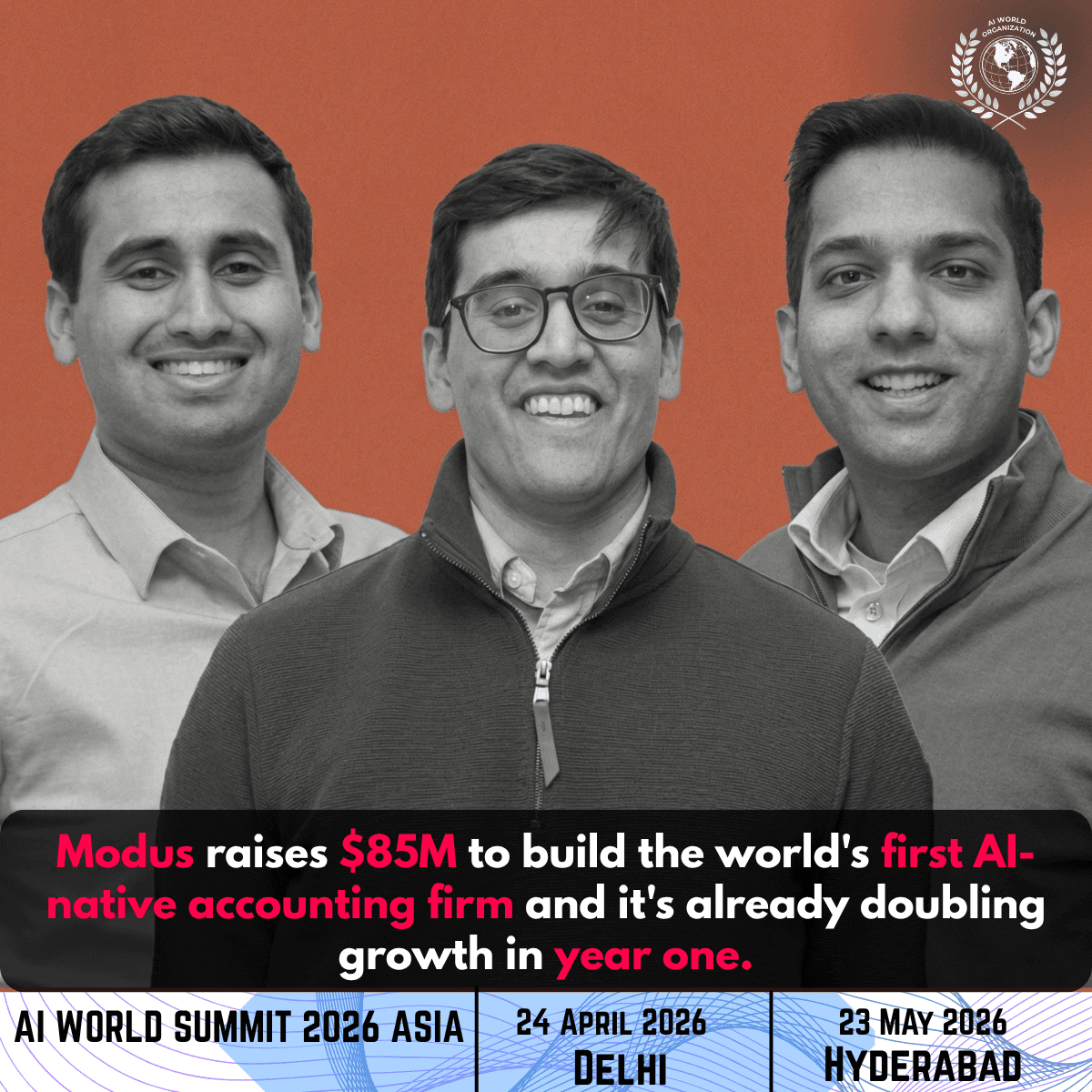
Modus Raises $85M AI Funding to Transform Auditing
Modus secures $85M in AI funding led by Lightspeed to build the world's first AI-native accounting and audit technology platform.
TL;DR
Modus, a startup reimagining how accounting firms operate, has raised $85 million in Seed and Series A funding led by Lightspeed Venture Partners. Founded in 2025, the company blends AI-powered audit tools with a holding company model — directly investing in established accounting firms while modernising their workflows. In under a year, it has already partnered with a top 200 firm crossing $30M in annual revenue, projecting more than double its organic growth rate in 2026.
Modus Secures $85 Million in AI Funding to Revolutionize the Accounting and Audit Industry
The accounting industry has long been one of the most resistant sectors to technological disruption — built on decades of manual workflows, paper-heavy audit trails, and deeply entrenched legacy software. But that status quo is now being challenged head-on. Modus, an AI-native audit technology platform and holding company, has officially announced the closing of $85 million in Seed and Series A funding, led by Lightspeed Venture Partners, with additional participation from Comma Capital and prominent investor Garry Tan. This landmark AI funding news signals a turning point not just for accounting technology, but for how trust and transparency are maintained across the world's capital markets. As covered and tracked by The AI World Organization, this investment reflects the accelerating confidence global venture capital is placing in AI-powered enterprise tools that solve real, structural inefficiencies in professional services.
The announcement positions Modus as one of the most boldly funded early-stage companies operating at the intersection of artificial intelligence and financial compliance. At a time when AI funding news is dominated by general-purpose models and consumer-facing applications, Modus stands apart — it is purpose-built for one of the most regulated and judgment-intensive professions in the world: auditing. The company's vision goes far beyond deploying chatbots or automating data entry. Modus is architecting an entirely new kind of accounting firm, one where artificial intelligence is embedded into the DNA of every audit workflow, from initial risk assessment to final regulatory reporting.
The Vision Behind Modus: Reimagining Audit from the Ground Up
Founded in 2025 by Arush Jain, Pranav Pillai, and Vinay Kasat, Modus was built around a singular conviction — that the audit profession, despite its critical role in sustaining trust in global financial systems, has been fundamentally underserved by technology. The company's founding team brings together rare expertise from some of the most demanding institutions in finance and technology, including Palantir, Citadel, Ramp, Thoma Bravo, Bridgewater, and AWS. This cross-disciplinary background gives Modus a credibility and technical depth that few early-stage ventures in the accounting-tech space can claim.
Arush Jain, Co-Founder and CEO of Modus, captured the urgency behind this AI funding round clearly: "Audits serve as the cornerstone for trust in our capital markets, yet the underlying tools and workflows have not meaningfully changed in decades. This funding allows us to invest aggressively in AI-enabled audit tooling while partnering with exceptional firms that want to lead the profession forward, without sacrificing quality or culture." These words carry significant weight in an industry where missteps can result in regulatory penalties, reputational damage, and catastrophic client losses.
The Modus approach is not about replacing human auditors — it is about elevating them. The company's technology is designed to automate repetitive, time-consuming manual procedures so that accounting professionals can spend more of their cognitive energy on high-stakes, judgment-driven decisions. This is precisely the kind of AI integration that the AI World Organization has consistently highlighted as the most sustainable and enterprise-ready form of AI deployment: not wholesale automation, but intelligent augmentation of skilled human professionals.
What makes Modus particularly distinctive in the current AI funding landscape is its dual-pronged strategy: it operates both as a technology platform developer and as a holding company that makes strategic investments in established accounting firms. Rather than building a technology product and hoping firms will adopt it, Modus is taking a more proactive approach — embedding itself directly into the firms it serves through investment partnerships. This preserves the heritage, people, and client relationships that give these firms their market value while simultaneously modernizing their operational capabilities.
Lightspeed Venture Partners and the Strategic Significance of This Investment
Lightspeed Venture Partners is no stranger to backing transformative AI companies. Managing over $50 billion in assets and active since 2000, the firm has made early bets on some of the most consequential companies in tech history — including Anthropic, Databricks, Glean, Mistral, Snap, Wiz, and Anduril, among others. Their decision to lead this AI funding round for Modus is therefore not incidental — it reflects a calculated thesis about where enterprise AI is heading and which sectors remain ripe for transformation.
Isaac Kim and Amish Desai, Partners at Lightspeed Venture Partners, articulated this perspective clearly: "Public accounting has been historically underserved by technology. Modus intends to drive the industry forward with thoughtful product philosophy and a partnership-first approach that earns the trust of each firm they invest in." Their assessment underscores a broader truth that the AI funding news cycle is increasingly validating — that the next wave of enterprise AI value won't come from general-purpose platforms, but from deeply vertical, domain-specific tools that understand the regulatory, compliance, and operational complexities of individual industries.
Justin Overdorff, another Partner at Lightspeed, added further detail to why this AI funding opportunity stood out: "The Modus team has driven highly effective automation in key audit workflows and meaningfully increased efficiencies for firms performing audits, and we are excited to partner with them in building the world's first AI-native audit technology for accounting firms." The phrase "world's first" is significant here. While AI tools have begun permeating the edges of accounting — automating invoices, reconciliations, and basic bookkeeping — nobody has yet attempted to build an AI-native audit platform from scratch with the institutional depth and investment strategy that Modus is pursuing.
The participation of Garry Tan and Comma Capital alongside Lightspeed also signals strong confidence from the broader startup ecosystem. Tan, widely recognized as one of Silicon Valley's most astute early-stage investors, rarely backs companies without a conviction that the founding team and market timing align exceptionally well. His involvement in this AI funding round adds another layer of credibility to Modus's ambition.
Early Traction: Proof That the Model Is Already Working
One of the most compelling aspects of this AI funding announcement is that Modus has not simply raised capital on the strength of a pitch deck. Since launching in June 2025 — less than a year ago — the company has already demonstrated meaningful, measurable traction in the market. Most notably, Modus has completed an investment in a top 200 accounting platform, as ranked by Inside Public Accounting, which generates over $30 million in annual revenue.
This early investment is already producing results. Through the deployment of Modus's AI platform within this partner firm, the company is projected to more than double its organic growth rate in 2026. That is not a modest improvement — it is a fundamental step change in business performance, driven entirely by the operational efficiencies and audit capabilities that Modus's technology enables. For a firm that had previously grown at a conventional rate typical of the accounting industry, achieving more than double organic growth within months of technology integration is a powerful proof of concept.
Furthermore, Modus reports a meaningful pipeline of additional partner firms that are actively exploring investment and technology partnerships. This pipeline suggests that the market appetite for AI-native audit solutions is far stronger than conventional wisdom about the accounting industry's conservatism might suggest. Firms are not waiting for the technology to mature further — they are eager to move now, particularly as competitive pressure and talent shortages make the status quo increasingly untenable.
This early traction is exactly the kind of AI funding story that The AI World Organization closely monitors and highlights — cases where AI investment is not just theoretical but is already generating compounding returns for the businesses that embrace it. The Modus story is a real-world case study in how strategic AI deployment, backed by serious capital, can transform the growth trajectory of an entire professional services firm within a single operating year.
Advisory Strength and the Institutional Credibility of Modus
Beyond its founding team and investor backing, Modus has assembled an advisory board that brings serious institutional credibility to its mission. Jim Burton, the former Chief Auditor at Grant Thornton — one of the world's largest accounting and advisory networks — serves as a key advisor. His experience navigating the regulatory demands and professional standards of large-scale public accounting makes him uniquely positioned to guide Modus's product development and firm partnership strategy.
Brian Blaha, former Chief Growth Officer of Wipfli, another major player in the accounting and consulting space, brings a commercial lens to Modus's advisory structure. His insights into how accounting firms grow, retain clients, and scale operations will be invaluable as Modus expands its network of partner firms. Additionally, the former CEO of a top 10 accounting firm rounds out the advisory team — providing strategic perspective from the very highest levels of the profession.
This combination of venture backing, founding team depth, and advisory board credibility gives Modus an unusual level of institutional trust for a company that is less than one year old. In a sector where relationships and professional reputation are everything, having former leaders of Grant Thornton, Wipfli, and a top 10 firm lending their names and networks to Modus's vision is a powerful signal to the broader accounting community. It demonstrates that this is not a tech company trying to impose a foreign paradigm on a resistant industry — it is a company that deeply understands the profession and is working from within the system to modernize it responsibly.
What This Means for the Future of AI in Professional Services
The $85 million AI funding round secured by Modus is more than a single company milestone. It is a bellwether moment for the broader trajectory of artificial intelligence in professional services — a category that includes not just accounting and audit, but also legal services, consulting, compliance, and financial advisory. These industries share a common characteristic: they are highly regulated, deeply relationship-driven, and historically slow to adopt technology. And yet, precisely because of these characteristics, they represent some of the highest-value opportunities for AI disruption.
As AI funding news continues to proliferate across sectors, the pattern that is emerging most clearly is that the deepest returns — both financial and operational — come when AI is not simply layered on top of existing processes but is used to fundamentally rethink how work gets done. Modus is betting everything on this philosophy in the accounting industry. The company's mission to build the world's first AI-native accounting firm is not just about improving margins or reducing headcount. It is about reimagining what trust, quality, and accountability look like when powered by artificial intelligence at scale.
For accounting firms that have spent decades watching technology pass them by — or being sold tools that promised transformation but delivered little — Modus represents a genuinely different proposition. It is not a software vendor asking for a subscription fee. It is a strategic partner willing to invest in the firm's future, bringing both capital and cutting-edge AI capabilities in a single relationship. This integrated model is one of the most thoughtful approaches to technology adoption in professional services that the industry has seen, and it is likely to inspire similar models in adjacent sectors.
The AI World Organization will continue to track and report on how Modus deploys this capital, how its partner firm network grows, and how its platform evolves as artificial intelligence itself continues to advance. In a year defined by accelerating AI investment across every corner of the global economy, few AI funding news stories carry the same combination of technological ambition, institutional depth, and clear market need as this one. Modus is building something that the accounting world — and the capital markets that depend on it — has genuinely needed for a very long time.


