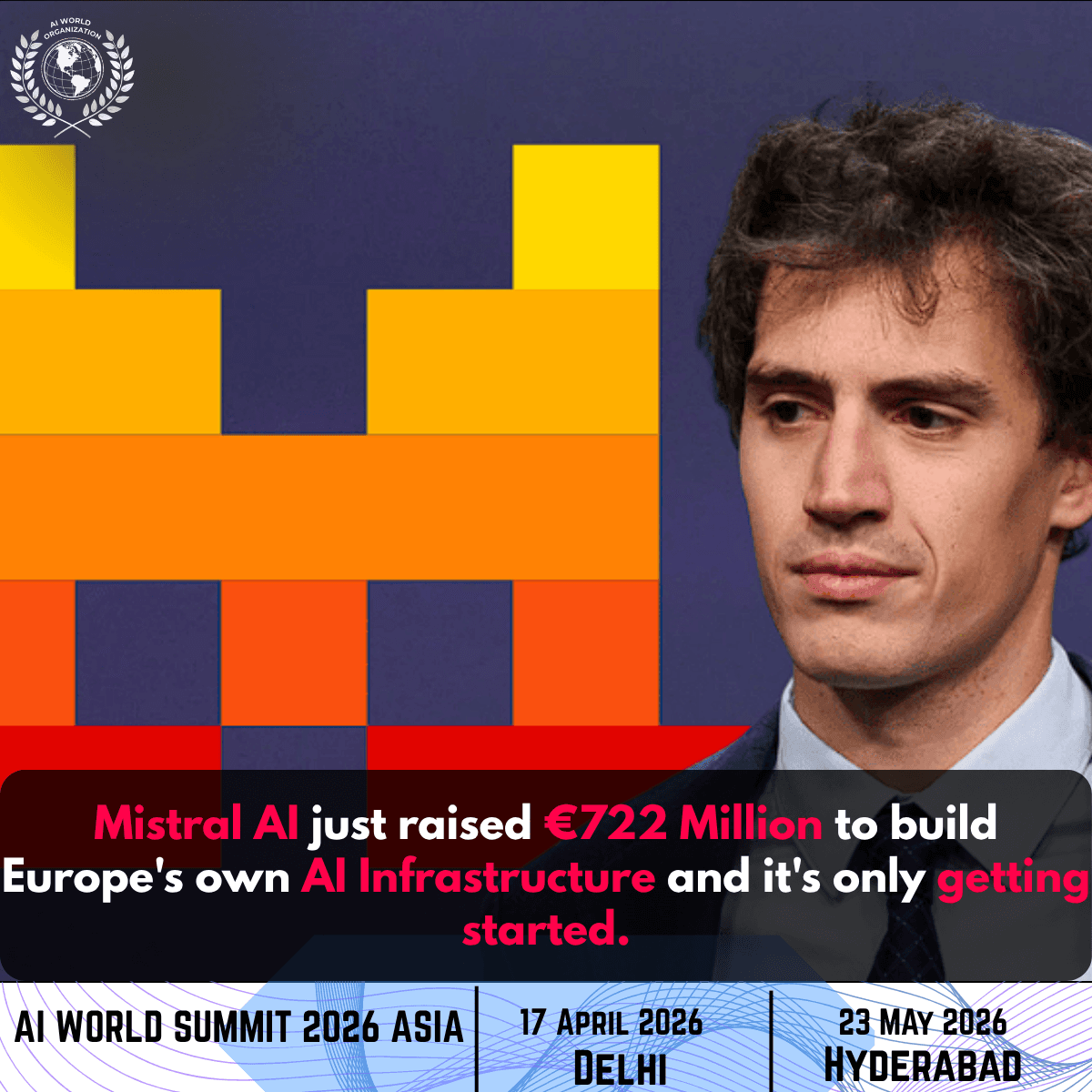
Mistral AI Raises €722M to Build Europe's AI Infrastructure
Mistral AI secures €722M in debt financing to build Nvidia-powered data centres across Europe, targeting 200MW of AI compute capacity by 2027.
TL;DR
Mistral AI has raised €722 million in debt financing: its first ever, to build Nvidia-powered data centres across Europe, starting with a facility near Paris going live by June 2026. Backed by French banks including Bpifrance and BNP Paribas, the company is targeting 200MW of compute capacity by 2027, with projects already underway in France and Sweden.
Mistral AI Secures €722 Million in Debt Financing to Strengthen Europe's AI Infrastructure
Europe's ambition to build a sovereign, self-reliant artificial intelligence ecosystem has taken one of its most definitive leaps forward. Mistral AI, the Paris-based startup that has rapidly grown into the continent's most prominent AI company, has secured $830 million — approximately €722 million — in debt financing, making it the company's first major foray into debt-based capital. This landmark development in AI funding news positions Mistral not just as a model developer, but as a full-stack AI infrastructure provider with ambitions that rival the biggest names in global technology. The announcement has sent ripples across the European startup and investment landscape, signalling a pivotal shift in how the continent approaches the race for artificial intelligence dominance.
Founded in April 2023 by Arthur Mensch, Guillaume Lample, and Timothée Lacroix — all three formerly of leading AI research institutions including DeepMind and Meta — Mistral AI has grown at a pace that few startups anywhere in the world have matched. Within just three years of its founding, the company has secured billions in investment, developed a portfolio of widely respected open-source large language models, and launched "Le Chat," a conversational AI product designed with European users and enterprises in mind. The AI funding round announced this week represents a new chapter altogether, one in which Mistral moves decisively from being a software-first AI company to becoming a builder and operator of heavy physical infrastructure. This transition, backed by real capital and concrete construction plans, is what sets this AI funding news apart from the wave of software-layer investments that have dominated headlines in recent years.
A €4 Billion Infrastructure Vision Taking Physical Shape
At the heart of Mistral's latest AI funding announcement is a bold and detailed infrastructure roadmap that stretches well into the end of this decade. The company has committed to deploying a total of €4 billion toward AI infrastructure development across Europe, with the current $830 million debt package representing the opening phase of that larger programme. The most immediate and concrete milestone within this plan is the development of a flagship data centre at Bruyères-le-Châtel, a site located to the south of Paris that was formally selected in February 2025 as the home of Mistral's first dedicated, proprietary computing facility.
This facility is no small undertaking. It will be equipped with 13,800 of Nvidia's latest GB300 chips — some of the most powerful graphics processing units currently available on the commercial market — and will provide 44 megawatts of computing power once fully operational. To put that in perspective, 44 megawatts represents approximately one and a half times the energy consumption of a traditional data centre, reflecting the sheer intensity of modern AI workloads. According to multiple reports, the facility is expected to become fully operational by the second quarter of 2026, meaning it is on track to come online within months. This is not a distant promise or a planning-stage proposal; it is a construction project at an advanced stage, backed by committed capital and a defined timeline.
The debt financing that is enabling this phase of construction was provided by a consortium of predominantly French financial institutions, including Bpifrance, the French state's public investment bank, alongside BNP Paribas, HSBC, and MUFG. The involvement of Bpifrance is particularly notable, as it signals a degree of state-aligned backing for Mistral's infrastructure vision — one that goes beyond a purely commercial transaction and reflects a broader French and European interest in ensuring that AI sovereignty is more than a political talking point. This AI funding structure also illustrates how the financial world is beginning to treat AI infrastructure investment as an asset class in its own right, comparable to the kind of debt financing traditionally seen in telecommunications or energy infrastructure.
Expanding Beyond France: Sweden and a Pan-European Compute Network
While the Bruyères-le-Châtel facility represents Mistral's first and most immediate infrastructure milestone, the company's ambitions extend far beyond a single data centre outside Paris. In February 2026, just weeks before the current AI funding announcement, Mistral revealed a €1.2 billion data centre investment in Sweden, a project that will deliver 23 megawatts of dedicated AI computing capacity and is expected to become operational sometime in 2027. The Swedish project is significant not just in terms of scale, but also in terms of what it signals about Mistral's geographic strategy. Rather than concentrating infrastructure in one country, the company is building a distributed European network of compute capacity, one designed to serve governments, enterprises, and research institutions across multiple jurisdictions with the speed, compliance, and data sovereignty requirements that pan-European clients increasingly demand.
Arthur Mensch, Mistral's co-founder and chief executive, has spoken candidly about the commercial logic underpinning this expansion. The Swedish facility alone, he has noted, could generate in excess of €2 billion in revenue over a five-year period, a projection that points to genuine and robust demand from customers who are willing to commit early and pay a premium for European-based, sovereign AI infrastructure. This is a crucial dimension of the AI funding story that often gets overlooked. The investment is not speculative; it is demand-driven. Governments that need to process sensitive data within jurisdictional boundaries, enterprises operating under strict compliance regimes, and research institutions that require both performance and data control are all driving a measurable commercial pull that Mistral is positioned to meet in a way that no American hyperscaler currently can.
When taken together, the French and Swedish projects put Mistral on a trajectory to achieve 200 megawatts of total AI compute capacity across Europe by the end of 2027. That figure would place Mistral firmly among Europe's top-tier infrastructure providers, operating at a scale that begins to make it a genuine alternative to the dominant offerings of Microsoft Azure, Amazon Web Services, and Google Cloud for clients who prioritise locality and sovereignty over global reach and brand recognition. This is the strategic bet at the core of the latest AI funding developments surrounding Mistral: that sovereignty is not just a political virtue but a commercial advantage, and that European clients will pay for it.
A Trajectory Built on Record-Breaking Fundraising
To fully appreciate the significance of this latest AI funding milestone, it is worth understanding the remarkable fundraising journey that brought Mistral to this point in just under three years. When the company was founded in 2023, it entered a market already crowded with well-funded AI competitors, most of them American, several of them already worth tens of billions of dollars. Yet Mistral's founders brought with them a rare combination of world-class research credentials and a clear thesis: that Europe needed its own competitive AI stack, one built on open-source principles, developed within European regulatory frameworks, and capable of serving European institutions without forcing them to hand their data to foreign platforms.
That thesis attracted capital quickly. By August 2025, reports indicated that Mistral was seeking a major new funding round at a valuation of approximately $10 billion — a number that reflected how dramatically the company had grown in its first two years. What followed in September 2025 was one of the most closely watched AI funding events in European startup history: a €1.7 billion Series C round, led by ASML, the Dutch semiconductor equipment giant, which valued Mistral at close to €12 billion (approximately $13.8 billion). At the time, it was reported to be among the largest funding rounds ever completed by a European startup, and it positioned Mistral unambiguously as the continent's most valuable AI company.
The total equity raised by Mistral now exceeds $3 billion, and the company is on track to surpass $1 billion in annual recurring revenue by the end of 2026. More than half of that revenue already comes from European clients, which provides a meaningful validation of the sovereign AI thesis that sits at the centre of the company's positioning. This AI funding news story is therefore not simply about one company raising money; it is about a thesis being validated in the market in real time, with paying customers providing the evidence that European AI infrastructure is a product people and organisations are genuinely prepared to invest in.
Mistral's Rise Within a Wider European AI Funding Wave
One of the most important contextual dimensions of this week's AI funding news is the broader ecosystem of capital that is flowing into European AI infrastructure simultaneously. Mistral's €722 million debt package does not exist in isolation; it is part of a substantial and accelerating wave of investment into European compute, cloud, and AI infrastructure that has gathered remarkable momentum over the past eighteen months. Nscale, a UK-based AI data centre company, raised an eye-catching $2 billion in 2026, while DataCrunch in Helsinki secured €55 million to scale its GPU cloud platform and advance its ambition to become a European AI cloud hyperscaler. NexGen Cloud raised €41 million to expand sovereign AI infrastructure capacity across the continent, and PoliCloud in Cannes closed a €7.5 million round to grow its sovereign high-performance computing cloud infrastructure in France — a direct domestic comparison point for Mistral's own home-country investments.
In France specifically, the AI funding landscape has been particularly active. AMI Labs, the new venture associated with Yann LeCun — the French-American AI scientist widely regarded as one of the founding fathers of modern deep learning and formerly Meta's chief AI scientist — raised more than $1 billion in early 2026 for advanced AI research. The fact that one of the world's most celebrated AI researchers chose Paris as the home of his new venture, and attracted over a billion dollars in funding to do so, is a powerful signal of the confidence that serious investors and scientists now place in France's ability to compete at the frontier of artificial intelligence development.
Taken together, the comparable AI funding announcements across Europe in 2025 and 2026 amount to roughly €1.8 billion excluding Mistral's latest debt package, or approximately €2.5 billion including it. This is a substantial and meaningful sum, and it demonstrates clearly that large pools of capital — both private and state-linked — are choosing to flow into Europe's AI infrastructure layer rather than purely into software applications. That strategic orientation matters, because infrastructure is the foundation upon which software runs, and a continent that controls its own infrastructure is a continent that has genuine agency over its own digital future.
At The AI World, we have been closely tracking this evolution in AI funding patterns across regions, and the European momentum in the infrastructure space represents one of the most significant structural shifts in global AI investment we have observed. The continent that was once widely dismissed as a regulatory jurisdiction rather than an innovation hub is now building the physical foundations of an independent AI stack — and doing so with serious capital, credible execution, and a growing roster of enterprise and government clients who are choosing European options for reasons that go well beyond ideology.
What This Means for European AI Sovereignty and the Road Ahead
The broader implications of Mistral's AI funding story extend well beyond the company itself. What is being built at Bruyères-le-Châtel and in Sweden, and what is planned across the rest of the European footprint that Mistral is actively developing, represents something genuinely new in the global AI landscape: a European company that is competing not just in models and software, but in the infrastructure layer that underpins all of modern AI. Until very recently, that infrastructure layer was almost entirely controlled by three American companies — Microsoft, Amazon, and Google — whose cloud platforms have become the default operating environment for AI workloads everywhere in the world, including in Europe.
The argument for change is clear and has been growing louder among European governments, enterprises, and research institutions for several years. Data sovereignty, regulatory compliance, geopolitical risk, and the desire to retain economic value within European borders have all contributed to a growing willingness among European clients to seek out and pay for locally operated AI infrastructure. Mistral's rapid commercial growth — and particularly the fact that more than half of its revenue already originates in Europe — suggests that this willingness is converting into real purchasing decisions at scale.
The road ahead is not without its challenges. Mistral still trails OpenAI and Anthropic in terms of model performance at the frontier, and the infrastructure investments it is now making are large, capital-intensive, and carry real execution risk. Building and operating data centres at the scale of hundreds of megawatts requires not just capital but deep operational expertise, reliable supply chains, and long-term energy agreements — all of which are complex to secure and manage. Some market observers have also raised questions about whether the pace of AI infrastructure construction globally could ultimately result in excess capacity if enterprise demand grows more slowly than current projections suggest.
Yet on balance, the weight of evidence currently favours Mistral's strategic direction. The AI funding environment for infrastructure in Europe is robust and accelerating. Government and enterprise demand for sovereign AI solutions is real and growing. The company has demonstrated exceptional capital efficiency and execution speed since its founding. And the combination of a first-mover position in European AI infrastructure, a strong open-source model portfolio, and a growing enterprise customer base gives Mistral a set of competitive advantages that will be difficult for late entrants to replicate quickly. For those watching AI funding news globally, Mistral's trajectory is one of the most instructive and consequential stories of this moment in technology history — and one that The AI World will continue to follow with close attention.


