Mendo Raises €12M to Fix Enterprise AI Adoption
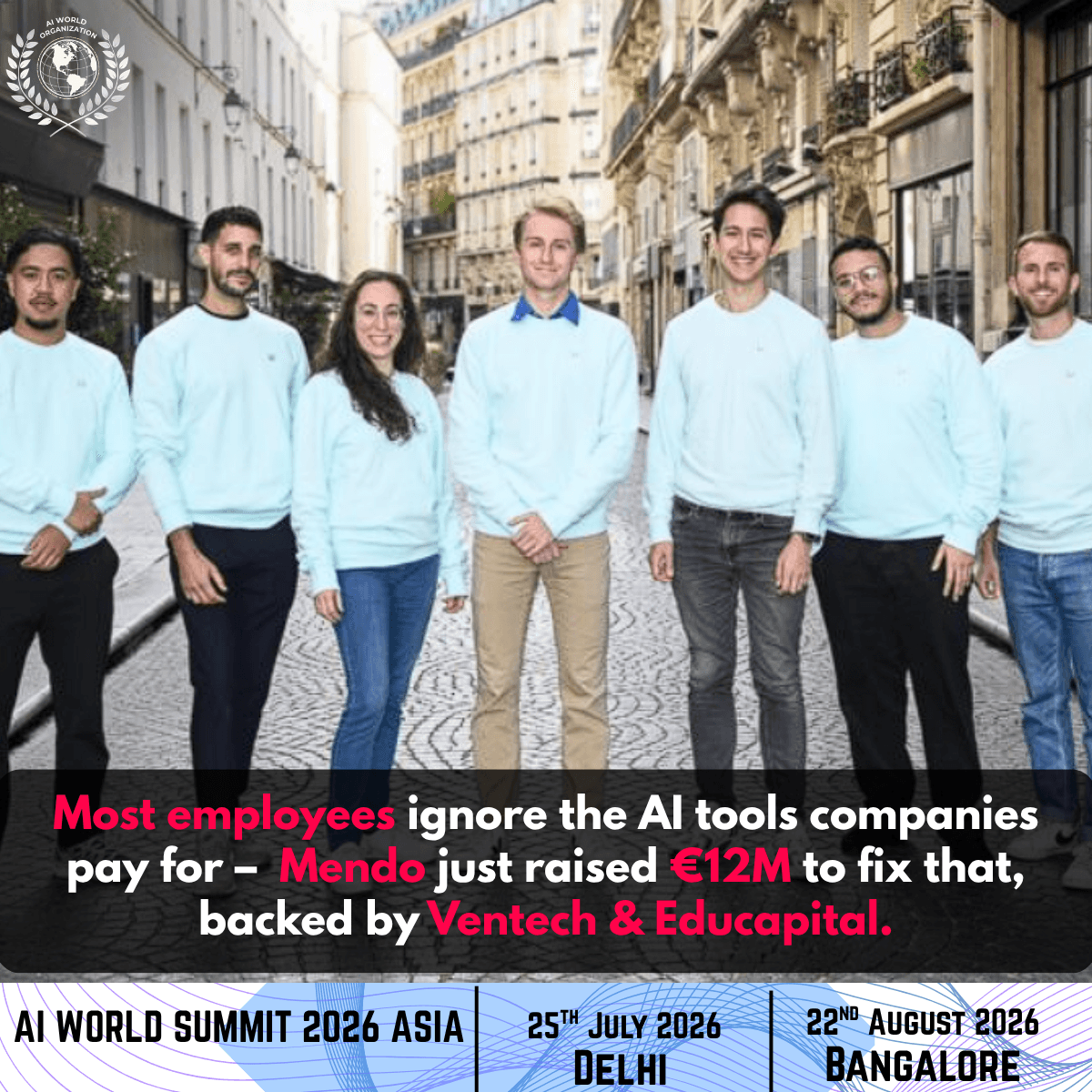
Paris startup Mendo secures €12M Series A led by Ventech and Educapital to help 100K+ employees adopt AI tools like Copilot, ChatGPT, and Gemini.
TL;DR
Paris-based Mendo has closed a €12M Series A led by Ventech and Educapital, bringing total funding to €15.5M. The startup works inside tools like Copilot, ChatGPT, and Gemini, nudging employees to actually use AI properly — a gap most companies struggle with. It already supports 100,000+ employees across 100+ firms, including PwC and Novo Nordisk, and plans to expand into Germany and the Nordics.
Paris AI Startup Mendo Raises €12 Million to Solve the Quiet Crisis Inside Enterprise AI Adoption
A French startup founded by an entrepreneur who spent part of his childhood in Madagascar has just landed a fresh €12 million Series A round, and the story behind it says a lot about where enterprise AI is actually headed in 2026. Mendo, a Paris-based company built around the idea that most employees quietly avoid the very tools their companies pay for, has closed the round with Ventech and Educapital leading the charge, alongside participation from Tomcat and OVNI. Combined with an earlier €3.5 million seed raised in October 2024, the company's total funding now stands at €15.5 million.
On the surface, this might read like just another European AI funding announcement — and there have been plenty of those lately. But dig a little deeper, and Mendo's story touches on something that almost every large organisation is quietly struggling with right now: companies are spending enormous sums on generative AI tools, yet a huge share of employees either don't use them properly or don't use them at all. Mendo's bet is that this gap — between what AI can do and what people actually do with it — is about to become one of the defining business problems of the next few years.
For the team at The AI World, this story sits right at the intersection of two themes we've been tracking closely throughout 2026: the explosive growth of agentic AI inside enterprises, and the growing realisation that technology alone doesn't create value — adoption does. Mendo's raise is a useful case study in how investors are starting to price that realisation into their portfolios.
A Founder Shaped by Growing Up in Madagascar
Every founder has an origin story, but Quentin Amaudry's is a little different from the typical Parisian tech narrative. Amaudry spent part of his upbringing in Madagascar, where he watched people make do with whatever technology they could get their hands on, often stretching tools far beyond their intended use simply because they had no other choice. That early exposure left a lasting impression on him — not about the technology itself, but about the relationship people have with it.
Speaking about that period of his life, Amaudry has said that he saw up close just how powerful technology can be as an equaliser when people actually embrace it. But he also noticed the flip side of that coin: in most professional settings, technology isn't something people love using. More often than not, it's a source of quiet frustration — another system to learn, another login to remember, another tool that promises to make work easier but ends up adding friction instead.
That observation eventually became the founding insight behind Mendo, which Amaudry co-founded in 2021 alongside Alexandre Pinon. The core idea was deceptively simple: instead of building another AI tool and hoping people would figure out how to use it, why not build something that sits inside the tools people already have, quietly helping them get more value out of software that's often underused?
Fast forward to today, and that idea has evolved into a fully-fledged adoption platform that's now being used by over 100,000 employees across more than 100 major organisations in Europe, including names like PwC, Novo Nordisk, Crédit Agricole, and Groupe Rocher. The fresh €12 million injection is designed to take that momentum and scale it across the continent.
The Hidden Crisis Behind Enterprise AI Spending
Here's the uncomfortable truth that a lot of enterprise leaders don't like to talk about: buying AI software is the easy part. Getting people to actually change how they work — to fold these tools into their daily routines in a way that genuinely improves output — is an entirely different challenge, and it's one that most companies are failing at.
The numbers back this up in a pretty stark way. According to research from Gartner, a striking majority of enterprise AI and agentic AI projects — somewhere around seven out of ten — never make it to real, sustained deployment. They get piloted, they get demoed in a few meetings, maybe a small team uses them for a couple of weeks, and then they quietly fade into the background while the licensing costs keep ticking away.
Amaudry frames this as a fundamental mismatch in incentives and expectations. Employers want maximum usage out of the tools they've invested in — they want to see ROI, they want adoption metrics that justify the spend. Employees, on the other hand, just want to get their jobs done with as little extra hassle as possible. When a new AI tool feels like one more thing to learn on top of an already full plate, it's no surprise that most people simply route around it and keep doing things the old way.
This gap between what's technically possible and what's practically happening on the ground is, in Amaudry's words, the day-to-day reality for employees across industries. And it's not a problem that's going away on its own — if anything, it's about to get a lot more pressing as AI moves from being a nice-to-have productivity booster to something far more structural.
Inside Mendo's Real-Time Guidance Engine
So how exactly does Mendo try to close that gap? The answer lies in where — and how — the platform operates. Rather than building a separate dashboard or yet another app that employees need to remember to open, Mendo embeds itself directly inside the generative AI tools that corporate employees are already using on a daily basis. That includes major platforms like Microsoft Copilot, ChatGPT, Google's Gemini, and Mistral AI.
In practical terms, this means an employee using Copilot to draft an email or summarise a report doesn't need to go anywhere else to get guidance on how to use the tool more effectively. The recommendations and nudges appear right there, inside the chat window they're already working in. As Amaudry puts it, people don't need to visit a separate website or learn a new interface — they just open the chat tool they already use, and the guidance comes to them in real time.
What makes this technically interesting — and arguably what's drawn investor attention — is the way Mendo achieves this integration. Rather than relying on back-end APIs or deep system integrations that can be slow to deploy and maintain, the company has built its own layer that sits on top of any generative AI chat interface and tracks usage patterns as they happen. This approach allows Mendo to work across multiple AI tools simultaneously without requiring each one to be custom-integrated from scratch, which is a meaningful advantage for large organisations juggling several AI vendors at once.
The other piece of the puzzle is analytics — but done in a way that's mindful of employee privacy. Mendo's analytics engine is designed to show organisations where AI is actually creating value, and where deploying autonomous agents would likely deliver the best results, without exposing individual employees' activity in a way that feels invasive or surveillance-like. According to Amaudry, it's this combination — unique embedded integration paired with privacy-conscious data capture — that allows Mendo to generate recommendations at scale across an entire workforce.
Early results from companies using the platform suggest the approach is working. Mendo says it has observed adoption rates that are roughly six times higher compared to traditional change-management or training methods — a figure that, if it holds up across larger deployments, would represent a meaningful shift in how organisations approach AI rollout.
Why Investors Are Betting on Adoption, Not Just Automation
It's worth stepping back for a moment to think about why this particular bet — adoption infrastructure rather than the AI models themselves — is attracting serious venture capital right now. For the past couple of years, much of the enterprise AI conversation has centred on capability: which model is smartest, which agent can automate the most complex workflow, which company has the best foundation model partnerships. Comparatively little attention has gone to the much less glamorous question of whether employees actually use any of it.
That's starting to change, and Mendo's funding round is a good illustration of why. Ventech, the lead investor on this round, has a track record that includes backing companies like Vestiaire Collective and Speexx, and operates out of hubs in Paris, Berlin, Munich, Helsinki, and Stockholm. According to Ventech general partner Audrey Soussan, the firm sees the real bottleneck in enterprise AI not as a budget issue, but as an adoption issue — and views Mendo as filling a gap that's been missing across the European market.
Educapital, meanwhile, brings a slightly different angle to the table. As Europe's first fund dedicated specifically to edtech and the future of work, managing around $200 million in assets, Educapital is framing this investment through the lens of workforce readiness. General partner Litzie Maarek has pointed out that as agentic AI begins automating entire categories of tasks, continuous reskilling stops being something HR departments handle on the side — it becomes a core business function. In that framing, what Mendo does isn't just "AI adoption support" — it's workforce transformation infrastructure for the agentic era.
There's also a competitive angle worth noting here. Digital adoption platforms aren't new — companies like WalkMe (which is now part of SAP), Whatfix, and Spekit have been helping organisations onboard employees onto new software for years. But these platforms have generally focused on general software onboarding — things like learning how to navigate a new CRM or HR system. Generative AI workflows are a different beast entirely, and it's an area where these established players haven't built out much specialised support. That's the lane Mendo has positioned itself in, and based on this funding round, investors seem to think it's the right lane to be in.
Scaling Across Europe: How the €12 Million Will Be Spent
Mendo has laid out a fairly focused plan for how it intends to deploy this new capital, and it breaks down into three main priorities.
First, the company plans to deepen its analytics capabilities, with a specific focus on sharpening visibility into the return on investment that organisations get from deploying AI agents. As more companies move from experimenting with individual AI tools to rolling out full agentic workflows, being able to clearly demonstrate ROI is likely to become increasingly important for justifying continued investment — both to finance teams and to boards.
Second, Mendo is planning a significant headcount expansion, roughly doubling its team from around 50 employees to 100. The focus of this hiring push will be on product, technology, and sales — a fairly standard pattern for a Series A company looking to both refine its core offering and build out the commercial muscle needed to land larger enterprise contracts.
Third, and perhaps most significant from a market-expansion standpoint, the company is planning to accelerate its commercial push into new European markets, with Germany and the Nordic countries specifically called out as priorities, alongside other major European markets more broadly. Given that Mendo already counts large organisations like PwC, Novo Nordisk, and Crédit Agricole among its customers, this expansion suggests the company is looking to replicate its early enterprise traction in new geographies rather than starting from scratch.
The Bigger Picture: A Question the Whole Industry Is Asking
Zooming out, Mendo's raise touches on a question that's becoming increasingly urgent across the entire AI industry, not just within the narrow world of enterprise software: can the people inside organisations actually keep pace with how quickly AI capabilities are evolving?
The shift toward agentic AI — systems that don't just respond to prompts but actually take actions, complete multi-step tasks, and operate with a degree of autonomy — represents a fundamentally different kind of change than previous waves of enterprise software adoption. As Amaudry puts it, once AI starts operating as an orchestration layer that governs how a company's operations actually run, rather than just a tool that shaves a few hours off someone's week, the stakes of getting adoption right go up dramatically.
For teams that are already stretched thin, the idea of rebuilding entire workflows around autonomous agents isn't a small ask. It's a much bigger organisational challenge than rolling out a new piece of software ever was, and it's one that most companies don't currently have a good framework for managing.
That's the broader context in which Mendo's €12 million raise makes sense. It's not just a bet on one startup's product — it's a bet on the idea that as agentic AI scales up across European enterprises, the companies that figure out how to bring their workforces along for the ride will pull ahead of those that don't. Whether Mendo becomes the standard tool for managing that transition, or whether other players emerge to compete for the same space, remains to be seen. But for now, with backing from Ventech and Educapital and a customer base that already spans some of Europe's largest employers, Mendo has positioned itself as one of the early movers trying to answer a question that's only going to get more important: as AI gets smarter and more autonomous, will the humans working alongside it be ready to keep up?
For organisations following the broader trajectory of enterprise AI adoption — and for anyone tracking how European startups are shaping the future of agentic workflows — Mendo's journey from a €3.5 million seed round to a €15.5 million total raise in under two years is a story worth watching closely. As more companies grapple with the gap between AI's potential and its actual day-to-day use, the lessons coming out of Paris may end up shaping how this challenge gets solved across the continent.