Mafer AI Raises €2M for Formulation R&D OS
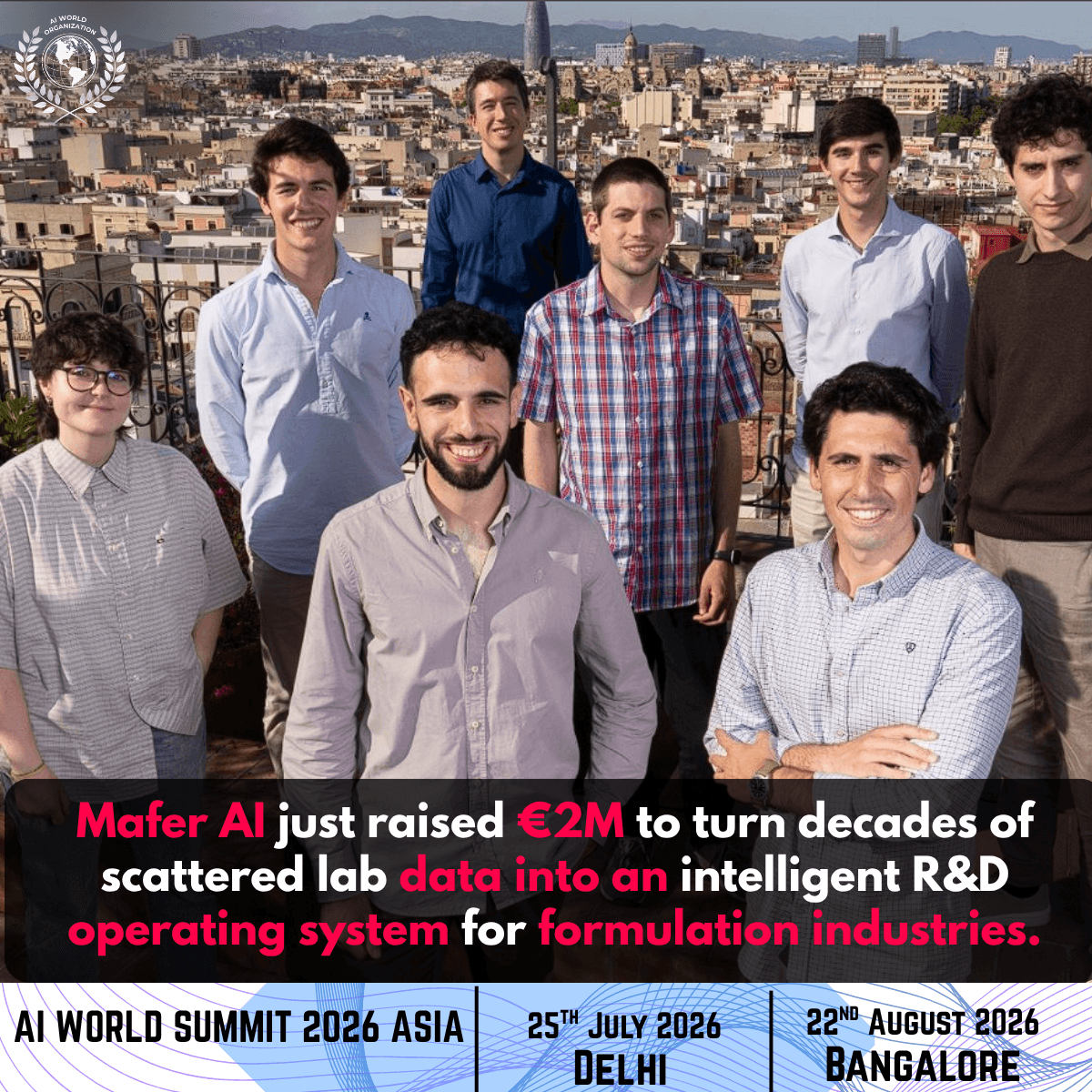
Barcelona's Mafer AI secures €2 million to build an AI operating system for R&D teams in formulation industries, backed by the BSC AI Factory.
TL;DR
Barcelona's Mafer AI has raised €2 million to build an AI platform for R&D teams in specialty chemicals, pharmaceuticals, and other formulation-driven industries. The system captures and structures scattered lab data — from chromatography outputs to regulatory requirements — turning it into usable intelligence that connects directly with existing workflows. The startup is part of the first batch of the BSC AI Factory programme in Barcelona.
Barcelona's Mafer AI Raises €2 Million to Build an AI Operating System for Formulation Industry R&D Teams
There is a quiet but persistent tension at the heart of every formulation-driven industry — a gap that has existed for decades between what scientists discover in laboratories and what industrial teams can actually execute at scale. Researchers in specialty chemicals, pharmaceuticals, cosmetics, and food science spend years perfecting complex formulas, generating thousands of data points in the process. Yet a surprisingly large portion of that knowledge never makes it into a system where it can be recalled, refined, or reused. It ends up in ageing spreadsheets, printed lab notebooks, or — worst of all — locked inside the memory of a scientist who has since moved on.
This is not an edge case. It is the industry's default condition. And the cost of it, measured in duplicated experiments, delayed product launches, failed reformulations, and missed regulatory deadlines, runs into millions every single year for companies of every size in the formulation space. The fundamental problem has always been one of data — too much of it, in too many incompatible formats, spread across too many disconnected systems, and never properly structured to support the kind of intelligent decision-making that modern AI tools are now capable of enabling.
Barcelona-based startup Mafer AI has raised €2 million in early-stage funding to tackle this problem head-on. The company is building what it describes as an AI operating system purpose-built for R&D teams working in formulation-heavy industries — a platform that captures, normalises, and structures chemical data into model-ready intelligence that scientists and product developers can actually use. The investment is a significant milestone for a startup that has already distinguished itself by being selected as part of the first intake of the BSC AI Factory, the artificial intelligence initiative anchored at the Barcelona Supercomputing Center.
At The AI World, we have been tracking the growing wave of vertical AI companies targeting sectors that have historically lagged behind in digital transformation. Mafer AI is one of the most technically serious entrants we have seen in this space, and the vision underpinning its platform — and the problem it is designed to solve — deserves to be understood in detail.
The Data Crisis Hidden Inside Every Formulation Lab
Walk into any R&D department working on formulated products — whether that company makes pharmaceutical excipients, cosmetic bases, specialty coatings, food additives, or agricultural chemicals — and you will find a version of the same story. Scientists are highly skilled, the equipment is sophisticated, and the work being done is genuinely complex. But the infrastructure for managing the data that all of this work generates is, in most cases, deeply inadequate for the demands of 21st-century R&D.
Formulation science is inherently iterative. Developing a new product or modifying an existing formula involves dozens, sometimes hundreds of experimental cycles. Each cycle generates data across multiple dimensions — raw material characteristics, concentration ratios, processing parameters, temperature profiles, stability results, sensory evaluations, analytical outputs from chromatographic and spectroscopic instruments. The volume of data produced is substantial, but the challenge is not volume alone. The real problem is heterogeneity. Data comes from different instruments, recorded by different scientists, in different formats, using different terminologies, stored in different systems, and often not linked together in any meaningful way.
When a company needs to reformulate a product — perhaps because a key raw material has been discontinued, a regulatory requirement has changed, or a sustainability initiative demands a switch to greener ingredients — the R&D team frequently has to approach the task without the benefit of the institutional knowledge that exists within the company's own historical records. Not because that knowledge does not exist, but because it has never been captured in a form that makes it accessible or useful. The result is wasted time, duplicated effort, and a longer and more expensive development process than should be necessary.
This problem compounds over time. As experienced scientists retire or change roles, the tacit knowledge they carry — the intuitions built from years of experimental work — disappears with them. Companies often discover the true scale of this knowledge loss only when they attempt to replicate or build upon previous work and find that the records are incomplete, inconsistent, or simply missing. It is a structural vulnerability that affects some of the most technically sophisticated organisations in the world, and it is one that technology has never adequately addressed — until now.
What Mafer AI Is Building: A Platform That Turns Chemical Data Into Intelligence
Mafer AI's response to this challenge is architectural in its ambition. Rather than building point solutions that address individual parts of the formulation workflow, the company is constructing a unified AI platform that connects data capture, structuring, modelling, and compliance into a coherent system — what it calls an AI operating system for formulation R&D.
The platform is built around three specialised modules, each targeting a distinct and high-friction area of the formulation process. The first module focuses on chromatography — one of the most widely used analytical techniques in formulation science and one that produces notoriously complex datasets. Gas chromatography–mass spectrometry (GC-MS) and related analytical methods generate production-grade data that, in most labs today, requires significant manual effort to process, compare, and interpret. Mafer's chromatography module structures this analytical data in a way that makes it searchable, comparable across experiments, traceable to specific raw materials and conditions, and usable for training AI models. For teams running multiple analytical tests every day, this capability alone represents a meaningful reduction in the time and effort consumed by data management.
The second module addresses formulation itself. Using generative AI models trained on structured chemical and formulation data, the platform supports the development of new products and the reformulation of existing ones by drawing on historical knowledge that has been transformed into reusable digital assets. Historical raw material and formulation knowledge — the kind of information that currently sits dormant in archived records — becomes, through this module, an active resource that helps scientists explore the formulation space more efficiently, predict outcomes with greater confidence, and reduce the number of physical experiments required to reach a viable result. This is arguably the most commercially compelling part of the platform, because it directly addresses the question that every formulation team faces: how do we shorten the path from brief to bench to market?
The third module deals with regulatory compliance, using agentic AI to handle the compliance workflows that have become an increasingly demanding aspect of bringing any formulated product to market. Regulations governing chemical products vary significantly across markets, are subject to frequent updates, and require careful documentation and evidence management throughout the development process. Mafer's regulatory module is designed to reduce the manual review burden, keep development teams aligned with current requirements across multiple jurisdictions, and help ensure that compliance is built into the product development process from the start rather than addressed as an afterthought at the end.
A crucial aspect of Mafer's design philosophy is how it integrates with existing client infrastructure. Rather than asking companies to undergo disruptive system migrations or rebuild their technical environments from scratch, the platform is engineered to connect directly with ERP systems, laboratory hardware, and established technical workflows. Integration is designed to happen with minimal friction — a principle that reflects an understanding of how large industrial organisations actually operate and what it takes to get new technology adopted in environments where operational continuity is paramount. Enterprise-grade security and encryption are embedded throughout the platform, recognising that the proprietary formulation data it handles represents some of the most sensitive intellectual property a specialty chemicals or pharmaceutical company holds.
Barcelona, the BSC AI Factory, and the Ecosystem Powering Mafer's Vision
It would be difficult to understand Mafer AI's trajectory without appreciating the city and institutional environment in which it is growing. Barcelona has emerged as one of Europe's most genuinely dynamic hubs for artificial intelligence innovation, and the data behind that claim is striking. The city leads Southern Europe in terms of the frequency and volume of AI-focused venture funding rounds, with capital consistently flowing into a diverse range of startups spanning healthcare technology, industrial automation, energy, and now specialty chemicals. Spain's AI investment story has gained significant momentum in recent years, with hundreds of millions of euros raised by Spanish AI companies in 2025 alone, cementing the country's position as one of Europe's most active and credible AI markets by investment volume.
Within this broader landscape, Mafer AI carries a particularly meaningful institutional credential. The company is part of the first cohort of startups selected for the BSC AI Factory — the AI-focused programme anchored at the Barcelona Supercomputing Center, home to the MareNostrum supercomputer and one of the leading scientific computing facilities on the continent. The BSC AI Factory was created with an explicit mandate to connect advanced computational research infrastructure with practical business and industrial applications, giving selected startups access to high-performance computing resources, deep scientific expertise, and an extended network of academic institutions and industry partners that would be extraordinarily difficult to access through commercial channels alone.
Selection for the BSC AI Factory is not a symbolic endorsement. It represents a substantive institutional validation of a startup's technical approach and its relevance to real-world industrial challenges. For a company working on AI applications that require training sophisticated generative models on complex chemical datasets, building robust analytical data structures, and developing agentic systems for regulatory compliance, access to the computing infrastructure and scientific network that the BSC provides is a genuine competitive advantage. It also signals to potential customers — typically large, conservative industrial organisations with high standards for technical credibility — that Mafer's work is grounded in rigorous science, not just product marketing.
The European context adds another layer of significance. The European Union's sustained investment in AI infrastructure, including the network of AI Factories being developed across the continent, reflects a strategic commitment to ensuring that European companies can build and deploy world-class AI systems across every major industry. Specialty chemicals and pharmaceutical formulation are exactly the kinds of high-value, knowledge-intensive industrial domains that this infrastructure is intended to support. Mafer AI's position at the intersection of Barcelona's commercial AI ecosystem and the BSC's scientific computing infrastructure places it well to benefit from both sides of this investment.
Why Formulation Industries Are One of AI's Most Significant Untapped Opportunities
The commercial opportunity that Mafer AI is addressing is larger and more complex than it might appear at first glance. The formulation industry, taken in its broadest sense, encompasses specialty chemicals, pharmaceutical drug products, cosmetics and personal care, agrochemicals, food and beverage ingredients, flavours and fragrances, adhesives, coatings, and advanced materials. These are sectors where product differentiation is achieved through formulation expertise, where regulatory requirements are stringent and constantly evolving across multiple jurisdictions, and where the commercial stakes of R&D failures — whether measured in failed regulatory submissions, product recalls, or missed market windows — are very high.
These are also sectors where the status quo has remained remarkably stubborn. Despite the broader acceleration of digital transformation across industry, formulation R&D has been among the slower domains to adopt data-driven and AI-powered approaches. The reasons are understandable: the knowledge involved is deeply tacit, the data is heterogeneous and proprietary, and the processes are complex enough that technology companies without genuine domain expertise have struggled to build solutions that actually work in practice. The result has been a market where the need is clear and well-documented but the available solutions have rarely matched the true complexity of the problem.
What makes the current moment different — and what makes Mafer AI's proposition particularly timely — is that several converging pressures are forcing formulation-intensive industries to confront their data and knowledge management challenges more urgently than before. Supply chain disruptions over recent years have pushed many companies to reformulate products around alternative raw materials, creating immediate demand for faster reformulation capabilities. Regulatory changes across major markets, particularly within the European Union, are introducing new compliance requirements that increase the documentation and evidence burden on R&D teams. And the accelerating industry-wide shift toward sustainable chemistry is compelling companies to reformulate existing products with greener, bio-based, or lower-impact ingredients, often on timelines that leave little room for traditional, purely empirical development approaches.
Against this backdrop, the value proposition of an AI operating system that can structure historical formulation knowledge, accelerate experimental design, and embed compliance into the development workflow is not a theoretical future benefit — it addresses needs that formulation teams are actively grappling with right now. The timing of Mafer's funding round and product development reflects a clear-eyed reading of where the market is and where it is heading.
What This Funding Means for Mafer AI — and for the Future of Intelligent R&D
The €2 million raised by Mafer AI represents an early-stage investment in what is clearly a long-term platform play. The company's stated ambition is to build a global business from its Barcelona base — an aspiration that aligns naturally with the genuinely international character of its target industries. Specialty chemicals and pharmaceutical companies operate globally, with supply chains, regulatory requirements, and customer relationships that span continents. A platform that can serve these needs across multiple markets and regulatory environments has a far larger addressable opportunity than one confined to any single geography.
The next phase of Mafer's development will likely centre on expanding its product capabilities across additional chemical process modules, growing its customer base within Europe, and establishing the proof points needed to build confidence among larger industrial organisations that typically require a higher bar of demonstrated performance before committing to a new platform. The company's BSC AI Factory connection provides a strong foundation for this, both in terms of technical resources and institutional relationships that can facilitate introductions to major industry players.
For the broader AI ecosystem, Mafer's funding round is a reminder that some of the most consequential applications of artificial intelligence are not the ones generating the most consumer-facing attention. They are the ones being built quietly in technical domains where the combination of data complexity, institutional knowledge fragmentation, and commercial stakes creates a genuine and urgent need for better tools. Formulation science is precisely such a domain, and the platform that Mafer is building — if it delivers on its promise — has the potential to meaningfully change how formulation-driven industries operate.
At The AI World, we will be following Mafer AI's progress closely as one of the more technically ambitious startups in the European AI ecosystem. The vision of an AI operating system for R&D — one that connects laboratories, workflows, historical data, and regulatory requirements into a single intelligent platform — points toward a future where the distance between scientific discovery and industrial scale is substantially shorter than it is today. Mafer AI is still in the early stages of that journey, but the foundation it is building, supported by serious institutional infrastructure and grounded in a deep understanding of a genuinely hard problem, makes it a company worth watching carefully in the months and years ahead.