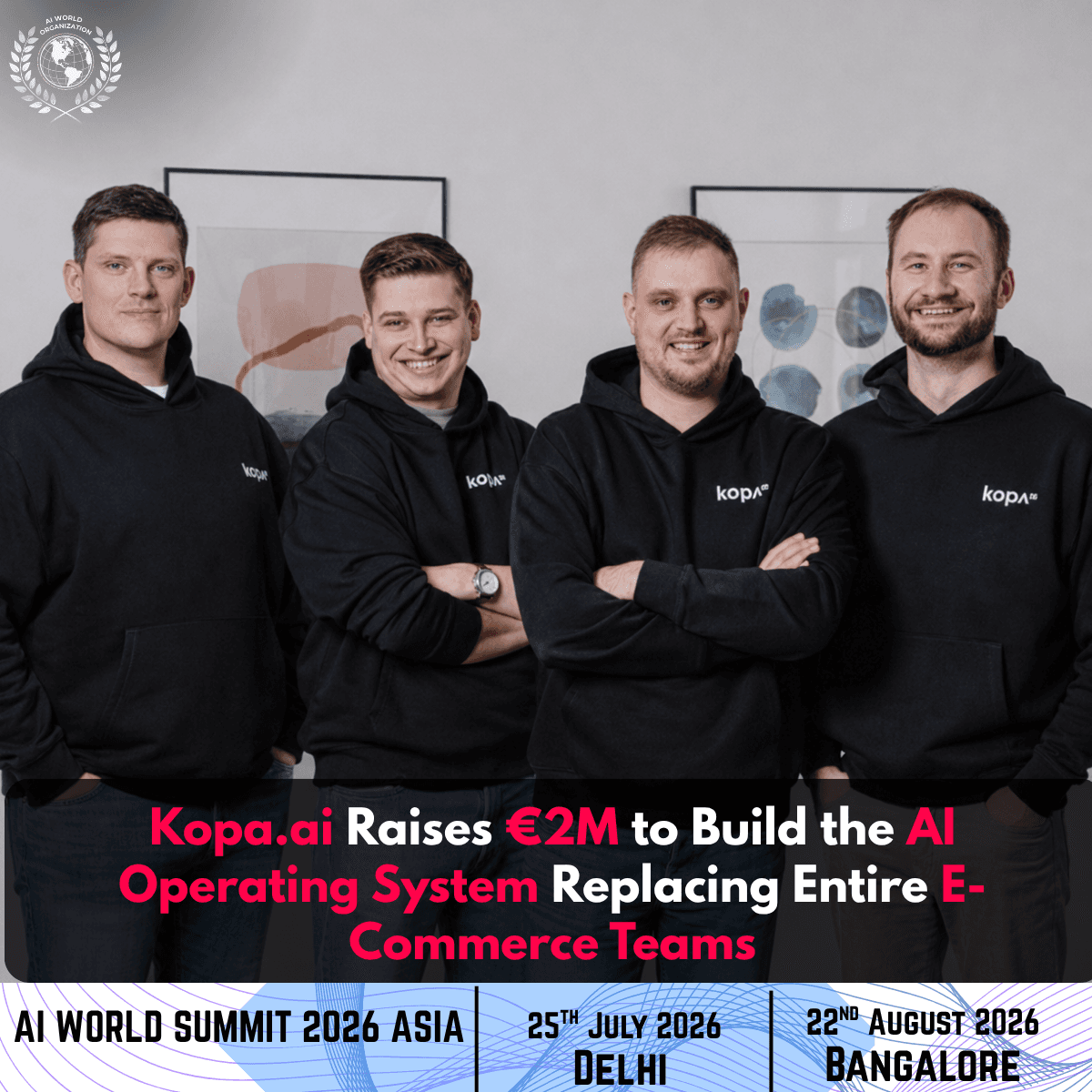
Kopa.ai Raises €2M to Build AI OS for E-Commerce
Kopa.ai secures €2M seed funding from XTX Ventures and Practica Capital to build autonomous AI agents that replace fragmented e-commerce operations. Here's what it means.
TL;DR
Kopa.ai, a Vilnius-based startup founded by operators who built 100+ e-commerce brands generating $300–400M in revenue, has raised €2M in seed funding. The platform uses autonomous AI agents to handle marketing, budgeting, creatives, and store operations — hitting €1M ARR in just 6 months with 2,000+ customers across Europe.
Kopa.ai Secures €2M Seed Funding to Build an AI Operating System That Could Redefine How E-Commerce Brands Operate
There is a quiet crisis running through the heart of modern e-commerce, and it has nothing to do with customer demand or product quality. The real problem is operational. Brands are drowning in fragmented workflows, disconnected tools, bloated team structures, and an ever-growing list of tasks that multiply faster than any hiring plan can address. Campaign management, creative testing, budget allocation, inventory tracking, customer analytics, and storefront updates — these are not small problems. They are the daily grind that consumes the bandwidth of even the most agile e-commerce teams, and they have become a serious competitive liability for brands trying to scale in 2026.
Into this gap steps Kopa.ai, a Vilnius-headquartered AI startup that has just closed a €2 million seed funding round with the explicit goal of building what it describes as an AI operating system for e-commerce brands. The round was co-led by XTX Ventures, the venture arm of XTX Markets — a leading algorithmic trading firm with a strong track record in backing AI-native companies — and Practica Capital, one of the Baltic region's most active and well-respected venture firms, managing over €130 million in assets and holding investments in companies such as TransferGo, Eneba, and PVcase. London-based entrepreneur and Remagine Ventures partner Etan Ilfeld also joined the round as an angel investor, adding international credibility and network reach to the deal.
The funding announcement signals more than just another early-stage startup getting off the ground. It reflects a growing conviction among serious investors that the next frontier in e-commerce is not better analytics or smarter dashboards — it is autonomous AI execution that removes the operational weight from human teams entirely and replaces it with agents that think, decide, and act on behalf of the business.
From Operators to Founders: The Story Behind Kopa.ai
What makes Kopa.ai immediately stand out in a crowded AI landscape is that it was not built by engineers looking for a problem to solve. It was built by operators who already lived the problem for years. The company was co-founded in 2023 by Donatas Benaitis and Vytautas Krutulis, and the founding team collectively brings more than a decade of hands-on experience building direct-to-consumer brands from scratch. This is not theoretical experience either — the team has launched and operated over 100 e-commerce brands that together generated somewhere between $300 million and $400 million in annual revenue. That is an extraordinary operational track record for a founding team, and it shapes everything about how Kopa.ai has approached product development.
When you have personally managed the chaos of scaling multiple e-commerce businesses — juggling ad spend decisions at midnight, briefing creative teams across time zones, trying to make sense of conflicting performance metrics from five different tools — you understand intuitively where the real pain lives. That understanding is embedded into Kopa.ai's architecture. The founders did not build a product designed to sit alongside existing workflows and generate reports. They built something designed to replace those workflows entirely by having AI agents take ownership of the operational layer.
Benaitis has spoken openly about this vision: the goal is to make Kopa.ai feel like handing your work to the best expert you have ever had on your team — someone who understands context, makes smart decisions, adapts to changing conditions, and delivers results without needing to be managed closely. That kind of intelligence, applied at scale across hundreds of operational decisions every single day, is what the company believes will unlock a new era of lean, high-performing e-commerce brands.
What Kopa.ai Actually Does — and Why It Is Different From Everything Else
It would be easy to file Kopa.ai away under the broad category of "AI tools for e-commerce" and move on. But doing so would miss what makes this platform genuinely distinctive. Most AI tools in the e-commerce space are built to assist human decision-making — they surface insights, generate options, or automate narrow, repetitive tasks within a single function like email marketing or ad creative generation. They are helpful, but they still require a human to interpret the output, decide what to do, and execute across disconnected systems. The core operational burden does not go away; it just changes shape.
Kopa.ai is taking a fundamentally different approach. Rather than building a tool that works within existing workflows, it connects directly to a merchant's store and the operational tools that sit around it, then continuously analyses the full picture: products, active campaigns, customer behaviour, budget performance, inventory levels, and site metrics. Its AI agents do not just generate recommendations — they interpret the business's intent, make decisions autonomously, and execute actions directly. This means launching campaigns, reallocating budgets in real time, producing creative assets, updating storefronts, and managing the operational details that typically eat up hours of human time every single day.
Crucially, the system is designed to learn continuously. Every action it takes feeds performance data back into the platform, and the agents use that data to improve the quality of future decisions. Over time, the system becomes increasingly calibrated to the specific dynamics of the business it is running — its audience, its product margins, its seasonal patterns, its growth levers. This is not a plug-in that needs to be configured once and then checked periodically. It is a living operational layer that evolves with the business.
This 360-degree approach is the core of Kopa.ai's competitive differentiation. Rather than targeting a single function like creative generation or marketing attribution, it is designed to understand how different parts of an e-commerce operation interact and to execute across the full stack. The ambition is nothing less than replacing the fragmented team structures that most mid-size and growing brands rely on today with a single AI-powered system capable of doing the work of multiple specialists simultaneously.
Traction, Investors, and the Market That Is Forming Around Agentic E-Commerce
The numbers behind Kopa.ai's early traction are worth dwelling on. The platform became publicly available in December 2025, and within roughly six months it had already reached €1 million in annual recurring revenue. That is a rapid climb for any SaaS product, let alone one entering the AI infrastructure space where adoption cycles can be longer and enterprise buying decisions more cautious. The broader business group has crossed $2 million in total ARR, and the platform is already serving over 2,000 customers, primarily across European markets.
These figures suggest that the problem Kopa.ai is solving resonates immediately with e-commerce operators — not as a theoretical future improvement, but as something they are willing to pay for right now because it addresses pain they feel acutely. The speed of ARR growth also provides a strong signal to investors that the product has genuine market pull, not just a compelling pitch deck.
The investors who backed this round are not passive observers in the AI landscape. XTX Ventures operates at the intersection of quantitative finance and AI infrastructure, bringing a rigorous, data-driven perspective to evaluating technology bets. Practica Capital has deep roots in the Baltic tech ecosystem and a portfolio that demonstrates consistent ability to identify category-defining startups before they break into mainstream coverage. The participation of Etan Ilfeld as an angel adds a London-based operational lens and access to European scaling networks that will matter as Kopa.ai pushes beyond its current geographic base.
The broader market context also helps explain why investors are taking this bet seriously. The agentic AI space in e-commerce is moving quickly. Competitors and adjacent players are raising significant capital to attack different parts of the same problem. Some are building AI systems focused on predictive data and multi-channel marketing attribution. Others are targeting the creative layer with tools that generate ad copy and image variations at scale. Still others are working on the customer engagement and loyalty dimensions of the business. What has been missing, until now, is a platform with the ambition and the operational depth to tie all of these dimensions together into a unified system that can run end-to-end.
Kopa.ai believes it can be that platform — not just a specialist tool for one job, but the operating system through which the entire e-commerce business runs. That is a large bet to make at the seed stage, but the founding team's background gives it more credibility than it might have coming from a purely technical team without operational scars.
What the €2M Funding Will Be Used For — and What Comes Next
With the seed round closed, Kopa.ai has articulated a clear set of priorities for deploying the capital. The primary focus will be on deepening the AI infrastructure that powers its agents — making them more capable, more contextually aware, and better equipped to handle complex decisions that go beyond straightforward operational tasks. As the platform matures, the ambition is for its agents to take on increasingly strategic decisions, not just the day-to-day mechanics of running a campaign or updating a product listing, but the kind of growth-oriented thinking that currently requires experienced operators or expensive consultants.
Alongside infrastructure investment, the company plans to expand its engineering team significantly. Building agents that can execute reliably across the full operational surface of an e-commerce business — integrating with dozens of platforms, parsing ambiguous business data, making real-time decisions under uncertainty — is an engineering challenge of genuine depth. Hiring the right talent to push that frontier forward is a critical use of the funding.
The third pillar of the plan is go-to-market acceleration across Europe. Kopa.ai's current customer base is primarily European, and the continent represents a large and underserved opportunity for AI-native e-commerce infrastructure. The fragmentation of the European market — multiple languages, varied regulatory environments, diverse consumer behaviours — actually creates a structural advantage for a platform that can abstract operational complexity and allow brands to focus on growth. The company intends to lean into that opportunity aggressively over the next twelve to eighteen months.
Looking further out, the founding team has articulated a vision that goes well beyond operational efficiency. They believe that AI agents will eventually allow very small teams — or even solo founders — to operate e-commerce businesses at a scale and sophistication that previously required organisations of ten, twenty, or more people. A solo founder with access to Kopa.ai's full agent network would, in theory, have the operational capabilities of a fully staffed e-commerce brand, running autonomously in the background while the founder focuses on product, brand, and strategy. That is not a vision for the next twelve months, but it is the north star that shapes every design decision the team is making today.
The Bigger Picture: Why Agentic AI in E-Commerce Matters Right Now
At The AI World, we track the evolution of artificial intelligence across every major sector of the global economy, and few applications are moving as fast or as practically as agentic AI in commercial operations. The distinction between AI as an analytical tool and AI as an execution engine is one of the defining shifts of 2025 and 2026. Organisations that understand this shift — and build or adopt platforms that reflect it — will operate at a structural cost and speed advantage over those that treat AI as a smarter version of their existing dashboards.
Kopa.ai's raise is a concrete data point in that trend. It joins a growing cohort of startups that are rethinking what it means to run a business in an era when intelligent agents can own entire operational domains. The e-commerce sector is particularly ripe for this transformation because it combines high operational complexity with relatively standardised workflows — a combination that makes it well-suited to autonomous execution. The barriers that have historically separated large, well-resourced brands from leaner competitors are beginning to erode as AI levels the operational playing field.
The €2 million Kopa.ai has raised is a small number by global standards, but the speed of its early traction, the quality of its investors, and the depth of its founding team's experience suggest this is a company building toward something considerably larger. For e-commerce operators wondering whether AI agents are ready to take on real responsibility inside their business, the answer is increasingly clear: they are not coming. They are already here.