JJG Aero Raises $30M to Scale Aerospace India
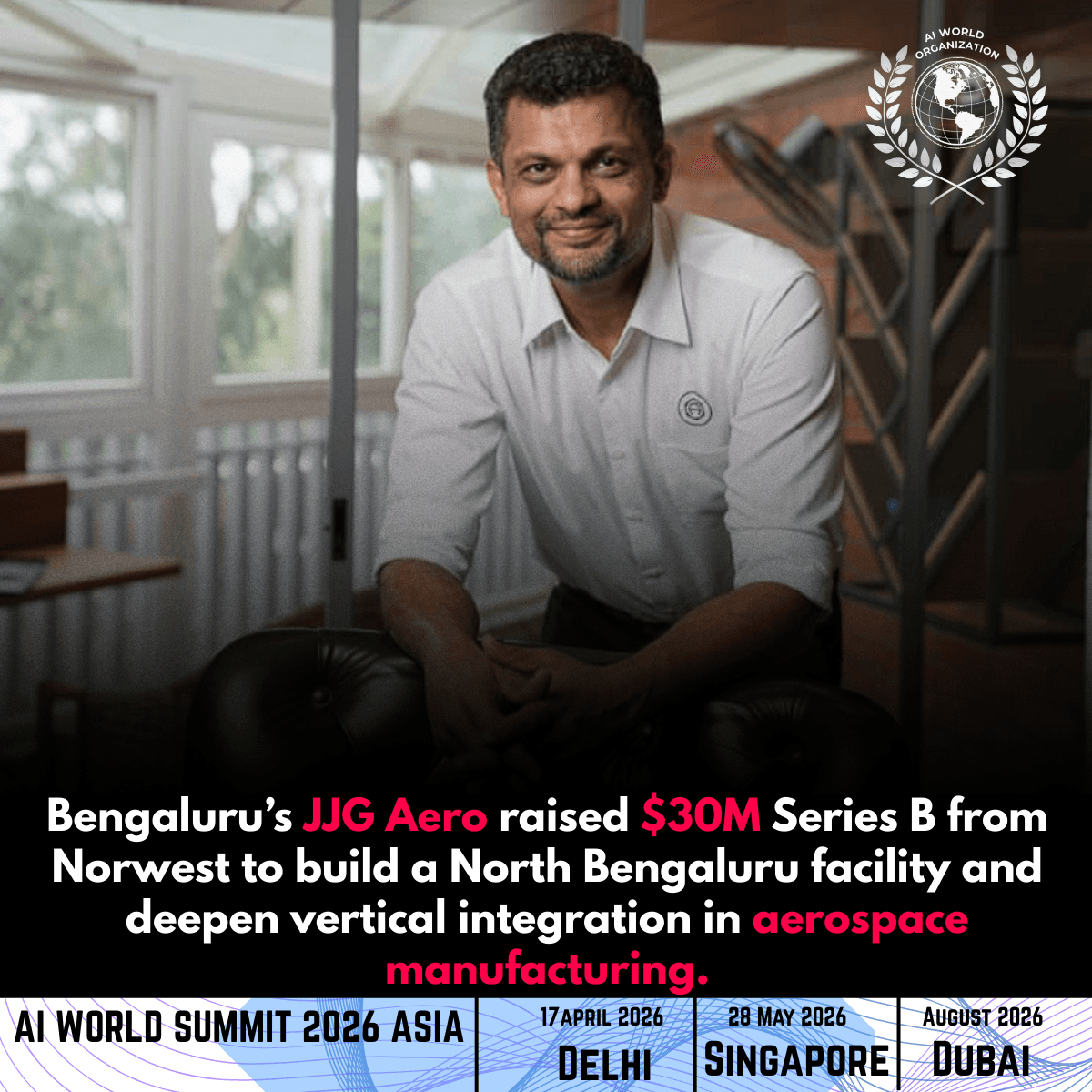
JJG Aero raised $30M from Norwest to expand its North Bengaluru plant, deepen vertical integration, and scale aerospace manufacturing for global OEMs.
TL;DR
Bengaluru-based aerospace components maker JJG Aero raised $30 million in a Series B led by Norwest. The company will use the funds to build a new North Bengaluru facility, strengthen vertical integration, and scale capacity for global aerospace customers. Total funding now stands at $42 million.
JJG Aero’s $30 Mn Series B signals a bigger push in India’s aerospace supply chain
Bengaluru-based aerospace components manufacturer JJG Aero has raised $30 Mn in a Series B round from Norwest. The company plans to use this capital to expand manufacturing capacity through a new facility in North Bengaluru, deepen vertical integration, and fund other strategic priorities tied to scaling production for global customers.
This development matters beyond one company because it lands at a time when global aircraft demand is rising and OEMs are carrying record backlogs, which is pushing suppliers to add capacity and improve delivery reliability. For ecosystem builders like the ai world organisation, stories like this are a strong indicator of how advanced manufacturing, supply-chain digitisation, and quality-led operations are becoming central themes across the ai world summit, ai world organisation events, and broader ai conferences by ai world.
What the funding is and where it will go
JJG Aero’s Series B totals $30 Mn and is led by Norwest, taking the company’s total funding to $42 Mn. That total includes an earlier $12 Mn round raised in April 2024 from CX Partners.
The company has indicated that the fresh capital will largely back expansion and capacity-building in and around Bengaluru, with the new North Bengaluru site positioned as a major step up from its earlier footprint. One stated direction is vertical integration—adding more processes and capabilities in-house—because aerospace programs reward suppliers who can consistently hit quality, compliance, and schedule requirements while taking on more complex work packages.
From an industry lens, this is the kind of scale-up story that tends to move a supplier from being a “parts shop” to becoming a deeper manufacturing partner that can win higher-value work, especially when it can demonstrate validated process control, inspection discipline, and repeatable output at volume. It also reflects a pattern we’re tracking closely at the ai world organisation: capital increasingly follows companies that combine hard engineering with operational excellence, and then layer software, analytics, and automation on top to compound advantage—topics that consistently show up in conversations around the ai world summit and ai world summit 2026.
The North Bengaluru facility and the vertical-integration angle
A key part of JJG Aero’s plan is a new manufacturing facility in North Bengaluru, which has been described as a large Unit 3 being built on a 10-acre site. Reporting on the expansion also references a 200,000-sq-ft manufacturing facility in North Bengaluru as part of the scale-up roadmap.
The move toward “backward and forward integration” is important because aerospace components are not just about machining; margins and defensibility often improve when a company can reliably control more steps such as finishing, special processes, testing, and sub-assemblies under one quality umbrella. In practical terms, this approach can reduce dependency risk, shorten lead times, and improve traceability—capabilities that global OEMs and Tier-1 suppliers typically value when expanding supplier share-of-wallet.
There’s also a strategic “optionality” embedded in building a large site: it provides room to grow into adjacencies when timing and customer pull align, rather than forcing expansions into constrained footprints. JJG Aero’s CEO has described the transition from two smaller one-acre sites to a much larger third unit with room for integration and adjacent opportunities, which frames the project as more than just incremental capacity.
For readers who follow the ai world organisation events calendar, this is a strong real-world example of what “scale” means in industrial businesses: not just new machinery, but the systems and governance to deliver consistent quality at higher volumes. It’s also where AI becomes highly relevant—predictive maintenance, process monitoring, quality analytics, and digital thread visibility can materially improve throughput and reduce scrap, and these are precisely the applied, ROI-linked use cases that our community often explores in tracks aligned with ai conferences by ai world.
What JJG Aero makes and who it serves
JJG Aero was founded in 2008 by Anuj Jhunjhunwala and manufactures high-precision machined components for aircraft systems and engines. It also produces a range of aerospace component categories, and has been described as working across sophisticated machining capabilities and related manufacturing services needed by aircraft programs.
Its customer list includes global aerospace OEMs and major suppliers such as Collins Aerospace, Safran, GE Aerospace, Pratt & Whitney, Boeing, Liebherr, and others referenced in coverage of the company’s operations. This matters because supplying such customers usually implies strict compliance expectations and consistent delivery performance, and it signals that the company has cleared meaningful supplier qualification and ongoing quality requirements.
JJG Aero also operates beyond aerospace through a subsidiary serving automotive and industrial markets, which can help balance cycles and provide process learning that transfers into aerospace manufacturing discipline. Operationally, the company has been described as running significant capacity around Bengaluru, with references to more than 100 machines across 60,000 sq ft of shop floor space at two locations near the city.
At the ai world organisation, we view these cross-sector manufacturing linkages as increasingly relevant because many of the same enabling layers—factory digitisation, ERP-MES integration, computer vision quality checks, and supply-chain planning—travel well across industries. That’s why industrial AI, manufacturing transformation, and applied automation remain recurring pillars across the ai world summit, ai world summit 2025, and ai world summit 2026 programming conversations in the wider ecosystem.
Why investors are leaning into Indian aerospace manufacturing now
One reason this funding resonates is the macro context: aircraft demand has been strong, and manufacturers have been reported to be sitting on an order backlog of nearly 16,000 aircraft. When backlogs stretch, supply chains feel pressure at every tier—components, assemblies, special processes, and inspection—and this typically creates incentives to expand qualified capacity, diversify sourcing, and “de-risk” delivery schedules.
India’s role is also evolving, and coverage notes that India’s share of the global aerospace components market remains below 2%, suggesting meaningful headroom if capability depth and supplier confidence keep rising. On the investment side, this round has been described as Norwest’s first investment in aerospace components manufacturing in India, which underscores the perception that the segment is entering a larger institutional capital phase.
Aerospace manufacturing is a game of compounding trust: once a supplier proves repeatability, process control, and compliance maturity, it can gradually move into more complex parts, higher-value sub-assemblies, and deeper lifecycle relationships. That’s also why vertical integration can be a strategic lever; it can help a supplier own more of the quality chain, reduce coordination friction, and deliver more complete work packages.
From the perspective of the ai world organisation, the most interesting overlap is how AI-enabled manufacturing is turning into a competitive advantage rather than an experiment. Whether it’s demand forecasting tied to OEM schedules, quality prediction, or automated inspection pipelines, industrial AI is becoming a key differentiator—and these applied “manufacturing + AI” stories are increasingly relevant for founder, operator, and investor audiences at the ai world summit and other ai world organisation events.
How this connects to the AI World community and events
Industrial scale-ups like JJG Aero highlight a larger theme: AI’s business value is often most measurable where operations are physical and constraints are real—machines, materials, tolerances, uptime, certification, and delivery windows. This is exactly where applied AI can shift outcomes: fewer defects, better traceability, improved throughput, and smarter maintenance scheduling, all of which ladder up to reliability and cost performance.
As the ai world organisation, we see an opportunity to bring more manufacturing leaders, aerospace suppliers, and industrial innovators into the same room as AI builders and platform teams—because that’s where practical adoption accelerates. If you’re tracking industrial transformation, keep an eye on ai conferences by ai world and the ai world summit editions, including regional summit experiences and global community programming hosted under our organisation’s umbrella.
For those planning their 2026 calendar, The AI World Organisation has promoted AI World Summit 2026 Asia & Global AI Awards (Singapore), which is one of the event anchors the community references when looking at upcoming global summit touchpoints. If your team sits at the intersection of advanced manufacturing, quality systems, and AI deployment, the ai world summit 2026 conversations can be especially relevant because they naturally connect “tech possibility” with operational execution.