INXM Raises €5.7M to Fix Enterprise AI Execution
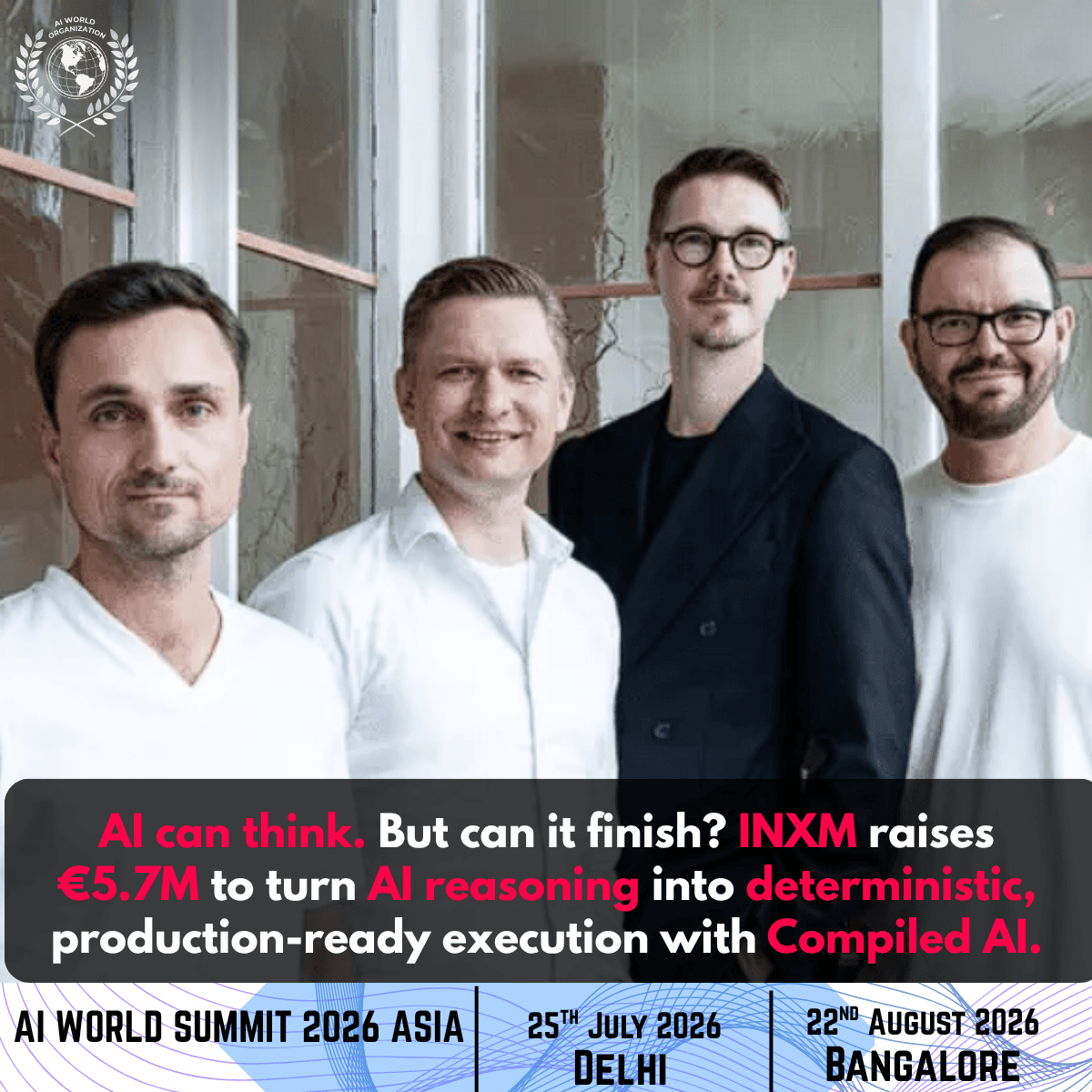
Berlin startup INXM secures €5.7M pre-seed led by Cherry Ventures to deploy its Compiled AI engine, solving enterprise AI's biggest challenge: reliable execution.
TL;DR
Berlin startup INXM has raised €5.7M in pre-seed funding to tackle a problem most enterprises quietly struggle with — turning AI-generated plans into reliable, repeatable outcomes. Founded by former aerospace CDOs, INXM's "Compiled AI" approach converts AI reasoning into deterministic code, making industrial workflows auditable and production-ready at scale.
INXM Raises €5.7M to Solve the Enterprise AI Execution Problem with 'Compiled AI'
There is a quiet crisis unfolding inside the world's largest organisations right now — one that rarely makes headlines but is costing enterprises billions in wasted investment and missed opportunity. Companies across manufacturing, logistics, aerospace, and heavy industry have poured enormous resources into artificial intelligence over the past several years. They have hired data scientists, rolled out large language models, deployed pilot programmes, and sat through countless vendor demos promising transformation. And yet, for most of them, what they have to show for it is a collection of dashboards, a handful of disconnected copilots, and an ever-growing graveyard of proofs-of-concept that never made it to production. The fundamental issue is not that AI cannot think. It is that AI cannot reliably finish the job.
That is exactly the problem a Berlin-based startup called INXM has been quietly working to solve, and this week it announced it has secured €5.7 million in pre-seed funding to take its solution to market. The round was led by Cherry Ventures, one of Europe's most respected early-stage investors, with co-investment from Redstone, Angel Invest, and Linden Capital. The fresh capital will be channelled into the commercial rollout of INXM's flagship product, Orchestrator, and into continued development of the underlying technology that powers it. For those watching the evolution of enterprise AI closely, this announcement carries more weight than the funding figure alone suggests.
The Founding Team: Engineers Who Have Lived the Problem
One of the most compelling aspects of INXM's story is where its founders have come from. Alex Oelling, who serves as the company's Chief Executive Officer, previously held the role of Chief Digital Officer at two of Europe's most technically demanding companies — Isar Aerospace and Volocopter. These are not household consumer brands. They are organisations where engineering decisions carry real consequences, where systems must work the first time, and where the margin for operational error is essentially zero. Isar Aerospace is building rockets. Volocopter is putting passenger aircraft in the sky. Oelling was the person responsible for building the digital and organisational infrastructure that makes both of those missions possible.
Matthias Kainer, INXM's Chief Technology Officer, worked alongside Oelling at both companies and brings hands-on expertise in building mission control systems, launch orchestration platforms, and cloud-native replacements for legacy operational software. These are not developers who have theorised about industrial AI from the outside — they have built the systems that complex engineering organisations depend on to function day to day. The founding team is rounded out by Jesper Bylund and Kamil Klüber, and collectively the group also carries experience from workflow automation platform n8n and global technology consultancy Thoughtworks, giving INXM a rare combination of deep operational credibility and software engineering sophistication.
Oelling has been candid about what motivated the company's creation. Speaking about the founding thesis, he described witnessing enterprise AI projects fall apart repeatedly — programmes that consumed years of implementation time, required armies of engineers, and ultimately delivered AI systems that created as many problems as they solved. His vision for INXM is built on a simple but radical premise: that AI should not just be a productivity tool sitting alongside workers, but should become the operational backbone of European industry, a system that takes responsibility for finishing the work rather than merely suggesting how it might be done.
This perspective is not born from idealism. It is the product of watching what happens when organisations hand autonomous AI systems the controls without having the right execution infrastructure underneath. The failures Oelling and Kainer have witnessed firsthand in some of Europe's most demanding engineering environments directly shaped the architecture INXM has chosen to build. That lived context is something that sets the team apart in a market crowded with AI infrastructure companies founded by talented developers who have never had to ship a rocket or certify an aircraft.
What INXM Actually Builds: The Case for Compiled AI
At the technical heart of INXM's offering is a concept the company calls Compiled AI, and understanding it is essential to understanding why the company believes it has found an approach that most of the enterprise AI market has so far missed. The prevailing paradigm in enterprise AI today is agent-based: LLMs are given tools, access to systems, and a degree of autonomy to make decisions at runtime as they work through a task. This approach has attracted enormous investment and generated significant excitement, but it also has a fundamental weakness when applied to mission-critical industrial operations: unpredictability.
INXM's Compiled AI approach takes a fundamentally different architectural path. Rather than allowing a language model to reason through decisions live during an operational process, INXM uses AI at the planning stage — to generate and optimise an execution plan — and then converts that plan into deterministic code that is then run independently of the model. The outcome is a system that delivers the flexibility and natural language reasoning of modern AI at the design stage, but the reliability, testability, and auditability of traditional deterministic software at the execution stage. In environments where compliance requirements are strict and the cost of an unpredictable outcome is measured in operational risk rather than inconvenience, this distinction is everything.
Kainer has described the concept in straightforward terms: using LLMs to generate enterprise-ready code, and then running that code to achieve outcomes. This gives teams the power of AI reasoning without making that AI reasoning a live variable in their production operations. For a manufacturer running a complex supply chain, for an aerospace company managing maintenance workflows, or for a logistics operator coordinating time-sensitive freight movements, the ability to execute AI-designed processes in a fully auditable and repeatable way is not a nice-to-have. It is a prerequisite for deployment.
The company's flagship product, Orchestrator, is built entirely around this philosophy. Crucially, INXM does not position Orchestrator as a replacement for the enterprise platforms organisations already rely on. The system integrates with existing ERP, MES, PLM, and quality management infrastructure, working within the operational reality of large industrial organisations rather than requiring them to rip out and replace the systems their operations depend on. This is a deliberate and strategically sensible decision. One of the most persistent reasons enterprise AI projects stall is the requirement to rebuild existing data and workflow infrastructure from scratch before any value can be delivered. INXM's approach sidesteps this barrier by meeting organisations where they are.
Investor Confidence and What It Signals About the Market
The investor group behind this round is not a casual collection of generalist funds. Cherry Ventures, which led the round, has a strong track record of identifying infrastructure-level opportunities in European technology before they become obvious to the broader market. Filip Dames, Founding Partner at Cherry Ventures, framed the investment in terms that speak directly to what INXM is trying to do at a philosophical level. He described enterprise AI as trapped in a paradox where the more ambitious a deployment becomes, the less predictable its outcome, and positioned Compiled AI as a genuine architectural reframing of that problem rather than an incremental improvement on what already exists. His argument is that the question is not how to make AI smarter, but how to make it executable — and that INXM is building the infrastructure to do exactly that.
Redstone's founding partner Michael Brehm pointed to something that many in the AI industry would benefit from hearing more often. Founders who have navigated the journey from concept to production readiness in genuinely complex engineering domains — rockets and air taxis being as complex as it gets — carry a different understanding of operational risk and systems thinking than most software teams. Brehm's observation was that workflow challenges in enterprise AI almost always trace back not just to the models themselves, but to the brittleness of integration with day-to-day operations. INXM's founders have lived that reality directly, and that lived experience has shaped their architecture.
Jens Lapinski of Angel Invest addressed the broader market need with equal clarity. His view is that enterprises do not need more disconnected AI tools — they need AI that can execute governed, repeatable processes across the systems they already operate. The orchestration layer that connects enterprise platforms, human workers, and AI agents to run operational workflows with genuine reliability and traceability is still largely missing from the market. That is the gap INXM is building into.
The participation of Linden Capital alongside these three experienced European tech investors adds further validation to the round. Together, the backing reflects a genuine conviction that the infrastructure layer for reliable, enterprise-grade AI process execution represents one of the most consequential investment opportunities in the current landscape — one that is still in its early innings despite the enormous volume of capital already flowing into AI broadly.
The Competitive Landscape and INXM's Position Within It
To understand where INXM sits in the wider market, it helps to look at the companies operating in adjacent spaces and understand precisely how INXM differs from each of them. The enterprise AI infrastructure space has attracted some substantial bets in recent months. Berlin-based workflow automation platform n8n closed a major Series C funding round in late 2025 at a valuation of around €2.5 billion, and subsequently received a strategic investment from SAP that pushed its value to over five billion euros, making it one of the most valuable AI companies in Germany. n8n's focus is on connecting applications through visual workflow automation — it allows teams to build integrations between software systems without deep coding expertise. While this shares surface-level similarity with what INXM does, the underlying intent is different. n8n is building a flexible automation fabric; INXM is building deterministic, governance-first execution infrastructure for industrial environments where the consequences of failure are operational, regulatory, and sometimes physical.
Parloa, another Berlin-based company, closed a massive funding round in early 2026 at a three-billion-dollar valuation after tripling in value in less than eight months. Parloa's domain is AI-powered customer service and contact centre automation — a meaningful market, but one that operates in a different risk environment than the manufacturers, aerospace companies, and logistics operators INXM is targeting. LangChain, which raised over a hundred million dollars in a Series B round in late 2025 at a valuation of $1.25 billion, provides developer-facing infrastructure for building AI applications and agents. It is a foundational layer for those constructing new AI systems from scratch; INXM, by contrast, is targeting operational teams managing existing industrial systems who need AI-designed processes that run reliably within those environments.
What emerges from this comparison is a picture of a company that has found a relatively uncontested position in a large and growing market. INXM's emphasis on industrial environments, compliance-first design, and deterministic execution gives it a differentiated value proposition that does not require it to compete head-on with any of these larger, better-capitalised players. The manufacturers and industrial operators it targets are precisely the organisations that have been most reluctant to hand control to autonomous AI systems — not because they do not see the value of AI, but because they cannot afford the unpredictability that current agent-based approaches introduce. INXM's architecture is specifically designed to address that reluctance.
Why the Timing Matters: Enterprise AI's Third Wave
The broader context in which INXM is launching matters enormously. The enterprise AI market has moved through recognisable phases over the past few years. The first wave was about generating content — using large language models to draft emails, summarise documents, and automate text-based tasks. This phase created genuine productivity gains for knowledge workers but left industrial operators largely untouched. The second wave has been about agents — giving AI systems the ability to take actions, browse the web, call APIs, and operate with greater autonomy across digital environments. This phase is still underway and still generating significant investment, but it has also exposed the limitations of autonomous AI in environments where predictability is not optional.
The third wave — the one INXM is positioning itself to lead — is about execution infrastructure. It is the question of whether AI can not only think through a task but can be trusted to complete it reliably, repeatedly, and in a way that satisfies the governance requirements of large organisations operating in regulated industries. This is not a marginal improvement on the second wave. It is a different problem requiring different architecture, different integrations, and a different founding team. The fact that INXM's founders built their instincts for this problem not in a software lab but inside the operations of a rocket company and an air taxi business gives the company a credibility in this space that is difficult to replicate.
For the AI World community — professionals, researchers, investors, and enterprise technology leaders watching the evolution of AI from pilot to production — INXM's emergence represents exactly the kind of development worth paying close attention to. The problem it is addressing is one that affects virtually every large organisation attempting serious AI deployment today. The approach it has taken is technically grounded, operationally informed, and backed by investors who have demonstrated an ability to identify important infrastructure plays early. Whether Compiled AI becomes the dominant paradigm for enterprise AI execution remains to be seen, but the case for why the current agent-based approach is insufficient for industrial environments is compelling, and the case for why INXM's team is well-positioned to build the alternative is equally strong.
The €5.7 million secured in this pre-seed round gives the company the runway it needs to prove that thesis in production, with real industrial customers, running real operational workflows. The AI industry has never been short of ambitious ideas. What it increasingly needs — and what INXM is trying to deliver — is the infrastructure to turn those ideas into outcomes that organisations can actually depend on.