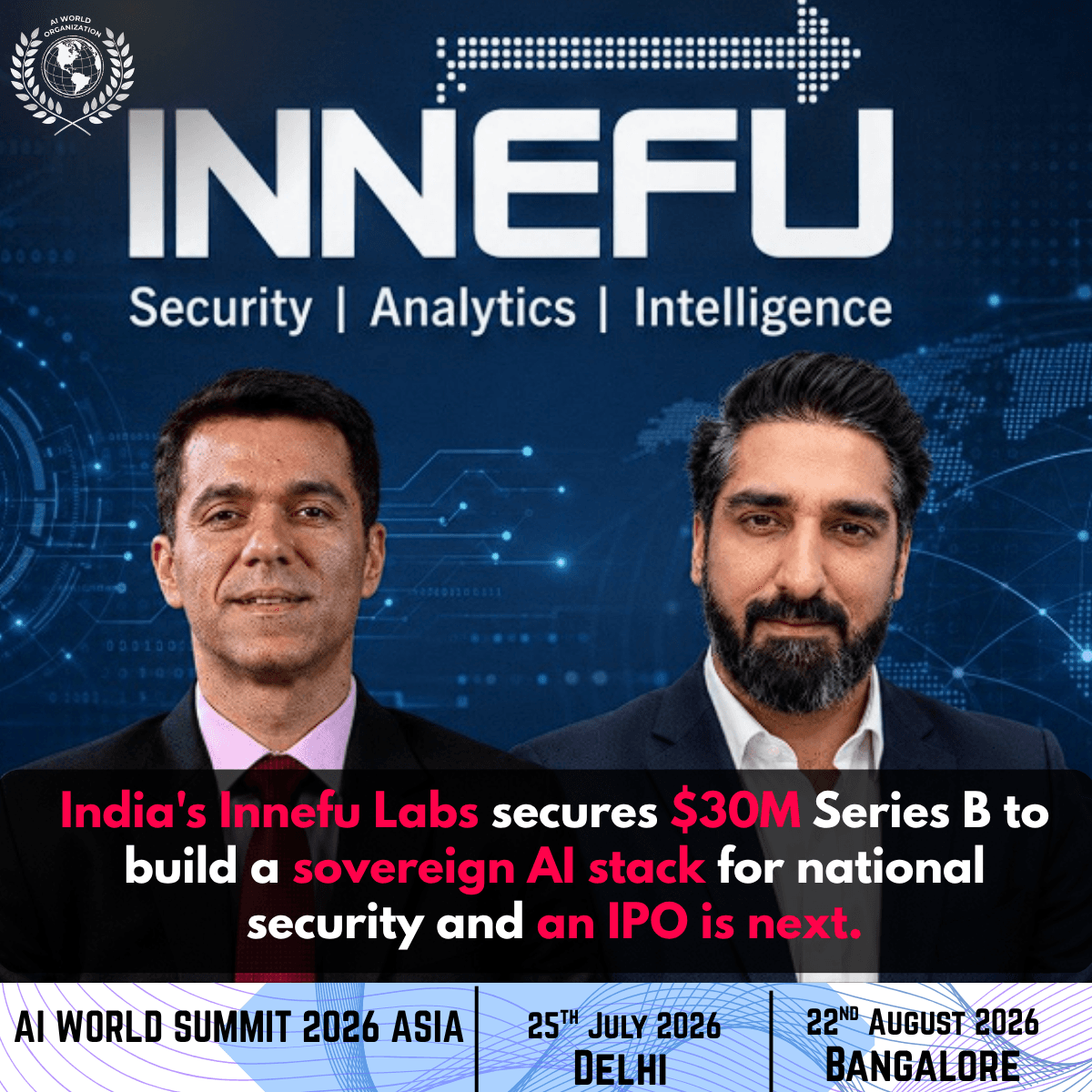
Innefu Labs Raises $30M Series B for Sovereign AI
Innefu Labs secures $30M Series B from Panthera Growth Partners to scale sovereign AI, agentic platforms & robotics globally, ahead of a planned IPO.
TL;DR
New Delhi's Innefu Labs has closed a $30 million Series B round led by Singapore's Panthera Growth Partners. The AI-driven national security company, founded in 2010, plans to use the capital to scale its agentic AI platform, launch a dedicated robotics division, and build sovereign AI infrastructure — all while setting the stage for an IPO and deeper expansion into global markets.
Innefu Labs Raises $30 Million in Series B Round Led by Panthera Growth Partners, Eyes IPO and Global Expansion
In what marks one of the more consequential funding announcements in India's deep-tech security landscape this year, New Delhi-based artificial intelligence company Innefu Labs has closed a $30 million Series B round led by Singapore-based growth equity firm Panthera Growth Partners. The round, which translates to approximately ₹285.2 crore, was executed through a combination of primary and secondary transactions from Panthera's second fund. More than just a capital infusion, this deal is being seen as a strategic endorsement of India's growing capability to build and deploy sovereign AI platforms for some of the most sensitive and mission-critical environments in the world.
For Innefu Labs, a company that has spent the better part of fifteen years quietly but persistently building artificial intelligence tools for national security agencies, defence organisations, and intelligence bodies, this is a pivotal moment. The funding does not signal the beginning of their story — Innefu is already deeply embedded across more than a hundred installations spanning the Indian subcontinent, the Middle East, and parts of Southeast Asia. What this capital injection does is accelerate the next phase of an already formidable journey: scaling their technology globally, taking their platform capabilities to an entirely new level, and laying the financial groundwork for a future public listing.
The announcement has drawn significant attention from the AI and technology investment community, not just because of the size of the round, but because of what it represents in the broader context of India's push toward self-reliance in critical technology infrastructure. At a time when governments worldwide are increasingly anxious about their dependence on foreign-built intelligence and security software, Innefu's indigenous AI systems are emerging as a compelling alternative — one built in India, for India, and increasingly, for the world.
India's Sovereign AI Ambitions Find a Powerful Strategic Backer
The timing of this investment is no coincidence. It comes in the backdrop of India's Atmanirbhar Bharat mandate, a sweeping policy initiative that has fundamentally reshaped domestic procurement priorities across defence, intelligence, and public security sectors. The government's emphasis on sourcing critical technologies from indigenous providers has created a structural tailwind for companies like Innefu, which have been building exactly the kind of deep, proprietary AI systems that high-trust environments demand.
Innefu Labs was founded in 2010 with an explicit and unflinching mission: ensure that India never needs to rely on external platforms to safeguard its people, its institutions, or its digital sovereignty. In the years since, the company has built and deployed AI platforms across an impressively diverse range of clients, including defence and intelligence organisations, law enforcement agencies, financial intelligence units, and several Fortune 500 corporations. The fact that it has operated in this space for over a decade, building a client base that includes some of the country's most sensitive agencies, speaks to both the depth of their technology and the trust they have earned in extraordinarily demanding environments.
Panthera Growth Partners' decision to back Innefu was, by the firm's own account, grounded in a rigorous assessment of what the company had actually built. Shilpa Kulkarni, Founder and Managing Partner of Panthera Growth Partners, described the investment thesis in direct terms: the decision rested on Innefu's proprietary technology, their deep domain expertise, and a track record of delivering reliable outcomes in high-stakes, mission-critical contexts. "We are partnering with Innefu to support their growth ambitions as they prepare for public markets," Kulkarni noted, signalling that Panthera sees this as more than a financial play — it is a partnership built around a shared conviction about where the global AI security market is headed.
Panthera's second fund itself carries considerable institutional weight. It is backed by investors from India, the European Union, and the United States, and is focused on growth-stage companies with demonstrated product-market fit across India and Southeast Asia. The firm deploys an average of $20 million per company, which means the $30 million allocated to Innefu represents a notably high-conviction bet. Panthera's existing portfolio includes names like OfBusiness, FoxTale, EMotorad, Zivame, Flipspaces, and Travelstack Tech — a group of companies that reflect a pattern of backing businesses with strong operational fundamentals and scalable technology moats.
Building the Full Sovereign AI Stack: Where the $30 Million Goes
The deployment plan for this fresh capital is ambitious and multi-layered. Innefu Labs has been explicit about its intentions, and the roadmap they have outlined reflects a company that knows exactly where it wants to go and has a reasonably clear picture of what it will take to get there.
The most immediate priority is the further development and scaling of Innefu's proprietary Agentic AI platform. Agentic AI — systems capable of autonomous, goal-directed reasoning and action — represents one of the most rapidly advancing frontiers in enterprise and defence-grade artificial intelligence. Unlike traditional AI tools that respond to queries or perform narrow tasks, agentic systems can independently plan, execute multi-step operations, and adapt their behaviour based on changing circumstances. For national security and intelligence applications, where the volume and velocity of data can be overwhelming, the ability to deploy AI agents that can autonomously process, fuse, and act on information is transformative. Innefu has been building in this direction for years, and this funding will allow them to push that capability significantly further.
Equally notable is the decision to establish a dedicated Physical AI and robotics division. This is a meaningful strategic expansion. Physical AI — the application of artificial intelligence to robots and autonomous physical systems — is a frontier that very few Indian technology companies have seriously entered, particularly in the context of national security. By creating an in-house robotics wing, Innefu is positioning itself to deliver not just software-defined intelligence, but embodied AI systems that can operate in the physical world. In defence and law enforcement contexts, the implications of this are substantial. Autonomous surveillance systems, reconnaissance drones with integrated AI decision-making, and intelligent border security robots are all plausible downstream applications.
The third major allocation of this capital is toward building out what Innefu describes as a sovereign AI infrastructure — specifically, the development of secure, domain-specialised large language models built from the ground up for high-trust environments. While the global conversation around AI has been dominated by general-purpose models built by a handful of large American and Chinese companies, the reality for governments and security agencies is that they cannot route sensitive national security data through third-party cloud infrastructure. They need models that run on domestic servers, are trained on domain-specific datasets, and are auditable by their own teams. Innefu's plan to build these sovereign language models is a direct response to that need, and it positions the company at the intersection of two of the most important trends in global AI policy: data sovereignty and the defence applications of generative AI.
Co-Founder and CEO Tarun Wig articulated this vision with clarity and evident conviction when the deal was announced. He spoke about the company's fifteen-year journey — the long years of building when AI wasn't a household term, the deliberate choice to focus on indigenous development rather than adapting imported tools, and the deep sense of purpose that has driven the company's growth. "We believe the next wave of technological leadership will belong to nations that own their intelligence capabilities," he said, "and Innefu is committed to ensuring that India stands at the forefront of that transformation." For Wig, this is not merely a business proposition — it reads as a genuinely held conviction about the role technology companies can play in shaping a country's strategic future.
Abhishek Sharma, Co-Founder and CTO, added important technical context. Having spent over a decade solving mission-critical challenges for defence, intelligence, and investigative agencies, Sharma emphasised that this funding now enables Innefu to "build the full sovereign AI stack that high-trust environments demand" — a phrase that neatly encapsulates the breadth and depth of what the company is attempting to deliver.
A Decade of Mission-Critical Deployments: The Track Record That Earned the Investment
It is easy to talk about ambition in the context of a funding announcement, but Innefu's credibility in this space is grounded in a genuinely exceptional operational track record. The company has already built and deployed some of the most sophisticated AI-powered security infrastructure in the region, and several of its flagship installations are genuinely landmark achievements in the context of India's technology story.
Among Innefu's most significant deployments is India's first National Terrorism Data Fusion Centre — a platform that integrates data from multiple intelligence streams and applies AI-driven analytics to detect, assess, and respond to security threats in real time. The scale and sensitivity of this deployment alone illustrates why Innefu commands the level of institutional trust that it does. Alongside this, the company has built what is recognised as Southeast Asia's largest operational Intelligence Fusion Centre, a facility that aggregates multi-source intelligence data and transforms it into actionable insights for security decision-makers.
The company has also deployed Revenue Intelligence Fusion Platforms, which use AI to detect financial crimes, smuggling, and revenue leakage — a sophisticated application of the same multi-modal data fusion capabilities that underpin its national security work. Its Predictive Policing Platforms, which apply machine learning models to historical crime data to allocate policing resources more effectively, represent another area where Innefu has translated AI research into practical, real-world outcomes. And its indigenous Open Source Intelligence (OSINT) and Deep Web Fusion Platform, designed specifically for law enforcement and defence agencies, gives operators the ability to monitor, analyse, and act on information gathered from open and dark web sources — a capability that has become increasingly central to modern counterterrorism and organised crime investigations.
This operational depth is reflected in Innefu's commercial momentum. The company has built a growing portfolio of contracts valued at $10 million or more, spanning defence, intelligence, law enforcement, and revenue intelligence — a concentration of large-ticket engagements that points to the mission-critical nature of the solutions being delivered. With over 100 installations live and operational across the Indian subcontinent, the Middle East, and Southeast Asia, the company is not a startup pitching a product — it is an established operator in one of the world's most demanding technology markets.
The Investor Landscape and the Global Market Opportunity
The broader investment environment for AI security companies is, by any measure, at an inflection point. Governments across the world are accelerating their spending on AI-driven national security infrastructure, and the conversation around data sovereignty has moved from the margins of policy debate to the centre of geopolitical strategy. Nations are increasingly reluctant to depend on foreign-owned platforms for intelligence operations, and the market for indigenous, sovereign AI systems is expanding rapidly.
India, in particular, occupies a uniquely important position in this landscape. As one of the world's largest democracies, with a complex security environment, a large and sophisticated technology talent pool, and a government that has made domestic AI capability a clear policy priority, the conditions for building a globally significant AI security company have arguably never been better. Innefu Labs has been operating in precisely this space for over fifteen years, and the alignment between what the company builds and what the market increasingly demands is striking.
The investment from Panthera Growth Partners also reflects a broader trend in growth equity: the recognition that the most defensible and valuable AI companies are not necessarily those with the flashiest consumer applications, but those that have embedded themselves in complex, regulated, mission-critical environments where switching costs are high, trust is hard-earned, and the technology advantage compounds over time. Innefu fits this profile exceptionally well. It has built products that agencies and organisations cannot easily replace, operates in domains where the barriers to entry are formidable, and has demonstrated the ability to execute at scale in some of the world's most demanding deployment environments.
The company's early traction in the Middle East is also worth noting in this context. Having successfully expanded into a region that represents a significant and growing market for national security technology, Innefu has demonstrated that its platforms can be adapted for international deployment — a critical proof point as the company now accelerates its push into global markets.
The Road to IPO and What Comes Next for Innefu Labs
Perhaps the most significant signal embedded in this funding announcement is the explicit mention of an IPO as a near-term ambition. The capital structure of the deal — combining primary investment with secondary transactions — is a setup that is often used to clean up a company's cap table ahead of a public listing, providing liquidity to early investors while simultaneously bringing in a growth-focused institutional partner. Panthera's track record and positioning as a growth-stage, pre-IPO investor lends further credibility to the timeline.
An IPO would represent a landmark moment not just for Innefu Labs, but for India's AI and deep-tech sector more broadly. Public listings of homegrown AI companies in high-value, mission-critical segments send a signal to the global investment community about the maturity and depth of India's technology ecosystem. They also create visibility that can accelerate international business development, attract top engineering talent, and catalyse a new generation of founders working on sovereign technology challenges.
In the near term, the company's energies are clearly focused on three parallel tracks: scaling its Agentic AI capabilities to handle increasingly complex, autonomous decision-support requirements; launching its Physical AI and robotics division to enter what is expected to be a rapidly growing market for intelligent physical systems in defence applications; and building out its sovereign language model infrastructure to serve the growing demand from government and security clients who need AI systems they can trust with their most sensitive data.
Taken together, these represent a coherent and well-considered vision for what an AI company operating at the intersection of national security and cutting-edge technology should look like in 2026 and beyond. Innefu Labs has spent fifteen years building the foundations. With $30 million in fresh capital, a credible investor by its side, and an IPO on the horizon, the next chapter of this company's story is poised to be its most consequential yet.
At The AI World, we will be tracking this space closely. The emergence of sovereign AI as a global policy imperative, the growing investment interest in defence-grade AI infrastructure, and the rapid evolution of Agentic AI and Physical AI capabilities are among the defining themes of this moment in technology history — and Innefu Labs sits right at their intersection.


