Inferact Raises $150M to Scale vLLM Inference
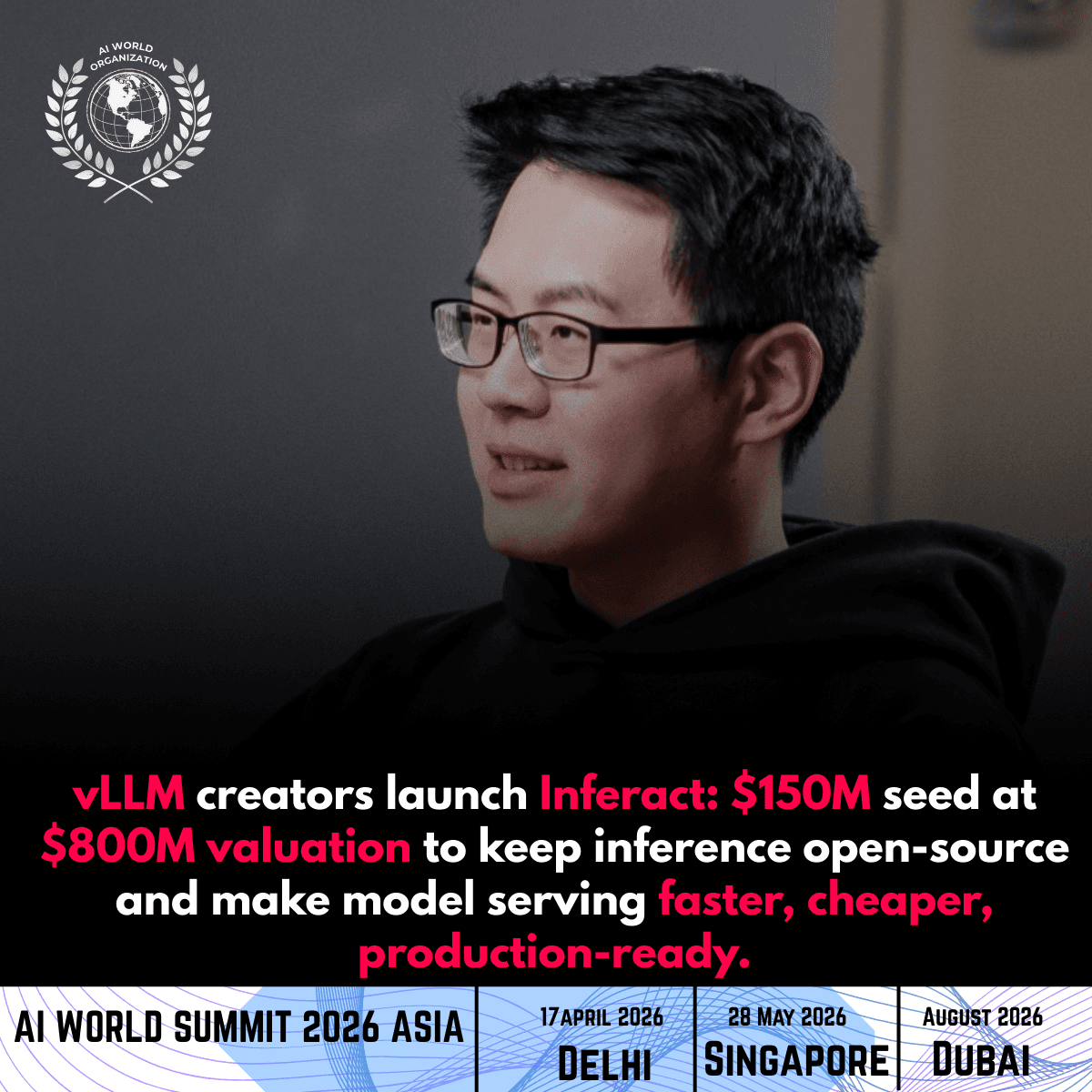
Inferact, built by vLLM maintainers, raised $150M at an $800M valuation to make AI inference cheaper and faster—an AI World Summit 2026 priority.
TL;DR
Inferact, a new startup formed by core vLLM maintainers, raised $150M in seed funding at an $800M valuation. Backed by a16z and Lightspeed, it will commercialize vLLM while keeping it open-source. Born out of UC Berkeley’s ecosystem and already used at large scale, the tech aims to make model serving faster, cheaper, and less painful for real products.
Inferact’s $150M debut and what it signals
Inferact has officially launched as a venture-backed startup built by the people who created and maintained vLLM, a widely used open-source engine for serving large language models efficiently. The company announced it raised $150 million in seed funding at an $800 million valuation, a rare “seed” round size that underlines how strategic inference infrastructure has become in the AI stack. The round was co-led by Andreessen Horowitz (a16z) and Lightspeed Venture Partners, aligning two top-tier investors behind the bet that serving models at scale—reliably and cheaply—will define the next wave of AI winners.
Beyond the headline numbers, Inferact’s positioning is clear: keep vLLM open, expand its capabilities, and build the kind of operational layer that makes deploying frontier models feel less like a research project and more like standard cloud infrastructure. In the company’s own framing, inference is not “finished,” and it is becoming harder as models grow larger and architectures diversify across mixture-of-experts, multimodal systems, and more agentic workflows that demand new serving patterns. At the same time, the hardware landscape is fragmenting into more accelerator options and more programming models, multiplying the number of performance combinations teams must tune to hit latency and cost targets.
This is the context in which Inferact enters the market: a moment when the capability gap between frontier models and the infrastructure that serves them is widening, leaving top performance accessible mainly to teams that can build custom systems. Inferact’s bet is that if inference complexity can be absorbed by better infrastructure—much like cloud databases absorbed earlier operational burdens—then more organizations can unlock the full scope of what modern models can do. For the ai world organisation, this is also why inference is becoming a core story line for the ai world summit and for ai conferences by ai world: it connects model innovation to real deployment outcomes that enterprises can measure.
Why inference is suddenly the center of gravity
The industry conversation is shifting from “who trained the biggest model” toward “who can deploy useful AI at scale,” and inference is the name for that deployment phase—turning a trained model into a real service that answers requests quickly and affordably. Investor attention is following the same shift, because the economics of serving models can determine whether an AI product is viable when traffic rises from prototypes to production. Technologies such as vLLM and SGLang are designed to make model-serving faster and cheaper, and that is exactly the kind of leverage that draws capital when the market expects inference demand to expand.
The pressure on inference is also increasing because AI workloads are broadening beyond basic chat. Inferact points to trends such as test-time compute, RL training loops, and synthetic data generation—patterns that can push inference from “a fraction of compute” to “the majority” of compute in many pipelines. In other words, even teams that still invest heavily in training may find that deployment and runtime cycles dominate total infrastructure cost as their products mature.
A second reason inference matters is architectural churn. As vendors ship new model designs, inference engines must keep up quickly or developers are forced into custom work that slows adoption and raises operating complexity. Inferact argues that vLLM sits at the intersection of models and hardware because it has been built alongside both communities, enabling “day-zero” support when model vendors introduce new architectures and close integration when hardware makers roll out new silicon. That connective role is difficult to replicate quickly, which helps explain why investors treat inference engines as potential platform assets rather than simple utilities.
For the ai world organisation community, these dynamics also reshape what “AI readiness” means. The ai world summit and ai world organisation events increasingly revolve around practical enterprise constraints—latency, reliability, cost per token, governance, and deployment models—rather than only model benchmarks. That is exactly why inference infrastructure announcements resonate strongly across ai world summit 2025 and ai world summit 2026 conversations: they sit where strategy meets execution.
What Inferact says it will build—and what stays open
Inferact describes its mission as growing vLLM into “the world’s AI inference engine” and accelerating AI progress by making inference cheaper and faster. The company emphasizes that vLLM was built in the open and that this won’t change, framing Inferact’s role as “supercharging” adoption while ensuring optimizations flow back to the community. That open-source continuity matters because it preserves a shared foundation for startups, enterprises, and cloud platforms that rely on vLLM as part of their production stack.
Inferact also highlights how large the vLLM ecosystem already is, noting support for 500+ model architectures and 200+ accelerator types, with 2,000+ contributors behind the project. Those figures are important not only as adoption signals, but because they describe a fast-moving compatibility surface that many AI builders implicitly depend on. If vLLM is already one of the default serving layers, then commercial support and faster platform evolution can reduce risk for enterprises that need predictable performance and security controls.
The company’s longer-term vision is to make serving AI feel effortless, with a future where deploying a frontier model at scale is as simple as spinning up a serverless database. Inferact’s argument is that the complexity doesn’t vanish; it gets absorbed into the infrastructure layer the company is building, so application teams can focus on products instead of bespoke serving systems. This message directly reflects a broader enterprise pain point: today, scaling a model service often requires a dedicated infrastructure team, and that staffing requirement can slow down experimentation and expansion.
Under the hood, vLLM is known for inference optimizations that improve throughput and reduce memory pressure, and external reporting has highlighted features such as PagedAttention as central to reducing KV-cache memory overhead during token generation. These kinds of optimizations matter in production because LLMs typically generate responses token-by-token while maintaining a growing “KV cache,” which can become a major memory and cost constraint at scale. When teams can fit more concurrent requests per GPU (or avoid costly memory bottlenecks), the unit economics of AI products improve, which makes growth and broader use cases feasible.
Commercialization trends: RadixArk, Berkeley roots, and the inference race
Inferact’s debut mirrors a pattern that is showing up repeatedly: open-source inference projects are spinning out into companies with large funding rounds because the “picks-and-shovels” layer of AI is now strategic. TechCrunch recently reported a similar commercialization story around SGLang becoming RadixArk, with sources describing a round that valued RadixArk at around $400 million led by Accel. The parallel is significant because it suggests inference is not a niche optimization problem anymore—it is a market category investors expect to expand quickly.
Both vLLM and SGLang were incubated in 2023 at the UC Berkeley lab of Databricks co-founder Ion Stoica, linking these projects to the same academic pipeline that has repeatedly produced widely adopted distributed systems. This shared origin story also helps explain why these tools gained traction: they were built close to real systems needs, then validated in open-source communities where usage exposes performance bottlenecks quickly. Inference engines often become popular not because they are flashy, but because they quietly solve the problems teams hit at 10x or 100x scale—traffic spikes, latency tails, memory limits, and multi-tenant complexity.
Investor composition further reinforces the importance of this layer. Bloomberg reported that the seed round included not only Andreessen Horowitz and Lightspeed, but also participation from Sequoia Capital, Altimeter Capital, Redpoint Ventures, and ZhenFund. A syndicate like that implies a belief that inference infrastructure could turn into an enduring platform category with meaningful enterprise spend and deep integration into cloud ecosystems.
Leadership and adoption signals also matter here. Inferact CEO Simon Mo—described as one of the original creators—has said that existing vLLM users include Amazon’s cloud service and a major shopping app, suggesting that vLLM is already embedded in high-scale, real-world deployments. Even without naming every user publicly, the implication is that production-grade inference is being shaped by open-source engines long before many enterprises recognize the dependency.
What it means for enterprises—and for AI World Summit 2025/2026 narratives
For enterprises building with LLMs, Inferact’s funding round is a reminder that the “real work” of AI often begins after training, when teams must deliver consistent performance under real user traffic. Inference infrastructure sits in the blast radius of every operational trade-off: response time, cost, security posture, and reliability all trace back to how models are served and monitored. As more companies move from demos to embedded workflows—customer support, internal copilots, search, analytics, document automation—the inference layer becomes the lever that determines whether AI scales sustainably.
This is also where the ai world organisation can add high value through community and programming. The ai world summit is a natural forum to translate funding headlines into practical lessons: what technical choices lower cost per request, how to evaluate inference stacks, and how to plan for shifting architectures and heterogeneous hardware. For ai world summit 2025 / 2026, a useful lens is to treat inference as the “delivery engine” of AI transformation—because even the best model strategy fails if serving costs explode or latency makes products unusable.
AI buyers also need clarity on build-versus-buy decisions. Inferact’s story suggests an emerging middle path: keep the base engine open (so teams aren’t locked in), but offer commercial-grade layers that simplify operations, harden deployments, and accelerate compatibility with new models and new hardware. That framing aligns closely with the kinds of decision points that show up at ai world organisation events, where leaders compare stacks, vendors, and operating models before committing budgets.
From a market perspective, the influx of capital into inference also implies faster product cycles and more competition among frameworks and platforms. That can be good news for customers, because competitive pressure often drives better tooling, clearer deployment patterns, and stronger interoperability across ecosystems. At the same time, it raises the bar for internal teams: leaders must understand not only model quality, but also infrastructure performance, governance, and total cost of ownership across environments.
For the ai world organisation, the opportunity is to make these conversations actionable and accessible. The ai world summit and ai conferences by ai world can spotlight how inference choices influence business metrics, how open-source stacks mature into enterprise-ready platforms, and what “future-proofing” looks like as model architectures continue to evolve. As ai world summit 2026 approaches—alongside other ai world organisation events listed on theaiworld.org—this topic is likely to remain central because it sits at the intersection of innovation, adoption, and ROI.