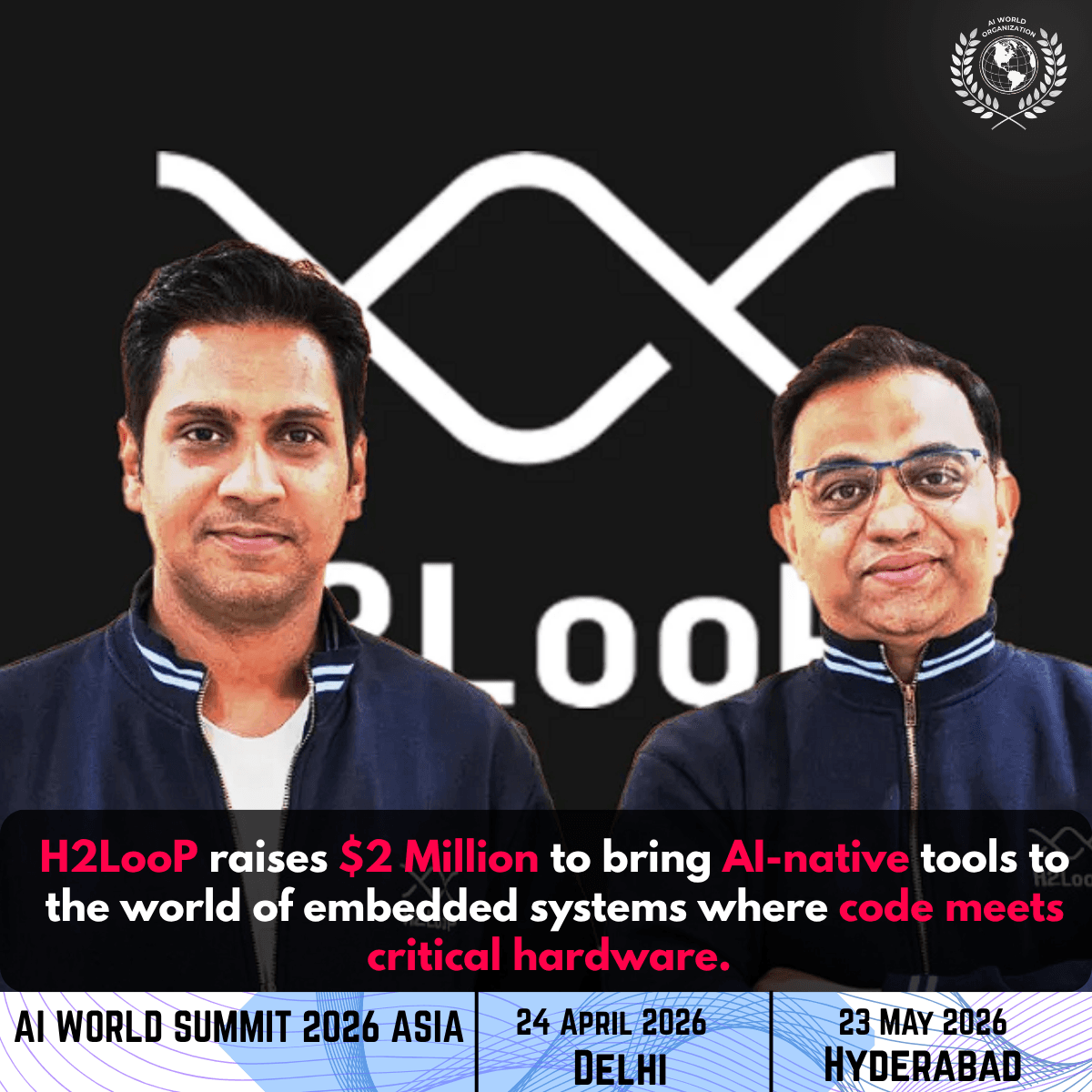
H2LooP Raises $2M to Power AI for Embedded Systems
H2LooP secures $2M seed funding from Speciale Invest and 3one4 Capital to build AI-native tools for embedded systems, UAVs, and defence tech.
TL;DR
Bengaluru-based deeptech startup H2LooP has raised $2 million in seed funding from Speciale Invest and 3one4 Capital. Founded in 2025, the company builds AI-native coding assistants and small language models tailored for embedded systems engineers — a space long ignored by mainstream AI tools. The fresh capital will fuel expansion into data centres, UAVs, and robotics.
H2LooP Secures $2 Million in Seed Funding to Revolutionise AI-Powered Embedded Systems Development
India's deeptech startup ecosystem has yet again demonstrated its growing maturity and global relevance with a significant early-stage investment. Bengaluru-based H2LooP has successfully closed a $2 million seed funding round, backed by prominent venture capital firms Speciale Invest and 3one4 Capital. This latest AI funding development marks an important milestone — not just for the company itself, but for the broader narrative of how India is positioning itself at the intersection of artificial intelligence and hardware engineering. The funds, equivalent to approximately Rs 18.59 crore, are set to accelerate the startup's expansion into some of the most technically demanding and high-stakes sectors in modern technology, including data centres, unmanned aerial vehicles (UAVs), and robotics.
The announcement arrives at a time when the global AI funding news cycle is increasingly dominated by large-scale generative AI plays and consumer-facing applications. H2LooP, however, is taking a fundamentally different path — one that digs deep into the layers of hardware infrastructure and the software that breathes life into it. In doing so, the startup is addressing a problem that has long been overlooked by mainstream AI tools and venture capital alike: the complexity and rigour required to develop, debug, and maintain embedded systems software.
The Problem H2LooP Is Built to Solve
To appreciate the significance of H2LooP's mission, it is essential to understand the landscape it is operating in. Embedded systems are everywhere — they power the brains of your car's engine control unit, the navigation systems in commercial aircraft, the firmware inside medical implants, and the microcontrollers that manage semiconductor fabrication equipment. Despite being so foundational, embedded software development has seen very little innovation in its tooling. Engineers working on firmware, drivers, and low-level system code have largely been left behind by the wave of AI-assisted development tools that transformed web and application development over the past few years.
Tools like GitHub Copilot and Cursor dramatically changed the workflow of web developers, offering real-time AI suggestions, auto-completion, and contextual code generation. But these tools were designed with high-level programming languages and cloud-connected environments in mind. For embedded engineers writing C/C++ for automotive ECUs, avionics software, or defence-grade hardware — operating under strict safety standards, real-time constraints, and often in air-gapped environments — these tools offered little practical value. The codebase architectures are different, the debugging processes are more complex, and the stakes are extraordinarily high; a bug in firmware can mean vehicle failure, aircraft malfunction, or national security risk.
H2LooP was founded with the explicit purpose of closing this gap. The startup brings AI-native infrastructure specifically tailored for embedded and system software engineering — an area that has, for too long, been underserved by the broader AI tools market. This positions H2LooP not just as a productivity tool but as a foundational platform for some of the world's most critical technology sectors.
Founding Story and the Minds Behind the Mission
H2LooP was co-founded in May 2025 by Sairanjan Mishra and Pulkit Agrawal, two entrepreneurs with hands-on experience building technology companies from the ground up. Sairanjan Mishra previously founded YoBulk, giving him a deep understanding of enterprise product development and the practical challenges of scaling B2B software. Pulkit Agrawal, the co-founder behind Pictogen, brings a strong background in AI and product engineering. Together, they identified a white space in the AI tools market that, despite being technically challenging, presented enormous commercial opportunity — especially as industries like automotive, aerospace, and semiconductors increasingly look to automate and accelerate their software development pipelines.
The founding of H2LooP in 2025 was timely. The global conversation around AI had matured significantly, moving beyond hype and toward real-world deployment in mission-critical environments. Companies in the defence, telecom, and semiconductor sectors were beginning to ask: "Can AI help our engineers work faster and more accurately?" H2LooP answered that question with a resounding yes — but on the condition that the AI had to be purpose-built for those specific environments, not a generic large language model adapted from a consumer-facing product.
From the very beginning, the Bengaluru-based startup focused on building small language models (SLMs) — a category of AI models that are compact, efficient, and can be fine-tuned for highly specialised domains. Unlike large language models (LLMs) that require massive compute infrastructure and broad training data, SLMs can be deployed in resource-constrained environments, including secure or air-gapped systems where internet connectivity is restricted for security reasons. This architectural decision alone sets H2LooP apart from virtually every other AI coding assistant on the market.
What H2LooP Actually Builds: A Deep Dive into the Platform
At its core, H2LooP is building a suite of AI-native tools specifically designed for engineers who work at the intersection of hardware and software. The platform spans three primary areas: AI-native coding assistants, small language models for low-level systems, and hardware-aware debugging tools — each serving a different but deeply interconnected part of the embedded software development lifecycle.
The AI-native coding assistants developed by H2LooP are domain-specific, trained on C/C++ embedded code along with associated hardware documentation, silicon specifications, and safety standards such as AUTOSAR, MISRA, and DO-178C. This means the assistant doesn't just understand programming syntax — it understands the hardware context in which the code will run. When an engineer is writing a driver for a custom microcontroller or building a RTOS-based application for an automotive module, the assistant can provide suggestions that are not only syntactically correct but also hardware-compliant and safety-aware. This is a step-change improvement over generic AI assistants that have no awareness of hardware constraints.
The small language model (SLM) layer is where H2LooP's deepest innovation lies. These models are designed to run locally on enterprise infrastructure — without sending proprietary code to external servers. For sectors like defence, semiconductors, and aerospace, this is non-negotiable. Intellectual property (IP) in these industries is extraordinarily sensitive, and any tool that requires uploading source code to a cloud environment is essentially off the table. H2LooP's air-gapped deployment model directly addresses this constraint, making enterprise adoption not just feasible but attractive.
The hardware-aware debugging tools add yet another layer of value. Debugging embedded software is notoriously difficult. Crash logs from firmware can span hundreds of lines with cryptic error codes tied to specific hardware registers, interrupt routines, or memory address conflicts. H2LooP's platform automates the analysis of these crash logs, helping engineers identify root causes significantly faster than manual inspection. Beyond debugging, the platform also ingests technical documents — PDFs of hardware datasheets, specification documents, and compliance standards — and converts them into structured, actionable training data. This creates a continuous loop of improvement for the AI models while also building a knowledge base that engineers can query in natural language.
The company is additionally building a data platform for hardware engineering — an infrastructure layer that allows teams to manage, version, and share hardware-specific data assets, enabling better collaboration across firmware teams that are often geographically dispersed and working on complex multi-year projects.
Investor Confidence and the AI Funding Landscape in India
The $2 million AI funding secured by H2LooP is particularly noteworthy given the profile of its investors. Speciale Invest is one of India's most respected deeptech-focused venture capital firms, with a clear mandate to back frontier technology companies at the earliest stages. The firm has a strong track record of identifying technically differentiated startups before they become mainstream, and its participation in this round signals a high level of conviction in H2LooP's thesis. In fact, Speciale Invest is in the process of launching a new growth-stage fund with a targeted corpus of INR 1,400 crore — a clear indicator that the firm is doubling down on its deeptech investment strategy in India at a significant scale.
3one4 Capital, the co-lead investor, is another name that carries enormous weight in the Indian startup ecosystem. Ranked by Preqin — a globally recognized alternative assets intelligence platform — as a top performer among India-focused venture capital funds, 3one4 Capital has built a reputation for backing bold, technically complex companies at the seed stage. Their participation in the H2LooP round is a strong vote of confidence not just in the team but in the broader opportunity presented by AI-powered tools for embedded systems.
Together, these two investors bring more than capital to H2LooP. They bring networks, domain expertise, and the kind of institutional credibility that helps early-stage deeptech companies navigate complex enterprise sales cycles. For a startup targeting defence organisations, semiconductor companies, and telecom firms, having investors with strong enterprise networks and deeptech credentials is invaluable.
This development is also an important piece of AI funding news in the context of India's broader tech investment environment. At a time when AI investment in India is gaining considerable momentum — driven by rapid advances in the technology and growing enterprise adoption — H2LooP's seed round reflects a shift in investor focus toward infrastructure-level AI tools. Rather than betting only on AI applications and consumer-facing products, investors are increasingly recognizing the value in the picks-and-shovels approach: building the tools and platforms that power AI development in the most demanding industrial environments.
Expansion Plans: Data Centres, UAVs, and the Robotics Frontier
With the fresh capital in hand, H2LooP has outlined an ambitious roadmap for expansion into three high-complexity sectors: data centres, UAVs, and robotics. Each of these verticals represents a unique deployment environment for embedded systems, and each presents distinct challenges that H2LooP's platform is well-positioned to address.
Data centres, for instance, are increasingly being built with custom silicon — from Google's TPUs to Amazon's Trainium chips to a growing number of hyperscaler-designed processors. Managing the firmware and low-level software that runs on this custom hardware is a highly specialised challenge, and as data centre infrastructure becomes more heterogeneous, the demand for smart embedded development tools will only grow. H2LooP's ability to analyse silicon specifications and generate hardware-specific code suggestions places it in a strong position to serve this market.
In the UAV and drone sector, the stakes for reliable embedded software are extraordinarily high. A firmware bug in an unmanned aerial vehicle can mean loss of the asset, mission failure, or in military applications, catastrophic consequences. UAV manufacturers and defence contractors are actively looking for ways to accelerate their software development cycles without compromising on safety or security. H2LooP's domain-specific models and air-gapped deployment capability make it a natural fit for this sector, where both speed and security are paramount.
Robotics, meanwhile, is perhaps the most exciting frontier for AI-powered embedded tools. As robotic systems become more sophisticated — incorporating real-time decision-making, multi-sensor fusion, and adaptive control algorithms — the complexity of the firmware and systems software that powers them grows exponentially. H2LooP's platform can analyse existing robotic firmware, suggest optimisations, and help teams manage the growing complexity of robotic software stacks. With the global robotics market expanding rapidly, particularly in industrial automation and logistics, this is a high-growth opportunity.
Beyond these three new sectors, H2LooP already has real-world deployments with semiconductor companies, defence organisations, and telecom firms. This early commercial traction is significant — it suggests that the product has moved beyond proof of concept and is delivering measurable value in production environments. For a company that was founded less than a year before closing its seed round, this is a remarkable achievement and a strong signal of product-market fit.
Why This Matters for the Future of AI in Hardware Engineering
H2LooP's emergence as a well-funded contender in the AI tools space for embedded systems has implications that extend well beyond the company itself. It signals a broader maturation of the AI industry — one in which the technology is no longer confined to high-level software tasks but is beginning to penetrate the deepest layers of the computing stack.
For years, hardware engineering has operated with minimal automation. The tools used by embedded engineers — IDEs, oscilloscopes, logic analysers, and debuggers — have evolved incrementally, but no AI-native platform had previously attempted to serve this community at the level of sophistication H2LooP is building toward. The company's ambition to replace legacy tools like GitHub Copilot for low-level systems engineering is audacious, but the technical foundation they have established makes it a credible possibility.
From a geopolitical and industrial standpoint, the timing could not be more significant. As nations double down on semiconductor self-sufficiency, defence technology modernisation, and aerospace capability development, the need for faster, more reliable embedded software development is becoming a strategic imperative. India, with its vast pool of engineering talent and a growing deeptech startup ecosystem, is well-positioned to develop globally competitive tools in this space — and H2LooP appears to be leading that charge.
At The AI World, we continue to track transformative AI funding news and developments across sectors that define the next era of technological progress. H2LooP's seed round is not just a funding story — it is a signal that AI is finally making its way into the foundational layers of the world's most critical hardware systems, and that India is at the forefront of this quiet but profound revolution.