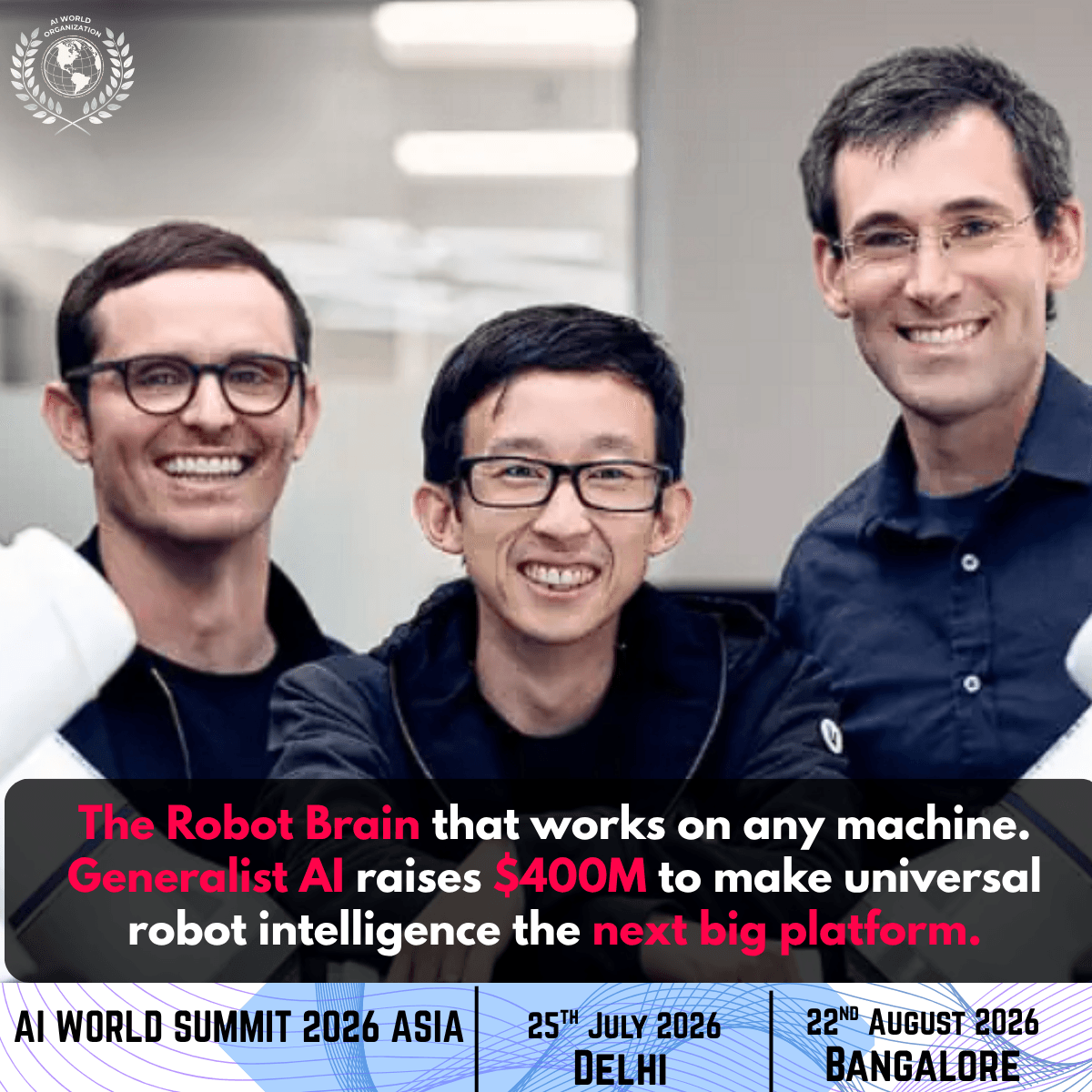
Generalist AI Raises $400M to Power All Robots
Generalist AI secures $400M led by Radical Ventures to build a universal AI brain for all robots. Learn how GEN-1 is reshaping physical AI at The AI World.
TL;DR
Generalist AI, founded by veterans from Google DeepMind and Boston Dynamics, has raised $400M to build a universal AI brain that works across any robot, regardless of hardware. Their GEN-1 model delivers 99% task reliability — crushing the previous industry benchmark of around 64%. Backed by NVIDIA, Bezos Expeditions, and Fei-Fei Li, total funding now exceeds $500M, with the firm betting that the real prize in robotics isn't the machine — it's the mind running it.
Generalist AI Raises $400M to Build the Universal Intelligence Layer for the Age of Robotics
The robotics revolution has been gathering pace for years, but most of the world's attention has been fixed on the machines themselves — the humanoids, the robotic arms, the warehouse bots. What has received far less scrutiny is the question of what actually makes these machines intelligent. Hardware, after all, is only half the story. The real challenge — and arguably the more valuable one — is building the intelligence that tells a robot what to do, how to adapt, and what to try when things go wrong. That is precisely the problem that Generalist AI, a San Francisco-based startup, has set out to solve. And the market appears to be listening. The company has just closed a landmark $400 million funding round, pushing its total capital raised to well over $500 million, in what represents one of the most significant bets placed on foundation models for physical AI in recent memory.
At The AI World, we have been closely tracking the evolution of embodied intelligence — the branch of AI that operates not in digital environments but in the real, physical world. Generalist AI's latest raise is a defining moment in that story, one that signals a fundamental shift in how the industry is thinking about the architecture of robotic intelligence. Rather than building one specific robot for one specific task, Generalist AI is building the cognitive layer that can sit inside any robot, on any hardware, in any environment. It is an audacious vision, and the investors backing it are among the most respected names in technology and venture capital.
A Different Kind of Robotics Company And a Deliberate One
To understand why this funding round matters, it helps to first understand what Generalist AI is not. It is not a company building its own robot. It is not pitching a humanoid for factory floors or a wheeled assistant for retail aisles. Instead, the company is building what it describes as a foundation model for the physical world — a general-purpose intelligence that can be deployed across robotic arms, mobile platforms, humanoid robots, and autonomous systems without needing to be retrained from scratch for each new body or task. Think of it like the operating system of the robotics era, except instead of managing files and applications, it manages perception, decision-making, and physical action in real time.
This distinction matters enormously from a business and technological standpoint. Most robotics companies face an inherently constrained market: they build one type of machine and sell it into one vertical. Generalist AI, by contrast, is positioning itself as the intelligence infrastructure that every hardware company will need to license or integrate. If the bet pays off, the addressable market is not one robot category — it is every robot, everywhere. That is the kind of platform thesis that has historically produced the most durable, highest-margin businesses in technology, and it is why the investors behind this round are so noteworthy.
The round was led by Radical Ventures, a firm known for backing some of the most ambitious AI research-driven startups in the world. Joining the round as new institutional investors are 8VC, Union Square Ventures, Hanabi Capital, and Norwest. All of the company's major existing backers returned with significant follow-on commitments, including NVIDIA's NVentures, Boldstart Ventures, Spark Capital, Bezos Expeditions, and NFDG. On the angel side, the company attracted Bin Lin, the co-founder of Xiaomi and one of Asia's most prominent technology entrepreneurs; Fei-Fei Li, the Stanford AI professor who created ImageNet and founded World Labs; and Naval Ravikant, the philosopher-investor who has backed some of the most transformative technology companies of the past decade. The combined credibility of this investor group — spanning hardware, frontier AI research, and global capital markets — is as much a signal as the dollar amount itself.
The Founding Team: Credentials That Few Startups Can Match
One of the most compelling aspects of Generalist AI's story is the founding team. The three co-founders bring a combination of academic depth and real-world engineering experience that is genuinely rare in any startup ecosystem, let alone in a field as technically demanding as embodied AI.
Pete Florence, who serves as CEO, spent years as a Senior Research Scientist at Google DeepMind, where he was centrally involved in the development of two of the most influential embodied AI models ever published — PaLM-E and RT-2. These are not obscure research papers. They are works that fundamentally reshaped how the AI community thinks about connecting language understanding with physical action. Florence's Google Scholar citation count exceeds 19,000, placing him among the most cited researchers in the field. When someone with that level of academic output decides to leave a well-resourced lab to start a company, it is usually because they see something the lab is not positioned to pursue — and in this case, that something appears to be a commercial-scale general intelligence platform for robots.
Andy Zeng, the company's Chief Scientist, co-authored PaLM-E alongside Florence at DeepMind before going on to work on scaling ChatGPT at OpenAI. His trajectory from physical AI research to large language model training and back again gives him a rare dual perspective on both the capabilities and the architectural challenges of foundation models. Andrew Barry, who serves as CTO, brings an entirely different dimension to the team. He spent five years as a Senior Roboticist at Boston Dynamics, where he worked directly on some of the most famous robotic platforms in the world — Atlas, Spot, and Stretch. After leaving Boston Dynamics, Barry joined the Broad Institute of MIT and Harvard as a machine learning scientist, bridging the gap between mechanical engineering and AI research in a way that few individuals have managed.
Together, the three founders cover the full stack of what Generalist AI is trying to build: the AI research foundation, the large-scale model training expertise, and the hands-on robotics engineering experience. According to Boldstart Ventures, the team has also developed a proprietary data collection method using instrumented gloves to capture human manipulation data at scale, creating a training dataset that is, by the firm's own description, exceptionally difficult for competitors to replicate. In a domain where data quality and diversity are often the binding constraint on model capability, this is not a small advantage.
From GEN-0 to GEN-1: Proving That Scaling Laws Work for Robots Too
The company's technical roadmap tells a story of rapid, deliberate progress. In November 2025, Generalist AI publicly launched GEN-0, its first-generation foundation model for robotics. What made GEN-0 significant was not just what it could do, but what it demonstrated about the structure of the problem. Specifically, GEN-0 was the first robotics model to empirically validate scaling laws in the physical domain — the same principle that underpins the success of large language models. The idea is simple but profound: if you give the model more physical experience and make it larger, it reliably becomes more capable. This is not a given in robotics, where the relationship between data and performance has historically been messy and task-specific. GEN-0 showed that with the right architecture and data strategy, robotics models obey the same improvement curves that have driven the explosive growth of language and image AI.
GEN-1, launched in April 2026, is where those scaling laws begin to translate into commercial reality. The model achieves 99% reliability across a diverse range of dexterous manipulation tasks — a figure that is striking when set against the broader context of the field, where prior state-of-the-art models were achieving approximately 64% reliability on comparable benchmarks. The jump is not incremental; it is the kind of performance threshold that moves a technology from interesting research to deployable product. GEN-1 also executes tasks at speeds up to three times faster than previous leading approaches and is capable of learning entirely new physical skills from a limited number of demonstrations. Perhaps most impressively, the model exhibits what the company describes as emergent improvisational intelligence — the ability to encounter a physical situation it was never explicitly trained to handle and find a solution anyway. This is the hallmark of genuine generalization, and it is what separates a capable specialist from something approaching a general-purpose system.
The model's hardware-agnosticism is another critical feature. Unlike approaches that are optimised for a single robotic platform, GEN-1 is designed to run on robotic arms, wheeled mobile robots, humanoids, and autonomous systems without requiring separate training runs or major modifications. This is what makes the platform thesis credible: a model that only works well on one type of hardware is a specialised tool; a model that works across all of them is infrastructure. Generalist AI's vision, articulated in its own communications, is that robot learning should follow a self-reinforcing cycle: better models enable more useful physical work, and data from real-world deployments in actual businesses drives the next generation of even more capable models. It is the same flywheel logic that has powered the growth of every major AI platform, now applied to the physical world.
The Competitive Battlefield: Who Is Fighting for the Robot Brain?
Generalist AI is not operating in a vacuum. The race to build foundation models for the physical world has attracted some of the most well-funded and technically formidable teams in AI, and the competitive dynamics are worth understanding in detail.
The closest conceptual peer is Physical Intelligence, often referred to by its symbol π, a San Francisco-based lab founded by researchers from Google DeepMind, UC Berkeley, and Stanford. Physical Intelligence is reportedly in advanced discussions to raise $1 billion at a valuation of approximately $11 billion, which would make it one of the most highly valued AI startups in the world. The key architectural difference between the two companies is meaningful: Physical Intelligence favours a diffusion-based model architecture, while Generalist AI emphasises real-world data collection at unprecedented scale and a unified model that is designed from the ground up to transfer across different hardware form factors. Both approaches have merit, and the AI research community has not yet reached consensus on which will prove more generalisable.
At the other end of the spectrum sits Figure AI, the humanoid robotics company that recently achieved a valuation of $39 billion. Figure takes an almost opposite approach to Generalist AI: rather than building intelligence that works across all hardware, Figure is vertically integrating its own humanoid platform and developing proprietary intelligence specifically for it. The bet is that owning the full stack — body and brain together — allows for tighter optimisation and a more defensible position in the market. Genesis AI has staked out yet another position in the landscape, having raised $105 million for a platform that combines robotics simulation tools with foundation model development, betting that high-fidelity synthetic environments can accelerate the kind of physical training data generation that Generalist AI is pursuing through instrumented human demonstrations.
What is emerging from this competitive landscape is a fundamental split in the robotics AI industry between hardware-first companies and intelligence-first companies. The former believe that controlling the physical platform is the key to long-term value capture. The latter believe that intelligence is the scarce resource, and that the company which builds the most capable, most general brain will ultimately be able to serve every hardware manufacturer rather than competing with them. History in technology generally favours platform plays over vertical integrators — but robotics is a domain where the physical constraints are real and the data collection challenges are severe enough that the outcome is genuinely uncertain.
Why This Moment Matters for the Future of Physical AI
Zooming out from the specifics of any single funding round, the rise of Generalist AI and its peers reflects something much larger happening in the global technology landscape. The AI industry spent the better part of the last decade building intelligence that operates in digital environments — language models, image generators, code assistants. The next frontier is bringing that intelligence into the physical world, and the economic stakes are enormous. Grand View Research estimates the global AI in robotics market will grow at a compound annual rate of over 30% through 2033, while the service robotics sector was expanding at over 70% annually as recently as 2025. Goldman Sachs projects the humanoid robot market alone will reach $38 billion by 2035.
Within that market, the intelligence layer represents the highest-margin component. Just as software has historically commanded higher margins than hardware in every major technology cycle, the company that provides the cognitive backbone for physical AI is likely to sit at the most valuable point in the value chain. This is the strategic logic behind Generalist AI's platform approach, and it is what makes the $400 million raise more than just a large number. It is a bet on a specific theory of where value will accrue as robots move from novelty to necessity across manufacturing, logistics, healthcare, and beyond.
At The AI World, we believe that the intelligence-first approach to robotics represents one of the most consequential technological bets being made anywhere in the world right now. The team at Generalist AI brings the research pedigree to push the science forward, the engineering experience to make it work in real environments, and now the capital to do it at the scale the problem demands. The question that the next few years will answer is whether a company building the brain for every robot can establish itself as the default standard before the hardware giants — Figure, Tesla, Boston Dynamics, and others — decide that owning the intelligence layer is too strategically important to leave to an independent third party. That is the race now underway, and it may well define the shape of the robotics industry for decades to come.


