Flora Raises $42M for AI-Native Design Workflows
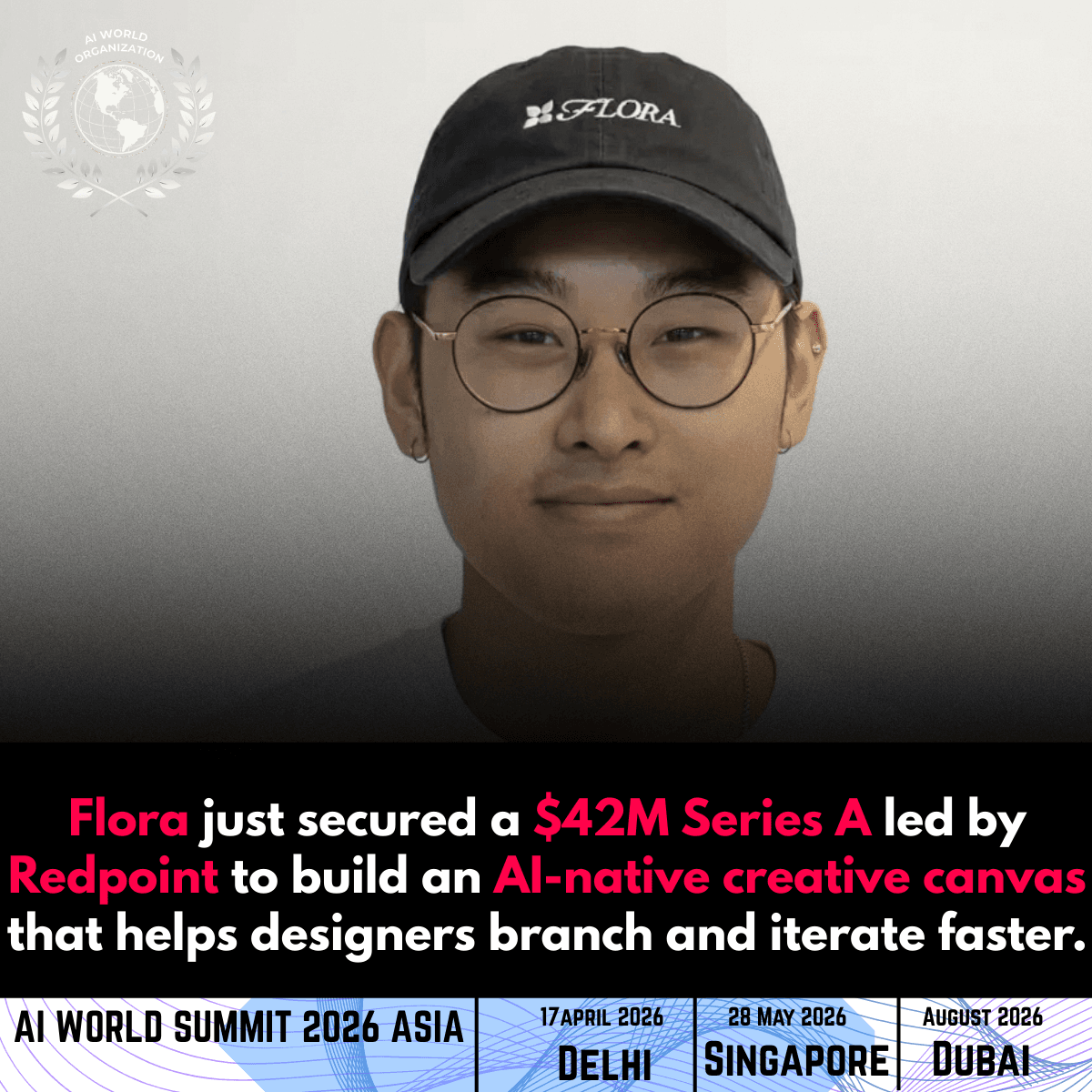
Flora raised $42M led by Redpoint to build AI-native design workflows. Learn what it means for creators and teams at the ai world summit 2026.
TL;DR
Flora, a node-based generative design platform used by teams at Alibaba, Brex, Pentagram and Lionsgate, raised $42M Series A led by Redpoint (total $52M). It’s building an intelligent canvas to generate and branch images/video from text, images or clips, so creatives can iterate faster without jumping between tools, while the team adds tighter controls.
Flora Raises $42M Series A to Build AI-Native Creative Workflows
Flora, a generative AI design platform used by teams at Alibaba, Brex, Pentagram, and Lionsgate, has secured $42 million in Series A funding led by Redpoint Ventures, taking total funding to $52 million. As the ai-native creative tooling category accelerates, this round signals growing enterprise confidence in workflows that treat AI as the core interface—not a side feature—and it’s a shift the ai world organisation continues to track across the ai world summit and other ai world organisation events.
The $42M raise and what it funds
The Series A round was led by Redpoint Ventures and brings Flora’s total funding to $52 million. Flora’s product is already being used by designers at Alibaba and Brex, as well as teams at Pentagram and Lionsgate, which indicates the tool is finding real adoption in high-demand creative environments. The company is led by founder and CEO Weber Wong, who previously worked as an investor at Menlo Ventures before moving deeper into the intersection of art and technology through NYU’s Interactive Telecommunications Program.
Flora’s positioning is clear: it wants to be the place where creative teams think, explore, and assemble generative work—not just type prompts in a box and download outputs. In reporting on the company, Flora is described as enabling creation and modification of media assets using text, image, or video inputs, with iterations mapped as connected nodes on a canvas. That “canvas + branching versions” approach matters because it’s closer to how professional teams actually work: exploring directions, comparing variants, and keeping a traceable creative path rather than losing decisions in a long chat history.
From the lens of the ai world organisation, this is exactly the kind of “workflow-first AI” story that belongs in conversations at the ai world summit and in the broader set of ai conferences by ai world—because it’s not just about model quality, it’s about how teams operationalize creative judgment at scale. As we look at ai world summit 2025 / 2026 themes and the practical constraints teams face, tooling like Flora sits at the intersection of creativity, productivity, governance, and collaboration.
Why “AI-native” design workflows are different
Many mainstream creative products have added AI features, but Flora is being framed as a new interface built for a world where creators need to orchestrate multiple generative models and move faster across concept-to-production. TechCrunch’s description emphasizes a node-based system where prompts can generate modifications and new nodes, with versions connected on a canvas so the flow of creation stays visible. That’s an important detail because it changes the unit of work from “a single output” to “a system of variations,” which is closer to how creative direction, client review, and iteration cycles actually operate.
Flora itself describes its product as an “intelligent canvas” where “text, image, and video models” can live in one place without constant tab-switching, reflecting an attempt to unify the creative workflow across media types. The company also highlights the idea of turning a single concept into scalable workflows for producing many assets while staying consistent and on-brand. When you connect this to enterprise adoption, the promise isn’t only speed; it’s repeatability and handoff—two things that historically break when teams rely on ad-hoc prompting across disconnected tools.
In practical terms, “AI-native” can be read as three things happening at once: first, creative exploration becomes parallel (many variations at once); second, the workflow becomes structured (nodes, graphs, reusable systems); third, collaboration becomes native (teams working in the same environment rather than passing files between apps). For creative leads, that structure is not about restricting creativity—it’s about keeping options alive while still moving toward decisions that can be executed reliably across formats, channels, and deadlines.
These are also the kinds of tactical, day-to-day issues that show up in real conversations at the ai world summit, because founders, agencies, and marketing teams don’t just need inspiration—they need workflows that survive client feedback, brand constraints, and operational pressure. That’s why the ai world organisation keeps emphasizing practical adoption: it’s not enough to have “cool outputs,” teams need systems they can run repeatedly, teach internally, and measure.
What enterprise teams are buying when they buy Flora
Enterprise adoption signals more than curiosity; it suggests the tool fits into real production environments where quality, consistency, and turnaround time matter. Flora is described as letting users create media assets using image, text, or video, while maintaining a mapped set of iterations on a canvas—an approach that can make review and refinement more manageable for teams. This “trackable creation graph” becomes valuable when multiple stakeholders are involved, because it preserves the reasoning behind a direction: what was tried, what changed, and why a final option was chosen.
From a business standpoint, the problem enterprises face is rarely “can we generate an image”; it’s “can we generate consistently, with approvals, with brand rules, and with clarity about provenance and edits.” Flora’s canvas framing—and the broader category of node-based creation—addresses a real workflow gap: creative work is iterative by nature, and teams need an interface that makes iteration legible rather than chaotic. When that iteration is legible, it’s easier to build a repeatable pipeline for specific use cases such as campaign concepts, product visualization, or early-stage video ideation.
There’s also a larger shift happening: as generative tooling becomes a normal part of creative production, organizations want to reduce tool fragmentation. The creator experience in many stacks today is still “generate here, edit there, version elsewhere, share in another place,” which creates risk and wasted time; Flora is explicitly pitching the opposite—a unified environment that composes multiple steps in one screen. That’s not just a UX preference; it affects cycle time, how quickly teams can test ideas, and how confidently they can scale output without degrading quality.
For the ai world organisation, this is also why enterprise AI conversations increasingly include creators and designers—not only engineers and data teams. The future of AI in business will be shaped by the people who turn strategy into artifacts: product visuals, storyboards, brand systems, launch assets, and content that moves markets. That cross-functional reality is a key reason ai world organisation events span multiple tracks and communities, bringing together operators, creators, and builders who are all impacted by AI’s new interfaces.
The competitive landscape and the “new interface” thesis
Flora’s round lands in a market where big incumbents and newer startups are both pushing AI deeper into the creative process. TechCrunch notes that companies like Adobe, Figma, and Canva have added AI features, while newer startups argue that to properly accommodate AI and compare different models, you need new workflows and a different interface. Flora’s bet is that a node-based, canvas-driven approach can make fast iteration and branching more intuitive, even though node-based creation has historically been complex for many users.
In the same reporting, Weber Wong is quoted describing an opportunity to stitch models together and run an entire workflow in one screen, which frames the product as an “interface innovation” rather than only a “model innovation.” That framing matters because model capabilities will continue to commoditize; workflow integration and collaboration design may become the lasting moat for creative tools. If you accept that thesis, then funding is not just about hiring or marketing—it’s about building the product depth needed to support professional-grade creative controls, repeatable pipelines, and editing capabilities that teams actually trust.
This also explains why investors and operators watch the “creative workflow stack” so closely: when creative production compresses from weeks into hours, the competitive advantage doesn’t just sit inside agencies—it moves into in-house teams, startups, and individual creators who can now execute at a higher level. In Redpoint’s public commentary, the firm highlights Flora’s potential to cover the workflow “from ideation to pixel-perfect editing,” reflecting the idea that the winning tools will be end-to-end rather than single-purpose generators. As this space evolves, it will likely reward platforms that can keep creators in flow, preserve decision context, and help teams scale output without losing taste.
These shifts sit naturally alongside the discussions happening across the ai world summit ecosystem, because they represent a real change in how businesses build brands and content in an AI-powered era. When ai world summit 2025 / 2026 conversations focus on practical adoption, it includes questions like: which workflows reduce bottlenecks, how teams manage quality, and what governance looks like when generation and editing happen inside one AI-native canvas. That’s why ai conferences by ai world and other ai world organisation events are increasingly relevant not just for “AI people,” but for creative and marketing leaders who need to turn AI into measurable execution.
What this signals for creators—and why it matters for The AI World Organisation community
Flora’s funding round is a reminder that the creative industries are no longer on the edge of AI adoption; they’re becoming a major proving ground for AI-native workflows. When designers can branch concepts, maintain linked versions, and iterate across media types inside a single canvas, they’re effectively building “creative systems,” not just outputs. That system-thinking is what allows teams to move from experimentation to production, where repeatability and collaboration become the difference between a demo and a dependable workflow.
For the ai world organisation, stories like Flora’s are valuable because they map directly to how the global AI community is evolving: AI is shifting from “tools you occasionally use” to “interfaces you work inside every day.” The AI World Organisation positions itself as a global entity fostering innovation and collaboration at the intersection of AI and business, organizing summits and community events worldwide, and the creative workflow layer is now a core part of that business intersection. On the events side, the site highlights AI World Summit 2026 Asia & Global AI Awards scheduled for May 28, 2026 in Singapore, signaling a strong emphasis on practical AI leadership, networking, and real-world application.
The ai world summit format also emphasizes tactical learning and workflows that creators, founders, and agencies can apply, which aligns closely with the kinds of “how do we actually do this day-to-day” questions that AI-native creative platforms are trying to answer. In other words, while Flora builds the product layer, the ai world organisation helps shape the community layer—where leaders compare notes on what works, what scales, and what breaks when AI meets real production constraints. That community layer becomes even more important as new interfaces change how teams collaborate, because best practices, governance, and creative standards will be rewritten in public—through case studies, workshops, and operator conversations at ai world organisation events and other ai conferences by ai world.
If you’re following the trajectory from ai world summit 2025 to ai world summit 2026, the big signal is clear: AI adoption is increasingly defined by workflow design, not just model access. Platforms like Flora are betting that the next creative advantage will come from unified canvases, branching iteration graphs, and reusable systems that encode taste and decisions—not from a single “best prompt.” And for teams planning their next phase of adoption, this is exactly the kind of category to watch, discuss, and pressure-test with peers at the ai world summit and across the ai world organisation events calendar.


