Equal AI Raises $30M Series B Led by Prosus
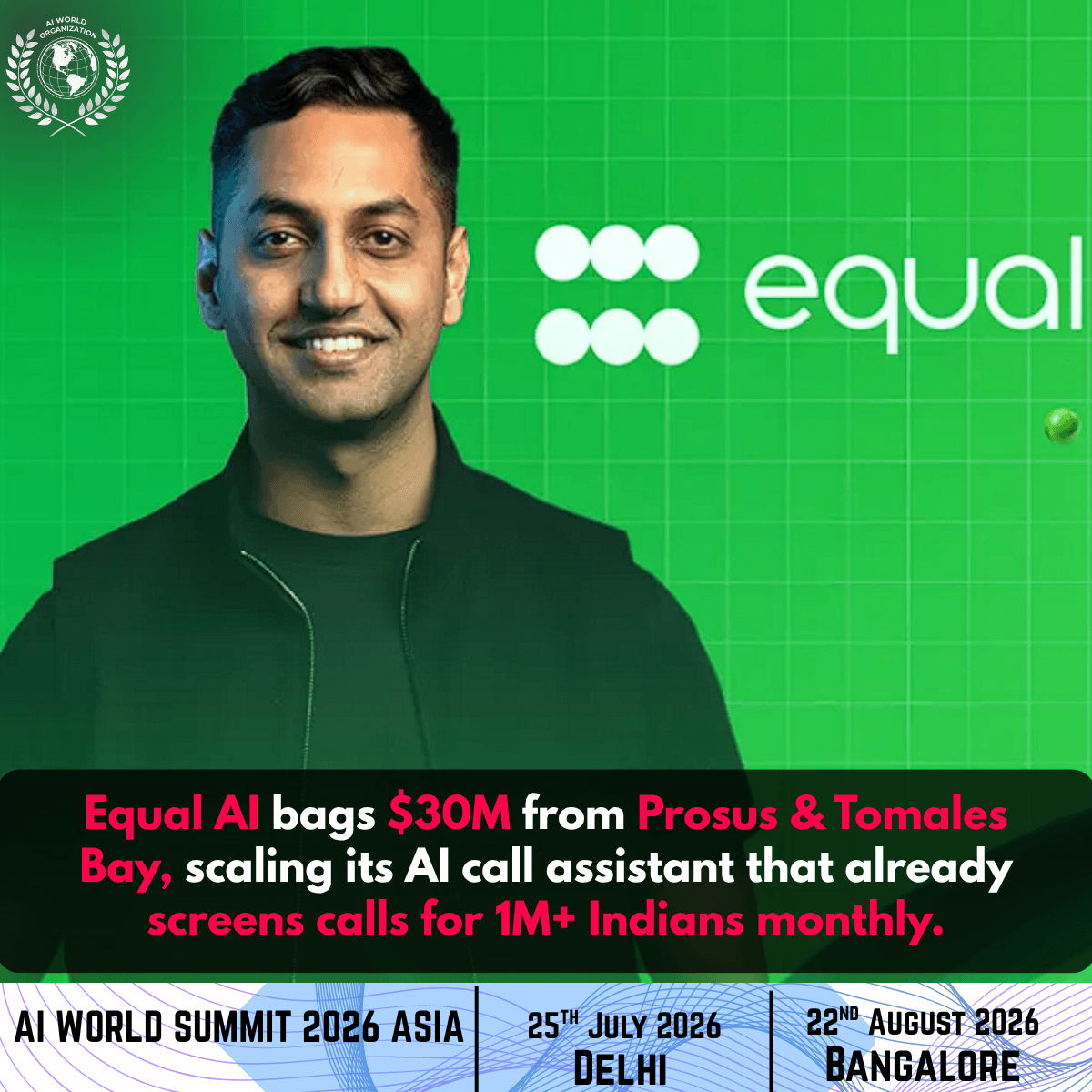
Hyderabad's Equal AI raises $30M Series B led by Prosus Ventures and Tomales Bay Capital to scale its AI call assistant, crossing 1 million users in India.
TL;DR
Hyderabad startup Equal AI just closed a $30 million Series B, with Prosus Ventures and Tomales Bay Capital returning to lead the round again. Its AI call assistant, which screens spam calls and tells you why someone is calling, has already crossed 1 million monthly users in under eight months. The fresh funds will go toward expanding into financial services, shopping, and everyday lifestyle help.
Equal AI Secures $30 Million Series B as Prosus and Tomales Bay Capital Double Down on India's Booming AI Assistant Race
India's consumer AI ecosystem has just witnessed another major funding milestone, and this time the spotlight is on Hyderabad-based Equal AI, a startup that has quietly become one of the fastest-growing AI products in the country. The company has announced a fresh infusion of $30 million in a Series B funding round, co-led by global investment giant Prosus Ventures and California-based Tomales Bay Capital. The development signals growing investor confidence in India's appetite for AI-native consumer applications, particularly those built around voice and call intelligence, an area where Equal AI has carved out a strong early lead.
For the team at The AI World, this announcement is a significant data point in our ongoing coverage of how artificial intelligence is reshaping everyday life for hundreds of millions of smartphone users across India. It also reinforces a theme we have been tracking closely through our reports and community discussions: the shift of AI innovation from purely enterprise-facing tools to deeply personal, consumer-first assistants that solve real, everyday frustrations. Equal AI's journey, from being a behind-the-scenes data infrastructure provider to becoming a household name for call screening, is a story that mirrors the broader transformation happening across India's technology landscape.
A Closer Look at the $30 Million Series B and Its High-Profile Backers
The Series B round was co-led by Prosus Ventures and Tomales Bay Capital, two investors who are no strangers to Equal AI. Both firms had previously come together to lead the company's $10 million Series A round back in November 2024, a round that, according to industry reports, valued the company at around $80 million at the time. The decision by both investors to return and lead a significantly larger round just over a year later speaks volumes about how Equal AI's growth trajectory has played out since then.
What makes this round particularly noteworthy is the breadth and calibre of participants who joined the cap table. The list includes Valiant Fund and Think Investments, both well-known names in growth-stage technology investing, alongside a striking roster of individual strategic investors. Among them is Sameer Nigam, the founder of PhonePe, one of India's largest digital payments platforms, whose involvement brings deep fintech and consumer-scale product expertise to the table. Zubin Bharti Mittal, who represents the family office connected to telecom major Airtel, also joined the round, a move that carries particular significance given Equal AI's product sits directly in the telecom and communications space.
The round also drew participation from Anshu Sharma, co-founder of data privacy company Skyflow, whose background in identity and data security aligns closely with Equal's original roots as a consent-based data-sharing platform. Sandhya Devanathan, who serves as Meta's vice president for India and Southeast Asia, also took part, adding a strategic voice from one of the world's largest consumer technology companies. Rounding out the list is Sridhar Pinnapureddy, chairman of CtrlS Datacenters, bringing infrastructure and enterprise technology expertise into the mix.
This combination of institutional capital and individually influential operators and founders suggests that Equal AI's pitch is resonating not just with traditional venture investors but also with people who have built and scaled some of India's most recognisable consumer technology brands. While the company has not publicly disclosed its new valuation following this round, the calibre of repeat and new investors indicates a meaningful step up from where it stood after its Series A.
From Consent-Based Data Infrastructure to Building India's First AI Call Assistant
To understand why investors are so enthusiastic about Equal AI, it helps to look at where the company came from. Equal was founded in 2022 by Keshav Reddy, an entrepreneur whose background blends venture investing experience with deep roots in one of India's well-known business families. Before starting Equal, Reddy had been involved in backing a number of high-profile startups, including names like Cred, Upstox, Hive, Genies, and Chipper Cash, giving him a front-row seat to how consumer technology companies scale in emerging markets.
When Equal first launched, it was not a consumer-facing product at all. Instead, the company built itself around consent-based data sharing and identity infrastructure, essentially creating the plumbing that allows banks, lenders, insurers, telecom operators, and digital service providers to securely access and verify user data with explicit consent. This positioned Equal as part of India's broader account aggregator ecosystem, often compared to the foundational role that UPI plays in digital payments. Over time, this infrastructure business grew to serve a substantial enterprise customer base across banking, lending, insurance, and telecom sectors, quietly becoming a critical backend layer for digital financial services in the country.
The pivot toward consumers came in October 2025, when Equal launched its AI-powered call assistant under the Equal AI brand. The founder has explained that the company always intended to build something consumer-facing eventually, but wanted to choose a starting use case that would create immediate, tangible value. Call screening and spam management emerged as the obvious entry point, given how disruptive unwanted calls have become for everyday smartphone users in India. The idea was that if the product could win decisively in this one use case, it would build the kind of user trust and habit-forming behaviour needed to expand into other categories later.
This strategic choice has paid off in ways that even the company may not have fully anticipated. Within roughly eight months of its public launch, Equal AI has gone from a niche beta product available to a small group of early users in Delhi NCR to a platform used by over a million people every month across India, a trajectory that has clearly caught the attention of both existing and new investors.
How Equal AI Is Tackling India's Massive Spam and Unknown Call Problem
At its core, Equal AI is built to solve a problem that almost every smartphone user in India can relate to: the constant stream of calls from unknown numbers, many of which turn out to be sales pitches, scam attempts, delivery updates, or service-related queries. According to the founder, the average Indian smartphone user receives somewhere between four and five calls from unfamiliar numbers every single day, a volume that makes manual screening exhausting and often counterproductive.
Traditional caller identification tools like Truecaller, along with newer regulatory mechanisms such as India's Calling Name Presentation system, have attempted to address this by showing users who is calling before they pick up. However, simply knowing a name attached to a number often does not solve the underlying problem. A single phone number might be used for a legitimate delivery update one day and a fraudulent scheme the next, and knowing the caller's identity does not tell a user why they are calling or what they actually want.
Equal AI approaches this differently. Rather than just identifying a caller, the AI assistant can actually answer unfamiliar calls on the user's behalf, engage the caller in a natural conversation, and figure out the intent behind the call. Once it has gathered enough context, whether that is a delivery executive needing directions, a bank representative following up on an application, or a telemarketer pitching a product, the assistant summarises this information for the user in simple terms. Depending on the situation, users can choose to take over the call directly, have the assistant continue handling it, or simply review a summary later and decide whether any action is needed.
This approach effectively positions Equal AI as a layer that sits between the user and the chaos of everyday telecommunication, doing the tedious work of filtering, understanding, and triaging calls so that people only need to engage with what genuinely matters to them. For a country where voice remains the dominant mode of interaction with technology for a huge share of the population, this kind of voice-first AI assistant addresses a need that text-based apps and traditional caller ID tools have struggled to fully meet.
The Growth Numbers That Have Investors Paying Close Attention
Numbers tend to speak louder than pitch decks, and Equal AI's growth metrics are a big part of why this funding round has generated so much buzz within India's startup and investment circles. The company has reported crossing one million monthly active users and around 350,000 daily active users within just eight months of its public launch in October 2025. To put that in perspective, the company had earlier set an internal target of reaching one million daily active users by the middle of 2026, and while that specific milestone has not yet been hit, the monthly user numbers already exceeding a million suggest the platform is scaling at a pace that is hard to ignore.
What is perhaps even more interesting is how this consumer growth sits alongside Equal's existing enterprise business. The company says its identity and data-sharing infrastructure now serves more than 350 enterprise customers and processes over one billion transactions annually. This means Equal AI is not a single-product startup riding one wave of hype, it is a company that has built a substantial, revenue-generating enterprise backbone while simultaneously launching and scaling a consumer product that has gone viral in its own right within a relatively short window.
For investors, this dual-engine structure is particularly appealing. The enterprise infrastructure business provides a degree of stability and existing revenue, while the consumer AI assistant represents the high-growth, high-potential side of the business that could eventually become the company's primary value driver if it continues expanding into new categories such as financial services, shopping, lifestyle management, and concierge-style tasks, as the company has indicated it plans to do with this fresh capital.
What This Funding Round Signals for India's Wider Consumer AI Landscape
Zooming out from Equal AI specifically, this funding round is also a useful indicator of where investor attention is heading within India's broader artificial intelligence ecosystem. There has been a noticeable shift over the past year toward AI-native consumer applications that are built specifically around how people in India actually use technology, rather than adaptations of products designed primarily for Western markets. Voice-based products, in particular, are gaining traction because they map naturally onto how a huge segment of India's population, including users who may not be comfortable with English-language text interfaces, prefers to communicate.
Equal AI's positioning as a tool that understands local calling patterns, where the same phone number might represent very different things depending on context, reflects a broader recognition among investors that successful AI products in India need to be built around local nuance rather than simply translated or localised versions of global tools. The involvement of operators like the founder of PhonePe and senior leadership from Meta's India operations in this round also suggests that some of the country's most experienced consumer technology minds see genuine long-term potential in this category.
For organisations like The AI World, tracking developments such as Equal AI's Series B round is part of a broader effort to map how artificial intelligence is moving from research labs and enterprise dashboards into the pockets of everyday people. As companies like Equal AI continue to expand their AI assistants into new domains such as financial services, shopping assistance, and lifestyle concierge functions, the line between a simple utility app and a comprehensive personal AI assistant is likely to blur further. With $30 million in fresh capital and a strong roster of backers, Equal AI now has the resources to push aggressively into this next phase, and the coming months are likely to reveal just how far the company's ambitions extend within India's rapidly evolving AI assistant market.
As always, The AI World will continue monitoring funding rounds, product launches, and policy developments across India's AI ecosystem, bringing our readers timely updates on the startups, investors, and innovations shaping the future of artificial intelligence in the country. Readers interested in deeper discussions around consumer AI trends, funding patterns, and upcoming AI World events and community sessions are encouraged to stay connected with our ongoing coverage for further updates on this fast-moving space.