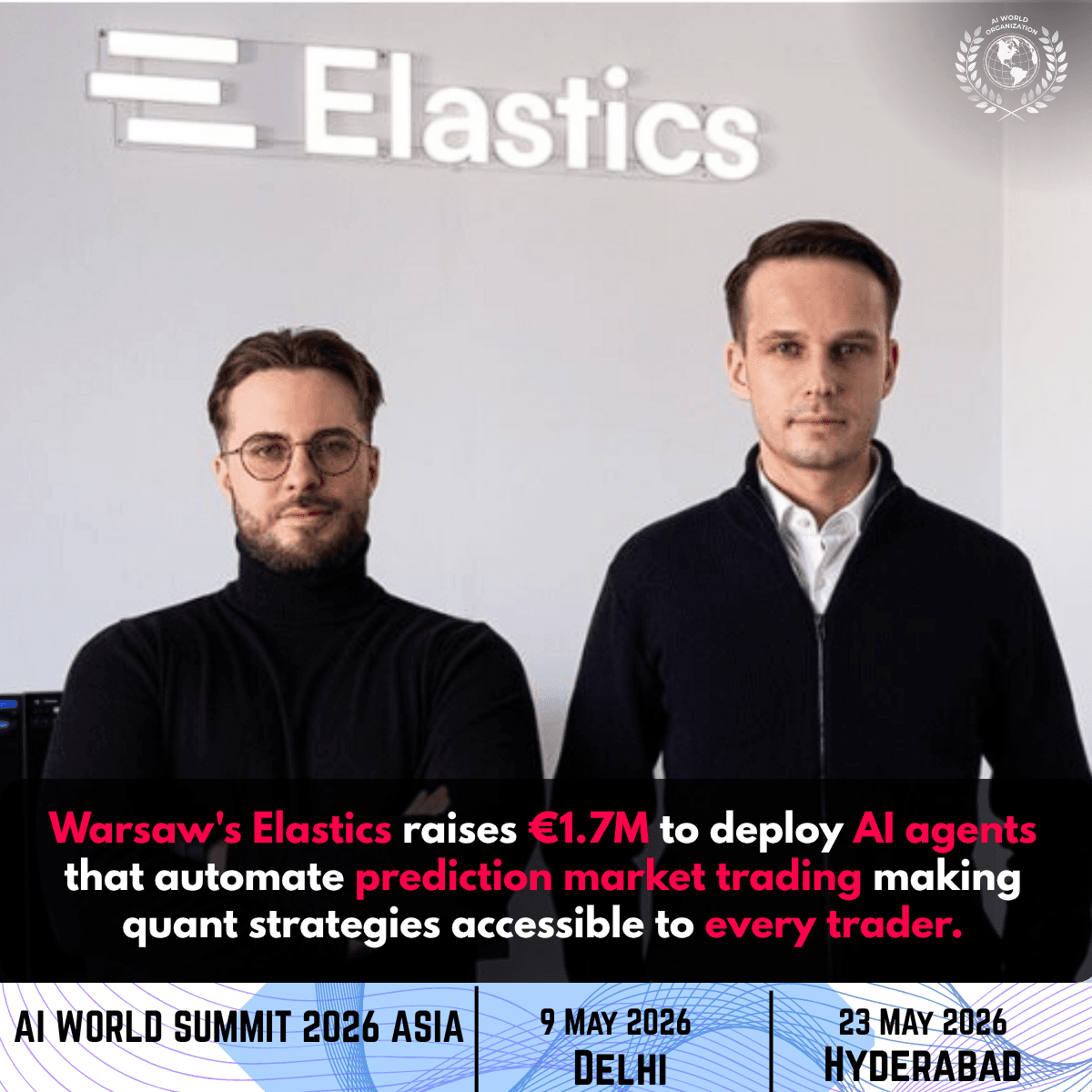
Elastics Raises €1.7M for AI Prediction Market Agents
Warsaw startup Elastics raises €1.7M in pre-seed funding to deploy AI agents for prediction markets, democratizing quant trading for all.
TL;DR
A Warsaw-based startup, Elastics, has raised €1.7 million in an oversubscribed pre-seed round to develop AI agents that automate trading on prediction markets. The platform is designed to bring institutional-grade quantitative trading tools to everyday traders — eliminating the need for complex infrastructure so they can focus purely on strategy and returns. The round closed at nearly €2 million due to high investor demand.
Polish AI Startup Elastics Bags €1.7 Million in Pre-Seed Round to Reshape Prediction Markets with Autonomous Agents
In a significant development for the European AI funding landscape, Warsaw-based startup Elastics has successfully closed an oversubscribed pre-seed funding round of €1.7 million — a testament to growing investor confidence in AI-driven financial technology. This latest AI funding news has placed Poland firmly on the radar of global tech investors, as Elastics prepares to deploy a next-generation platform that uses intelligent autonomous agents to automate trading workflows in prediction markets. The round was oversubscribed, ultimately reaching approximately €2 million, signaling overwhelming investor enthusiasm for the startup's vision of making quantitative trading accessible to a broader audience through the power of artificial intelligence. The AI funding round marks yet another milestone in what has been an increasingly active year for AI investments across Central and Eastern Europe.
Elastics was founded with a clear and ambitious mission: to take the complexity out of prediction market trading by providing traders with institutional-grade AI tools that were previously available only to large hedge funds and financial institutions. Prediction markets, which allow participants to trade on the outcomes of future events — from elections to economic indicators — have long been considered a domain requiring deep technical expertise and sophisticated data infrastructure. With this fresh AI funding in place, Elastics is poised to change that narrative entirely, offering a streamlined platform where traders can focus on generating alpha rather than wrestling with backend infrastructure. The company's founding team, which combines deep expertise in financial technology and artificial intelligence, believes that the timing could not be more ideal given the explosive global growth of both prediction markets and autonomous AI agents.
Why Prediction Markets Are the Next Big Opportunity in AI Finance
Prediction markets occupy a unique and underexplored niche within the broader financial derivatives ecosystem. Unlike traditional derivatives instruments — which often involve complex variables like Greeks, volatility modeling, and advanced pricing mechanisms — prediction markets strip all of that away and offer something elegantly simple: a direct, binary expression of probabilistic views on future events. This simplicity makes them ideal as a testing ground for AI agents, which can process vast amounts of real-time and alternative data to identify patterns, generate signals, and execute trades with precision and speed that far exceeds human capability. Elastics' founding team has previously pitched the concept at high-profile venues including Davos Innovation Week, where the idea received strong traction among global fintech leaders and investors.
Despite the inherent simplicity of prediction markets as financial instruments, the tooling available to traders participating in these markets has historically lagged far behind the infrastructure available in more mature financial markets. Elastics is addressing this tooling gap directly by building a comprehensive platform that brings together live data feeds, alternative data sources, and AI-powered signal generation under one roof. The platform is designed with institutional-grade execution and risk management capabilities, ensuring that even retail traders can operate with a level of precision and discipline that was previously inaccessible. In the broader context of AI funding news globally, this investment reflects a growing recognition that AI applications in finance go well beyond chatbots and customer service, extending into deep, high-value domains like quantitative trading and market prediction.
The timing of this AI funding round also aligns with a broader global surge in interest around agentic AI — a category of artificial intelligence in which autonomous software agents take independent actions, make decisions, and execute workflows without requiring constant human intervention. According to market research from MarketsandMarkets, the AI platform market is projected to grow from approximately USD 18.22 billion in 2025 to over USD 94.30 billion by 2030, reflecting a compound annual growth rate that underscores the enormous opportunity that companies like Elastics are tapping into. Against this backdrop, the latest AI funding for Elastics represents not just a vote of confidence in the company itself, but in the broader thesis that agentic AI will fundamentally transform how financial markets operate.
What Elastics Is Building: Platform, Technology, and Vision
At its core, Elastics is building an intelligent trading automation platform purpose-built for prediction markets. The platform allows traders to automate their entire trading workflow — from data ingestion and signal generation to order execution and risk management — using AI agents that continuously learn and adapt to changing market conditions. One of the key differentiators of the Elastics platform is its ability to ingest and process both live market data and alternative data sources simultaneously, uncovering non-obvious signals that human traders or traditional quantitative models might miss entirely. This approach mirrors the methodology used by top-tier quantitative hedge funds, but packages it in a way that is accessible, scalable, and affordable for a much wider range of traders and investors.
The company's AI agents are designed to adapt to each trader's portfolio in real time, adjusting strategies and risk parameters dynamically as market conditions evolve. Rather than relying on static, pre-programmed trading rules, these agents employ machine learning techniques to identify and exploit alpha-generating opportunities as they emerge, making the platform genuinely adaptive rather than merely automated. This is a critical distinction in the world of AI-powered finance — static automation only helps traders execute pre-defined strategies faster, while true AI agents can discover new strategies, respond to unexpected events, and manage risk in ways that static systems simply cannot. The company's LinkedIn presence and professional positioning clearly articulates this vision: "One platform where traders focus on alpha, not infrastructure."
Beyond the technology itself, Elastics has a broader democratization mission at the heart of its business. The founders strongly believe that quantitative trading — a discipline that has historically been locked behind the walls of elite financial institutions — should be accessible to any sophisticated trader who has the market insight and the will to compete. By abstracting away the engineering complexity of building and maintaining trading infrastructure, Elastics allows individual traders and smaller trading firms to compete on a more level playing field with larger, better-resourced institutional players. This democratization thesis is one that resonates strongly with investors focused on fintech and AI funding, as it mirrors successful democratization stories in other areas of finance such as commission-free stock trading and robo-advisory services.
The Broader Context: AI Funding and Europe's Growing Tech Ecosystem
The successful closing of Elastics' pre-seed round is part of a much larger story about the growing strength and maturity of Europe's AI startup ecosystem. Central and Eastern Europe, in particular, has emerged as a hotbed of technical talent and entrepreneurial ambition, with Warsaw increasingly positioned as a leading hub for deep technology startups. Poland has produced a number of notable technology companies over the past decade, and the startup ecosystem in Warsaw has benefited significantly from access to top engineering talent emerging from the country's world-class technical universities. The Elastics AI funding round adds another data point to a growing body of evidence that European investors are increasingly willing to back early-stage AI companies with bold, transformative visions.
On the global stage, AI funding news has been dominated in recent years by large rounds for generative AI and large language model companies. However, a new wave of AI funding is now flowing into more specialized vertical applications of artificial intelligence — including financial technology, healthcare AI, industrial automation, and autonomous systems. Elastics' successful raise reflects this shift, as investors increasingly look beyond the "foundation model" layer of the AI stack to fund companies that are building applied AI products in specific, high-value domains. This is precisely the kind of AI funding news that signals the maturation of the AI investment cycle, moving from infrastructure bets to application-layer companies solving real-world problems.
The oversubscribed nature of Elastics' pre-seed round — originally targeting €1.7 million but closing at approximately €2 million — is itself a telling indicator of the strong demand among investors for quality AI funding opportunities in the fintech vertical. Oversubscribed rounds typically occur when a company's vision, team, and market timing resonate so strongly with the investor community that more capital is offered than the company initially sought. For a pre-seed stage company, this is an especially meaningful signal, as pre-seed investors are making bets almost entirely on the team's capability and the market's potential rather than on proven revenue or customer traction. That Elastics managed to generate this level of excitement at such an early stage speaks volumes about the strength of its founding team and the compelling nature of the problem it is solving.
What This Means for the AI World and Future Outlook
Looking ahead, Elastics plans to use the newly secured AI funding to accelerate product development, expand its team, and deepen the capabilities of its AI agents across a growing range of prediction market platforms. The company is expected to focus heavily on data infrastructure in the near term, ensuring that its platform can process and act on information from a wide variety of market feeds with minimal latency. As prediction markets continue to grow in prominence — driven partly by increasing mainstream acceptance of platforms like Polymarket and Kalshi — the demand for sophisticated trading tools in this space is only going to intensify, and Elastics is positioning itself to be the infrastructure layer that serious prediction market traders rely on.
The broader AI world is watching developments like Elastics' raise with keen interest, as they offer a window into where the next wave of AI funding is heading. As foundation models become commoditized and the "picks and shovels" of AI infrastructure consolidate around a handful of large providers, the real value creation will increasingly occur at the application layer — in companies that take powerful AI capabilities and deploy them intelligently in specific, high-value contexts. Prediction markets represent exactly this kind of opportunity: a high-value, technically demanding domain where AI agents can deliver concrete, measurable advantages to traders and investors. The AI funding news around Elastics is therefore not just a story about one Warsaw startup — it is a signal of where the broader AI application economy is heading, and which kinds of companies are likely to attract capital and generate value in the years ahead.
With a strong founding team, an oversubscribed funding round, and a clear product vision, Elastics is well-placed to become a defining company in the AI-powered fintech space. As the AI world continues to evolve at a breathtaking pace, startups like Elastics — those that combine deep technical expertise with a clear understanding of their target market — will be among the most important to watch. For anyone tracking AI funding news in the European startup ecosystem, Elastics is unquestionably a name to keep a very close eye on in 2026 and beyond.


