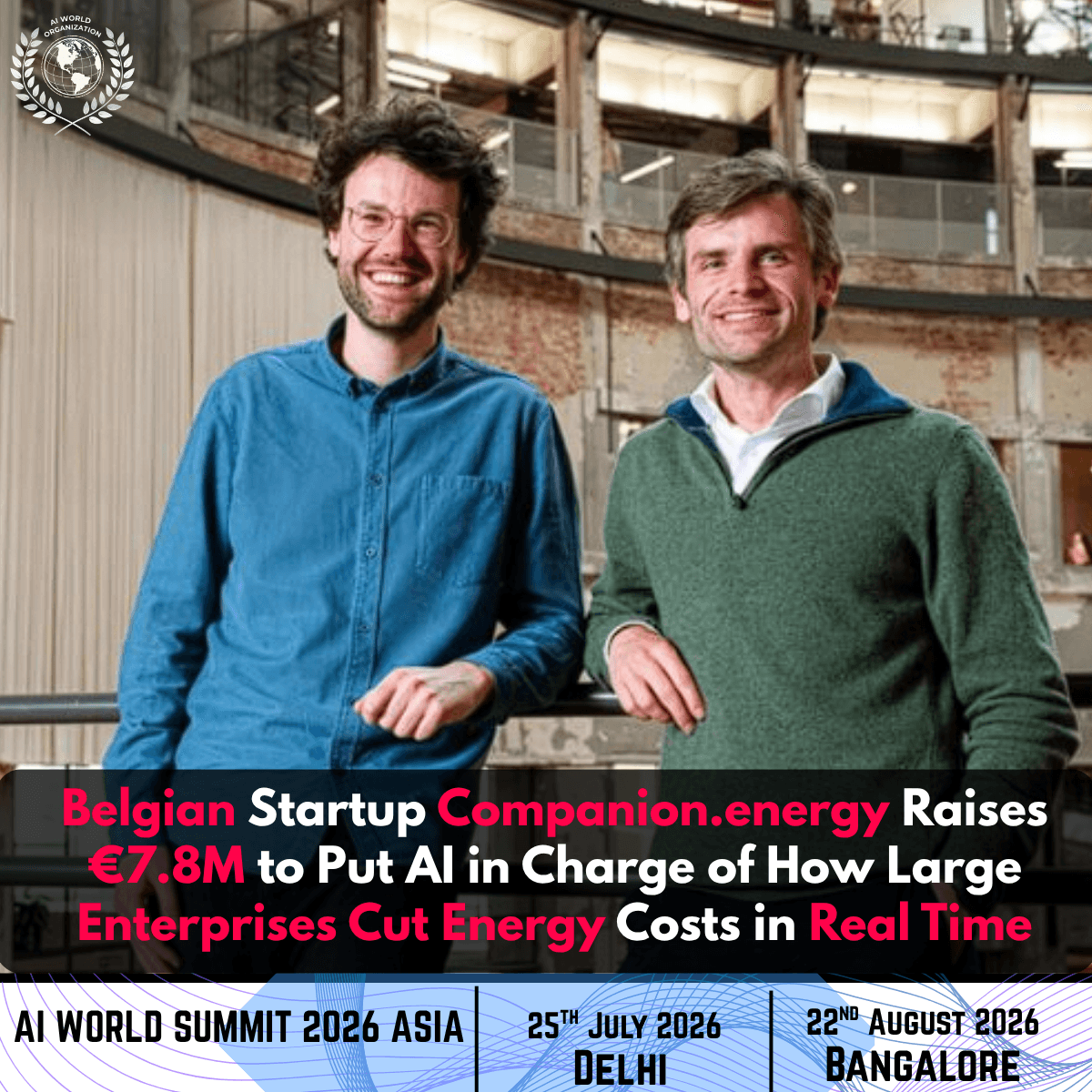
Companion.energy Raises €7.8M for AI Energy Management
Ghent's Companion.energy secures €7.8M Seed funding to scale its AI-powered real-time energy management platform across Europe's largest enterprises.
TL;DR
Ghent-based Companion.energy has closed a €7.8 million Seed round to expand its real-time energy management platform across Europe. Founded in 2022, the startup automates energy decisions for large enterprises — reducing costs by up to 30%. With major clients like TotalEnergies and KPN already on board and over €500M in annual energy spend under management, the company is now pushing into Germany and Spain.
Companion.energy Raises €7.8 Million to Revolutionise How Large Enterprises Handle Energy in Real Time
There is a quiet but deeply consequential transformation taking place across Europe's industrial landscape. It is not happening on factory floors or in boardrooms — it is happening inside the very infrastructure that powers those places. The way large enterprises buy, consume, and optimise energy is changing faster than most organisations can keep up with, and that gap between the speed of change and the tools available to manage it has become one of the defining operational challenges of this decade. It is precisely into that gap that a Belgian startup has stepped — and with fresh capital behind it, it is ready to scale significantly.
Companion.energy, a technology startup headquartered in Ghent, Belgium, has successfully closed a €7.8 million Seed funding round. The company has built what it describes as an AI-powered energy management platform that gives large industrial and commercial enterprises real-time visibility and automated control over their entire energy operation — from procurement contracts right through to the physical assets generating or consuming power on-site. The fresh capital will be directed at strengthening the platform's multi-asset and multi-market optimisation capabilities and fuelling a commercial push into new European markets, starting with Germany and Spain.
The round was led by Realyze Ventures, the Germany-based investment firm, and Pi Labs, the UK-based proptech and energy-focused venture capital fund, with further participation from Asterion Ventures out of France, alongside existing backers who chose to reinvest.
A Company Born Out of a Structural Shift in European Energy Markets
To understand why Companion.energy exists, it helps to understand the environment it was built for. Europe's electricity markets have been going through a structural upheaval over the past several years. The rapid integration of renewable energy sources — solar, wind, and increasingly battery storage — has fundamentally altered how power is priced and traded. Unlike the relatively predictable energy markets of a decade ago, where prices moved in broad seasonal cycles, today's markets can swing dramatically within hours or even minutes. Prices that once fluctuated over weeks now move in real time, driven by weather patterns, grid conditions, demand surges, and the growing complexity of distributed energy resources feeding into the system.
For large enterprises, this creates a new kind of operational and financial exposure. A manufacturer running several shifts a day, a logistics company managing temperature-controlled warehouses, a telecom operator maintaining energy-intensive data infrastructure — all of these organisations spend tens of millions of euros on energy annually. And yet, as co-founder Thomas Vyncke has noted, most of them are still managing that exposure through spreadsheets, fragmented dashboards, and manual procurement workflows that were designed for a much simpler energy world.
Companion.energy was founded in 2022 by Vyncke and Jonas Verstraeten with a clear thesis: that the energy transition would eventually force every large industrial player to manage energy far more actively than they had ever needed to before, and that the software tools to help them do that simply did not exist at the required level of sophistication. The two co-founders set out to build exactly that — a platform that could do for enterprise energy management what modern ERP systems did for supply chain and finance.
What the Platform Does and Why It Represents a Genuine Leap Forward
At the heart of Companion.energy's offering is a unified software platform that connects three things that most enterprises currently handle separately: their energy procurement contracts, their operational systems, and their distributed physical assets. That last category has grown enormously in recent years, as companies have installed solar panels on rooftops, deployed battery storage systems, added EV charging infrastructure for vehicle fleets, installed e-boilers to electrify heat, and connected a whole range of smart industrial systems to their energy supply.
The result of that buildout is an increasingly complex web of assets, all of which interact with each other and with volatile energy markets in ways that are simply impossible to optimise by hand. The Companion.energy platform addresses this by continuously forecasting energy demand across a customer's operations, modelling their exposure to market price movements, and automatically executing decisions — not just recommending them — to optimise the entire system in real time. This is an important distinction. Many existing energy management tools function as dashboards or recommendation engines, surfacing data and offering suggestions that a human analyst must then interpret and act on. Companion.energy's platform goes further, functioning as what the company calls a system of execution: it does not just show you what to do, it actually does it.
The practical impact of this is significant. Enterprises using the platform can optimise their procurement decisions dynamically, steering assets like batteries and solar installations in response to real-time market signals rather than static schedules. They can reduce curtailment, capitalise on arbitrage opportunities, and manage the economics of electrification projects much more effectively over time. According to the company, customers can expect energy cost reductions in the range of 10 to 30 percent, which on a portfolio spending hundreds of millions of euros annually translates into very material savings.
Dhruv Gupta, Principal at Pi Labs, put it clearly when he noted that enterprise energy management is evolving from static procurement and reporting toward around-the-clock real-time optimisation. He pointed out that despite spending tens of millions on energy every year, many large enterprises still rely heavily on spreadsheets, dashboards, and manual processes, and described Companion.energy as having built a deeply technical AI platform that fundamentally transforms software from a recommendation layer into something that actually executes. That framing — execution over recommendation — captures what makes the platform meaningfully different from the tools most enterprises currently rely on.
Investor Confidence Backed by Serious Commercial Traction
The €7.8 million round is a vote of confidence not just in the technology itself but in the commercial momentum Companion.energy has already built up. Investor appetite tends to sharpen considerably when a company can pair a compelling product thesis with evidence that real enterprises are paying for it, sticking with it, and expanding their usage. On that front, Companion.energy has delivered results that are genuinely hard to ignore.
Over the twelve months prior to closing this round, the company grew its customer base and revenue by a factor of ten, crossing the €1 million annual recurring revenue threshold in the process. For a company that had been operating quietly out of Ghent since 2022, that kind of acceleration is the sort of inflection point that signals a product has found its market and is beginning to scale. The growth trajectory — rather than just the absolute number — is what makes this milestone meaningful, because it suggests the company is in the early stages of what could become a much larger commercial curve.
The customer list the company has assembled is also worth noting. Companion.energy currently serves more than 30 enterprise clients across Belgium, the Netherlands, and Switzerland. These are not pilot customers or proof-of-concept engagements — they are large, sophisticated organisations with significant energy operations. The portfolio includes TotalEnergies, one of the world's largest integrated energy companies; KPN, the major Dutch telecommunications operator; the Port of Antwerp-Bruges, one of the biggest port complexes in the world; Interparking, a major European parking infrastructure operator; and Proximus Group, the leading Belgian telecoms and ICT provider. Across this portfolio, Companion.energy manages over two terawatt-hours of annual energy consumption and production, representing approximately €500 million in annual energy spend and revenue. It also currently manages more than 200 megawatts of distributed energy assets — solar PV installations, wind assets, battery storage systems, e-boilers, and EV charging infrastructure.
These are not vanity metrics. They are operational numbers that reflect the genuine scale at which the platform is already running, and they make a compelling case that what Companion.energy has built is production-grade infrastructure trusted by some of Europe's most energy-intensive organisations.
The Road Ahead: Germany, Spain, and Beyond
With the funding secured and a strong baseline of commercial traction in the Benelux region and Switzerland, Companion.energy is now setting its sights on the broader European market. The initial expansion push will be focused on Germany and Spain — two countries that represent very different but equally important dimensions of the European energy transition.
Germany is the continent's largest economy and one of its most ambitious in terms of the energy transition, with massive investments in renewables, a rapidly growing industrial electrification agenda, and a complex, highly liquid electricity market that creates both significant risk and significant opportunity for large energy consumers. Spain, meanwhile, has one of Europe's fastest-growing renewable energy sectors and a large industrial base that is increasingly grappling with the implications of electrification. Both markets present Companion.energy with a large addressable customer base and relatively underpenetrated competitive dynamics in the enterprise energy management software space.
Jonas Verstraeten, the company's co-founder, spoke to the decade-long opportunity ahead. His view, which clearly shaped the founding thesis from the very beginning, is that every large industrial enterprise will eventually need to manage energy actively as a core operational function — not as an afterthought handled by a small procurement team running spreadsheets. The transition from passive energy consumption to active energy management is, in his view, not a matter of if but when, and the organisations that make that transition earlier will gain a meaningful cost and operational advantage over those that do not. The new funding round, he noted, gives Companion.energy the runway to bring that software to many more enterprises across Europe and accelerate the pace at which companies can make that shift.
The broader strategic picture is also worth considering in the context of where European enterprise software investment is flowing. Over the past two years, the energy technology sector has attracted a growing wave of venture capital, as investors have come to recognise that the energy transition is not just an infrastructure story — it is also a software story. The physical assets being deployed across Europe's industrial landscape, from gigawatt-scale battery installations to millions of EV chargers, all require sophisticated software to operate optimally. Companies that can build that software layer — and particularly those that can do so at enterprise scale with the reliability and compliance requirements that large organisations demand — are in an increasingly valuable position.
What This Signals for the Future of AI-Driven Energy Management
The Companion.energy funding round sits within a broader and genuinely important moment for the intersection of artificial intelligence and energy management. At The AI World, we cover the frontiers of AI application across industries, and energy management is rapidly emerging as one of the most consequential domains for real-world AI deployment. The reason is straightforward: energy is both one of the largest cost items for industrial enterprises and one of the most complex to optimise, particularly as the asset landscape becomes more distributed and the market environment becomes more volatile.
What makes platforms like Companion.energy interesting from an AI perspective is that they are not using artificial intelligence as a marketing layer or a dashboard enhancement — they are deploying it as the core operational mechanism. The AI is not helping humans make better decisions by surfacing more data; it is making decisions autonomously, in real time, at a speed and scale that no human team could match. That is a meaningful step forward in how AI is being applied in industrial and enterprise contexts, and it carries implications that go well beyond the energy sector.
The ability to manage complex, multi-variable systems in real time — continuously forecasting demand, modelling financial exposure, and executing optimisation decisions across dozens of assets and multiple market contracts simultaneously — is essentially what modern AI infrastructure is designed to do well. The fact that Companion.energy has built a system that does this reliably, at scale, for some of Europe's largest and most demanding enterprises, and has demonstrated a ten-fold revenue growth trajectory in the process, suggests that the platform has achieved something genuinely difficult. Translating AI capability into enterprise-grade operational software that customers trust enough to let run autonomously is no small feat, and it is the kind of milestone that typically marks the beginning of a much longer growth story.
As Europe continues to navigate the complexities of the energy transition — with increasing renewable penetration, growing industrial electrification, ongoing market volatility, and regulatory pressure to reduce consumption and carbon intensity — the demand for exactly the kind of platform Companion.energy has built is only going to grow. The company's trajectory, its customer base, and the calibre of investors who have backed this round all point in the same direction: toward a future where real-time AI-driven energy management is not an optional upgrade for large enterprises, but a fundamental operational necessity.


