Cognition AI Raises $1B at $26B Valuation in 2026
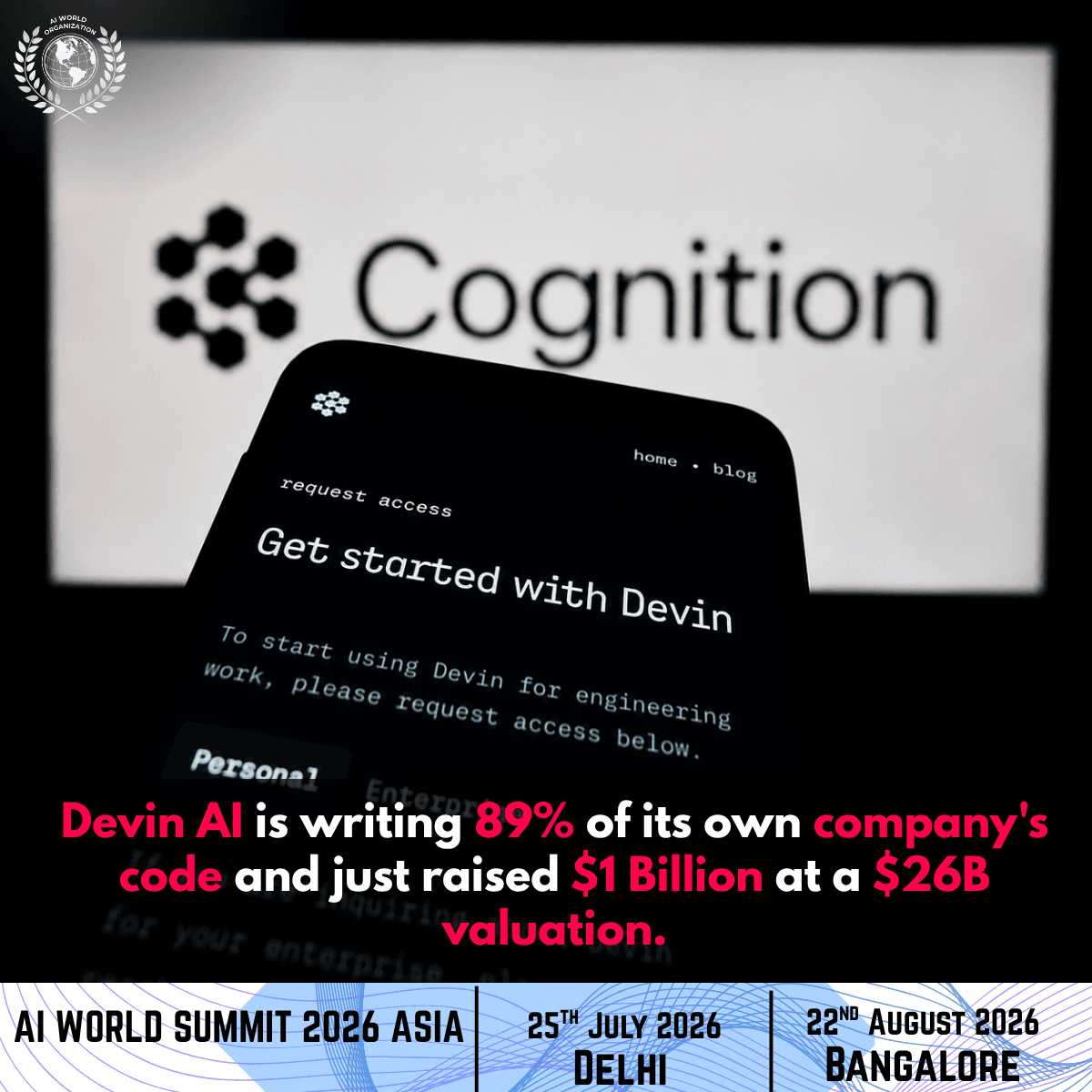
Cognition AI raises $1B at a $26B valuation as Devin writes 89% of its own code. See how this AI startup is reshaping enterprise software development in 2026.
TL;DR
Cognition AI just closed a $1B Series D at a $26B valuation. Its autonomous coding agent, Devin, now writes 89% of the company's own code and it's already live in production at Citi, Goldman Sachs, Mercedes-Benz, and the US Army. Enterprise usage grew over 10x in 2026, with annualised revenue at $492M. AI-native software development is no longer theoretical.
Cognition AI Raises $1 Billion at $26 Billion Valuation as Its AI Engineer Devin Now Writes 89% of the Company's Own Code
Eight months. That is how long it took a team of experienced engineers to modernise a legacy system for Mercedes-Benz. Then they handed the same task to Devin — Cognition's autonomous AI software engineer — and it was done in eight days. Not a prototype, not a partial fix. The job was completed, tested, and deployable in just over a week. If a single anecdote can summarise the seismic shift now unfolding inside the software industry, that is probably the one.
Cognition AI, the San Francisco-based AI agent lab, has now closed over one billion dollars in Series D funding at a staggering valuation of twenty-six billion dollars. The round was led by Lux Capital, General Catalyst, and 8VC, and saw continued backing from a constellation of prominent investors including Founders Fund, Elad Gil, Alpha Wave, Bain Capital Ventures, Vitruvian, Definition Capital, Conversion Capital, and 137 Ventures. New investors Ribbit Capital, Atreides, and Layer Global also joined the round. For a company that only came into existence in November 2023, reaching a $26 billion valuation in roughly two and a half years is the kind of growth trajectory that makes even the most seasoned venture capitalists sit up straight. At The AI World, we have been closely tracking how AI-native companies are reshaping entire industries — and Cognition may be the clearest example yet of what that transformation looks like at full speed.
From Zero to $26 Billion: Cognition's Rapid Rise Through the Funding Ranks
To appreciate how extraordinary this latest raise is, you need to look at the trajectory. Cognition's funding history reads less like a traditional startup arc and more like a controlled detonation. The company secured a $400 million round in September 2025 at a $10.2 billion valuation. Just months later, following its acquisition of Windsurf — the popular AI code editor whose founding team had drawn attention from Google — Cognition closed another $500 million round at a valuation approaching $10 billion at the time. The Series D, now confirmed at $1 billion-plus and a $26 billion valuation, represents a near-tripling of its worth in the span of just over half a year.
The founding team behind this growth is relatively small and remarkably young. Scott Wu serves as CEO, Steven Hao as CTO, and Walden Yan as Chief Product Officer. The three co-founders built Cognition with a singular thesis: that the future of software development would not be about AI tools that sit alongside human developers and offer suggestions, but about AI agents that take full ownership of engineering tasks from start to finish. That philosophy has proven commercially prescient in ways that even optimistic forecasters might not have expected this quickly. What began as a bold claim — that an AI could function as a genuine software engineer, not just an autocomplete tool — has become a business generating annualised run-rate revenue of $492 million, with enterprise usage growing more than tenfold in 2026 alone.
The investors who led this round are not newcomers to high-stakes deep technology bets. Lux Capital, General Catalyst, and 8VC have collectively backed companies like Zipline, Wealthfront, and Anduril — businesses that required years of patient capital before reaching commercial scale. Their decision to back Cognition at this valuation signals a conviction that AI-native software development is not a niche experiment. It is becoming a foundational layer of how serious technology businesses will build and maintain software going forward.
Devin: The AI Software Engineer That Actually Ships Production Code
Devin launched approximately two years ago as the world's first AI software engineer capable of independently handling an engineering task from initial brief to final deployment — writing code, running tests, debugging failures, and committing finished work, all without requiring a human to supervise each step. The product was met with a mixture of fascination and scepticism when it first appeared. Could an AI really be trusted to take end-to-end ownership of a complex software task? The answer, based on two years of real-world deployment across some of the most demanding organisations on the planet, appears to be an increasingly confident yes.
The most striking data point in Cognition's latest announcement is internal rather than external. Today, 89% of the code committed by Cognition's own engineers is written by Devin. Read that again slowly, because it is easy to skim past it. The engineers who built the world's most capable AI coding agent are themselves relying on that agent to produce nearly all of the code that keeps the business running and evolving. That is not a marketing claim or a controlled demo. It is the operational reality of a company that has essentially collapsed the boundary between the tool and its creator. When the people who understand the limitations of a technology better than anyone have chosen to depend on it for almost all of their own work, it tells you something fundamental about where the capability now stands.
The Windsurf acquisition, completed earlier this year, added significant depth to Cognition's product suite. Windsurf brought with it hundreds of thousands of daily active users and a proprietary model called SWE-1.6, which has since become one of the most widely used models across Cognition's platform. The deal was notable not just for its scale but for the context surrounding it: Windsurf's founders had been publicly courted by Google, and yet Cognition's offer prevailed. That outcome speaks to a broader competition for AI engineering talent and intellectual property that is playing out across the industry with increasing intensity.
Enterprise Adoption: From Pilot to Production Across Finance, Defence, and Automotive
One of the more revealing aspects of Cognition's current position is the breadth of its enterprise client base. This is not a company that has found a comfortable niche in one or two sectors. Citi, Goldman Sachs, Santander, and Itaú — one of Latin America's largest and most complex financial institutions — are all deploying Devin in production environments. Mercedes-Benz uses it for legacy modernisation. Dell has integrated it into its technology operations. Notably, the US Army and US Navy are also among confirmed clients, which suggests that even defence and national security environments — typically among the most conservative and compliance-heavy adopters of new technology — have concluded that autonomous AI development is mature enough for operational use.
The Itaú use case deserves particular attention because it goes beyond productivity metrics. The Brazilian banking giant is using Devin to automatically resolve 70% of its security vulnerabilities. Security remediation has historically been one of the most resource-intensive and time-sensitive challenges facing large financial institutions. Finding the vulnerability, understanding the codebase context, writing a safe fix, testing that fix, and deploying it without introducing new risks — that chain of steps typically requires skilled human engineers with deep domain knowledge. The fact that Devin is now handling 70% of this workload at one of the hemisphere's largest banks is a data point that compliance officers, CISOs, and board-level risk committees across the financial industry will be paying close attention to.
Systems integrators Infosys and Cognizant have gone further still, embedding Devin directly into client delivery workflows. That matters because both companies operate at the intersection of enterprise IT and large-scale software transformation programmes. By integrating an autonomous AI engineer into the services they deliver to their own clients, they are effectively multiplying the reach of Cognition's technology across dozens or potentially hundreds of additional organisations. When large consulting firms start building their delivery methodologies around a piece of technology, it signals something about where mainstream enterprise adoption is heading — and it is heading there faster than most predictions suggested even eighteen months ago.
The Competitive Landscape: How Cognition Differs From Copilot and Cursor
Any serious coverage of Cognition needs to address where it sits relative to the other major players in AI-assisted software development, because the distinctions matter enormously. GitHub Copilot, backed by Microsoft, remains the most widely deployed AI coding tool in the world by raw user numbers. Cursor, which closed a $2.3 billion Series D in November 2025 at a $29.3 billion valuation and is currently reported to be in talks to raise a further $2 billion at a potential $50 billion valuation, has carved out a strong position among professional developers who want a more powerful, contextually aware coding environment than Copilot offers.
The critical difference, however, is not about quality of code suggestion or the sophistication of the interface. It is about the fundamental model of how AI and human work together in the development process. Copilot and Cursor are both excellent tools, but they are fundamentally assistive — they help a developer work faster and more accurately by providing real-time completions, suggestions, and context-aware recommendations. The developer still defines the task, makes the architectural decisions, reviews every output, and decides what gets committed. The AI is a co-pilot in the truest sense: present, useful, and capable, but not in command.
Devin operates on an entirely different premise. You give it a task. It executes the task. It handles the intermediate steps — researching unfamiliar APIs, writing helper functions, running test suites, identifying why a test failed, adjusting the logic, and committing working code — without requiring human intervention at each stage. The human sets the destination; Devin navigates the route. That distinction sounds incremental when described in abstract terms, but the practical implications for engineering team structure, hiring, and organisational design are anything but incremental. If one AI agent can independently handle the work that would otherwise require multiple human engineers, the conversation about the future of software development jobs is not a distant hypothetical. It is a question companies need to be preparing answers to right now.
This is precisely why Cognition's growth trajectory commands attention beyond the venture capital community. At The AI World, we have been covering the rapid evolution of agentic AI systems — AI that does not just respond to prompts but takes sustained, goal-directed action across extended time horizons. Devin is perhaps the most commercially mature example of this category that exists today, and its adoption at firms like Goldman Sachs, the US Army, and Mercedes-Benz suggests that the era of agentic AI in production environments is not approaching. It has arrived.
What This Means for the Future of Software Engineering and the Broader AI Landscape
The $26 billion valuation placed on Cognition by this round of investors is not simply a reflection of current revenue — at $492 million annualised run-rate, the multiple is substantial even by the inflated standards of the AI sector. It reflects a bet on what autonomous software development will be worth as it scales from hundreds of enterprise clients to thousands, and as the technology continues to improve with each successive model update. Every dollar that flows into Cognition is, in effect, a wager that the autonomous AI engineer is not just a useful tool for the early majority of technology adopters — it is a structural shift in how software gets built, maintained, and evolved at every level of the economy.
For software engineers, that reality introduces a tension that the industry has not yet developed a consensus on how to handle. On one hand, developers who adopt agentic AI tools are becoming dramatically more productive, able to ship code faster and tackle more complex problems than they could working alone. On the other hand, if a single developer with Devin can accomplish what previously required a team, the arithmetic of technology hiring changes in ways that organisations and individuals will need to reckon with honestly. This is not the first time a new technology has reshaped a skilled profession, and historically those transitions have eventually created more roles than they eliminated — but the speed of the current shift is unlike anything previous technological transitions have produced.
The unanswered question that sits underneath all of Cognition's impressive numbers is one of governance and trust. Enterprises running financial systems, healthcare infrastructure, or defence platforms do not hand over operational control lightly. Legal, compliance, and security functions within large organisations are already grappling with questions about accountability when AI-written code creates vulnerabilities or errors. Who is responsible when an AI agent makes an architectural decision that later proves problematic? How do organisations audit what an autonomous system has built? These questions are not reasons to slow adoption — they are the agenda for the next phase of the conversation, and organisations that get ahead of them will be better positioned to extract the full value of what tools like Devin can offer.
At The AI World, we believe that moments like this — a company growing from founding to a $26 billion valuation in thirty months, with 89% of its own code now autonomously generated — are not just funding stories. They are signals about the shape of the decade ahead. The organisations, engineers, policymakers, and investors who understand those signals clearly will be better equipped to act on them. Those who wait for the trend to become undeniable before engaging with it may find that the window for meaningful preparation has already passed.