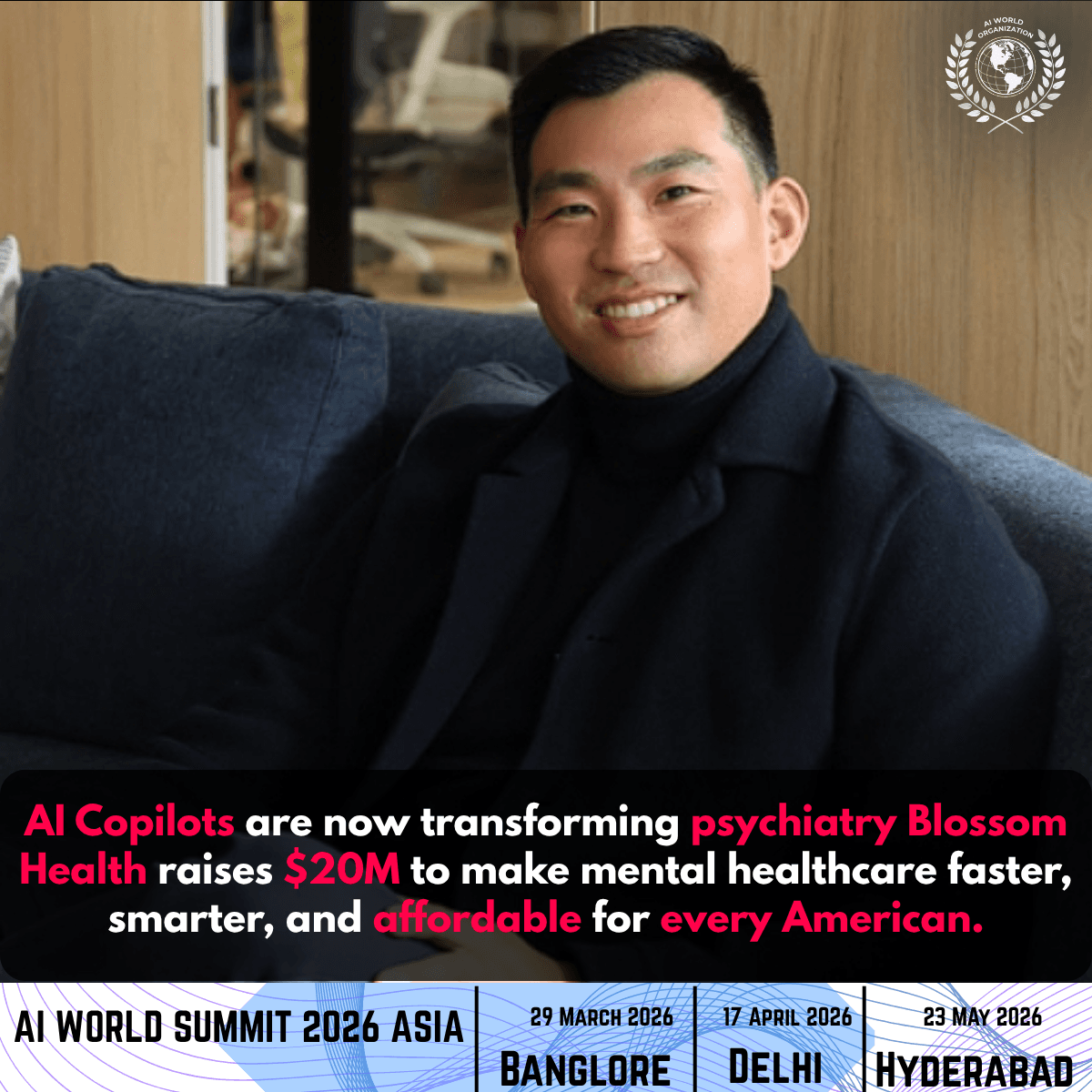
Blossom Health Raises $20M for AI Psychiatry
Blossom Health secures $20M in AI funding to deploy AI copilots across US psychiatry, cutting wait times, reducing admin load, and making mental care affordable.
TL;DR
Blossom Health, a New York-based telepsychiatry startup, has raised $20M in AI funding to bring AI-powered copilots to psychiatric care across the US. The platform cuts appointment wait times to under 48 hours, handles admin tasks automatically, and keeps patient copays as low as $22 making quality mental healthcare genuinely accessible for millions of Americans.
Blossom Health Raises $20M to Deploy AI Copilots Across Psychiatry Care in the US
The mental healthcare sector in the United States has long been caught in a difficult paradox — demand is rising sharply, yet the supply of qualified psychiatric professionals remains critically limited. Millions of Americans who need psychiatric attention either go without care entirely or wait weeks, sometimes months, for an appointment. Against this backdrop, a New York-based AI-native telepsychiatry company called Blossom Health has made a significant move that is drawing widespread attention across both the healthcare and technology investment communities. The company has successfully closed a combined seed and Series A funding round totalling $20 million, in a deal backed by prominent names from the global venture capital world. This latest AI funding news signals not just confidence in Blossom Health's model, but a broader recognition that artificial intelligence may finally be ready to solve one of modern medicine's most persistent challenges.
The round was led by Headline, a globally active venture capital firm, with co-founder and managing partner Mathias Schilling personally joining Blossom Health's board of directors following the investment. Alongside Headline, the round saw participation from returning investors Village Global and TA Ventures, both of whom had previously backed the company and chose to double down on their belief in its trajectory. New institutional backers including Operator Partners and Correlation Ventures also joined the cap table, further broadening the coalition of support behind Blossom's mission. The angel investor list is equally compelling, featuring founders and operators from some of the most respected names in health technology — including individuals connected with General Catalyst, Flatiron Health, Sword Health, and Zip. The diversity and calibre of this investor group reflects how seriously the broader ecosystem is taking AI's role in transforming psychiatric care delivery.
A New Chapter in AI Funding for Mental Healthcare
The AI funding landscape in healthcare has seen remarkable momentum over the past few years, but few sub-sectors have attracted as much focused interest as mental health technology. Psychiatric care, in particular, has remained stubbornly difficult to scale because of its deeply human and highly nuanced nature. Unlike many other medical disciplines, psychiatry requires sustained relationships between clinicians and patients, careful long-term medication management, and a high degree of clinical judgement that cannot be easily standardised. This has made it a sector where technology has historically underperformed, with tools either too generic to be clinically useful or too narrow to integrate meaningfully into day-to-day practice.
What makes this particular round of AI funding notable is that Blossom Health is not simply layering AI on top of an existing workflow. It is building a fundamentally different infrastructure for how psychiatric care is organised and delivered. Rather than acting as a peripheral tool, the platform is designed to serve as the central operating environment through which all aspects of a psychiatric practice — clinical, administrative, and financial — are coordinated and managed. In the context of current AI funding news, this approach places Blossom in a distinct category of companies that are pursuing systemic transformation rather than incremental improvement. Investors backing this round appear to share that conviction, committing capital not just to a product but to a structural reimagining of an entire care category.
The freshly raised capital will be deployed across several strategic priorities. Blossom plans to extend its services to more US states, significantly broadening its geographic reach. The company is also working to deepen its partnerships with both national and regional health insurance providers, which is essential for ensuring that its services remain financially accessible to a wide patient population. Additionally, the funding will allow Blossom to onboard more licensed clinicians onto its platform and continue investing in the research and development required to keep its AI systems at the clinical frontier.
Building the Operating System for Modern Psychiatry
The metaphor that best captures what Blossom Health is building is that of an operating system — not for a device, but for an entire medical practice. Just as an operating system provides the foundational environment in which applications run, communicate, and share resources, Blossom's platform provides the underlying layer through which clinicians, patients, insurers, pharmacists, and referral networks all interact within a single, unified environment. This is a departure from the fragmented, disconnected tools that most healthcare providers currently rely on, where different pieces of software serve different functions but rarely communicate with one another effectively.
The consequences of fragmentation in healthcare are well-documented. When clinical data lives in one system, billing in another, and patient communication in a third, the result is inefficiency, missed information, and errors that can have serious consequences for patient care. Blossom's integrated design directly addresses this problem by ensuring that every participant in a patient's care journey has access to the same real-time information, presented in a format appropriate to their role. For the patient, this means continuity and clarity. For the clinician, it means reduced cognitive load and more time for meaningful patient interaction. For the insurer, it means cleaner data, fewer disputes, and more accurate claims processing.
Founded by John Zhao in 2024 in New York, Blossom Health is a relatively young company that has nonetheless managed to build a platform of considerable sophistication. Zhao, who serves as the company's Chief Executive Officer, has articulated a vision that positions Blossom not simply as a technology provider but as a fundamental infrastructure layer for the future of psychiatric medicine in America. His founding thesis — that AI can be harnessed to "productise" the work of psychiatrists, making their output more scalable without compromising quality — is at the core of everything the company is building. It is a vision that resonates strongly with the growing number of venture investors who are monitoring AI funding news closely and looking for startups that are addressing real-world problems with durable, defensible technology.
How AI Copilots Are Reshaping Clinical Decision-Making in Psychiatry
The phrase "AI copilot" has become something of a buzzword in technology circles, but Blossom Health is using it in a clinically meaningful way. Its suite of AI-powered clinical copilots is designed to work alongside psychiatrists at each stage of the patient interaction, providing intelligent assistance that enhances rather than replaces human judgement. This distinction is important, particularly in a field like psychiatry where the therapeutic relationship itself is a critical part of treatment.
In practice, the clinical copilots support psychiatrists across a range of complex tasks. During the diagnostic phase, the AI assists clinicians in evaluating patient-reported symptoms, cross-referencing them with established clinical frameworks, and surfacing patterns that might otherwise require significant time to identify manually. This is particularly valuable in cases where patients present with overlapping conditions — something that is common in psychiatric care and that often makes diagnosis a lengthy, iterative process. By providing structured, data-informed prompts, the copilot helps clinicians arrive at more precise assessments more efficiently.
Treatment planning is another area where the AI adds meaningful value. Designing a personalised treatment plan in psychiatry involves weighing multiple factors simultaneously — the patient's history, current symptom profile, prior medication responses, lifestyle considerations, and comorbidities. The copilot assists clinicians in navigating this complexity by presenting relevant clinical evidence and helping structure the decision-making process. Medication selection, which is often the most delicate part of psychiatric treatment, is similarly supported. Given the wide variation in how patients respond to psychiatric medications and the potential for side effects, having an AI system that surfaces relevant pharmacological information in real-time can meaningfully improve both safety and outcomes.
Blossom's track record to date supports the clinical effectiveness of this approach. With thousands of patients already treated through the platform, the company has demonstrated measurable results — including the stabilisation of mental health conditions and, in a number of cases, the reversal of progression toward more severe stages of illness that would have required intensive, highly costly care. In a healthcare system where the cost of untreated or poorly treated mental illness is enormous — both in human and financial terms — this ability to intervene effectively at an earlier stage is one of Blossom's most compelling value propositions.
Eliminating Administrative Overload in Psychiatric Practices
One of the most frequently cited reasons for burnout among psychiatrists and other mental health professionals is not the clinical work itself — it is the administrative burden that surrounds it. Documentation, billing, scheduling, insurance authorisations, and coordination with pharmacies and referral networks can easily consume half of a clinician's working day. This is time that could and should be spent with patients, and its loss is felt acutely in a specialty where time with a clinician is already scarce.
Blossom Health has taken a direct approach to this problem by creating what it describes as a network of digital support roles that operate alongside human clinicians on the platform. These include AI-powered billing assistants that handle the complex, time-consuming process of submitting and reconciling insurance claims. Schedulers that manage appointment booking across multiple clinicians and time zones. Receptionists that handle patient communication, reminders, and intake processing. Care coordinators that track patient progress and ensure follow-up happens on time. And medical scribes that document clinical encounters in real-time, allowing psychiatrists to focus on the patient in front of them rather than on note-taking.
Together, these digital roles represent a comprehensive reimagining of the administrative infrastructure of a psychiatric practice. Rather than hiring a large team of support staff — an option that is costly and difficult to scale — practices using Blossom's platform can rely on AI-powered systems that are available around the clock, consistent in their output, and capable of handling large volumes of work simultaneously. The result is a practice environment where clinicians can operate more effectively, see more patients without sacrificing care quality, and experience meaningfully lower rates of the administrative frustration that drives so many talented clinicians out of the field.
The operational improvements enabled by this model have real consequences for patients. On Blossom's platform, most patients are able to secure an appointment within 48 hours of requesting care, and a significant number are seen on the same day. For context, the national average wait time for a psychiatric appointment in the United States is often measured in weeks or months. In a field where delayed care can result in rapid deterioration — sometimes leading to crisis situations that require emergency intervention — Blossom's responsiveness represents a meaningful clinical differentiator, not just a feature.
Expanding Access Through Insurance Partnerships and Affordable Care
One of the most persistent barriers to psychiatric care in the United States is cost. Even when care is available, many patients are deterred by the expense — particularly when their insurance does not cover mental health services adequately, or when out-of-pocket costs make regular appointments prohibitively expensive. This financial barrier disproportionately affects lower-income populations, who also tend to experience higher rates of mental health conditions and have less access to other support systems.
Blossom Health has structured its business model with this barrier explicitly in mind. The company has established partnerships with all of the major commercial health insurers operating in the United States, including Optum UnitedHealthcare, Aetna, Cigna Evernorth, and Blue Cross Blue Shield. This breadth of insurance coverage is significant because it means that the vast majority of Americans with employer-sponsored or marketplace health insurance can access Blossom's services at little to no additional cost beyond their standard plan. The average patient copay on the Blossom platform is approximately $22 — a figure that is remarkably low for psychiatric care and that makes the service genuinely accessible rather than theoretically available.
The combination of fast appointment access and low cost is not incidental. It reflects a deliberate strategic choice to optimise for patient access above all else, and it is what distinguishes Blossom from many other digital health companies that have launched with similar ambitions but failed to achieve meaningful penetration among the populations most in need. With the new capital from this round of AI funding, Blossom plans to deepen these insurance relationships further, adding regional payers to its network and working to reduce administrative friction in the reimbursement process even further.
The broader implications of Blossom's growth are significant not just for individual patients but for the American healthcare system as a whole. Mental health conditions, when left untreated or poorly managed, generate enormous downstream costs — through emergency room visits, hospitalisation, lost productivity, and the compounding effects of co-occurring physical health conditions. By intervening earlier, more consistently, and at greater scale, Blossom has the potential to reduce these costs substantially while improving quality of life for millions of people.
John Zhao, the company's founder and CEO, has been clear about the scale of the challenge he believes Blossom is addressing. "Mental health is the singular most important public health crisis in America," he has stated. "Tens of millions of Americans are suffering because of an acute shortage in psychiatric care. By productising AI to supercharge psychiatrists, Blossom is finally making psychiatry affordable and attainable for every American in need."
Mathias Schilling, who joined Blossom's board through Headline's participation in this round, echoed this perspective. "Blossom is addressing one of the most urgent and consequential challenges in modern healthcare with extraordinary focus and technological depth," he noted. "Their AI operating system is not just improving access to psychiatric care — it's fundamentally redefining how clinicians practice and how patients heal. We believe Blossom has the potential to become the technological backbone of modern mental health, bridging the gap between overwhelming demand and limited clinical supply."
At The AI World Organisation, we see Blossom Health's $20 million raise as a powerful example of what purpose-driven AI funding can accomplish. When artificial intelligence is directed not toward automation for its own sake but toward solving deeply human problems improving health, reducing suffering, and expanding access to care — it demonstrates the transformative potential that continues to draw visionary investors and founders into the field. This AI funding news stands as a testament to the growing maturity of AI-powered healthcare, and we look forward to watching Blossom Health scale its impact across the United States and beyond.