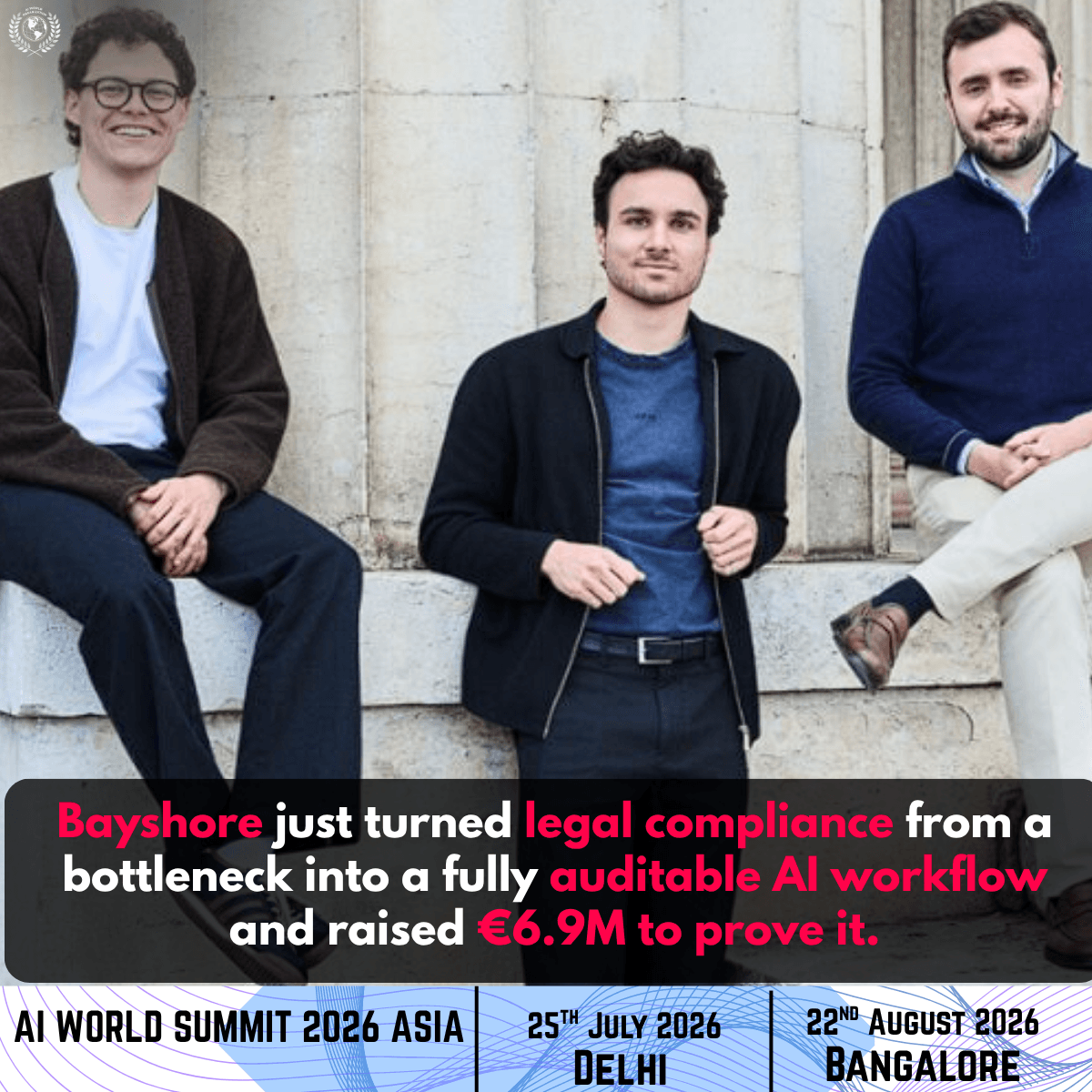
Bayshore Raises €6.9M to Automate Legal AI Compliance
Munich startup Bayshore exits stealth with €6.9M in seed funding to transform legal and compliance workflows using auditable, agentic AI technology.
TL;DR
Munich-based startup Bayshore has come out of stealth with €6.9 million in seed funding to fix one of enterprise's most stubborn headaches — compliance. Instead of leaving AI to guess its way through legal rules, Bayshore converts regulations into machine-readable code, giving AI agents precise guardrails to work within. The result is faster approvals, full audit trails, and less pressure on overworked legal teams.
Munich's Bayshore Steps Out of Stealth with €6.9 Million to Reshape How Organisations Handle Legal and Compliance Through AI
For anyone who has spent time inside a large organisation, the compliance process is painfully familiar. A business unit wants to sign a new vendor. Another team needs approval to onboard a sales partner. A bank wants to update a core operational procedure. In each case, the path forward involves the same exhausting cycle — fill out a PDF form, send it via email, wait for a legal or compliance expert to review it, follow up, and repeat. Weeks pass. Decisions stall. Business slows down. And somewhere in the middle of all that friction, the humans meant to be driving growth are instead managing spreadsheets and inbox threads.
This is the exact problem that Munich-based startup Bayshore was created to solve. And after operating quietly in stealth mode since its founding, the company has officially made its presence known — emerging with a €6.9 million (approximately $8 million) seed funding round that signals serious investor confidence in its approach. The round was led by Earlybird Venture Capital, one of Europe's most respected deep-tech investors, and drew participation from Lucid Capital, Booom, Heliad, and a group of strategic angel investors with backgrounds spanning law, technology, and enterprise operations. Notably, the round came together in just two weeks, reflecting just how strongly the market responded to what Bayshore is building.
At The AI World, we cover the full landscape of artificial intelligence — from foundational research to the real-world products reshaping how industries operate. Bayshore's emergence represents something that genuinely matters in the broader AI story: a company that is not just using AI as a buzzword, but deploying it in one of the most demanding, high-stakes environments imaginable — the intersection of law, regulation, and enterprise operations.
The Compliance Crisis That No One Talks About Enough
To understand why Bayshore exists, it helps to understand the scale of the problem it is addressing. Regulatory complexity has been growing steadily for decades, but the pace has accelerated significantly in recent years. Financial institutions must navigate a web of anti-money laundering rules, know-your-customer requirements, ESG disclosure obligations, and data protection regulations — often simultaneously across multiple jurisdictions. Healthcare organisations face HIPAA, GDPR, and sector-specific clinical compliance requirements. Technology companies operating in Europe now contend with the EU AI Act, the Digital Services Act, and a growing patchwork of national-level regulations.
The people responsible for managing this complexity — legal counsel, compliance officers, risk teams — are under enormous pressure. But the problem is not simply one of workload. It is structural. The gap between what regulations require and what organisations are actually capable of executing in day-to-day operations has been widening for years. Business units that need approvals are slowing down because the teams they depend on are overwhelmed. And the tools available to those compliance teams have not kept pace with the challenge. Most still rely on manual reviews, email chains, and document management systems that were built for a different era.
Philipp Wiegand, co-founder and CEO of Bayshore, put it plainly when discussing the motivation behind the company. Across every industry, he noted, business units are caught in an endless loop of approval processes — whether that means getting clearance to take a customer out to lunch, bringing a new sales intermediary on board, or making changes to a critical internal process at a bank. The vast majority of these processes still run on PDF forms, Excel spreadsheets, and scattered email threads. The result is uncertainty, friction, and a creeping paralysis that holds organisations back from moving at the speed the market demands.
The challenge is not simply about efficiency, either. Every time a compliance process fails to be executed correctly, organisations face real liability. Mistakes in legal reviews create exposure. Inconsistent application of rules across departments or jurisdictions opens up regulatory risk. And when the process is entirely manual, there is simply no reliable way to demonstrate to regulators that every decision was made correctly and consistently. This is a problem with legal, financial, and reputational dimensions — and it is one that has been growing more acute with every new wave of regulation.
How Bayshore's Agentic AI Platform Actually Works
What makes Bayshore different from other legal tech or compliance software companies is not just that it uses AI — it is how it uses AI. The company has built a platform that combines the flexibility of large language models with the precision of deterministic, machine-readable rule systems. This distinction is crucial, and it goes to the heart of why existing AI tools have struggled to gain traction in legal and compliance contexts.
Large language models, as impressive as they are, are probabilistic by nature. They generate responses based on patterns and probabilities rather than absolute rules. For most use cases — drafting emails, summarising documents, generating ideas — this is perfectly acceptable. But in legal and compliance work, probabilistic outputs can be catastrophic. A compliance review that is 95% accurate is not good enough when the other 5% represents regulatory violations, liability exposure, or audit failures. Legal decisions need to be not just correct, but verifiably correct, consistently applied, and fully traceable.
Bayshore's solution is to not treat AI as the final decision-maker. Instead, the company's platform works by taking any ruleset — whether that is a government regulation, an internal company policy, an industry standard, or a contractual obligation — and converting it into machine-readable code. This code functions as a set of deterministic guardrails that AI agents must operate within. The result is a system where the AI can move quickly and handle volume, while the legal logic that governs its decisions remains precise, consistent, and fully auditable.
In practice, this means that when a business unit submits a compliance request through Bayshore's platform, an AI agent applies the relevant legal logic to assess the request. For straightforward, low-risk cases, the agent can clear the request automatically, without any human intervention required. For more complex matters — situations where the rules are ambiguous, where multiple jurisdictions apply, or where the stakes are particularly high — the system escalates to a human expert, but not before completing a comprehensive preliminary analysis that dramatically reduces the time that expert needs to spend on review.
The platform functions as what Bayshore describes as a governed legal and compliance front door. Every request that comes through it is tracked with a full audit trail. Every decision — whether made by an AI agent or a human expert — is documented with the reasoning behind it, the rules that were applied, and the outcome that was reached. This creates an auditable record that satisfies regulatory requirements and gives organisations the confidence to embed compliance directly into their business processes, rather than treating it as a separate, parallel function that slows everything down.
Paul F. Welter, Bayshore's Chief Legal Engineering Officer, was direct about the reasoning behind this architecture. Large language models have demonstrated genuine capability in supporting legal work, he acknowledged. But their probabilistic nature simply does not provide the accuracy and consistency that complex legal and compliance processes require. For any legal or compliance review, organisations need full auditability to prevent liability — so that AI reduces risk rather than introducing new forms of it. Bayshore achieves this by having lawyers create deterministic, machine-readable guardrails for the AI to act within.
This technical foundation is not incidental to Bayshore's story. It is central to it. The research underlying the platform originated from work carried out by Welter at Stanford University, where he focused specifically on how legal documents could be converted into machine-readable logic that represents legal decisions in a consistent and reproducible way. That academic foundation gives Bayshore's approach a rigour that sets it apart from companies that have simply applied off-the-shelf AI tools to legal workflows without addressing the fundamental limitations of those tools in regulated environments.
The Founding Team and the Vision That Drove Them
Bayshore was founded in 2025 by three people whose backgrounds make them unusually well-suited to the challenge they have taken on. Philipp Wiegand brings commercial and operational leadership as CEO, with a perspective rooted in understanding how organisations actually function at scale and where the friction points in compliance processes cause the most damage. Paul F. Welter, as Chief Legal Engineering Officer, brings the deep technical and legal expertise that underpins the platform's architecture — his Stanford research providing the intellectual foundation for the company's approach to converting legal logic into machine-readable code. Erik Krauter completes the founding team, contributing to the engineering side of the platform.
Together, they represent a genuine fusion of the legal and technical disciplines that this problem requires. One of the persistent failure modes in legal tech and compliance software is building tools that are technically sophisticated but legally naive — or, conversely, legally rigorous but technically clunky. Bayshore was built from the ground up by people who understand both sides of that equation, and who recognised that the only way to build AI that works reliably in legal contexts is to combine the power of modern language models with the precision of deterministically encoded legal logic.
The company was built on a conviction that regulation should be the infrastructure of progress, not its bottleneck. This is a framing that will resonate with anyone who has watched a promising business initiative grind to a halt waiting for a legal clearance, or seen a product launch delayed by months because compliance sign-off was stuck in a queue. Bayshore's founders believe — and are building their company to demonstrate — that it does not have to be this way. With the right tools, regulatory requirements can be embedded directly into the fabric of how organisations operate, rather than sitting as an obstacle in front of it.
Early Traction and What the Funding Will Enable
Perhaps one of the most compelling signals in Bayshore's story is not the funding itself, but who is already using the platform. The company has confirmed that multiple Global 2000 organisations — the world's largest companies by revenue — are already deploying Bayshore's technology to automate legal and compliance processes. This is not a startup with a promising demo and a handful of pilot customers. It is a company that has already won the trust of some of the most demanding, risk-sensitive organisations in the world, and that is doing so while still at seed stage.
The investors who backed this round clearly saw what those early customers saw. Earlybird Venture Capital, which led the round, has a long track record of backing European deep-tech companies that are tackling genuinely hard problems with technically differentiated solutions. The participation of Lucid Capital, Booom, and Heliad, alongside a group of strategic angels, further reinforces the sense that this is a company with a strong signal of product-market fit at a very early stage.
The €6.9 million raised in this round will be deployed across three main priorities. First, Bayshore plans to continue developing the platform — deepening its capabilities across more regulatory frameworks, expanding the range of jurisdictions it can handle, and refining the AI agents that sit at the heart of the system. Second, the company is actively growing its team, with open roles across AI engineering, legal engineering, and go-to-market functions. This hiring push reflects the ambition to scale both the technology and the commercial operation simultaneously. Third, the funding will support deeper customer deployments, helping organisations in highly regulated industries to integrate Bayshore's platform more deeply into their operational workflows.
The speed at which the round came together — reportedly in under two weeks — says something important about the current investment climate for AI companies that are solving real enterprise problems with defensible technical approaches. There has been a great deal of capital chasing AI startups in recent years, but investors are increasingly distinguishing between companies that are building on top of general-purpose AI tools and companies that are building genuinely differentiated architectures. Bayshore clearly falls into the latter category.
Why This Moment Matters for the Future of AI in Regulated Industries
Bayshore's emergence from stealth is significant beyond the specifics of one funding round. It is a data point in a broader and increasingly important conversation about how artificial intelligence can — and should — be deployed in environments where the stakes are high, the rules are complex, and the consequences of error are serious.
The narrative around AI in enterprise settings has sometimes been dominated by enthusiasm for what AI can do in ideal conditions, without sufficient attention to the constraints that make deployment in regulated industries genuinely difficult. Legal and compliance work is perhaps the most demanding test case for enterprise AI because it combines the need for speed and scale with uncompromising requirements for accuracy, consistency, and auditability. Getting this right is hard. Getting it wrong, in a world of increasing regulatory scrutiny, is expensive.
What Bayshore represents is a mature, architecturally thoughtful answer to that challenge. By encoding legal logic as deterministic, machine-readable rules rather than leaving it to the probabilistic instincts of a language model, the company has found a way to give AI agents genuine reliability in high-stakes legal contexts. By wrapping every decision in a full audit trail, it has made AI outputs defensible in ways that matter to regulators and legal teams. And by positioning the platform as the front door for all compliance requests — the single point through which every inquiry is routed, assessed, and resolved — it has given organisations a way to scale their compliance capacity without simply adding more headcount.
The broader implications are worth sitting with. We are at a moment when organisations across virtually every sector are grappling with how to use AI responsibly — how to capture the efficiency gains without introducing new risks, how to deploy AI at scale without losing accountability, how to move faster without moving recklessly. Bayshore's approach offers a model for how this can be done in one of the hardest domains imaginable. The lessons it is learning, and the architecture it is refining, are likely to have relevance well beyond legal and compliance workflows.
At The AI World, we believe the most consequential AI developments are not always the ones with the largest models or the most dramatic demos. Sometimes they are the ones that solve a specific, deeply felt problem with exactly the right combination of technical sophistication and practical understanding. Bayshore looks very much like one of those developments — and its emergence from stealth, backed by serious capital and serious customers, is a story worth watching closely.