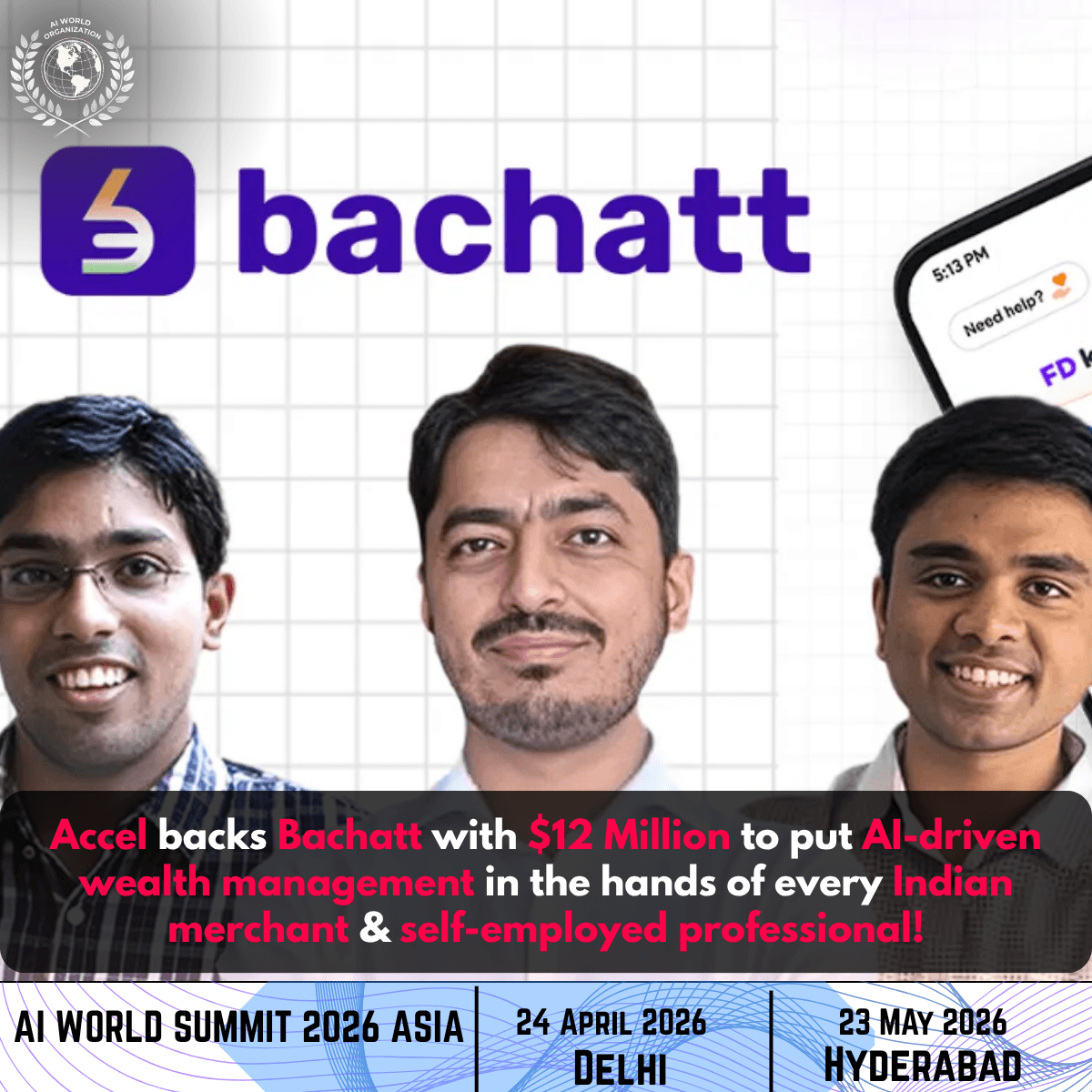
Bachatt Raises $12M Series A to Scale AI Savings
Delhi's AI-powered wealthtech startup Bachatt raises $12M in Series A led by Accel to scale savings and launch AI-driven wealth and credit tools.
TL;DR
Delhi-based wealthtech startup Bachatt has raised $12 million in a Series A round led by Accel, with continued backing from Lightspeed and Info Edge Ventures. The AI-powered savings platform, which lets users invest in mutual funds starting at just ₹100 via UPI, has already crossed 3 million users since its May 2025 launch. The fresh funds will go toward scaling its user base and launching AI-led wealth advisory and instant credit products for India's self-employed and merchant community.
Bachatt Raises $12 Million in Series A to Redefine AI-Powered Savings for India's Self-Employed
India's wealthtech sector continues to make bold strides in 2026, and the latest AI funding news making waves across the financial technology landscape is the $12 million Series A raise by Bachatt — a Delhi-based AI-led savings and wealth platform. The round was led by Accel, one of India's most prolific and respected venture capital firms, with continued backing from existing investors Lightspeed Venture Partners and Info Edge Ventures. This milestone not only cements Bachatt's position as a rising force in India's personal finance ecosystem but also reinforces the growing investor conviction in AI-driven financial products catering to underserved demographics, particularly India's massive merchant and self-employed population.
The fresh capital injection comes at a time when the Indian startup ecosystem is experiencing a measured but confident recovery in funding activity. AI funding across fintech and wealthtech segments is gathering momentum, as investors increasingly prioritize platforms that demonstrate real user traction, meaningful financial inclusion, and scalable technology infrastructure. Bachatt's journey from seed to Series A in less than a year offers a compelling case study of what's possible when product-market fit aligns with a massive untapped audience.
From Seed to Series A: Bachatt's Rapid Ascent
Bachatt was founded in 2025 by Anugrah Jain, Ankur Jhavery, and Mayank Agarwal — a trio of fintech veterans who saw an enormous gap in India's wealth management ecosystem. While urban salaried professionals have long had access to mutual fund apps, robo-advisors, and investment platforms, India's 300 million merchants and self-employed individuals — kirana store owners, freelancers, gig workers, and small business operators — have largely been left out of the wealth-building conversation. The founders set out to build a platform that respects the financial reality of this segment: irregular income, unpredictable cash flows, and a deep-rooted distrust of complicated financial products.
The startup's early momentum was hard to ignore. In April 2025, Bachatt secured $4 million in seed funding co-led by Lightspeed and Info Edge Ventures, a vote of confidence that helped the team build out the product and begin user acquisition. The platform officially launched in May 2025, and within months, it had accumulated a user base that few would have predicted so quickly. The fact that it has now raised three times the amount in its Series A compared to its seed round — and attracted Accel as a lead investor — speaks volumes about the product's early performance and the broader opportunity it is pursuing.
The AI funding news around this round is particularly significant because it comes from Accel's Fund VIII, a $650 million early-stage fund that the VC launched with a clear focus on AI, fintech, and consumer startups in India. Accel has publicly stated its interest in wealth management startups "catering to affluent and semi-urban consumers seeking personalized wealth advisory services through digital channels," which makes its decision to back Bachatt a natural strategic fit. This isn't just a financial investment — it's an endorsement of the thesis that AI-powered financial inclusion is one of the defining investment themes of this decade.
The Product: Making Wealth Accessible at ₹100 a Day
At the core of Bachatt's offering is a strikingly simple yet powerful product philosophy: what if anyone in India could start building wealth with as little as ₹100? That's the entry point for the platform's flagship savings product, which allows users to invest in debt mutual funds through UPI AutoPay on a daily, weekly, or monthly basis. Partnering with some of India's most trusted asset management companies — SBI, ICICI, and Axis — Bachatt provides FD-like returns of 7–8% per annum through liquid debt mutual fund schemes, while offering the kind of flexibility that traditional banks simply cannot match.
What makes the product stand out in an already crowded savings app landscape is its suite of user-friendly features. Unlike most investment platforms that lock in users' capital, Bachatt offers pause options — allowing users to stop contributions during lean months — as well as top-up features for when business is good, weekend savings modes, and critically, instant withdrawals. For a merchant whose monthly earnings fluctuate wildly based on season or market conditions, these are not luxury features. They are fundamental necessities that make the difference between adopting a financial product and abandoning it.
The KYC and onboarding process has also been designed for speed and accessibility. While traditional banks require 2–3 days and a branch visit, and most competing apps take 15–30 minutes, Bachatt completes onboarding in under 2 minutes using Aadhaar and PAN verification. This frictionless entry point is a major driver of the platform's explosive early user growth and speaks to the founding team's deep understanding of the target demographic's preferences and pain points.
Since launching in May 2025, Bachatt has acquired over 3 million users — a remarkable achievement for a platform that is barely a year old. In February 2026 alone, the platform executed more than 2 million mutual fund transactions, signaling not just user acquisition but genuine, active engagement. These metrics are what convinced Accel and its co-investors to double down on the platform and fuel its next phase of growth with the latest round of AI funding.
AI at the Centre: Wealth Advisory and Credit on the Horizon
While Bachatt's savings product is the growth engine today, the company's long-term vision is far more ambitious — and AI is the central pillar of that future. With the fresh $12 million in hand, Bachatt is preparing to launch two new verticals: an AI-led wealth advisory product and an instant credit solution tailored specifically for merchants and self-employed individuals. These are not incremental add-ons; they represent a fundamental expansion of the platform's value proposition and a direct response to the financial needs of its core user base.
The AI-led wealth product is built around a proprietary engine that continuously monitors over 4,000 mutual fund schemes and market patterns to surface investment opportunities for users in real time. In practice, this means that a user running a small electronics shop in Lajpat Nagar or a freelance graphic designer in Bengaluru will soon have access to the kind of intelligent portfolio guidance that was previously available only to high-net-worth individuals through private wealth managers. This democratization of wealth intelligence is at the heart of what makes Bachatt's AI funding story so compelling from a societal standpoint.
The credit product is equally transformative in intent. Millions of merchants in India struggle to access working capital through traditional banking channels because they lack formal salary slips or credit histories. Bachatt's AI-powered credit offering aims to bridge this gap by leveraging the behavioral and transactional data of its user base to underwrite near-instant working capital loans. For a merchant who needs to restock inventory before a festival season but can't wait weeks for a bank loan to process, this kind of product is not just useful — it can be genuinely life-changing. This is precisely why AI funding news in the wealthtech space is generating so much excitement among both investors and entrepreneurs right now.
The AI World Organization closely tracks innovations like these because they represent the very best of what artificial intelligence can do — not as a buzzword, but as an actual technology that improves financial outcomes for real people. Bachatt's approach to AI is thoughtful, product-first, and deeply anchored in the lived realities of its users. Rather than layering AI on top of an existing product for optics, the team has built AI into the core architecture of its wealth advisory engine, allowing it to generate personalized, data-driven recommendations at scale. That is what separates genuinely transformative platforms from those merely riding the AI wave.
India's Wealthtech Sector: A Market at an Inflection Point
Bachatt's $12 million raise doesn't exist in a vacuum — it is part of a broader, exciting narrative unfolding across India's wealthtech landscape. According to data compiled from industry sources, Indian wealthtech startups raised more than $634 million across 51 deals involving 39 startups during 2024 and 2025. That is a substantial pool of capital flowing into a sector that is still in relatively early innings when compared to the size of the addressable market.
In 2026, the momentum has continued. AssetPlus secured $19.3 million to deepen its mutual fund distribution network, while Wint Wealth raised $28 million to expand its fixed-income investment platform. Otto Money raised $1.3 million in early-stage funding, and Jiraaf is actively in the process of raising fresh capital in an extended Series B round. Together, these deals paint a picture of a sector that is maturing rapidly, attracting repeat investors, and drawing in users who are becoming increasingly comfortable managing their finances through digital platforms.
The Indian wealthtech opportunity is ultimately a story about numbers. India has over 300 million merchants and self-employed individuals who are either unserved or severely underserved by traditional financial institutions. As smartphone penetration deepens, UPI becomes the default payment rail for millions of Indians, and digital financial literacy improves, platforms like Bachatt are poised to capture an enormous slice of a market that is only beginning to understand what AI-powered wealth management can look like. Accel's own analysis suggests that India's tech ecosystem will add $2 trillion in market capitalization over the next decade, with AI and fintech at the core of that growth.
The broader startup funding landscape in India also supports optimism. Inc42's research projects that Indian startup funding will recover to between $11.5 billion and $13.8 billion in 2026, with capital increasingly concentrated in proven platforms that demonstrate product-market fit, user retention, and a credible path to profitability. Bachatt, with its 3 million users, 2 million monthly transactions, and a clear roadmap for revenue expansion through wealth advisory and credit, is precisely the kind of platform that investors in 2026 are excited about.
The Road Ahead: 30 Million Users and Beyond
Bachatt's ambitions are not small. The company has set a target of scaling its user base to 30 million over the next 12 to 24 months — a 10x growth trajectory from its current 3 million users that will require flawless execution, aggressive but targeted marketing, and the successful rollout of its AI-led product verticals. The $12 million raised in this Series A round will be deployed primarily toward user acquisition and the development and launch of the new AI-powered wealth and credit products.
Accel's decision to lead this round is not merely a financial bet on Bachatt — it is a strategic alignment between two entities that share a vision of what AI-powered financial inclusion in India can look like. Accel has a long history of backing category-defining companies in India, and its involvement typically signals to the broader market that a startup has passed a rigorous bar of evaluation. The continued participation of Lightspeed and Info Edge Ventures as existing investors further underscores the alignment and confidence that surrounds Bachatt's trajectory.
As the AI World Organization continues to cover the latest AI funding news and innovations shaping the global and Indian technology landscape, Bachatt's story stands out as a particularly meaningful one. It demonstrates that AI funding is not just flowing into large language models, enterprise software, or robotics — it is also quietly and powerfully transforming the way ordinary Indians save, invest, and access credit. The platform's success could serve as a model for how AI-native fintech startups can leapfrog traditional financial institutions and deliver superior outcomes for segments of the population that have historically been left behind.
The journey from ₹100 savings to $12 million in institutional backing is, in many ways, a mirror of Bachatt's own core message to its users: start small, stay consistent, and let intelligent systems do the heavy lifting. That message — simple, powerful, and deeply resonant — may well be what carries Bachatt from 3 million users today to 30 million users tomorrow, and eventually to becoming one of India's most impactful financial technology companies of this decade.