Aria Networks Raises $125M for AI-Native Networking
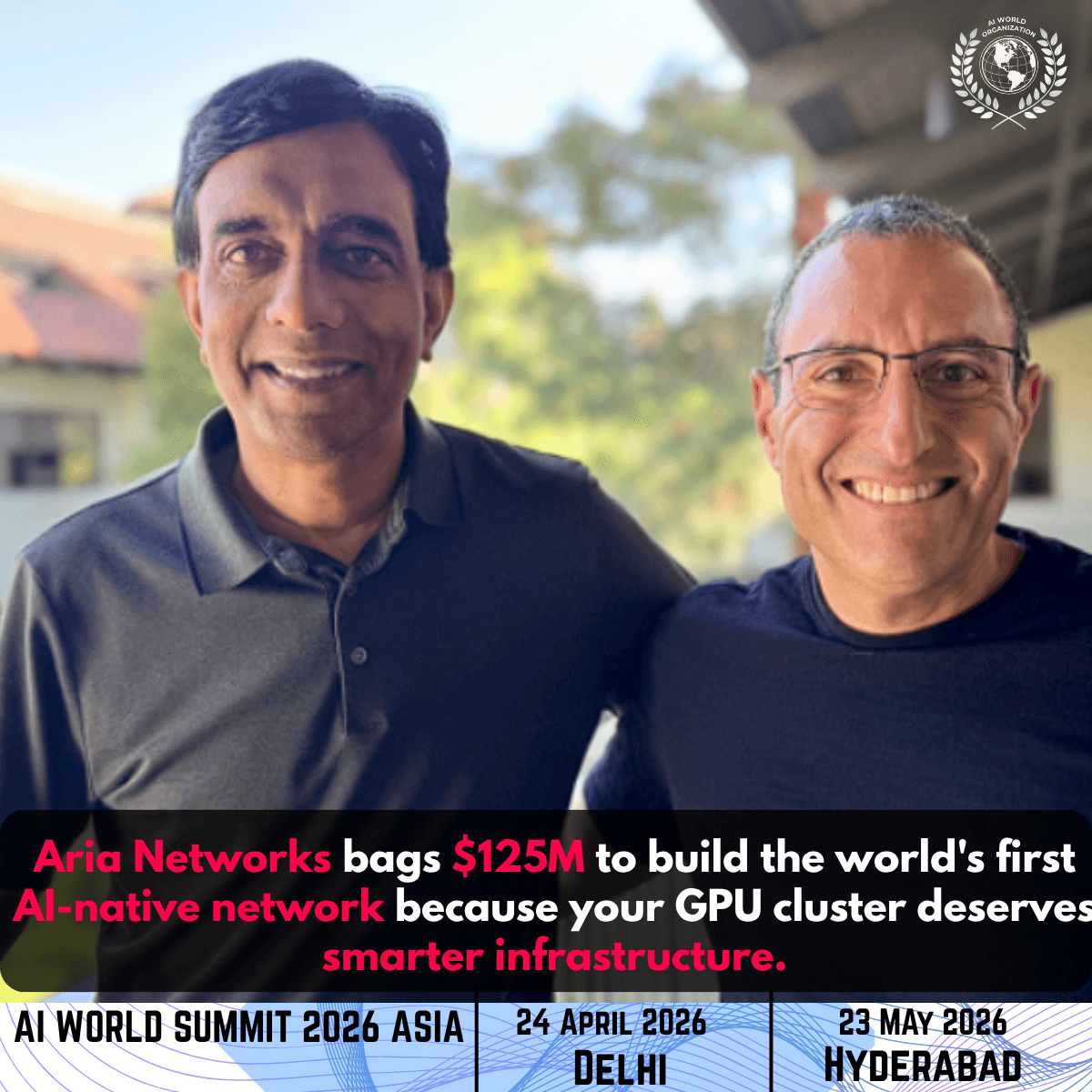
Aria Networks exits stealth with a $125M Series A to build the world's first AI-native network, backed by Sutter Hill Ventures and top-tier investors.
TL;DR
Aria Networks, founded by Mansour Karam — who previously sold Apstra to Juniper Networks for ~$190M — has raised $125M in a Series A round led by Sutter Hill Ventures. The startup builds AI-native Ethernet switches and intelligent cluster software designed to maximize GPU performance in large-scale data centers, and has already secured early customer orders.
Aria Networks Raises $125M to Build the World's First AI-Native Network — A New Chapter in AI Funding
The race to power the infrastructure behind artificial intelligence is no longer limited to chips and servers. Networking — the silent backbone of every AI cluster — is emerging as the next frontier of competition, and investors are starting to notice. In one of the most significant AI funding news stories to come out of the enterprise tech space this year, Aria Networks, a Palo Alto-based startup, has officially exited stealth with a massive $125 million Series A funding round. The raise, led by Sutter Hill Ventures and co-backed by Atreides Management, Valor Equity Partners, and Eclipse Ventures, marks a decisive bet on the idea that AI workloads demand an entirely new kind of network — one built from the ground up with artificial intelligence in mind.
This is not just another infrastructure startup story. It is a story about a serial entrepreneur who has done this before, a product team that has spent years inside the world's most sophisticated networking companies, and a market that is growing at a speed that the industry has rarely seen. The $125 million raise is being closely watched across the AI funding landscape, and for good reason — it signals that the investment community is now thinking far beyond models and algorithms, and directing serious capital toward the physical and software layers that make large-scale AI possible.
The Founder Who Has Already Changed Networking Once
To understand why Aria Networks is attracting so much attention, it helps to understand the man behind it. Mansour Karam, the company's CEO and co-founder, is not stepping into the world of networking for the first time. He spent nearly two decades building his credentials in the field — joining Arista Networks during the company's formative years back in 2006, and later spending a significant period at Big Switch Networks during the first wave of software-defined networking (SDN). His most notable chapter before Aria, however, was Apstra — an intent-based networking company he co-founded that genuinely transformed how data center networks are managed and operated.
Apstra was acquired by Juniper Networks in 2020, and by most accounts, the acquisition was a landmark moment for the networking automation space. The company had pioneered the concept of intent-based networking — a model where network operators could describe what they want a network to do, and the software would figure out how to achieve it. The deal was reportedly valued at approximately $190 million, and Karam went on to serve at Juniper for several years after the acquisition. In September 2024, he announced his departure from Juniper and, within weeks, was already laying the groundwork for his next venture.
Aria Networks was officially founded in October 2024. The company emerged with a clear and aggressive thesis: the networking infrastructure that powers traditional cloud data centers was never designed for the kind of parallelized, GPU-heavy workloads that modern AI demands. Karam and his team set out to build something entirely different — and this latest AI funding round is the clearest sign yet that the market agrees with him.
What Aria Networks Is Actually Building
At its core, Aria Networks is developing what it describes as the world's first AI-native network — a hardware and software stack specifically engineered for the demands of large-scale artificial intelligence training and inference. The company's product lineup currently includes the Aria Switch 800G and the Aria Switch 1.6T, two high-performance Ethernet switches powered by Broadcom Tomahawk 5 and Tomahawk 6 ASICs. These are not modified off-the-shelf products — each switch is paired with dedicated processors that give the hardware an extraordinary capacity for capturing telemetry data at resolutions that Aria claims are 100 to 10,000 times higher than what competing solutions offer.
This level of telemetry is not just a technical benchmark — it is the foundation of Aria's entire value proposition. In a large AI cluster running hundreds of thousands of GPU accelerators, the network is constantly generating signals about how data is flowing, where bottlenecks are forming, and why certain computational tasks are taking longer than expected. Traditional networking equipment captures some of this data, but not nearly enough to provide actionable, real-time intelligence. Aria's hardware changes that equation entirely, providing a detailed and continuous picture of what is happening across the entire cluster at any given moment.
Complementing the hardware is the Aria Cluster Software, an AI reasoning engine that sits on top of the telemetry layer and does something genuinely novel. It doesn't just surface the data — it interprets it, correlates signals from the network, the host systems, and the workloads running across them, and then proposes or executes automated fixes. The software features dynamic dashboards for operators, but its most powerful capability lies in its ability to perform root-cause analysis at a speed and depth that human operators simply cannot match. This is not a monitoring tool with some AI bolted on. It is an intelligent system built around the assumption that AI-scale data centers require AI-scale operations.
The company has also adopted SONiC — the open-source network operating system originally developed at Microsoft — as the foundation of its networking software stack, adding proprietary enhancements on top that unlock the full potential of its hardware telemetry capabilities. AMD has already certified the platform for use with Pensando Pollara 400 AI NICs, and the system is designed from the outset to be chip-agnostic, meaning it works equally well with accelerators from Nvidia, AMD, and Google. This flexibility is a critical differentiator in an industry where customers are increasingly wary of hardware lock-in.
Why This AI Funding News Is Bigger Than It Looks
The $125 million raised by Aria Networks is, on its own, a significant sum. But the broader context of this AI funding story makes it even more meaningful. The first quarter of 2026 saw investors deploy approximately $300 billion across more than 6,000 AI startups — a figure that represents a 150% increase compared to the previous quarter. That kind of capital velocity speaks to an industry that is not slowing down. If anything, the infrastructure layer of AI is just beginning to attract the kind of serious, specialized investment that it requires.
Aria's raise stands out even within this record-setting environment because of what it represents strategically. The investors backing this round are not generalists making broad bets on the AI sector. Sutter Hill Ventures, the lead investor, has a long track record of backing deep infrastructure companies at the earliest stages. Stefan Dyckerhoff from Sutter Hill and Gavin Baker, the managing partner at Atreides Management, are both joining Aria's board — a signal that these are engaged, conviction-backed investors who see Aria as a long-term platform play and not just a short-cycle infrastructure bet.
The commercial momentum is also already visible. Aria Networks has early customer orders in place, which is remarkable for a company that is technically just exiting stealth. The primary target market is what the industry calls "neo-cloud operators" — the new generation of cloud and AI infrastructure companies that are building their own GPU clusters, often at enormous scale. These companies — think CoreWeave, Lambda Labs, and similar players — are building clusters with 100,000 or more accelerators, and at that scale, the network becomes one of the most critical performance bottlenecks in the entire system. Aria is positioning itself as the specialist that understands this problem better than anyone else, and the early order flow suggests the pitch is resonating.
The Market Opportunity and the ROI Math
One of the most compelling aspects of Aria's story is the economic case it presents to potential customers. The company projects a 10x return on investment for neo-cloud operators who deploy its platform. The math goes something like this: a typical AI-scale network deployment might cost in the region of $6.5 million. Aria claims that its hardware and software together can improve Model Flops Utilization (MFU) — a measure of how efficiently a GPU cluster is actually using its theoretical computational capacity — to a degree that the network cost is effectively recovered within approximately 18 months. For operators running GPU clusters worth hundreds of millions of dollars, even a modest improvement in MFU translates to tens of millions in recaptured revenue or reduced operating cost.
This framing of the AI networking value proposition in pure ROI terms is deliberate and smart. Karam has long noted that data center networking overall has grown at only single-digit percentages for the past decade or more. AI is changing that trajectory at a pace that the industry has rarely experienced. When growth is that explosive, the gaps between what existing infrastructure can deliver and what customers actually need become enormous, and those gaps are exactly where new entrants like Aria can establish strong footholds before incumbents have a chance to respond. The market for AI networking infrastructure is projected to reach $30 billion within the next four years — and Aria, with its first-mover positioning and deep technical differentiation, is staking a serious claim to a meaningful share of that opportunity.
The Team and the Broader Vision
Behind every credible infrastructure startup is a team that has earned the right to make bold claims, and Aria Networks is no exception to that principle. Co-founder and CTO Subhachandra Chandra brings deep software engineering experience to the company, having previously served as Director of Software Engineering at Arista Networks — one of the most respected networking companies in the world. The combination of Karam's entrepreneurial track record and strategic vision with Chandra's engineering depth creates a founding team that investors and customers alike can take seriously.
The broader vision that Aria is pursuing goes beyond selling switches and software to a handful of early neo-cloud customers. The company is making a foundational architectural argument: that the AI-native network is a new category, not an incremental upgrade to existing networking technology. Just as cloud computing required new approaches to networking that the enterprise networking world had not previously imagined, AI-scale computing requires a networking layer that was not built by incrementally improving what already existed. Aria is betting that this architectural shift is real, irreversible, and worth building a major company around.
This is also where the AI funding news narrative becomes a technology story. The capital being raised in this round is not primarily for sales and marketing. It is being deployed to accelerate deployments with early customers, build out the engineering team, and expand the product roadmap — particularly around the software intelligence layer, where the long-term defensibility of the business is likely to be established. The Aria Cluster Software, with its AI reasoning engine and automated operations capabilities, is where the company sees the deepest moat forming over time. Hardware can be matched; an intelligent, deeply integrated, continuously learning software platform is far harder to replicate.
What This Means for the Future of AI Infrastructure
The story of Aria Networks and its $125 million raise is part of a much larger shift in how the industry thinks about AI infrastructure investment. For the past several years, the dominant narrative in AI funding news has been about models — about who has the best large language model, the most parameters, the most impressive benchmark scores. That conversation is not going away, but it is being joined by a parallel and arguably more durable conversation about the physical and software infrastructure on which those models run.
Networking has historically been one of the least glamorous parts of that infrastructure story, but it is quickly becoming one of the most important. As GPU clusters scale to hundreds of thousands of accelerators, and as model training and inference workloads become ever more distributed and parallelized, the network connecting all of those accelerators becomes a performance-critical variable in a way that was simply not true at smaller scales. The difference between a well-optimized network and a poorly optimized one can mean the difference between a training run finishing in days versus weeks — and at the compute costs involved in frontier AI training, that translates to millions of dollars.
Aria Networks is not the only company that has recognized this. Competitors exist in the AI networking space, both from established players like Arista and Cisco and from other startups. But Aria's approach — combining purpose-built hardware with a deeply integrated AI reasoning software layer, and wrapping it all in an open, chip-agnostic architecture — is genuinely differentiated. The $125 million in fresh funding gives the company the runway it needs to prove out its technology at scale, establish reference deployments with credible neo-cloud customers, and build the commercial momentum that will define its trajectory over the next several years.
For those watching AI funding trends, Aria Networks is one of the clearest examples yet of capital flowing not just toward AI applications, but toward the infrastructure that makes AI possible at all. The AI funding ecosystem in 2026 is maturing rapidly, and the investors and founders who understand where the infrastructure gaps truly lie are the ones who are likely to build the most durable businesses over the next decade. Aria Networks, with its experienced founder, differentiated product, and strong early commercial traction, is making a very credible case that it is one of those businesses.