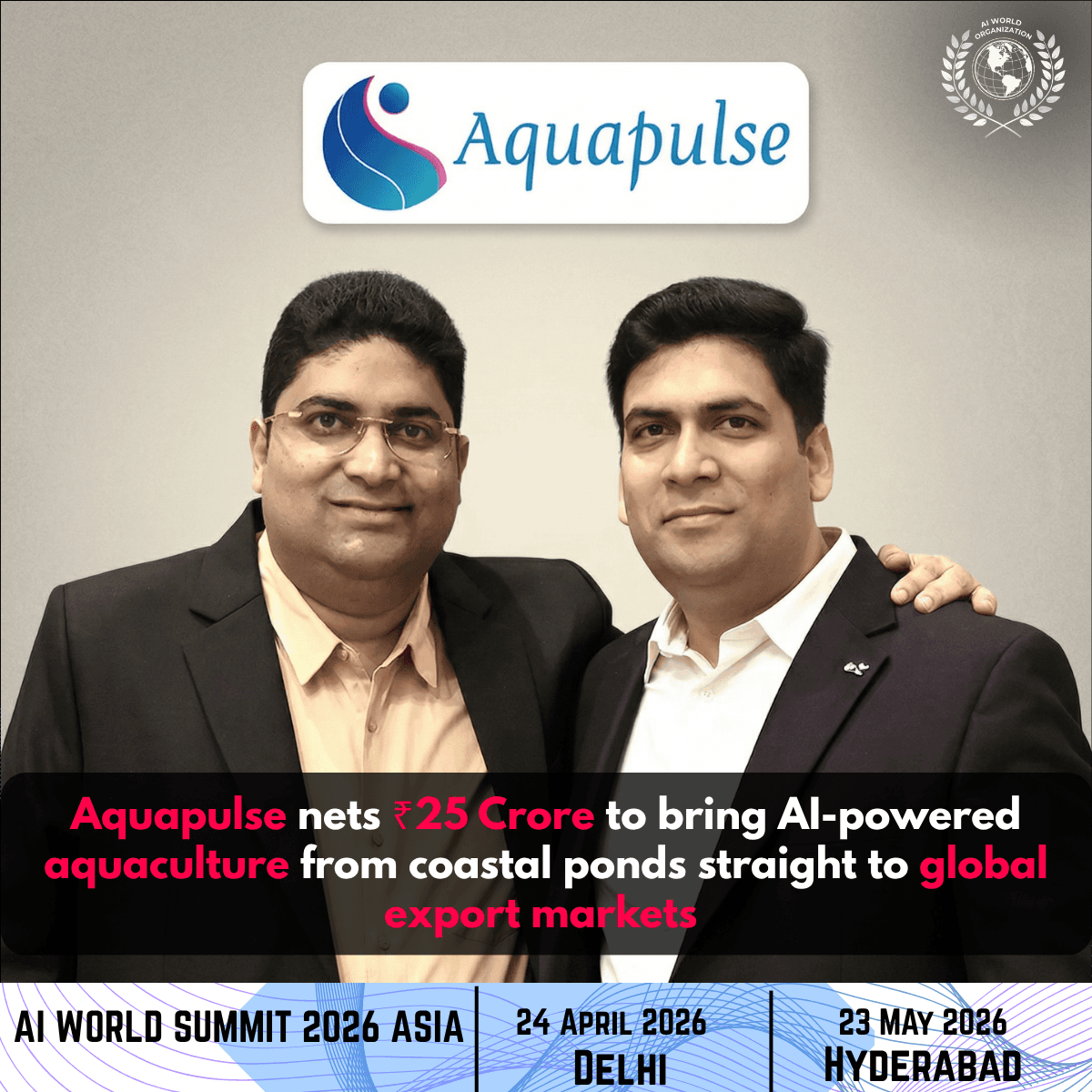
Aquapulse Raises Rs 25 Cr Series A from NABVENTURES
Aquapulse secures Rs 25 Cr in Series A AI funding led by NABVENTURES' AgriSURE Fund to scale its pond-to-port aquaculture tech platform across coastal India.
TL;DR
Aquapulse, a Bhubaneswar-based aquaculture startup, has raised Rs 25 crore in a Series A round led by NABVENTURES through the AgriSURE Fund. The company uses AI-powered tools to help smallholder shrimp farmers across Odisha, Andhra Pradesh, and West Bengal with real-time pond monitoring, fair price discovery, and cold chain access. The fresh capital will be used to expand their farmer network, set up an in-house processing facility, and strengthen their pond-to-port supply chain model.
Aquapulse Nets Rs 25 Crore in Series A Funding Led by NABVENTURES to Revolutionize India's Aquaculture Tech Ecosystem
India's aquaculture sector is undergoing a quiet but powerful transformation, and the latest AI funding news from the coastal startup ecosystem is proof of that momentum. Aquapulse, a Bhubaneswar-based aquaculture technology startup, has successfully secured Rs 25 crore — approximately $2.7 million — in an ongoing Series A funding round led by NABVENTURES, the dedicated venture capital arm of the National Bank for Agriculture and Rural Development (NABARD), through its flagship AgriSURE Fund. This development marks not only a pivotal chapter in Aquapulse's journey but also signals a broader institutional confidence in AI-powered solutions that are reshaping the way India approaches its seafood value chain. The funding round stands as one of the most significant aqua-tech AI funding announcements to emerge from eastern India in recent memory, and it carries profound implications for the livelihoods of thousands of smallholder shrimp farmers spread across India's coastal belt.
Aquapulse: Building the Future of Aquaculture from the Ground Up
Founded in 2022 by Abhishek Dwivedy, who serves as the company's CEO and Managing Director, and Abhilash Dwivedy, who leads as the Chief Growth Officer, Aquapulse was conceived with a singular ambition — to bridge the enormous structural gap between traditional aquaculture farming and the efficiency-driven demands of the modern seafood market. The company is headquartered in Bhubaneswar, Odisha, a coastal state that contributes significantly to India's shrimp export output yet has historically suffered from fragmented supply chains, erratic pricing, and staggering post-harvest losses.
From its inception, Aquapulse has positioned itself at the intersection of three core operational verticals: aquaculture management, physical infrastructure, and deep technology. This multi-dimensional approach was deliberate. The founders recognized early on that a purely technology-focused solution would fail to solve the real, on-ground challenges faced by smallholder farmers. These farmers — many of whom produce export-grade shrimp — were often completely disconnected from fair pricing mechanisms, reliable cold chain infrastructure, and access to export-ready markets. Aquapulse set out to fix all of these pain points simultaneously, not through a fragmented suite of products but through a deeply integrated, end-to-end ecosystem.
The company began its journey by providing farmer advisory services at the grassroots level and rapidly evolved into a full-spectrum AI-driven aquatech and seafood export enterprise. Today, Aquapulse operates across Odisha, Andhra Pradesh, and West Bengal — three of India's most critical shrimp farming geographies — and works with over 6,000 farmers. With this fresh round of AI funding, the company has set an ambitious target to expand this farmer network to more than 15,000 within the near term, making it one of the fastest-growing agri-tech platforms in India's blue economy space.
How AI is Powering the Pond: Technology at the Heart of Aquapulse's Model
At the core of Aquapulse's value proposition is a robust and continuously improving AI-driven technology stack that addresses both the pre-harvest and post-harvest stages of the aquaculture lifecycle. This AI funding news is particularly significant because of how deeply artificial intelligence is embedded within the company's day-to-day operations and farmer-facing services. The platform uses advanced machine learning models to monitor pond conditions in real time, providing farmers with actionable insights on water quality parameters, dissolved oxygen levels, temperature fluctuations, and other critical environmental indicators that directly affect the health and growth rate of shrimp.
Beyond environmental monitoring, Aquapulse's AI systems are engineered to detect early signs of disease risk, enabling farmers to take preventive action before outbreaks occur — a problem that has historically caused enormous losses in the shrimp farming industry. The company also leverages AI for feed optimization, helping farmers calibrate feed quantities and schedules based on real-time pond data to reduce wastage and improve feed-conversion ratios. These are not just incremental improvements; they represent a fundamental upgrade to the way aquaculture has been practiced by smallholder farmers for generations.
On the post-harvest side, Aquapulse offers a comprehensive suite of services that includes automated grading of shrimp based on size and quality, cold chain logistics management, and compliance support for export standards. One of the platform's most impactful features is its real-time price discovery mechanism, which gives farmers transparent access to current market prices and ensures assured offtake — meaning farmers are guaranteed a buyer for their produce at a fair price. This combination of pre-harvest intelligence and post-harvest infrastructure is what sets Aquapulse apart in a crowded agritech landscape and is precisely why this round of AI funding has generated significant attention across investor and startup ecosystems.
The company also holds a patented ice slurry technology that significantly reduces post-harvest temperature breaks in the cold chain — a common cause of quality degradation and export rejection in Indian seafood supply chains. This patented capability, combined with AI-backed digital standard operating procedures and predictive analytics, positions Aquapulse as a genuinely differentiated player that blends hardware innovation with software intelligence.
NABVENTURES and the AgriSURE Fund: Strategic Capital Meets National Vision
The investor backing this Series A round is not a typical private venture fund. NABVENTURES is the official venture capital arm of NABARD — the National Bank for Agriculture and Rural Development — and its participation in this AI funding round reflects a high level of institutional validation for Aquapulse's model. NABVENTURES has been strategically deploying capital through the AgriSURE Fund, which is a blended-capital, SEBI-registered Category II Alternative Investment Fund jointly sponsored by the Government of India through the Ministry of Agriculture and Farmers Welfare, and NABARD itself, with additional backing from premier domestic financial institutions.
The AgriSURE Fund's mandate is specifically focused on investing in innovative, technology-driven agri and rural startups that can demonstrate measurable impact on farm-to-market linkages and sustainable rural development. Aquapulse fits squarely within this mandate, given that its entire business architecture is built around empowering smallholder farmers with the tools and infrastructure they need to compete in global export markets. The fact that NABVENTURES chose to lead this round through AgriSURE — rather than as a co-investor — signals a strong conviction in Aquapulse's long-term scalability and social impact potential.
Speaking on the investment, Ashish Choudhury, Chief Investment Officer at NABVENTURES, articulated the strategic rationale clearly: "Aquapulse's ability to combine domain expertise with technology to solve structural inefficiencies in the aquaculture value chain positions it uniquely for long-term value creation. This is precisely the kind of business NABVENTURES and AgriSURE are designed to support — one that creates lasting economic value for farmers while building a scalable, sustainable business." This statement is particularly meaningful in the context of India's ambitions to become a global leader in sustainable seafood exports, a vision that requires exactly the kind of AI-powered supply chain transformation that Aquapulse is building.
This latest AI funding news also underscores a broader trend of government-backed venture funds stepping up to fill an investment gap in the agri-tech and blue economy sectors, areas that have historically been underserved by mainstream venture capital due to perceived execution complexities and longer gestation periods. NABVENTURES' track record with the AgriSURE Fund — including its investments in other agri-focused startups — demonstrates a consistent commitment to this thesis.
The Pond-to-Port Vision: Mapping Aquapulse's Deployment Strategy for the New Capital
The Rs 25 crore raised in this AI funding round is not being deployed haphazardly. Aquapulse has articulated a clear, multi-pronged capital allocation strategy that reflects the company's understanding of the specific bottlenecks it needs to break through in order to scale sustainably. The fresh capital will be channelled across three primary growth pillars: farmer network expansion, physical infrastructure development, and technology stack strengthening.
On the farmer network front, Aquapulse plans to grow its active farmer base from the current 6,000 to over 15,000 across Odisha, Andhra Pradesh, and West Bengal. This expansion is not simply about numbers — each additional farmer onboarded to the platform brings greater data density, which in turn improves the accuracy of the AI models that power the platform's advisory and prediction capabilities. The network effects here are substantial: as more farmers contribute data about their pond conditions, disease patterns, and harvest outcomes, the machine learning systems become progressively smarter and more responsive to regional variations in aquaculture conditions.
The second pillar involves setting up an in-house processing facility, which will give Aquapulse direct control over a critical stage in the seafood value chain. Currently, reliance on third-party processing facilities introduces quality control risks and logistical friction. By owning the processing infrastructure, Aquapulse can enforce consistent quality standards from the moment shrimp leave the pond to the moment they arrive at export ports — a capability that will be essential for maintaining and expanding the company's presence in demanding international markets such as Asia, the Middle East, and South Korea, all markets where Aquapulse's premium, antibiotic-free shrimp are already being exported.
The third and perhaps most forward-looking area of investment is in the company's technology stack, with a specific emphasis on AI-led pre- and post-harvest systems and the scaling of pricing and supply chain infrastructure. This includes enhancing the platform's real-time price discovery capabilities and building more sophisticated supply chain visibility tools that can track every batch of shrimp from pond to port. The founders have described their overarching goal as building a fully integrated "pond-to-port" supply chain model that improves quality control, transparency, and ultimately, farmer income. This vision resonates strongly in an era where traceability and sustainability credentials are becoming non-negotiable requirements for accessing premium export markets.
From Coastal Ponds to Global Ports: The Bigger Picture for India's Blue Economy
Aquapulse's rise and its latest AI funding milestone are part of a much larger story about India's blue economy and the role that technology-first startups can play in modernizing sectors that have been largely overlooked by the innovation economy. India is the second-largest producer of fish in the world, and the seafood export sector generates billions of dollars in foreign exchange annually. Yet the vast majority of the farmers who power this industry — smallholder shrimp farmers working on small pond plots across coastal Odisha, Andhra Pradesh, and West Bengal — have historically operated with almost no access to market information, reliable infrastructure, or financial services.
Aquapulse's model directly addresses this systemic inequity. By providing farmers with AI-powered advisory tools, assured offtake guarantees, and access to cold chain and processing infrastructure, the company is effectively enabling a transition from subsistence-level aquaculture to globally competitive seafood production. The social and economic impact of this transition is not abstract — thousands of smallholder farmers have already transitioned from local producers to exporters, gaining access to global market prices and reducing the post-harvest losses that previously ate into a significant portion of their income.
The recognition that Aquapulse has received from institutional bodies further underscores the strength of its model. The company has been officially recognized by Startup Odisha and Startup India for its innovation in sustainable seafood and rural empowerment. These recognitions, combined with the backing of NABVENTURES and the AgriSURE Fund, provide Aquapulse with a powerful combination of credibility, capital, and institutional support as it enters its next phase of growth.
Looking ahead, Aquapulse's trajectory positions it as a strong candidate to become not just a leading domestic agri-tech platform but a globally relevant player in sustainable seafood sourcing. As international buyers increasingly demand traceability, sustainability certifications, and antibiotic-free production standards, Aquapulse's integrated model — powered by AI and anchored by deep farmer relationships — offers exactly the kind of supply chain assurance that global importers require. The combination of this AI funding infusion, institutional support, and a clearly articulated pond-to-port strategy makes Aquapulse one of the most compelling aqua-tech stories emerging from India in 2026, and a company that will be closely watched by investors, policymakers, and sustainability-focused buyers around the world.


