ANSCER Robotics Raises $5.4M Series A for AI Robotics
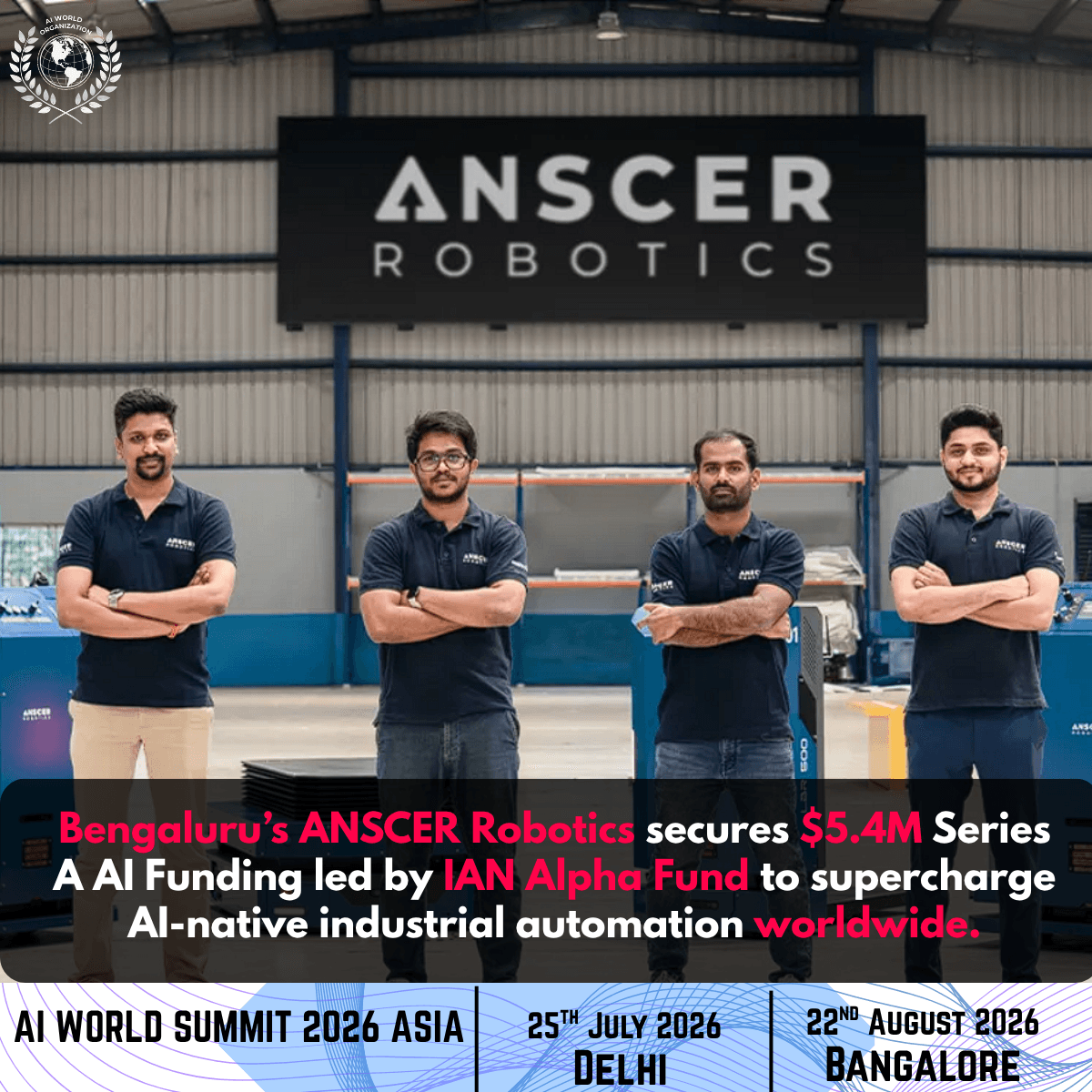
ANSCER Robotics raises $5.4M in Series A led by IAN Alpha Fund to scale AI-native industrial automation in warehouses and factories globally.
TL;DR
Bengaluru-based ANSCER Robotics has raised $5.4 million in Series A AI funding led by IAN Alpha Fund, with support from Info Edge Ventures, to scale its AI-native autonomous robots, boost US expansion, and deepen partnerships for smarter, more flexible industrial automation worldwide, marking a key moment in AI funding news.
ANSCER Robotics Secures $5.4 Million in Series A Funding to Power AI-Native Industrial Automation Globally
India's industrial robotics sector is witnessing a compelling surge of investor confidence, and Bengaluru-based ANSCER Robotics is the latest to capture that momentum. The deep-tech startup has successfully raised $5.4 million (approximately ₹45 crore) in a Series A funding round, with IAN Alpha Fund stepping in as the lead investor. Info Edge Ventures and a clutch of prominent angel investors also participated in this round, further reinforcing confidence in the company's vision of building intelligent, AI-native automation systems for factories and warehouses across the globe. This latest development in AI funding news signals a broader shift in how Indian deep-tech ventures are positioning themselves for international scale.
The funding announcement comes at a time when global manufacturing and logistics industries are grappling with persistent labor shortages, rising operational costs, and the increasing demand for faster, more agile supply chains. ANSCER Robotics, which has been quietly but steadily building its platform since its founding in 2020, is now entering a critical phase of growth — one that involves strengthening its core product capabilities, deepening its US market presence, and expanding its network of global partners.
From Bengaluru Garage to Global Ambition: The ANSCER Robotics Story
ANSCER Robotics was co-founded in 2020 by four engineers — Ribin Mathew, Ebin Sunny, Raghu V, and Raj Mohan — who shared a common belief that the future of industrial operations would be defined by autonomous intelligence, not manual labor. Based out of Bengaluru's IKP Knowledge Park, the company set out to design and manufacture autonomous mobile robots (AMRs) that could genuinely transform how goods move within factories and distribution centers.
What made ANSCER stand out from the very beginning was its focus on what the industry refers to as "Hybrid AMR" — a concept that combines the best of autonomous navigation, real-time object recognition, and omnidirectional mobility into a single, adaptable robotic platform. Rather than building robots that only worked within a narrow set of parameters, the team at ANSCER invested heavily in modular architecture that allowed their systems to be deployed across verticals ranging from automotive and electronics to pharmaceuticals, FMCG, and healthcare.
By February 2025, the company had already secured a $2 million seed round from Info Edge Ventures, which gave it the runway to refine its product, onboard enterprise clients, and develop a US expansion roadmap. Now, with its total funding crossing $6 million following this latest round, ANSCER is no longer just a promising Indian deep-tech startup — it is actively positioning itself as a global player in the industrial robotics and AI-driven automation space.
What the $5.4 Million Series A Will Fund
The AI funding secured in this Series A round is not going to sit idle. ANSCER Robotics has outlined a clear, multi-pronged deployment strategy for the fresh capital, each component designed to accelerate its growth at a different level of the business.
The first and most significant use of funds is the strengthening of its core product platform. ANSCER is actively building what it describes as a "future-ready automation platform" — one that integrates intelligent mobility, advanced vision systems, and Vision-Language Model (VLM) capabilities within a unified enterprise-grade architecture. This is not merely about improving existing hardware. The company is investing in the cognitive layer of its robots — enabling them to understand context, make real-time decisions, and adapt to dynamic environments that older automation systems simply cannot handle.
The second major area of investment is scaling operations in the United States. The American market represents one of the largest opportunities for industrial robotics globally, with thousands of warehouses and manufacturing plants still running on largely manual processes. ANSCER's expansion strategy involves establishing local partnerships, building a distribution and deployment network, and eventually positioning the US as a key revenue hub alongside its Indian operations.
The third pillar involves expanding the global partner ecosystem. Rather than trying to sell and deploy every robot directly, ANSCER is building an open, partner-first model where system integrators, logistics companies, and industry-specific distributors can plug into its platform and deploy solutions for their own clients. This approach not only accelerates market penetration but also reduces the operational overhead that comes with going direct in new geographies.
Building an Open AI Infrastructure for Industrial Robotics
Perhaps the most technically ambitious aspect of ANSCER Robotics' current roadmap is its work on what it calls an "open robotics infrastructure layer" — a framework that aligns with Model Context Protocol (MCP) principles and enables enterprise customers to securely integrate their own AI agents and Large Language Models (LLMs) directly into robotic operations.
This is a game-changing proposition. Most industrial robotics platforms today operate as closed systems — the hardware runs on the vendor's proprietary software, and the enterprise has little to no ability to customize the intelligence layer or bring in their own AI models. ANSCER is essentially flipping this model on its head. By building an MCP-aligned infrastructure, the company is giving enterprises the ability to deploy their own AI models on top of ANSCER's robotic systems, while retaining complete ownership and control of their internal data.
In the context of the broader AI funding landscape, this architectural decision is significant. Enterprises globally are making massive investments in custom AI models — whether for demand forecasting, quality control, or supply chain optimization. The ability to bring those models into the physical world through a robotics platform that actively supports LLM integration is something very few companies are offering today. ANSCER's bet is that this openness will become a decisive competitive differentiator as more businesses look to build cohesive, end-to-end AI strategies that span both digital and physical operations.
The company's platform already supports real-time analytics, contextual decision-making, and seamless interoperability with customer-owned AI systems and digital infrastructure — capabilities that are increasingly essential as manufacturing environments grow more connected and data-rich.
A Market Ripe for Disruption
To truly appreciate the scale of opportunity that ANSCER Robotics is chasing, one needs to understand just how underautomated the global warehousing and manufacturing sector remains. According to a report by McKinsey & Company, nearly 80% of warehouses worldwide still operate with little to no automation. That figure is staggering when you consider how much pressure logistics and manufacturing companies are under to reduce costs, improve throughput, and deal with chronic labor shortages.
The AI funding news around ANSCER Robotics is part of a wider wave of capital flowing into industrial automation and robotics globally. India, in particular, has emerged as a surprising hotbed for this kind of deep-tech innovation. While the country is more commonly associated with software and IT services, a new generation of hardware-first startups is proving that India can build world-class physical automation systems — and export them to some of the most competitive markets on the planet.
IAN Alpha Fund, which led this round, is a $100 million Category-II Alternate Investment Fund that focuses on health-tech, clean-tech, deep-tech, med-tech, and manufacturing. Its decision to back ANSCER signals that serious, institutional money is beginning to flow toward Indian industrial robotics — not just as a domestic play but as a global technology bet. The participation of Info Edge Ventures as a continuing investor further validates the long-term thesis behind ANSCER's approach.
In terms of competitive positioning, ANSCER operates in a space that includes global players such as AGILOX, Mobile Industrial Robots, Ati Motors, and The Hi-Tech Robotic Systemz. While these competitors bring scale and brand recognition, ANSCER's edge lies in its AI-native architecture and its open integration philosophy — both of which are increasingly valued by enterprise customers who want flexibility rather than vendor lock-in.
AI Funding and the Future of India's Deep-Tech Ecosystem
The story of ANSCER Robotics raising Series A AI funding is not just about one company. It represents a broader signal about where India's deep-tech ecosystem is headed. For years, Indian startups were largely associated with consumer internet, fintech, and SaaS businesses. But the last three years have witnessed a quiet but powerful shift — deep-tech ventures working on robotics, semiconductors, space technology, and AI hardware are now attracting serious attention from both domestic and international investors.
This shift is directly connected to the global narrative around AI funding. As AI becomes more embedded in industrial operations, the demand for physical systems that can execute AI-driven decisions in real-world environments is growing exponentially. Companies like ANSCER Robotics are building exactly that — the bridge between digital intelligence and physical action.
From a macroeconomic perspective, India's manufacturing sector is also at an inflection point. The government's Production Linked Incentive (PLI) schemes and the broader push for "Make in India" have created strong incentives for companies to invest in domestic manufacturing capacity. As factories scale up, so does the need for automation. And as automation becomes smarter, the line between a robotics company and an AI company begins to blur. ANSCER, with its Vision-Language Model integration and open AI infrastructure, sits right at the intersection of both.
For followers of AI funding news, the ANSCER Robotics raise is one to watch closely. Not just because of the numbers involved, but because of what it represents architecturally. The company is building the kind of platform that could, within the next five years, become fundamental infrastructure for AI-enabled manufacturing globally — and it is doing so from Bengaluru, with a small but exceptionally focused founding team and a growing base of enterprise clients who are already seeing real results on their factory floors.
What's Next for ANSCER Robotics
Looking ahead, ANSCER Robotics has made clear that this Series A is not the finish line — it is the fuel for the next stage of the race. The company plans to accelerate development of next-generation automation systems designed specifically for increasingly intelligent and connected industrial environments. This means investing in R&D around newer generations of Hybrid AMRs, expanding their vision system capabilities, and deepening the integration between their robots and enterprise digital infrastructure.
The US expansion is perhaps the most watched aspect of the company's near-term roadmap. Breaking into the American market is notoriously difficult for hardware companies, given the complexity of regulatory requirements, customer procurement cycles, and competition from established players. But ANSCER's open integration model — which allows US enterprises to use their existing AI investments alongside ANSCER's robots — could prove to be a compelling hook that helps the company navigate these challenges faster than traditional robotics vendors have managed.
At the AI World Organisation, we will be closely tracking the progress of companies like ANSCER Robotics as they push the boundaries of what's possible at the intersection of AI and physical automation. The intersection of AI funding news with deep-tech hardware innovation is one of the most exciting frontiers in global technology today — and India is increasingly writing itself into that story in a way that few would have predicted even five years ago.