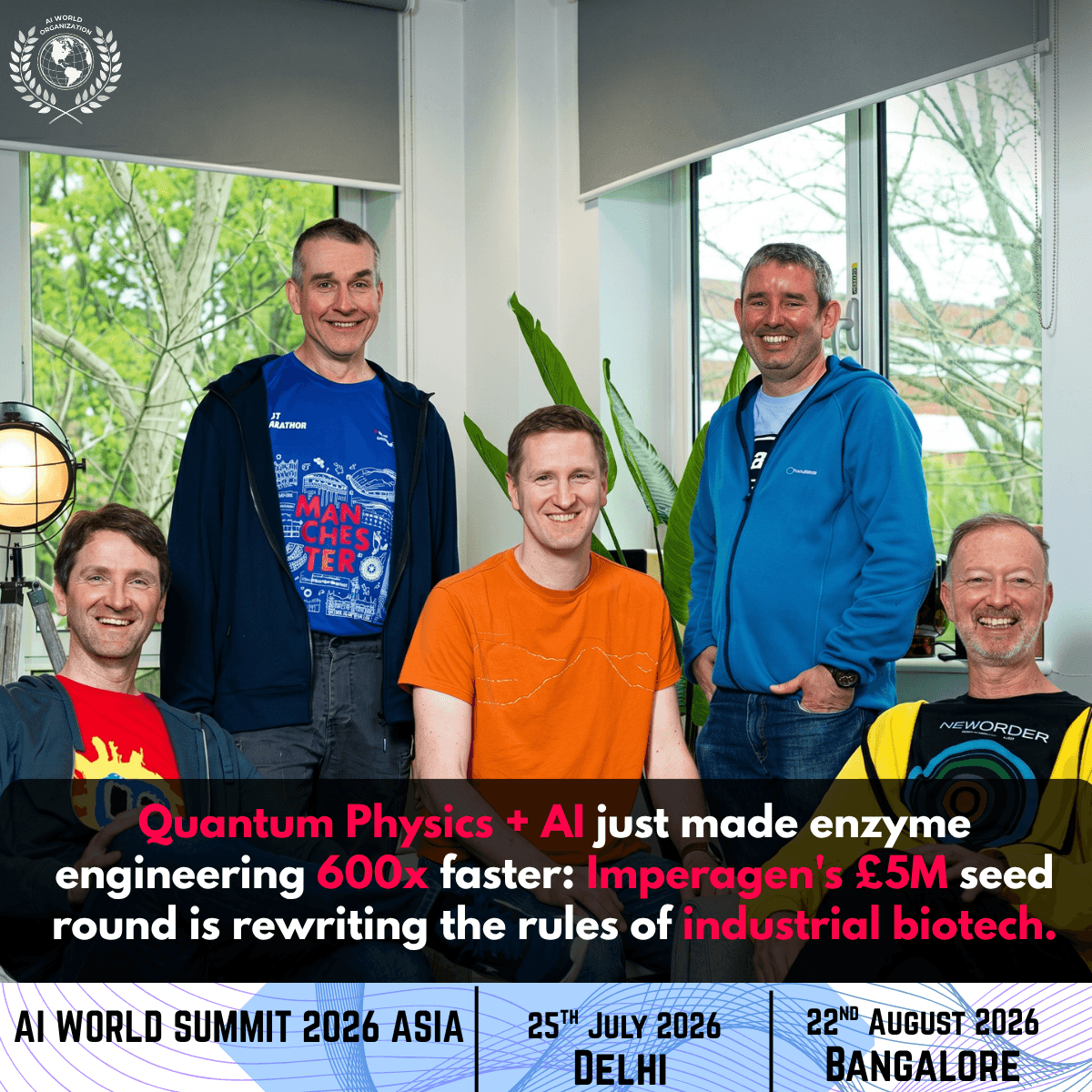
Imperagen Raises £5M to Fuse Quantum AI & Enzymes
Manchester's Imperagen lands £5M seed funding to accelerate enzyme engineering using quantum simulation, AI models, and robotic lab automation.
TL;DR
Manchester-based startup Imperagen has raised £5 million in seed funding to transform the way enzymes are engineered. Using a unique blend of quantum physics simulations and AI-driven closed-loop learning, the company has already delivered staggering results — improving enzyme performance by over 600-fold in just five development cycles for a Fortune 500 client. This AI funding news signals a bold new direction for industrial biotech.
Imperagen Bags £5 Million in Seed Funding to Revolutionise Enzyme Engineering With Quantum Physics and AI
The intersection of quantum computing and artificial intelligence is producing some of the most exciting deeptech stories in the world right now, and the latest comes straight from Manchester. Imperagen, a UK-based spin-out that has been quietly building one of the most technically ambitious platforms in biotech, has officially closed a £5 million seed funding round. The AI funding milestone — led by PXN Ventures, with continued backing from IQ Capital and Northern Gritstone — marks a significant inflection point for a company that is attempting to do what most in the enzyme engineering space have only theorised: make the process faster, more predictable, and genuinely scalable through the power of quantum simulation and machine intelligence.
This AI funding news arrives at a moment when the broader life sciences and industrial biotech sector is paying close attention. Enzymes are biological catalysts that power everything from pharmaceutical drug synthesis to sustainable manufacturing and personal care formulations. The problem has always been that engineering them to perform a specific function is painstaking work — expensive, slow, and maddeningly unpredictable. Imperagen believes it has found a way to change that equation entirely, and the £5 million it just raised will go a long way toward proving that belief right.
From Manchester to the Frontier of DeepTech
Imperagen was founded in 2021 by three researchers who met through the University of Manchester — Dr. Andrew Almond, Dr. Andrew Currin, and Dr. Tim Eyes. Each of them brings a rare combination of deep scientific expertise and entrepreneurial ambition. Rather than spinning up another AI startup trying to repurpose general-purpose language models for biology, they made a fundamentally different bet: start from the physics of how molecules actually behave, and build an AI system trained on data generated from those first principles.
The company's roots in Manchester are more than just biographical. The city has a long legacy of scientific breakthroughs — from the discovery of graphene to the pioneering work done at its university research labs — and Imperagen is the latest startup to carry that tradition forward. It operates at the boundary of quantum chemistry, machine learning, and synthetic biology, three fields that rarely talk to each other but, when combined properly, can unlock capabilities that none can achieve alone. The AI funding news out of Manchester is therefore not just about one startup raising money; it's a signal about where some of the most interesting scientific bets are being placed in 2026.
Northern Gritstone, one of the returning investors in this round, was established specifically to back university spin-outs from the North of England, and its continued involvement here speaks to the quality of what Imperagen has built in just a few years. IQ Capital, known for backing deep-science companies with strong IP foundations, has similarly stayed the course. The participation of PXN Ventures as the lead for this seed round brings additional capital and network access that will help Imperagen accelerate its commercial conversations across multiple industries.
The Platform: Where Quantum Simulation Meets Closed-Loop AI
The most technically compelling part of Imperagen's story is not the funding number — it's the platform architecture that makes the funding worthwhile. Most enzyme engineering workflows today follow a slow, iterative pattern: scientists pick a promising enzyme, run physical laboratory experiments, analyse what worked and what didn't, make educated guesses about the next modification, and repeat. Each cycle takes weeks, sometimes months, and the outcome is still largely uncertain. The costs are substantial, and the failure rate is high enough to deter many companies from pursuing enzyme-based solutions at all.
Imperagen replaces this approach with a three-stage closed-loop system that continuously improves with every experiment cycle. The first stage is a quantum physics simulation layer. Rather than starting with guesswork or borrowing training data from publicly available protein databases, Imperagen uses quantum-level modelling to simulate millions of possible enzyme mutations. This generates a rich, high-quality dataset of predicted molecular properties — data that doesn't depend on what someone else has already measured in a lab.
The second stage is robotic laboratory automation. Once the quantum simulation identifies a promising set of mutations, automated robots carry out the physical experiments at scale, far faster and with more consistency than human researchers could manage. The third stage closes the loop: all experimental results feed directly back into the AI model, refining its predictions for the next round. Each iteration, the system becomes smarter and more focused, zeroing in on the modifications most likely to deliver the target outcome.
This closed-loop approach is what makes the performance numbers so striking. When Imperagen ran its platform for a Fortune 500 personal care company, it improved the performance of two target enzymes by 677-fold and 572-fold respectively — and it did this in just five development cycles. Those are not incremental gains. They are the kind of results that make industrial partners stop and take notice. For the AI funding news landscape, this is precisely the kind of outcome that justifies early-stage investment: a platform that doesn't just promise better results but has already demonstrated them in a commercial context.
Competitive Landscape: Standing Apart in a Crowded Space
The enzyme and protein engineering market is not short of ambition. Several well-capitalised companies are working in adjacent spaces, and Imperagen enters a competitive field that includes protein engineering firms such as Absci and Arzeda, as well as AI-driven drug discovery companies that have begun pushing into industrial biotech, including players like Exazyme and Charm Industrial. The market is noisy, and differentiation is everything.
Imperagen's distinctive edge comes from where it sources its training data. The vast majority of competitors train their AI models on existing experimental datasets — databases of protein structures, enzyme activity measurements, and sequence-function relationships that have been accumulated by the scientific community over decades. Others rely on general-purpose protein language models that have been trained on enormous volumes of biological sequence data. Both approaches are legitimate, but they have a shared limitation: the quality and coverage of the training data is bounded by what has already been measured.
Imperagen sidesteps this limitation entirely. By generating its own training data through quantum simulation before a single physical experiment is run, it creates a higher-quality, more targeted dataset that is directly relevant to the specific enzyme challenge at hand. It is not borrowing someone else's data — it is manufacturing its own, calibrated to precision. This is a philosophically different bet about where the value in AI-powered biology comes from, and so far, the experimental results support the thesis.
That said, the company and its backers are clear-eyed about the road ahead. As biological foundation models continue to improve and accumulate more training data, the gap between quantum-generated datasets and model-trained predictions may narrow. Imperagen will need to keep innovating at the simulation layer to ensure its approach continues to deliver a meaningful edge over time. But for now, the five-cycle performance results speak for themselves, and the AI funding it has secured will help the team build on that foundation aggressively.
What the £5 Million Will Build
Fresh capital means focused deployment, and Imperagen has been transparent about how it intends to use the seed funding. The priorities span four interconnected areas: core research and development, laboratory infrastructure, team growth, and commercial expansion.
On the R&D side, the team will deepen its quantum simulation capabilities and continue refining the closed-loop learning architecture. Every improvement in the simulation layer compounds over time, because better simulations generate better training data, which produces better AI predictions, which leads to faster and more effective lab results. This virtuous cycle is the core intellectual asset that Imperagen is building, and investing in its continued development is the most direct path to long-term competitive advantage.
Laboratory capacity expansion is equally important. The robotic automation component of the platform is central to its speed advantage, and scaling up physical lab infrastructure means the team can run more experiments in parallel, serve more clients simultaneously, and generate more data to feed back into the AI. This is an area where capital translates directly into throughput.
Hiring is the third priority. Building a team that can work credibly at the intersection of quantum chemistry, machine learning, synthetic biology, and robotic automation is genuinely difficult. The people who understand all of these domains deeply are rare, and competition for them is fierce. The AI funding secured in this round gives Imperagen the runway to attract and retain the calibre of talent its platform demands.
Finally, the commercial push. The company has already demonstrated results with a Fortune 500 client in the personal care sector, and it has active interest from potential partners in pharmaceuticals, life sciences, sustainable fine chemicals, and industrial biotech. Translating that interest into signed contracts and recurring revenue is the next critical milestone, and the new capital provides the resources needed to pursue those conversations seriously.
Why This Matters for the AI and DeepTech Ecosystem
For anyone tracking AI funding news across the UK and Europe, this round is worth paying attention to for reasons beyond the headline number. It represents a particular kind of AI funding story that is becoming increasingly important: not an application layer startup that wraps a large language model around an existing workflow, but a foundational deeptech company that is rebuilding the scientific methodology itself.
The AI World is watching companies like Imperagen because they represent the frontier of what AI can actually do when it is combined with genuine scientific depth. This is not AI as a search tool or a content assistant. This is AI as a discovery engine, one that works in tandem with quantum physics and robotic experimentation to explore molecular space at a scale and speed that human researchers could never achieve on their own. That is a genuinely new capability, and the industries that can access it first will have significant advantages.
The life sciences sector in particular stands to benefit enormously. Enzymes are implicated in almost every industrial process that the world is trying to make more sustainable — from the production of bio-based chemicals to the development of novel pharmaceuticals and the creation of greener personal care formulations. If Imperagen's platform can reliably engineer high-performance enzymes in five development cycles rather than fifty, it changes the economics of sustainable biotech in a fundamental way.
For the AI funding ecosystem more broadly, the Imperagen seed round also illustrates the continued strength of the UK deeptech scene. Despite macroeconomic headwinds, investors like PXN Ventures, IQ Capital, and Northern Gritstone are continuing to back technical founders with genuine scientific IP and demonstrable results. That is an encouraging signal for a startup community that needs long-term capital to turn scientific breakthroughs into commercial realities.
At theaiworld.org, we remain committed to tracking these developments closely. The stories that matter most in the AI era are not always the billion-dollar rounds or the celebrity announcements — sometimes they are the £5 million seed investments backing a team of three scientists in Manchester who are quietly rewriting the rules of enzyme engineering with quantum physics and machine intelligence.


