4baseCare Raises Rs 128 Cr for AI Oncology Push
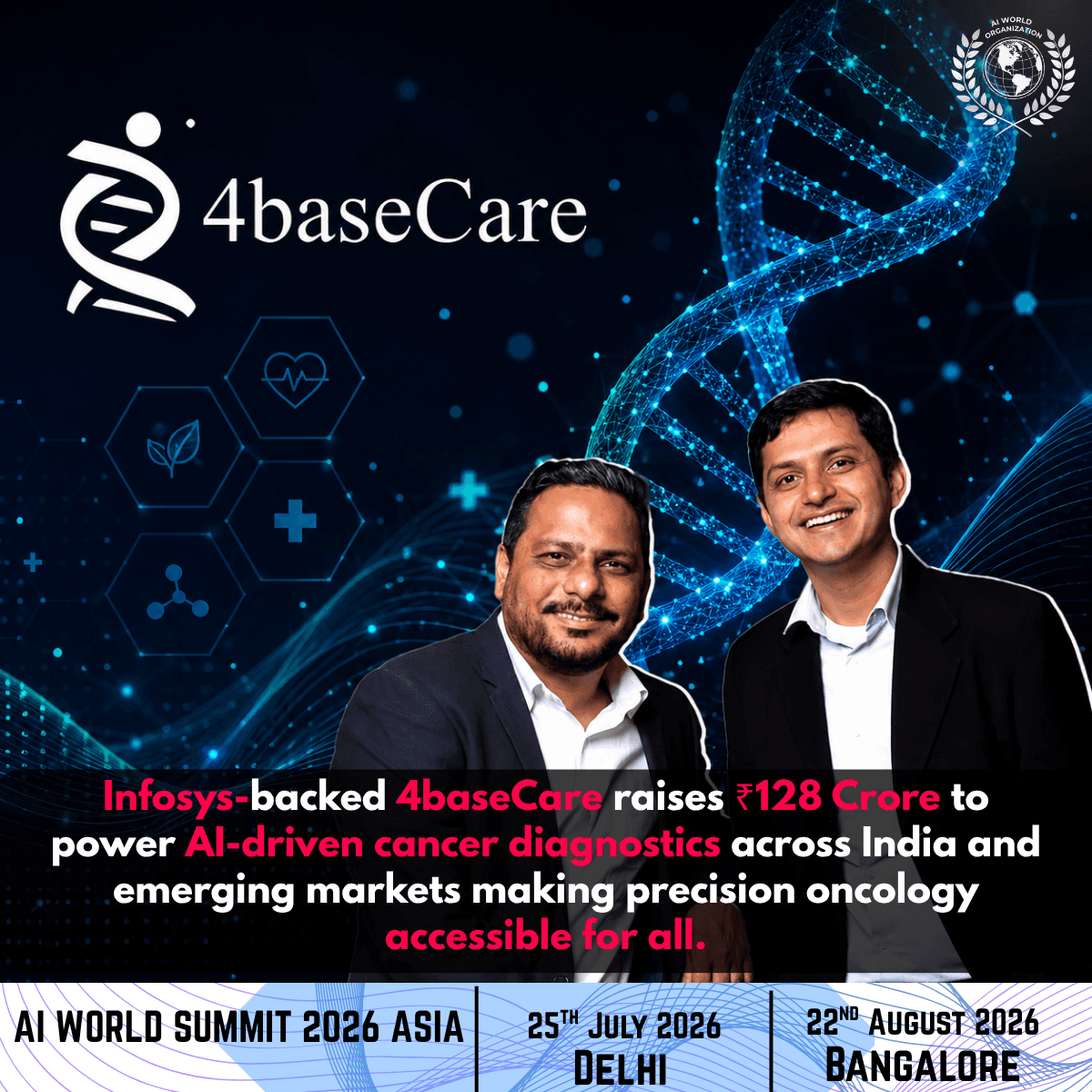
Infosys-backed 4baseCare raises Rs 128 crore to expand its AI-driven precision oncology platform OncoTwin across India, the Middle East, and Southeast Asia.
TL;DR
Bengaluru-based precision oncology startup 4baseCare has raised Rs 128 crore in total funding, with a fresh Rs 38 crore top-up co-led by Infosys and growX Ventures. The company plans to scale its genomics lab network and AI-powered cancer diagnostics platform, OncoTwin, across India and emerging markets including the Middle East, Southeast Asia, and Latin America.
4baseCare Raises Rs 128 Crore to Accelerate AI-Driven Precision Oncology Across Emerging Markets
There is something quietly remarkable about what is happening at the intersection of artificial intelligence and cancer care in India right now. While much of the global conversation around AI tends to fixate on large language models and generative tools, a different and arguably more consequential application of the technology is gaining serious momentum — one that is beginning to reshape how cancer is diagnosed and treated across some of the world's most underserved healthcare landscapes. Bengaluru-based precision oncology startup 4baseCare has just closed a significant funding milestone, raising a cumulative total of Rs 128 crore, which translates to approximately $13.3 million, including a fresh top-up round of Rs 38 crore led by growX Ventures and Infosys. This development is not just a headline for the Indian startup ecosystem — it is a statement about where intelligent, data-driven healthcare is headed, and who is going to lead that charge.
The latest infusion of capital follows closely on the heels of the company's earlier Series B first close, where it brought in Rs 90 crore from a set of high-profile investors including Ashish Kacholia, Lashit Sanghvi, and Yali Capital. The fact that Infosys — one of India's most recognisable and globally respected technology giants — has co-led this round alongside growX Ventures is a signal worth pausing on. It tells you something about the credibility of the technology 4baseCare has built, and about the scale of ambition that investors see in its platform. Infosys has not traditionally been known as a backer of early-to-mid-stage health-tech ventures, which makes its involvement here all the more notable.
Cancer remains one of the most devastating and complex disease areas in the world, and the challenge is especially acute in countries like India, where late-stage diagnosis is common, access to sophisticated diagnostic tools is limited, and clinical decision-making is often constrained by a lack of individualised patient data. Precision oncology — the practice of tailoring cancer treatment to the specific genetic and molecular profile of a patient's tumour — holds immense promise as a solution to these systemic gaps. But it has historically been expensive, inaccessible, and confined to well-resourced healthcare environments in high-income countries. 4baseCare is trying to change that, and the capital it has now secured gives it the resources to move considerably faster.
A Strategic Bet on AI-Powered Cancer Diagnostics
To understand why this funding round matters, it helps to understand what 4baseCare actually does and how it fits into the broader evolution of oncology care. The company was founded in 2019 by Hitesh Goswami and Kshitij Rishi, both of whom brought a deep understanding of genomics and clinical data science to the table. Their core insight was straightforward but important: the biggest bottleneck in cancer treatment is not just access to chemotherapy or surgery — it is access to the right information at the right time. An oncologist treating a patient with lung cancer, for instance, needs to know not just that cancer is present, but which specific mutations are driving tumour growth, which drug targets are likely to be effective, and what real-world outcomes have looked like for patients with similar genomic profiles. This kind of nuanced, data-rich clinical intelligence is what 4baseCare was built to provide.
The company develops genomics-based cancer diagnostics alongside AI-powered clinical decision support solutions. Its approach brings together two things that are often kept separate in traditional healthcare systems — the laboratory (where genetic testing happens) and the clinic (where treatment decisions are made) — and integrates them into a single, intelligent workflow. When a patient undergoes genomic testing through 4baseCare, that data does not just sit in a report. It feeds into an AI engine that contextualises the findings against a growing body of real-world clinical evidence, helping the oncologist understand what the data means for that specific patient and what the most evidence-based treatment options are.
This is not a trivial technical challenge. Cancer genomics generates enormous amounts of data, and interpreting it in a clinically meaningful way requires sophisticated machine learning models trained on diverse, high-quality datasets. The fact that 4baseCare has managed to build this kind of infrastructure in under six years — and is now conducting around 1,500 genomic tests every month — speaks to both the strength of its founding team and the quality of its technology. With the fresh capital in hand, the company expects to scale that testing volume dramatically, targeting between 8,000 and 10,000 genomic tests per month as it expands its laboratory network and deepens its hospital partnerships. That would represent a roughly five-to-seven-fold increase in throughput, a growth trajectory that underscores just how significant this investment round is.
OncoTwin — The AI Brain Behind 4baseCare's Clinical Edge
At the heart of 4baseCare's platform sits a product called OncoTwin, and it is arguably the most interesting and differentiated piece of the company's technology stack. The name is evocative — and intentionally so. A digital twin, in engineering and manufacturing, is a virtual replica of a physical object or system that can be used to simulate behaviour, test scenarios, and predict outcomes without interfering with the real thing. OncoTwin applies a similar philosophy to cancer treatment planning. It creates, in effect, a data-rich representation of a patient's cancer — drawing on that individual's genomic profile, clinical history, and treatment response data — and uses this model to help oncologists derive personalised treatment insights.
What makes OncoTwin particularly powerful is the type of data it works with. Rather than relying solely on controlled clinical trial data, which is often limited in its diversity and real-world applicability, OncoTwin is built on clinico-genomic data combined with real-world patient evidence. This is a meaningful distinction. Real-world data captures how patients actually respond to treatments outside the highly controlled environment of a clinical trial — including patients who are older, sicker, or from ethnic backgrounds that have historically been underrepresented in research studies. For a company that is specifically targeting emerging markets where those populations are the majority, this is not a minor technical detail. It is central to the company's entire value proposition.
The AI models underpinning OncoTwin are trained on diverse, multi-ethnic patient data — something that most precision oncology platforms developed in Western markets simply cannot claim. This gives 4baseCare a potential competitive advantage that goes beyond India's borders. As the company scales into the Middle East, Southeast Asia, and Latin America, it is entering markets where patients have historically been poorly served by clinical decision support tools built predominantly on data from European and North American populations. The platform's ability to draw meaningful insights for diverse patient groups could prove to be one of its most important differentiators on the global stage.
The integration of OncoTwin into hospital workflows is another dimension worth exploring. Rather than positioning the platform as a standalone tool that oncologists must separately consult, 4baseCare is working to embed it directly into the clinical environments where cancer care decisions are made. Its in-hospital genomics lab model — which involves setting up on-site genomic testing facilities within healthcare institutions — is a particularly smart distribution strategy. Hospitals partnering with 4baseCare include major names like AIIMS Jammu, Max Healthcare, and Shankara Hospital, and these partnerships serve a dual purpose: they expand access to genomic testing for more patients, and they generate the kind of rich, longitudinal clinical data that continues to train and improve the OncoTwin platform. It is a classic virtuous cycle, and it is one of the clearest signs that 4baseCare has thought carefully about not just the technology it is building, but the ecosystem in which it needs to operate.
Expanding the Lab Network Across Emerging Markets
With the funds from this latest round secured, 4baseCare is moving quickly to expand its geographic footprint. The company currently operates genomics laboratories in four markets — India, Dubai, Nepal, and the Philippines — but it has set itself an ambitious target of entering 8 to 10 additional countries over the next 12 to 18 months. This is an aggressive expansion timeline by any measure, and it reflects both the confidence the founding team has in its platform and the urgency with which it views the problem it is trying to solve.
The markets it is targeting — which span the Middle East, Southeast Asia, Latin America, and other emerging regions — share a common characteristic: they are all places where access to sophisticated, genomics-based cancer diagnostics has historically been extremely limited, and where the burden of cancer is simultaneously very high. According to data from the World Health Organisation, low and middle-income countries account for approximately two-thirds of all cancer deaths globally, despite having access to far fewer oncology resources than high-income nations. The gap between where precision oncology is currently available and where it is most needed is enormous, and 4baseCare is explicitly positioning itself to close that gap.
The laboratory expansion strategy is designed to be capital-efficient. Rather than building large, standalone genomics facilities from scratch in every new market, 4baseCare's approach of embedding labs within existing hospital infrastructure significantly reduces both the upfront capital required and the time needed to become operational. It also speeds up the integration of genomic testing into routine oncology workflows, since clinicians are working with a facility that is physically present within their institution rather than sending samples to an external testing centre. For patients, the benefits are equally tangible — faster turnaround times for results, lower costs associated with sample logistics, and tighter coordination between the testing process and the clinical team making treatment decisions.
The expansion into Dubai is particularly significant from a strategic standpoint. The UAE has been aggressively positioning itself as a healthcare and medical technology hub, and its geographic location makes it a natural gateway into broader Middle Eastern markets. 4baseCare's presence there gives it an early-mover advantage in a region where demand for advanced diagnostic capabilities is growing rapidly, and where healthcare systems are increasingly looking to integrate AI-powered tools into their oncology departments.
Bridging the Gap in Precision Oncology for Underserved Populations
One of the aspects of 4baseCare's story that resonates most strongly from the perspective of AI-driven healthcare is the company's explicit commitment to serving populations that have long been left behind by the genomics revolution. Precision oncology, for much of its relatively short history, has been a luxury available primarily to patients in wealthy countries with access to cutting-edge academic medical centres. The genomic data underpinning the field has been dominated by samples from populations of European ancestry, which creates real clinical limitations when those same tools are applied to patients with South Asian, African, or Southeast Asian genetic backgrounds.
4baseCare is attempting to correct this imbalance in a practical, on-the-ground way — not through advocacy or research alone, but through the actual deployment of accessible genomic testing infrastructure in the markets where these populations live. By building a dataset that reflects the genomic diversity of Asia, the Middle East, and Latin America, it is creating the raw material for AI models that will genuinely work better for these patients than anything currently available on the market. This is a long-term competitive moat that will only deepen as the company scales, and it is the kind of mission-driven product development that tends to attract both sustained investor interest and durable institutional partnerships.
At a broader level, what 4baseCare is doing sits squarely within a larger shift that is happening across global healthcare: the democratisation of AI-powered diagnostics. For decades, the most advanced diagnostic tools in medicine were accessible only in a small number of elite institutions, typically in high-income countries. The combination of cloud computing, declining genomic sequencing costs, and increasingly powerful machine learning frameworks is beginning to change that calculus. Companies like 4baseCare are at the forefront of applying these converging forces to one of the areas where the impact is greatest — cancer — and in some of the geographies where the need is most acute.
A Growing Wave of Investment in India's Cancer-Tech Ecosystem
4baseCare's funding milestone does not exist in isolation. It is part of a discernible and accelerating pattern of investor interest in cancer-focused startups across India, and the broader signal it sends about where venture capital is flowing within the health-tech sector is worth examining. The past couple of years have seen a meaningful uptick in funding directed at oncology ventures in the Indian market.
Everhope Oncology, for instance, secured $10 million in seed funding, an unusually large seed round that reflects strong investor conviction in the team and the opportunity. MOC Cancer Care and Research Centre brought in $18 million in a round led by Elevation Capital, one of India's most respected and active venture funds. ErlySign, OnCare, and OneCell Diagnostics are among the other names that have attracted capital in the cancer diagnostics and care space in recent years. Taken together, these investments suggest that the Indian venture ecosystem is beginning to take oncology seriously as a sector — not just as a social good, but as a commercially viable, long-term opportunity.
The reasons for this growing interest are not hard to identify. India has one of the highest cancer burdens in the world, with incidence rates rising steadily as lifestyle factors, environmental exposures, and an ageing population combine to drive up disease prevalence. At the same time, the country's existing oncology infrastructure — while improving — remains significantly under-resourced relative to the scale of the challenge. There is a massive and growing gap between the number of patients who need advanced cancer care and the capacity of the healthcare system to deliver it. Technology, and particularly AI-enabled technology, is one of the most credible pathways to closing that gap at scale.
4baseCare's latest round of funding positions it well to take advantage of this moment. With Infosys's backing comes not just capital but a level of institutional credibility and technological partnership that could open doors — within India and globally — that might otherwise take years to unlock. With growX Ventures co-leading the round, the company also gains the support of an investor with a strong track record in backing high-growth, technology-driven startups. Together, these partnerships represent a significant endorsement of 4baseCare's vision, its platform, and its potential to become a meaningful player in the global precision oncology landscape.
As the company moves into its next phase of growth — scaling lab capacity, expanding into new markets, deepening hospital partnerships, and continuing to build out the OncoTwin platform — it carries with it a compelling story about what happens when rigorous science, thoughtful technology design, and a genuine commitment to equitable access come together in one company. The cancer diagnostics space is crowded, and the road ahead will not be without its challenges. But for the patients in India, the Middle East, Southeast Asia, and Latin America who stand to benefit from better, faster, and more personalised cancer care, the progress that 4baseCare is making could not come at a more important time.
At The AI World, we believe that the most meaningful applications of artificial intelligence are those that solve real, urgent human problems — and few problems are more urgent than cancer. 4baseCare's continued rise is a story we will be watching closely.