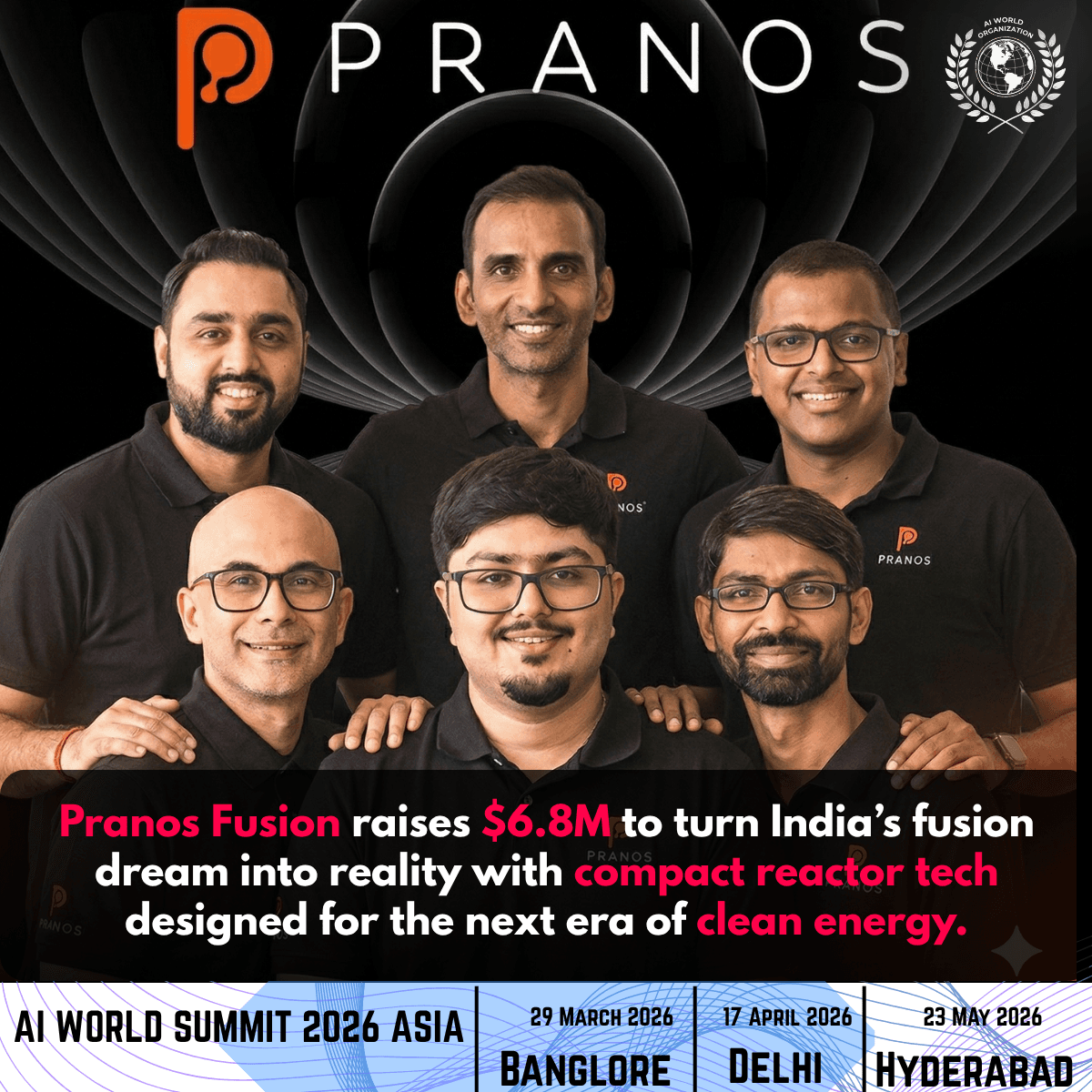
Pranos Fusion Raises $6.8 Mn for Compact Tokamak
Bengaluru's Pranos Fusion secures $6.8 Mn seed funding from pi Ventures and Ankur Capital to build India's first integrated fusion technology stack for clean energy.
TL;DR
Bengaluru-based fusion startup Pranos Fusion has raised $6.8 Mn in seed funding, backed by pi Ventures, Ankur Capital, and angel investors including Groww's co-founder and Razorpay's co-founders. The company is building a full fusion technology stack — covering design software, a compact test tokamak, and superconducting magnets — with the long-term goal of powering nearly a billion homes through modular fusion reactors.
Pranos Fusion Secures $6.8 Million in Seed Funding to Build India's Compact Tokamak Reactor Technology
India's deep-tech landscape has long been associated with software, fintech, and consumer internet — but a quiet revolution is now taking shape in its scientific underbelly. Bengaluru-based fusion energy startup Pranos Fusion has officially raised $6.8 million, roughly Rs 63 crore, in a seed funding round, announcing its intent to chart a bold new course for India in the global race toward commercially viable nuclear fusion. This development arrives at a time when AI funding news and deep-tech investment cycles are increasingly converging with energy transition mandates, as the world's biggest economies scramble to secure long-term power for AI infrastructure, data centres, and manufacturing growth.
The seed round was co-led by pi Ventures and Ankur Capital, two of India's prominent venture capital firms known for their appetite for frontier science and deep technology. The funding round also saw participation from existing investor Industrial47, as well as a notable lineup of angel investors including Lalit Keshre, the co-founder of investment platform Groww, the co-founders of payments infrastructure giant Razorpay, and Bhukhanwala Industries. The breadth of participation — spanning institutional capital, consumer-tech entrepreneurs, and industrialists — reflects the growing cross-sector conviction in fusion energy as a long-term bet. While the company did not disclose its valuation, it indicated that its current valuation is aligned with global fusion startups at a comparable stage of development.
From Pre-Seed to a $6.8 Million Vote of Confidence
The journey of Pranos Fusion to this milestone is worth contextualising. Before this seed round, the startup had secured Rs 3.5 crore in a pre-seed funding round from Industrial47, its earliest institutional backer. The company also received a grant of Rs 20 lakh from the Startup India Seed Fund, a government initiative designed to support early-stage deeptech ventures that may not yet have products generating commercial revenue. These initial resources allowed the founding team to lay the groundwork — incubating the core technology stack, forming academic collaborations, and prototyping early versions of their systems.
Co-founded in May 2024 by Shaurya Kaushal and Roshan George, the company was born out of a shared belief that the scientific knowledge to enable fusion already exists — what the world lacks is the commercial engineering infrastructure to bring that power to the electricity grid at scale and cost. Kaushal, a PhD researcher from the Jawaharlal Nehru Centre for Advanced Scientific Research (JNCASR), and George, formerly a principal engineer at REConnect Energy, bring together the rare combination of advanced plasma science and practical energy systems engineering. Their founding thesis: build not just a reactor, but the entire integrated technology stack needed to design, operate, and eventually replicate fusion systems globally.
The freshly raised capital will be channelled into several critical development areas. This includes continued advancement of its magnet systems, expansion of software-driven design and plasma control capabilities, scaling up the team with specialised talent across electrical engineering, computational science, and magnet engineering, and building out dedicated testing facilities capable of handling the complex experimental demands of fusion energy research. In the broader AI funding news landscape, this round is particularly notable as it represents one of the largest early-stage investments in India's nascent fusion energy sector.
The Integrated Technology Stack: JENGA, PRAGYA, and MAGGA
What sets Pranos Fusion apart from traditional nuclear research organisations and even many global fusion startups is its approach — it is not building a single reactor, but an entire integrated development ecosystem. The company's technology stack is composed of three interdependent systems, each addressing a foundational challenge in the path toward commercial fusion power.
The first pillar is JENGA, a software platform purpose-built to bridge the gap between a tokamak concept and an actual functioning machine. Fusion reactor design has historically been a painstaking, decades-long process of iterating between theoretical physics simulations and physical engineering trade-offs. JENGA aims to compress this cycle by integrating control-oriented design from the very beginning of the development process, ensuring that every design choice made during the engineering phase actively supports the goal of stable plasma operation. This kind of software-first thinking — borrowed from the playbook of modern AI and aerospace engineering companies — is what makes Pranos distinctly a product company rather than just a research lab. Kaushal has noted that JENGA is the most commercially near-term element of the stack, with pilot-level integration with external fusion companies expected within the next year once prototyping is complete.
The second pillar is PRAGYA, Pranos Fusion's compact, low-aspect-ratio, medium-scale tokamak. Unlike conventional tokamaks that occupy enormous physical footprints and require massive capital expenditure, PRAGYA is designed as a test platform for validating plasma control techniques and testing integrated components in a real plasma environment. While PRAGYA is not optimised for producing net energy from fusion reactions, it plays a critical role as an experimentation and training platform — enabling researchers to run dozens of plasma experiments, test new magnet configurations, and validate control software responses in real-world conditions. Importantly, PRAGYA is also intended as an offering to third-party customers, including global fusion startups — particularly those based in Europe — that need access to a compact, affordable testing environment without the costs of building their own infrastructure.
The third and arguably most scientifically ambitious pillar is MAGGA, Pranos Fusion's High-Temperature Superconducting (HTS) magnet programme. Superconducting magnets are the beating heart of any modern tokamak, and HTS magnets in particular represent the cutting edge — enabling stronger magnetic fields that can confine plasma more effectively while allowing for a significantly more compact reactor design. This is the same technological edge that has propelled companies like Commonwealth Fusion Systems to global attention. Currently, MAGGA is in the R&D phase, with both JENGA and PRAGYA being engineered from the ground up to accommodate and integrate HTS magnet modules as they mature. The combined effect of stronger magnetic fields and compact reactor geometry is what gives Pranos its competitive ambition: achieving longer confinement times and higher field strengths in a reactor significantly smaller than anything the fusion industry has previously attempted at a commercial scale.
India's Fusion Ecosystem and the Role of AI in the Energy Transition
The timing of this AI funding news around Pranos is deeply connected to a broader global energy crisis — one that is increasingly being shaped by artificial intelligence. According to market research, global electricity consumption is projected to grow by nearly 20% before the end of this decade. The primary drivers of this growth are not traditional heavy industries but rather the explosive expansion of AI infrastructure, including large-scale data centres, GPU computing clusters, and edge AI deployments, alongside rapid urbanisation across the Global South and the ongoing reindustrialisation of advanced economies. The energy demands of AI alone have become a geopolitical pressure point, prompting governments and investors alike to look beyond traditional renewables toward more reliable and dense power sources — making fusion not a distant aspiration but a near-term strategic priority.
India, in particular, is positioning itself at the intersection of these forces. The Union Budget 2025-26 announced a Rs 20,000 crore Nuclear Energy Mission specifically focused on Small Modular Reactors, with a commitment to develop at least five indigenously designed and operational SMRs by 2033. The government has also set a target of achieving 100 gigawatts of nuclear power capacity by 2047, which represents an unprecedented scale-up of nuclear ambition for a country whose energy policy has long been dominated by coal and renewables. Alongside these policy tailwinds, recent legislative changes now allow private sector participation in nuclear energy projects for the first time, opening the door for startups like Pranos to operate within India's broader nuclear framework rather than at its periphery.
Pranos is not alone in this mission. India now has at least three private companies venturing seriously into fusion energy — Pranos Fusion, Hylenr Technologies from Hyderabad, and Anubal Fusion from Bengaluru — all of which have attracted investor interest in recent months. Anubal Fusion, founded by Dr. Pravin Kini, is pursuing a markedly different approach through inertial confinement fusion, using laser technology to trigger plasma reactions rather than magnetic fields. Hylenr, meanwhile, has secured patents for its low-energy nuclear reactor technology. The emergence of this cluster of India-based fusion startups, taken alongside the broader AI funding news ecosystem in deep-tech and energy sectors, signals a genuine inflection point for Indian science-based entrepreneurship.
Global Competition and the Compact Tokamak Advantage
On the global stage, the race to commercialise fusion energy has never been more competitive, or better funded. Companies like Commonwealth Fusion Systems in the United States have attracted billions of dollars in AI funding and climate investment, betting heavily on high-temperature superconducting magnets and compact tokamak designs to leapfrog the timelines that government programmes like ITER — the International Thermonuclear Experimental Reactor — have projected. ITER itself, the world's largest fusion research initiative with participation from 35 countries including India, is targeting first plasma operations and will not achieve full fusion power operations for another decade or more.
Pranos Fusion is playing a different but strategically complementary game. Rather than positioning itself purely as a reactor developer competing head-to-head with well-capitalised Western fusion firms, Pranos is building the enabling infrastructure — the design software, the test reactors, and the magnet systems — that any tokamak developer, anywhere in the world, will eventually need. This platform model is a deliberate strategic choice, one that creates earlier revenue pathways through software licensing and test infrastructure access while the longer-duration work of building a full-scale fusion reactor continues in parallel.
The company's collaboration with the Institute for Plasma Research under India's Department of Atomic Energy, and with JNCASR, provides it with access to decades of plasma physics knowledge accumulated within India's government research establishment. Its engagement with ITER gives it exposure to the international frontier of fusion science and global partnership networks. These relationships are not merely academic; they represent the kind of institutional depth that helps a young, capital-efficient startup de-risk the enormous scientific uncertainties inherent in fusion energy development.
Vision for the Future: Powering a Billion Homes with Fusion
The long-term vision articulated by Pranos Fusion is as ambitious as it is specific. The company ultimately aims to develop 2,500 modular fusion reactors, each with a capacity of 50 megawatts. If realised, the combined output of these reactors would generate approximately 3,000 gigawatt-hours of electricity daily — enough to power close to one billion average Indian households for a single day. This is not a timeline measured in years but in decades, and it is a vision that requires not only scientific breakthroughs but sustained investment, policy alignment, and the kind of patient capital that is only beginning to emerge in India's deep-tech ecosystem.
Shaurya Kaushal, Co-founder and CEO of Pranos Fusion, captured this ambition eloquently: "We stand on the shoulders of brilliant fusion physics. Now, the world needs the commercial infrastructure to bring it to the grid — the technology to design, construct, and operate fusion power plants at scale. At Pranos, we are building exactly that, and we are beginning our contribution today, from India."
That declaration carries weight beyond its words. For a country that has historically been a consumer and adaptor of frontier technologies developed elsewhere, Pranos Fusion represents a genuine attempt to be at the origin of what many believe will be the most transformative energy technology of the 21st century. As AI funding news continues to dominate global investment conversations and the demand for clean, reliable baseload power intensifies, the bet being placed on Pranos — by its investors, its institutional partners, and its founders — is that India can not only participate in the fusion revolution, but help define it.
The company's plans to achieve first plasma from its PRAGYA tokamak by the end of 2026, begin pilot integration of JENGA with external customers, and push MAGGA further along its development curve make the coming 12 to 18 months a defining period for the startup. With $6.8 million now in its arsenal and a technology roadmap that is both scientifically grounded and commercially thoughtful, Pranos Fusion stands as one of the most compelling deep-tech stories to emerge from India's startup ecosystem in recent memory.


