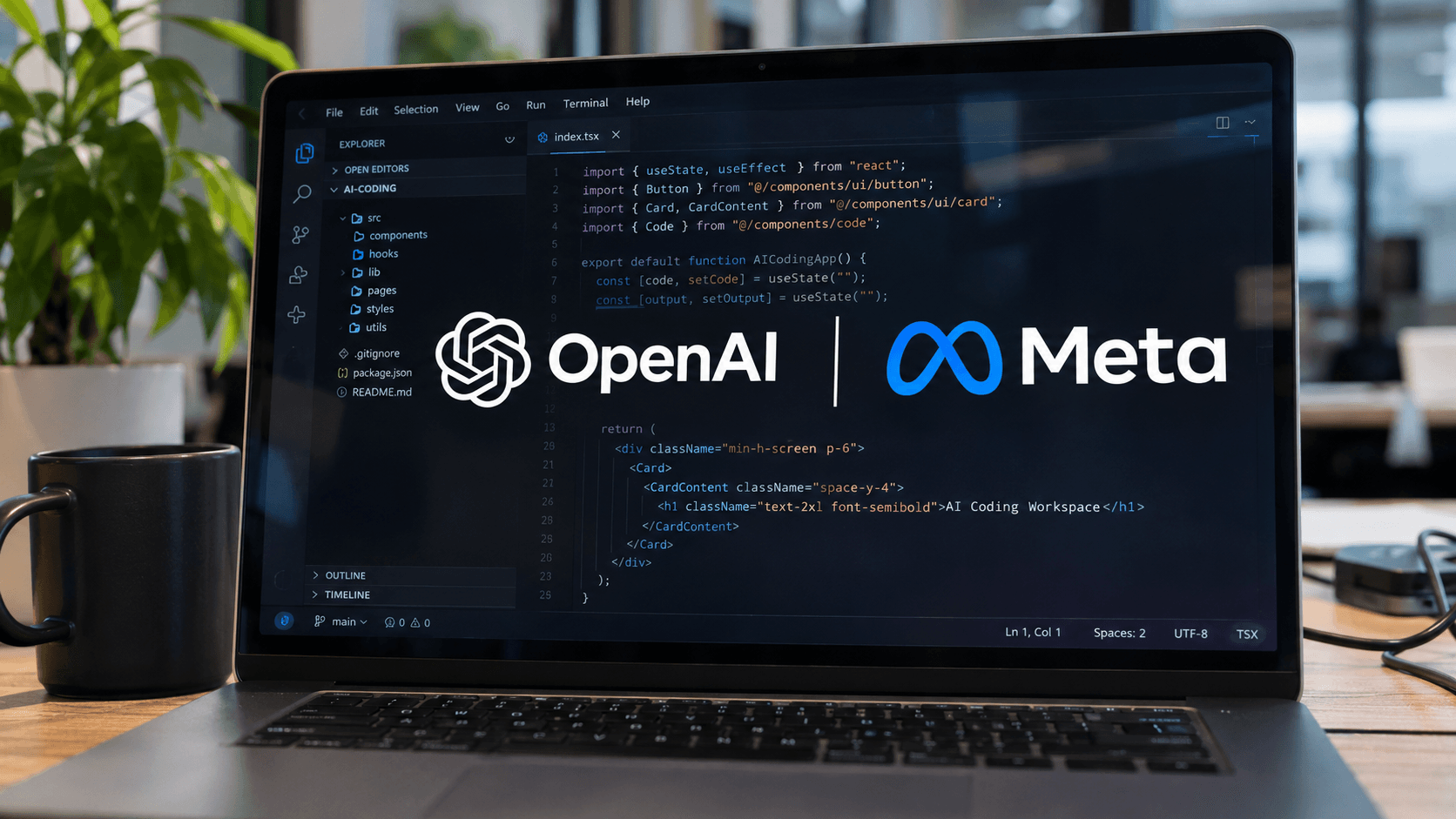
OpenAI and Meta Acquire AI Coding Startups to Strengthen Their Developer Ecosystems
OpenAI plans to acquire Pierre Computer while Meta acquires Conductor, signalling a growing race to control the tools behind AI-powered software development.
TL;DR
OpenAI has announced plans to acquire Pierre Computer Company, whose developer tools are already used within its Codex coding platform.
Meta has acquired Conductor, a startup that helps developers coordinate multiple AI coding agents working on different parts of a project simultaneously.
Both transactions were announced on November 4, 2026. Financial terms have not been disclosed.
Pierre strengthens code navigation, review and storage within Codex, while Conductor adds multi-agent coordination capabilities to Meta's developer ecosystem.
The acquisitions reflect a wider industry shift from building AI coding models towards controlling the complete software development workflow.
OpenAI and Meta Are Buying the Tools Behind AI Coding. Here's Why
Building a capable AI coding model is only one part of making AI useful for software developers. Developers also need tools to manage code, review changes, coordinate multiple AI agents and take projects from development to deployment.
OpenAI and Meta are now investing in this wider layer of software development.
OpenAI plans to acquire Pierre Computer Company, a developer-tools startup whose technology is already used within its Codex platform. At the same time, Meta also confirmed its acquisition of Conductor, a startup that helps developers coordinate multiple AI coding agents across parallel workspaces.
Although the two acquisitions target different parts of the development process, they point towards a similar ambition: building more complete platforms where developers and AI agents can work together.
What OpenAI Gains From Pierre Computer
Pierre Computer Company develops tools that help software developers navigate, review, edit and manage code.
Its products include Trees, which allows developers to navigate project files, and Diffs, which helps them understand and review code changes. It has also developed Highlights, a syntax-highlighting tool, and Code Storage, an API that allows applications to store code and track its history using Git.
Some of Pierre's open-source libraries, particularly Trees and Diffs, are already integrated into OpenAI's Codex application.
The acquisition is expected to strengthen Codex's capabilities beyond generating and editing code. OpenAI wants to connect more parts of the development process, from the creation of a new code branch to reviewing changes and eventually deploying software.
Pierre's open-source projects will remain open-source, according to OpenAI. Existing Code Storage customers will also be able to continue using the service after the acquisition closes while its functionality is integrated into Codex.
The transaction remains subject to customary closing conditions, including regulatory approvals. Financial terms have not been disclosed.
Why Meta Acquired Conductor
Meta's acquisition of Conductor targets a different challenge: helping developers manage multiple AI coding agents working at the same time.
Founded in 2024, Conductor developed a platform that allows software engineers to assign different parts of a coding project to separate AI agents. These agents can work simultaneously in isolated workspaces, reducing the need for developers to manage every task individually.
An important distinction is that Conductor does not build its own underlying AI models. Its platform works with agents from major AI companies, including Anthropic and OpenAI.
By bringing Conductor into its ecosystem, Meta could strengthen its developer-facing AI capabilities and make it easier for software engineers to coordinate complex coding tasks.
However, the acquisition also changes the future of Conductor's existing product. Its founder, Charlie Holtz, announced that the company was joining Meta and said a new experience was planned for early 2027.
Conductor Cloud will become read-only on November 13 and shut down on November 20, 2026. Existing users have been advised to export or transfer their cloud workspaces. The local application will continue receiving new models and critical bug fixes until early 2027.
Meta has confirmed the acquisition, but has not disclosed its financial terms or detailed integration plans.
The Bigger Race: Owning the Entire Software Development Workflow
These acquisitions reflect a change in how technology companies are approaching AI-assisted software development.
Early AI coding tools primarily focused on helping developers generate code, complete functions and identify errors. Newer systems are moving towards AI agents that can handle larger portions of a software project.
As this happens, the tools surrounding the AI model become increasingly important.
Developers need systems that can:
Navigate large codebases and understand existing projects.
Store code and track changes.
Review and improve AI-generated output.
Assign tasks to multiple agents.
Monitor progress across different workspaces.
Coordinate the development process before software is released.
Pierre and Conductor address different parts of this workflow.
Pierre strengthens the systems used to navigate, review and manage code. Conductor focuses on coordinating multiple AI agents so they can work on different tasks together.
For OpenAI and Meta, acquiring these capabilities could make their developer platforms more useful and encourage developers to spend more time within their respective ecosystems.
What Happens Next?
The immediate focus will be on integrating the acquired teams and technologies into their new organisations.
For OpenAI, the next step is bringing more of Pierre's code-management capabilities into Codex, subject to the acquisition closing.
For Meta, developers will be watching what emerges from Conductor's team and how the company's multi-agent experience develops in early 2027.
Both acquisitions also highlight a growing challenge for independent developer-tool startups: as AI platforms expand, specialised tools may become valuable acquisition targets for larger technology companies.
However, successful integration will depend on whether these capabilities provide a genuinely better development experience rather than simply adding more features to existing products.
The Bottom Line
OpenAI's planned acquisition of Pierre and Meta's acquisition of Conductor are more than two separate developer-tool transactions.
They reflect a wider shift in the AI industry towards controlling the infrastructure and workflows that support software development.
As AI agents take on more coding responsibilities, the value of platforms that help developers manage, coordinate and review their work is likely to increase.
The competition may no longer be decided only by which company builds the best coding model. It could also depend on who builds the most useful environment around it.