US Visa Policy Changes: How Indian IT Companies Are Rebuilding Their US Strategy
US immigration restrictions are reshaping Indian IT hiring and delivery models. Here's how TCS, Infosys, Wipro and HCLTech are adapting.
Can Indian IT Keep Its US Business Growing as Immigration Rules Tighten?
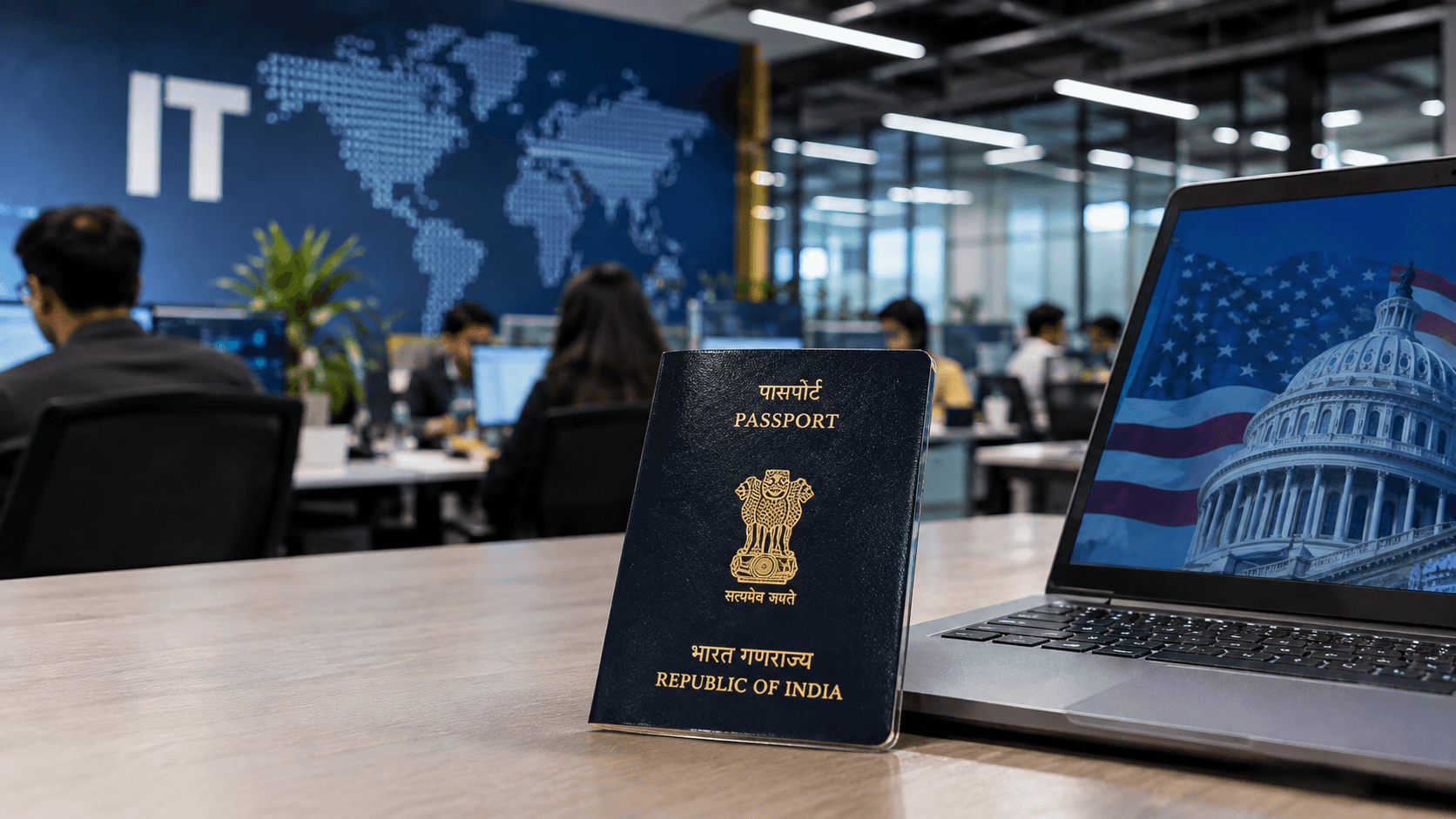
For decades, Indian IT companies have relied on a combination of offshore delivery centres in India and skilled professionals working at client locations in the United States. That model is now facing another challenge as the US introduces stricter immigration rules and increases scrutiny of foreign-worker hiring.
In October 2026, the US Department of Labor suspended new and pending applications under the Permanent Labour Certification (PERM) programme involving major technology companies, including Tata Consultancy Services (TCS), Infosys, Wipro, HCLTech, Cognizant and Capgemini. Microsoft and Adobe were also included in the action.
The move is part of a broader US effort to tighten oversight of foreign-worker employment. For Indian IT companies, it adds uncertainty to an operating model that has historically depended on moving skilled professionals between India and overseas client locations.
However, the industry is not starting from scratch. Many companies have spent years expanding local hiring and building delivery centres across different regions to reduce their dependence on US work visas.
What Has Changed in US Immigration Policy?
One of the most significant developments is the suspension of PERM applications involving the named companies.
PERM is a labour certification process generally used by US employers before sponsoring eligible foreign workers for employment-based green cards. It requires employers to demonstrate that hiring a foreign worker will not negatively affect the wages and working conditions of US workers.
The suspension prevents the affected companies from submitting new or processing pending PERM applications through this route while the restrictions remain in place.
It is important to distinguish PERM from the H-1B visa programme. The suspension does not automatically cancel existing H-1B visas, stop ongoing work assignments or block every route to permanent residency. However, it can delay the green-card process for affected employees.
The changes extend beyond PERM. The US has introduced a weighted H-1B selection process that gives greater priority to higher-skilled and higher-paid applicants. It has also proposed higher prevailing-wage requirements and additional scrutiny of employers.
The previously announced $100,000 payment requirement for certain new H-1B petitions has also faced legal challenges. Although the White House extended its proclamation in September 2026, federal courts have blocked enforcement of the payment policy. A separate proposed $103,265 H-1B fee is still undergoing the rulemaking process and should not be treated as an existing charge.
Together, these developments create a more demanding environment for companies that depend on bringing skilled professionals into the US.
How Indian IT Companies Are Reworking Their US Strategy
The shift towards local hiring and distributed delivery models began well before the latest restrictions.
According to an Indian Express analysis citing Kotak Neo, the traditional offshore-to-onshore workforce ratio of approximately 70:30 could move towards 85:15 by FY27. Nearshore centres in Canada, Mexico and Latin America are also becoming more important.
Company disclosures provide examples of this transition.
HCLTech reported in its FY26 annual report that approximately 80% of its US workforce consisted of local hires. The company has also expanded its international operations across the Americas and Europe.
TCS has been building a stronger presence in Latin America, including Mexico, where it operates multiple delivery centres. Following the PERM suspension, the company said its limited use of the programme would not materially affect its workforce strategy or customer engagements. It also reiterated its plan to hire 15,000 people in the US over five years.
Wipro has similarly increased local hiring in the US. Its HR leadership has previously stated that more than 80% of its workforce was localised, alongside a gradual reduction in dependence on H-1B workers.
These strategies allow companies to continue serving American clients while reducing the need to move employees across borders for every project.
Could India Benefit From the Changing Delivery Model?
The US remains extremely important to India's technology services industry.
According to a Global Trade Research Initiative (GTRI) analysis, India's software and IT-enabled services exports reached $221.4 billion in FY26, with the US accounting for approximately $119.7 billion, or 54.1% of the total.
A large share of this work is already delivered from India rather than through employees stationed at overseas client locations.
This creates an opportunity for Indian technology companies to strengthen their domestic engineering, delivery and research capabilities.
The shift could also benefit India's Global Capability Centres (GCCs). As multinational companies rethink where their technology teams operate, India could attract more engineering work, specialised roles and long-term digital operations.
However, the transition will not be automatic. Companies will still need local employees for client-facing responsibilities, specialised projects and operations requiring an on-site presence. They may also face higher costs when hiring and maintaining teams in the US and other international markets.
The Bottom Line
US immigration policy changes are putting pressure on a traditional part of the Indian IT business model, but they are also accelerating a transition that was already underway.
Companies such as TCS, Infosys, Wipro and HCLTech have spent years building local workforces and expanding delivery operations beyond India and the US.
The next phase of competition may depend less on how easily companies can move employees across borders and more on how efficiently they can manage talent, technology and customer delivery across multiple countries.
For Indian IT, the challenge is not simply adapting to tighter visa rules. It is building a global operating model that can continue growing even as the rules change.