Jensen Huang Steps Down After 33 Years. Can NVIDIA Move Forward Without Its Founder?
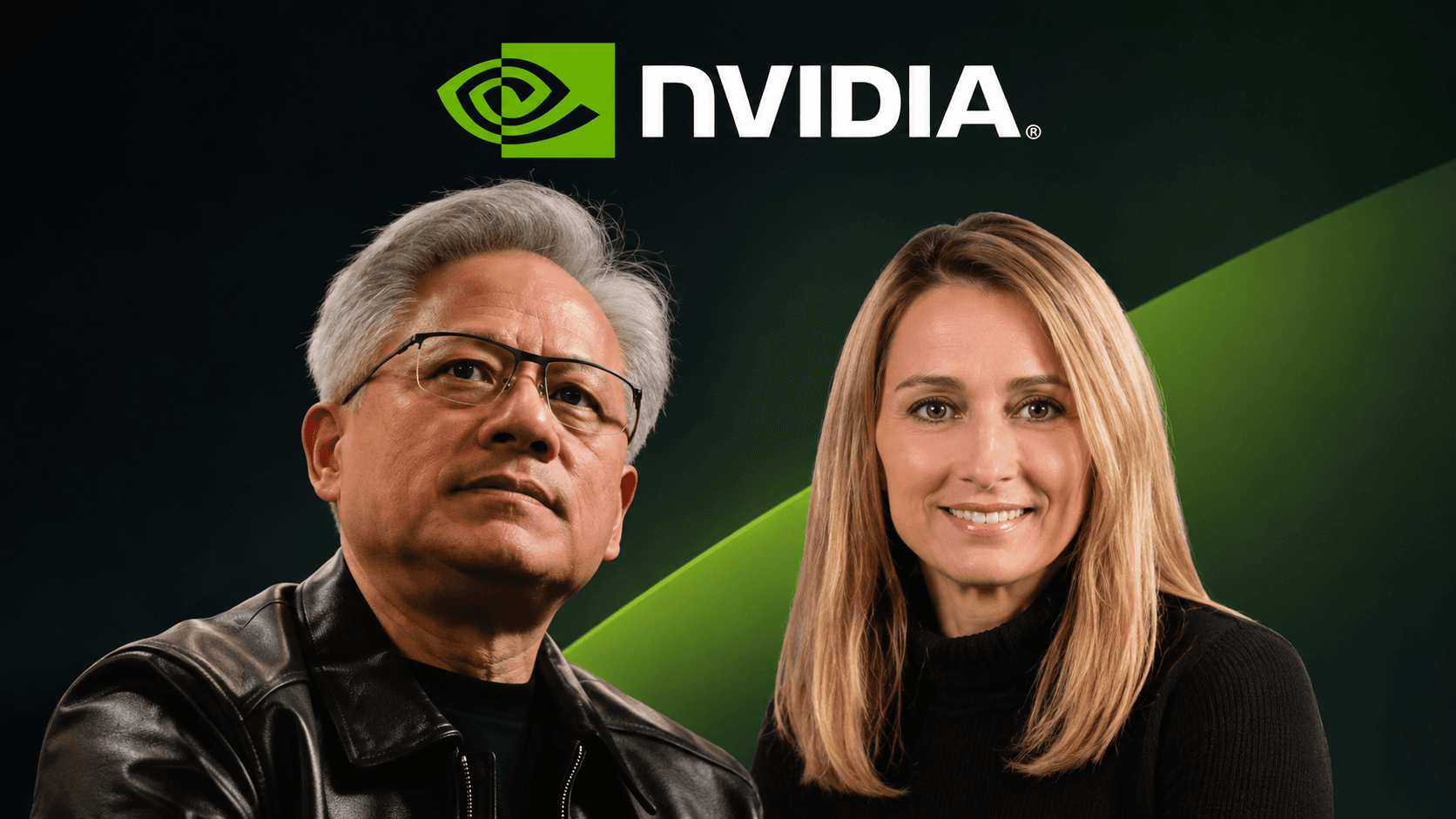
NVIDIA co-founder Jensen Huang has resigned as CEO and board member with immediate effect. CFO Colette Kress will take over as interim CEO as the chipmaker begins searching for a permanent successor.
The Man Who Led NVIDIA for 33 Years Is Stepping Away
For more than three decades, Jensen Huang was the central figure behind NVIDIA's rise from a graphics-chip company into one of the most influential businesses in the artificial intelligence industry.
That leadership has now come to an abrupt end.
NVIDIA announced on November 12, 2026, that Huang had resigned as President, Chief Executive Officer and a member of the Board of Directors, effective immediately.
The company has appointed Colette Kress, its long-serving Chief Financial Officer, as interim CEO while the board searches for a permanent successor. Kress will continue to serve as CFO during the interim period.
The board has also appointed Harvey C. Jones as its first-ever Chair.
Huang co-founded NVIDIA in 1993 and led the company throughout its 33-year journey. His departure marks one of the most consequential leadership changes in the technology industry, particularly because NVIDIA's hardware has become central to the infrastructure powering modern AI.
Who Is Taking Over at NVIDIA?
The immediate responsibility now rests with Colette Kress, who joined NVIDIA in September 2013 as Executive Vice President and CFO.
Before NVIDIA, she spent nearly 25 years in finance roles at technology companies including Cisco and Microsoft.
Her appointment is interim. NVIDIA has said it will consider both internal and external candidates for the permanent CEO position.
Kress has already set out her message to employees, customers and investors. In the company's announcement, she said:
"NVIDIA's strength has always come from its people."
She also committed to building on the foundation Huang created over the past 33 years and continuing the company's work in accelerated computing and AI.
Harvey C. Jones, meanwhile, brings more than three decades of experience as an entrepreneur, technology executive and venture investor. He has served on NVIDIA's board since 1993 and becomes its first Board Chair.
The leadership structure is therefore changing, but the board says the company's operations, customer commitments and product roadmap are expected to continue without interruption.
The Resignation Comes After a Turbulent Week
Huang's departure follows a period of intense scrutiny.
On November 8, NVIDIA's board announced an independent investigation after reports that Huang had been the target of a foreign intelligence effort. The board appointed a committee of independent directors to oversee the review and later retained former acting US Attorney Joon H. Kim and the law firm Wachtell, Lipton, Rosen & Katz to conduct the investigation.
The board stated that it had no reason to believe that national security or NVIDIA's confidential information had been compromised.
Separately, Huang acknowledged in a message to employees that he had been unfaithful to his wife and apologised for the impact on his family and colleagues. Media reports also raised allegations involving a businesswoman with connections to a Singapore-based technology company. Those reports have not all been independently verified.
Importantly, NVIDIA's November 12 resignation announcement did not state why Huang was leaving, nor did it explicitly connect the resignation to the board's investigation.
That distinction matters. The timing is clear, but the company's formal statement does not establish the reason for his departure.
Why Huang's Exit Matters Beyond NVIDIA
NVIDIA's importance to the AI industry goes far beyond selling GPUs.
Under Huang's leadership, the company built an ecosystem spanning chips, networking, software, data-centre infrastructure and partnerships with cloud providers and AI developers.
He was also closely involved in relationships with key manufacturing and supply-chain partners, including TSMC, Foxconn, Wistron, SK Hynix and Samsung.
Reuters reported that suppliers and business partners in Asia are now assessing what a leadership transition could mean for their relationships with NVIDIA. Some analysts have raised concerns that a successor may approach long-term capacity investments and strategic partnerships differently.
There is also a wider question around NVIDIA's role in financing and supporting parts of the AI ecosystem. The company has invested in AI infrastructure providers and technology businesses, making its decisions relevant to companies beyond its direct customers.
However, a change in leadership does not automatically mean an immediate change in the product roadmap. NVIDIA's current chips are already in production, and some analysts expect limited short-term disruption.
The longer-term question is whether the company can maintain the same pace of investment, partnership-building and strategic decision-making without Huang at the centre.
The Real Test Is Succession, Not Just the CEO Appointment
NVIDIA is now facing a test familiar to many founder-led technology companies: can the institution continue to operate at the same level when its most recognisable leader is no longer in charge?
Kress inherits a company with a deep leadership team, an established customer base and a strong position in AI computing. But the permanent succession decision will matter because NVIDIA's influence has been built through a combination of technology, ecosystem relationships and long-term strategic bets.
The board will need to demonstrate that these capabilities are embedded across the organisation, rather than dependent on one individual.
The bottom line: Jensen Huang's departure does not erase the company he built, but it changes the leadership structure of one of the most important businesses in the AI economy. NVIDIA's next chapter will be judged by how smoothly it manages this transition and whether it can preserve the strategic momentum that made it central to the AI boom.