Amazon Funds Back Greenjoules' ₹150 Crore Bet on Turning Farm Waste Into Fuel
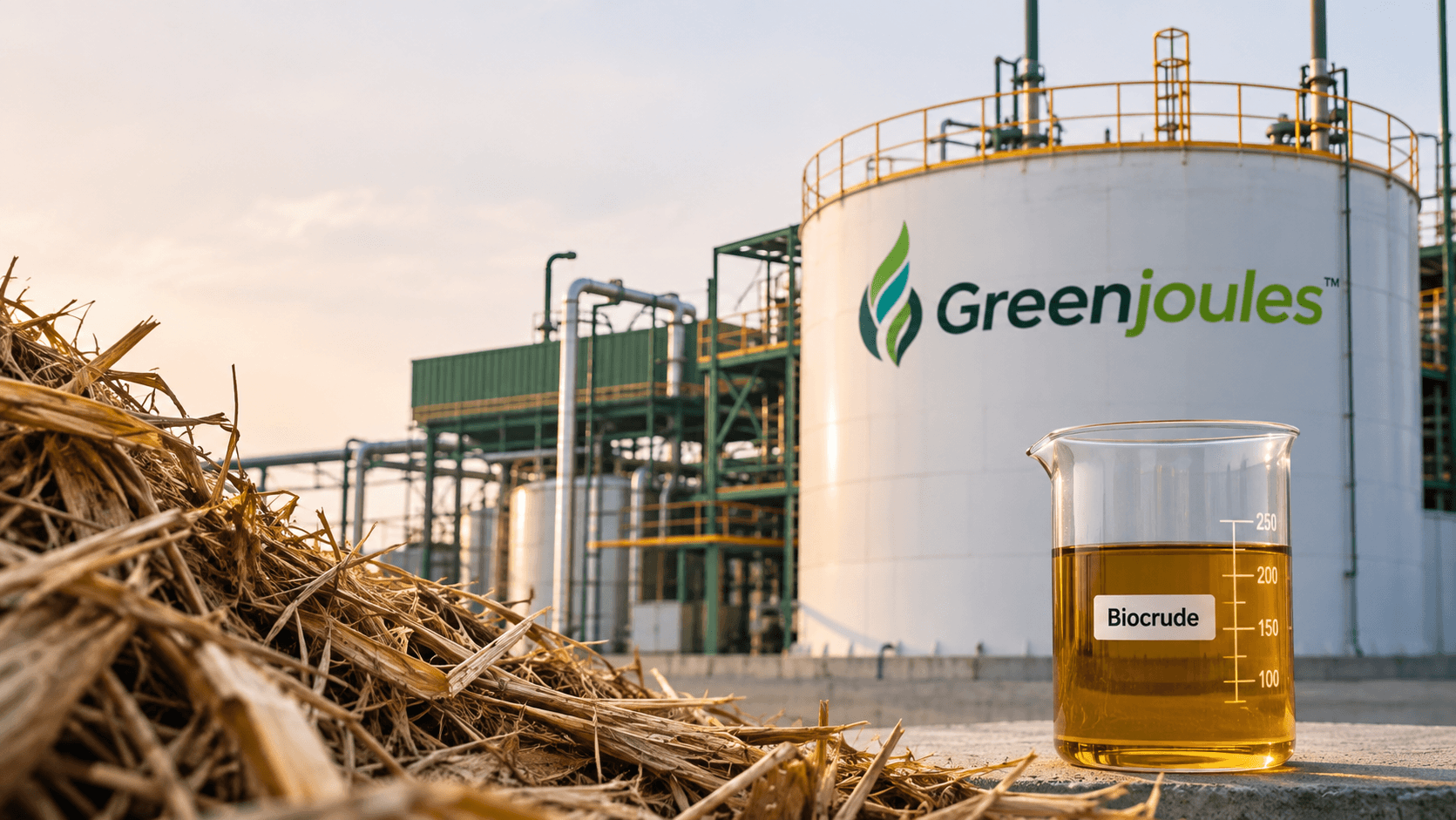
Pune-based Greenjoules has raised ₹150 crore in Series B funding co-led by Amazon's Smbhav Venture Fund and Climate Pledge Fund. A separate ₹100 crore government-backed loan will support a new facility that converts agricultural waste into biocrude.
TL;DR
Greenjoules has raised ₹150 crore in a Series B round co-led by Amazon's Smbhav Venture Fund and Climate Pledge Fund.
Rainmatter and Singularity's Strategic Autonomy Fund also participated.
The company separately secured a ₹100 crore loan from the government's Technology Development Board.
The combined ₹250 crore financing will support a plant at Khed City, Pune, designed to produce 200,000 litres of biocrude daily from agricultural waste.
Construction is planned in phases from 2027, with future ambitions in sustainable aviation fuel, green hydrogen and sustainable materials.
Amazon Is Backing a Startup That Turns Farm Waste Into Fuel
Agricultural waste is often treated as a disposal problem. Pune-based Greenjoules wants to turn it into a source of industrial fuel.
The renewable fuels company has raised ₹150 crore in a Series B funding round, co-led by Amazon's Smbhav Venture Fund and Climate Pledge Fund. Rainmatter, the investment arm of Zerodha, and Singularity's Strategic Autonomy Fund also participated.
The company has also secured a separate ₹100 crore loan from the government's Technology Development Board (TDB), taking the total financing for its expansion to ₹250 crore.
Announced on November 11, 2026, the financing will support a new manufacturing facility at Khed City in Pune. Once completed, the plant is expected to produce up to 200,000 litres of biocrude every day, using agricultural waste as its feedstock.
Construction is expected to begin in phases from 2027.
How Greenjoules Converts Agricultural Waste Into Fuel
Greenjoules' approach starts with crop residue and other agricultural waste that can be difficult to process using conventional fuel-production methods.
Its technology converts this low-energy-density material into biocrude, which can then be refined into renewable diesel. The resulting fuel is designed as a drop-in alternative, meaning it can be used with existing vehicles and fuel infrastructure without requiring major modifications.
The company has developed and tested its process at its existing facility in Chakan, near Pune. The proposed Khed City plant is intended to take that process to a much larger industrial scale.
This distinction matters. Greenjoules is not simply collecting agricultural waste or producing small batches of experimental fuel. It is trying to build the manufacturing capacity needed to make waste-derived fuels commercially relevant.
Co-founder and Chief Technology Officer Shweta Viraraghavan said the company had spent more than six years proving that agricultural waste could be converted into specification-grade fuel.
The next challenge is doing that consistently and economically at a much larger scale.
Why Amazon and Other Investors Are Interested
Amazon's participation brings a notable corporate investor into India's renewable fuels sector.
The company's Climate Pledge Fund backs technologies that can help reduce carbon emissions, while the Smbhav Venture Fund invests in businesses addressing areas such as sustainability and small-business growth.
For Amazon, alternative fuels are relevant to the challenge of decarbonising transportation, particularly long-distance logistics where electrification may not be practical for every use case.
Rainmatter and Singularity's Strategic Autonomy Fund also participated in the round. Blue Ashva Capital, which led Greenjoules' Series A in 2021, remains the company's largest shareholder.
The separate TDB loan is also significant. It brings government-backed financing into the expansion plan without increasing the size of the equity round. Together, the equity funding and loan provide ₹250 crore for the planned facility and related expansion.
From Renewable Diesel to Sustainable Aviation Fuel
Greenjoules is also looking beyond its immediate renewable diesel opportunity.
The company says it plans to explore applications in sustainable aviation fuel, green hydrogen and sustainable materials.
These areas could broaden the potential use of its underlying technology, particularly as industries look for alternatives to fossil-based fuels and materials. However, the new Khed City facility is currently described as a biocrude production project; its planned capacity should not be confused with confirmed production capacity for sustainable aviation fuel or green hydrogen.
The immediate test will be whether Greenjoules can build the plant, secure consistent agricultural feedstock and produce fuel at a cost and scale that attract long-term buyers.
The Bigger Picture: Can Agricultural Waste Become an Energy Asset?
India generates large quantities of agricultural residue while continuing to rely heavily on imported fossil fuels. Converting some of that residue into usable fuel could create another route to domestic energy production.
It could also provide an additional market for agricultural waste, although the economics will depend on collection, transportation, processing costs and the final fuel's ability to compete with conventional alternatives.
Greenjoules is now moving from a technology-development phase towards a much larger manufacturing ambition. Amazon's backing and the TDB loan give the company capital to attempt that transition.
The bottom line: Greenjoules has raised ₹150 crore in equity and secured a separate ₹100 crore loan to turn agricultural waste into industrial-scale fuel. The real milestone will come when the Khed City plant moves from construction to consistent commercial production.