Ineffable Intelligence Raises $1.1B AI Funding
Ex-DeepMind scientist David Silver raises $1.1B to build a self-learning AI superlearner. Backed by Sequoia, NVIDIA & Google. Latest AI funding news inside.
TL;DR
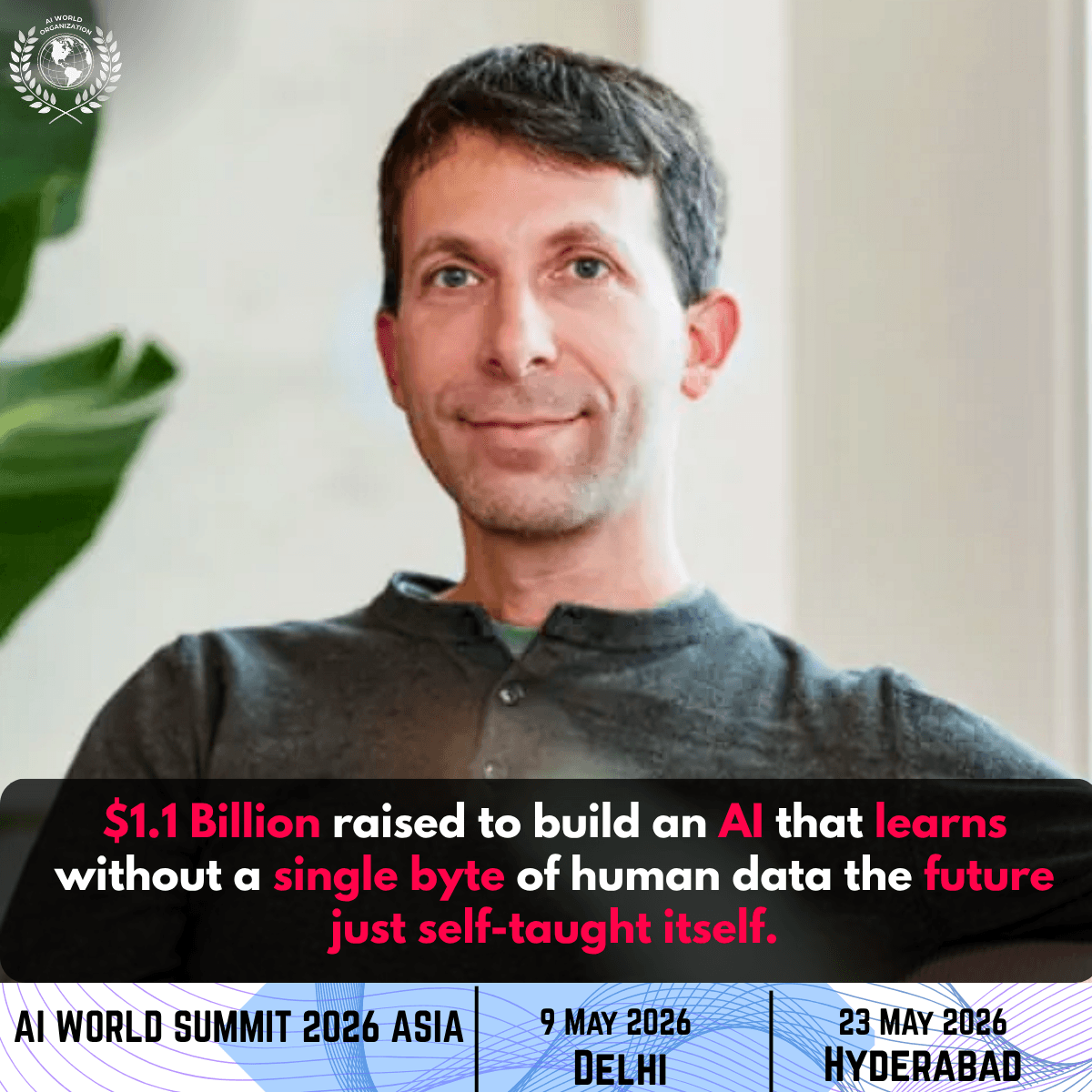
David Silver, the researcher behind AlphaZero at DeepMind, has launched a new company called Ineffable Intelligence and raised $1.1 billion within months of founding it. The London-based startup is building an AI that learns entirely on its own — no human data needed. Sequoia, NVIDIA, Google, and even the UK government are backing it.
Ineffable Intelligence Raises $1.1 Billion to Build a Self-Learning AI That Needs No Human Data
In what has quickly become one of the most talked-about developments in the global AI funding landscape, a relatively young British artificial intelligence lab called Ineffable Intelligence has secured a staggering $1.1 billion in funding, earning a valuation of $5.1 billion — barely months after it was founded. The company was launched by David Silver, a name that commands enormous respect in the world of artificial intelligence research. Silver spent well over a decade at DeepMind, Google's renowned AI division, before stepping away to pursue what he has called the most ambitious project of his life. For the global AI community, this latest AI funding news represents far more than just another large investment — it signals a potential shift in how machines learn, think, and ultimately understand the world around them.
The sheer scale of this AI funding round is enough to raise eyebrows, but what makes it truly remarkable is the vision behind it. Ineffable Intelligence is not building another large language model in the vein of GPT or Gemini. Instead, the company is working toward something far more foundational — a so-called "superlearner" that can acquire knowledge and develop skills entirely on its own, without ever being trained on human-generated data. It's an idea that pushes the boundaries of what we currently understand to be possible in machine learning, and it has drawn the attention — and capital — of some of the biggest names in the technology investment world.
From DeepMind to Disruption: Who Is David Silver?
To understand why Ineffable Intelligence has attracted this level of attention so rapidly, one needs to understand the man at the center of it all. David Silver is not simply a well-regarded researcher — he is widely considered one of the foundational architects of modern reinforcement learning. At DeepMind, Silver led the reinforcement learning team and was a central figure in some of the most astonishing demonstrations of machine intelligence the world has ever witnessed. He was deeply involved in the development of AlphaZero, a program that taught itself to master the games of chess and Go without being shown a single human game or strategy. It learned purely through trial, error, and self-play — and it ended up defeating the world's best computer programs at both games with a decisiveness that left the scientific community in awe.
Silver is also a professor at University College London, where he has spent years teaching and refining the theoretical underpinnings of reinforcement learning. His departure from DeepMind to build something new was never going to go unnoticed. When someone of his caliber decides to leave a comfortable position at one of the world's leading AI labs to start a company, the industry pays attention — and investors respond. The founding of Ineffable Intelligence triggered what many in venture capital circles have started calling "coconut rounds" — a somewhat playful term for seed-stage investments that have grown so large they outgrow the typical definition of a seed round. In Ineffable's case, the company jumped straight past unicorn status ($1 billion valuation) and planted its flag firmly in pentacorn territory, meaning it is now valued at over $5 billion. That journey happened within just a few months of being founded, which is a remarkable pace by any standard.
The Superlearner Vision: AI Funding News That Rewrites the Rules
The central idea driving Ineffable Intelligence — and the reason this particular AI funding news has generated so much discussion — is the concept of a superlearner. Most of today's most powerful AI systems, from large language models like ChatGPT to image generators and code assistants, are built on a foundation of human-produced data. They are trained on billions of pages of text written by people, millions of images taken by people, and countless hours of audio and video recorded by people. These systems are, in a very real sense, mirrors of human knowledge — they reflect back what we have collectively produced, organized, and fed into them.
What Silver and his team at Ineffable Intelligence are attempting to do is fundamentally different. The superlearner they are developing would not rely on any of that human data. Instead, it would discover knowledge organically, the same way AlphaZero discovered how to play chess — through experience, exploration, feedback, and the gradual accumulation of understanding. The reinforcement learning approach that Silver pioneered at DeepMind is at the heart of this ambition. In reinforcement learning, an AI agent takes actions, observes the outcomes, receives rewards or penalties, and over time learns to optimize its behavior accordingly. The key distinction here is that no one has to show it the "right" answer in advance. It figures things out on its own.
Ineffable Intelligence's website describes this vision with remarkable boldness. The company claims that if successful, their work would represent a scientific breakthrough of comparable magnitude to Darwin's theory of evolution — arguing that where Darwin explained all life, their law would explain and build all intelligence. It is an audacious claim, but in the context of this AI funding round and the caliber of people involved, it is not being dismissed as mere marketing hyperbole. Silver himself, in a personal note published on the company's blog and in statements to the press, described Ineffable Intelligence as his "life's work." He also made a pledge that has captured significant public attention: any personal financial gains he makes from the venture will be directed to high-impact charities focused on saving as many lives as possible.
Sequoia, NVIDIA, Google, and the UK Government Back the Vision
The $1.1 billion AI funding round that has anchored Ineffable Intelligence's early trajectory was co-led by two of the most prestigious names in venture capital — Sequoia Capital and Lightspeed Venture Partners. These are firms with an extraordinary track record of identifying and backing transformative technology companies at the earliest stages, and their participation here sends a strong signal about how seriously the investment world is taking Ineffable's ambitions. Alongside them, Index Ventures, Google, and NVIDIA also participated in the round, adding not just capital but strategic weight to the company's network and resources.
Perhaps the most distinctive element of this funding round is the involvement of two uniquely British backers: the British Business Bank and Sovereign AI, the United Kingdom's recently established sovereign venture fund specifically focused on artificial intelligence. The inclusion of these government-backed institutions is telling. It suggests that the UK government sees Ineffable Intelligence not just as a promising startup, but as a strategic national asset — a company that could put Britain at the forefront of next-generation AI development. This is particularly significant at a time when the global race to dominate artificial intelligence is intensifying by the month, and when governments around the world are increasingly treating AI capabilities as a matter of national interest and security.
The backing of NVIDIA is worth noting separately. As the company that produces the chips that power the majority of the world's AI training workloads, NVIDIA's participation in any AI funding round carries both financial and symbolic significance. When NVIDIA invests, it often means the company believes in both the technology and the infrastructure demands that will come with scaling it. For Ineffable Intelligence, which will need enormous computing resources to train and iterate on its superlearner models, having NVIDIA as an investor could prove strategically invaluable as the project moves from concept to reality.
London's Rise as a Global AI Powerhouse
One of the more quietly significant dimensions of this AI funding news is what it tells us about the changing geography of global artificial intelligence development. For years, the dominant narrative has placed the United States — and Silicon Valley in particular — at the undisputed center of AI innovation. While the US clearly remains a powerhouse, the emergence of Ineffable Intelligence as a London-based pentacorn suggests that another city is steadily building the infrastructure, talent, and capital networks needed to compete at the highest level.
London's rise as an AI hub is not happening in a vacuum. It is, in large part, a consequence of DeepMind's continued presence in the city since Google acquired it back in 2014. Over more than a decade, DeepMind has trained and developed a remarkable generation of AI researchers who have now begun to branch out and build their own ventures. The alumni network spawned by DeepMind is proving to be one of the most consequential in the global technology industry. Several former DeepMind staffers are already reported to be joining Ineffable Intelligence's executive team, which means the company is drawing directly from a pool of people who have already worked at the very frontier of AI research.
Ineffable Intelligence is not alone in this space. Recursive Superintelligence, another UK-incorporated AI lab co-founded by Tim Rocktäschel — formerly a principal scientist at DeepMind — reportedly raised $500 million in a round with enough demand that it could scale to $1 billion. And just last month, AMI Labs, co-founded by Turing Award winner and former Meta AI scientist Yann LeCun, closed a $1.03 billion round at a $3.5 billion pre-money valuation. Even Jeff Bezos' AI lab, Project Prometheus, is reportedly in discussions to secure office space near Google's AI hub in London. The pattern is becoming impossible to ignore. London is no longer simply benefiting from the presence of one exceptional AI lab — it is becoming the setting for a genuine cluster of frontier AI ventures, each with world-class talent, global investor backing, and transformative ambitions.
What This Means for the Future of Artificial Intelligence
Stepping back from the specifics of this individual AI funding round, it is worth considering what the broader trajectory of these investments tells us about where the field of artificial intelligence is heading. The money pouring into companies like Ineffable Intelligence is not flowing toward incremental improvements on existing technology. It is flowing toward bets on entirely new paradigms — AI systems that learn differently, think differently, and potentially operate with a level of autonomy and self-directed discovery that today's models cannot approach.
Reinforcement learning, the core methodology behind Ineffable's superlearner, has already proven itself capable of astonishing things in narrow domains. AlphaZero mastered chess and Go. Other RL-based systems have learned to play video games, control robots, and optimize complex industrial processes. But the promise — and the genuine scientific challenge — is generalizing those capabilities. Can a reinforcement learning system not just master a specific game or task, but develop the kind of broad, flexible, self-directed intelligence that would allow it to explore and understand an open-ended world? That is the question Ineffable Intelligence is betting $1.1 billion on answering.
The implications, if they succeed even partially, would be profound. An AI system that can discover knowledge independently rather than depending on human-generated data would represent a qualitative leap beyond today's generation of AI tools. It would not be bounded by the limits or biases of existing human knowledge. It could, in theory, surface insights that humans have never arrived at — not because it has been trained on the right data, but because it has explored the right territory. The AI funding news surrounding Ineffable Intelligence is therefore not simply about dollars and valuations. It is about the possibility of a genuinely new chapter in the development of machine intelligence — one that begins not with what humans have already learned, but with what a machine might discover entirely on its own.
At The AI World Organisation, we will continue to track the developments coming out of Ineffable Intelligence closely, as well as the broader wave of frontier AI funding that is reshaping both the technology landscape and the global race to define the future of intelligence.