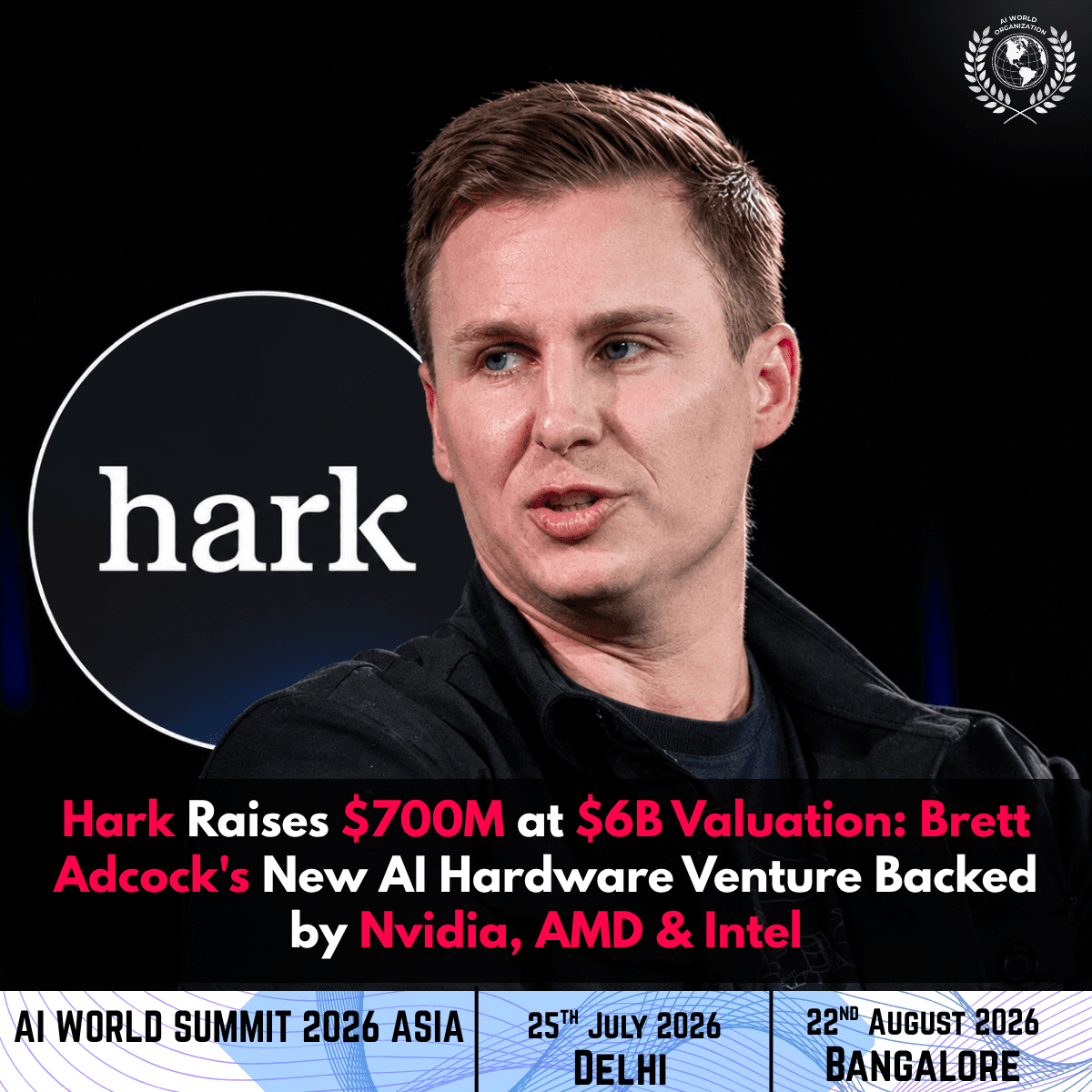
Hark Raises $700M at $6B Valuation for AI Hardware
Hark secures $700M Series A led by Parkway Venture Capital with Nvidia, AMD, Intel backing. $6B valuation marks major AI hardware breakthrough in 2026.
TL;DR
Brett Adcock's AI hardware startup Hark just closed a massive $700 million Series A round, reaching a $6 billion valuation. The company landed backing from tech heavyweights including Nvidia, AMD, Intel, and Qualcomm. Hark is building personalized AI systems with custom hardware, planning to launch its first software models this summer before rolling out specialized devices designed for more natural human-AI interaction.
Hark Secures Massive $700 Million in Series A Funding, Achieves $6 Billion Valuation in AI Hardware Revolution
The artificial intelligence hardware landscape witnessed a seismic shift this week as Hark, a San Jose-based AI laboratory, announced the successful closure of over $700 million in Series A funding, propelling the company to an impressive $6 billion post-money valuation. This development marks one of the most significant funding rounds in the AI hardware sector for 2026, signaling strong investor confidence in the future of personalized artificial intelligence systems and next-generation computing infrastructure.
The oversubscribed funding round was spearheaded by Parkway Venture Capital, with an impressive roster of technology giants and venture firms participating in the investment. The list of backers reads like a who's who of the semiconductor and cloud computing industry, including Nvidia Corporation, AMD Ventures, Intel Capital, Qualcomm Ventures, and Salesforce Ventures. Additional prominent investors include ARK Invest, Brookfield, Greycroft, Prime Movers Lab, Align Ventures, and Tamarack Global, demonstrating broad-based institutional support for Hark's ambitious vision.
Founded by serial entrepreneur Brett Adcock, who previously established Figure AI and Archer Aviation, Hark represents his latest venture into the rapidly evolving artificial intelligence ecosystem. Adcock has built a reputation for tackling complex technological challenges, and with Hark, he's setting his sights on fundamentally transforming how humans interact with AI systems. The company's mission centers on developing what it calls "advanced personalized intelligence" that goes beyond traditional chatbot interfaces to create more natural, intuitive interactions between people and AI-powered systems.
The Vision Behind Hark's Universal AI Interface
What sets Hark apart from the crowded field of AI startups is its dual focus on both software models and purpose-built hardware designed specifically for personalized AI experiences. The company isn't simply developing another large language model or conversational assistant. Instead, Hark is pursuing an integrated approach that combines sophisticated AI algorithms with custom hardware architectures optimized for running these advanced systems efficiently and effectively.
According to industry sources, Hark is building what it describes as a "universal AI interface" that will fundamentally change how people engage with artificial intelligence in their daily lives. This vision extends beyond screen-based interactions to encompass physical world applications, suggesting that Hark's hardware ambitions may include novel form factors and interaction paradigms that haven't yet been widely adopted in consumer markets. The company's approach appears designed to compete directly with established players like OpenAI, Google, Apple, and Meta, all of whom are investing heavily in AI assistant technologies.
The timing of Hark's emergence is particularly noteworthy. As AI technology matures beyond text generation and image creation, there's growing recognition that existing computing hardware wasn't necessarily designed for the demands of modern AI workloads. Hark's strategy of co-developing AI models alongside specialized hardware addresses this fundamental challenge, potentially offering performance advantages and unique capabilities that purely software-focused competitors cannot match.
Brett Adcock has been characteristically ambitious in his public statements about the company's goals. In announcing the funding round, he emphasized his belief that current AI models "feel basic" and that there's substantial room for improvement in how these systems understand and assist users. This perspective reflects a broader industry sentiment that despite impressive recent advances, artificial intelligence still falls short of delivering truly personalized, context-aware assistance that adapts seamlessly to individual users' needs and preferences.
Strategic Investor Participation Signals Industry Confidence
The composition of Hark's investor syndicate provides important insights into the strategic positioning of the company and the technologies it's developing. The participation of major semiconductor manufacturers like Nvidia, AMD, Intel, and Qualcomm is particularly telling. These companies are at the forefront of developing chips and processing architectures for AI workloads, and their investment in Hark suggests they see potential for collaborative development or anticipate significant demand for their technologies as Hark scales its hardware production.
Nvidia's involvement is especially significant given the company's dominant position in AI computing infrastructure. Nvidia's GPUs have become the de facto standard for training large AI models, and the company has expanded into specialized AI chips for inference and edge computing. Their investment in Hark could indicate alignment on future hardware architectures or signal Nvidia's belief that Hark's approach to personalized AI will drive demand for advanced computing capabilities.
Similarly, the participation of AMD Ventures and Intel Capital represents validation from two of Nvidia's primary competitors in the semiconductor space. Both companies are aggressively pursuing opportunities in AI hardware, and their willingness to back Hark suggests they see the startup as either a potential customer for their technologies or a valuable ecosystem partner that can help demonstrate new use cases for AI computing.
Qualcomm Ventures' involvement adds another dimension, given Qualcomm's strength in mobile and edge computing processors. This could hint that Hark's hardware plans include mobile or portable devices that would benefit from Qualcomm's expertise in power-efficient processing. The combination of cloud-focused investors like Salesforce Ventures with edge-computing specialists like Qualcomm suggests Hark may be pursuing a distributed computing architecture that spans from datacenter to device.
The presence of ARK Invest, known for its focus on disruptive innovation and aggressive technology bets, further underscores the transformative potential investors see in Hark's approach. ARK has been a prominent voice advocating for AI's world-changing impact, and their participation lends credibility to Hark's ambitious vision for reimagining human-AI interaction.
Competitive Landscape and Market Positioning
Hark enters a fiercely competitive market where established technology giants and well-funded startups are all vying to define the next generation of AI interfaces and hardware. OpenAI has demonstrated the commercial potential of advanced AI with ChatGPT and is expanding into multimodal capabilities. Google has deep expertise in both AI models and custom hardware through its TPU chips. Apple is rumored to be developing AI-specific processors and has shown interest in more natural interaction paradigms through its work on augmented reality and voice interfaces. Meta continues to invest heavily in AI research and has open-sourced several competitive models.
What distinguishes Hark in this crowded field is its founding team's track record in bringing ambitious hardware projects from concept to production. Brett Adcock's experience with Figure AI, which is developing humanoid robots, and Archer Aviation, which is building electric vertical takeoff and landing aircraft, demonstrates an ability to tackle complex engineering challenges that span software, hardware, and physical systems. This background is particularly relevant for Hark's mission, as creating hardware for AI interfaces requires solving challenging problems in industrial design, thermal management, power efficiency, and manufacturing scalability.
The company's emphasis on personalization also represents a strategic differentiator. While many AI assistants offer some degree of customization, they typically operate using shared models that serve millions of users identically. Hark's focus on "advanced personalized intelligence" suggests an architecture where AI models can be tailored to individual users' needs, preferences, and contexts more deeply than current solutions allow. Achieving this vision likely requires innovations in both model architecture and the hardware systems that run these models, explaining why Hark is pursuing both simultaneously.
The $6 billion valuation, while substantial for a Series A company, positions Hark below some of the most prominent AI startups but above many emerging players. This valuation reflects investor belief in the team's execution capabilities and the market opportunity for differentiated AI hardware, while acknowledging the significant technical and commercial challenges that remain ahead. The company will need to demonstrate that its integrated hardware-software approach delivers meaningful advantages over software-only or hardware-agnostic competitors.
Development Timeline and Strategic Roadmap
According to available information, Hark is targeting summer 2026 for the debut of its first software-based AI models. This relatively near-term milestone suggests the company has already made substantial progress in model development and may have been working on the technology for some time before publicly announcing the funding round. Brett Adcock reportedly began funding Hark out of his own pocket in late 2025, giving the team several months of runway before this Series A announcement.
The decision to launch with software before introducing custom hardware aligns with a logical development and go-to-market strategy. By first proving the capabilities of their AI models, Hark can build a user base, gather feedback, and demonstrate the value proposition before asking customers to invest in new hardware devices. This approach also allows the company to iterate on the model architecture and understand performance requirements more concretely before finalizing hardware specifications.
Following the initial software release, Hark plans to introduce hardware devices specifically optimized for running these AI systems. While details about these devices remain limited, the company's description of building systems that "interact more naturally with people and the physical world, not just through chat" suggests form factors or interaction modalities that go beyond traditional smartphones, tablets, or computers. Possibilities could include wearable devices, ambient computing systems, or entirely new product categories designed around AI-first experiences.
The $700 million in fresh capital will primarily be directed toward team expansion and continued research and development across both the AI model and hardware tracks. Building a company that can compete with the resources of Google, Apple, and Microsoft requires assembling world-class talent in multiple disciplines including machine learning, chip design, industrial design, systems engineering, and manufacturing. The funding provides Hark with the resources to attract top talent and make the substantial investments required to bring complex hardware products to market.
Implications for the Broader AI Industry
Hark's successful fundraise and ambitious vision carry several important implications for the artificial intelligence industry as a whole. First, the substantial investment from major semiconductor companies validates the thesis that specialized hardware will play a crucial role in the next phase of AI development. While much of the recent AI boom has been driven by software innovations running on general-purpose GPUs, there's growing recognition that purpose-built hardware can unlock new capabilities and efficiency improvements.
Second, the focus on personalized AI represents a potential shift from the current paradigm of massive, general-purpose models toward more tailored systems. If Hark succeeds in demonstrating that personalized models running on custom hardware deliver significantly better experiences than cloud-based general models, it could influence the development roadmaps of larger competitors and reshape user expectations for AI assistants.
Third, the emergence of a well-funded competitor with a differentiated approach intensifies the already fierce competition in AI, which ultimately benefits end users through faster innovation and more diverse options. The AI landscape needs multiple successful approaches and business models to ensure healthy competition and avoid market concentration around one or two dominant platforms.
The involvement of such a diverse group of investors also highlights the increasing recognition that AI represents not just a software opportunity but a full-stack challenge encompassing chips, systems, applications, and user experiences. The convergence of interest from chip makers, cloud providers, venture capitalists, and strategic investors reflects the breadth of potential value creation across the AI ecosystem.
For the global AI community and organizations focused on advancing artificial intelligence technology, Hark's emergence represents both an exciting development and a reminder of the substantial capital requirements for competing at the frontier of AI research and hardware development. The $700 million Series A is among the largest early-stage funding rounds in technology history, reflecting the immense market opportunity but also the significant barriers to entry in this space.
Looking Ahead
As Hark moves from stealth mode toward product launches, the technology industry will be watching closely to see whether the company can deliver on its ambitious vision. The challenges ahead are formidable, ranging from the technical complexity of developing state-of-the-art AI models and custom hardware simultaneously, to the operational challenges of manufacturing and distributing physical products at scale, to the competitive pressure from established technology giants with far greater resources.
However, the strength of the founding team, the caliber of the investor syndicate, and the substantial capital now available provide Hark with the tools needed to pursue its vision. If successful, the company could help define a new category of AI devices and interaction paradigms that make artificial intelligence more useful, personal, and integrated into daily life.
The summer 2026 timeline for initial software releases means the technology community won't have to wait long to get a first look at what Hark has been building. That initial release will provide important signals about the company's technical capabilities and product philosophy, setting the stage for the subsequent hardware introductions that represent the full realization of Hark's vision.
For now, Hark stands as a compelling example of the enormous investment and ambition flowing into artificial intelligence, and a testament to the industry's belief that we're still in the early stages of AI's transformation of computing and human-computer interaction. The coming months and years will reveal whether Hark can convert this extraordinary financial backing and team expertise into products that genuinely advance the state of the art in personalized AI.