Earlybird Closes €360M Fund VIII for AI & DeepTech
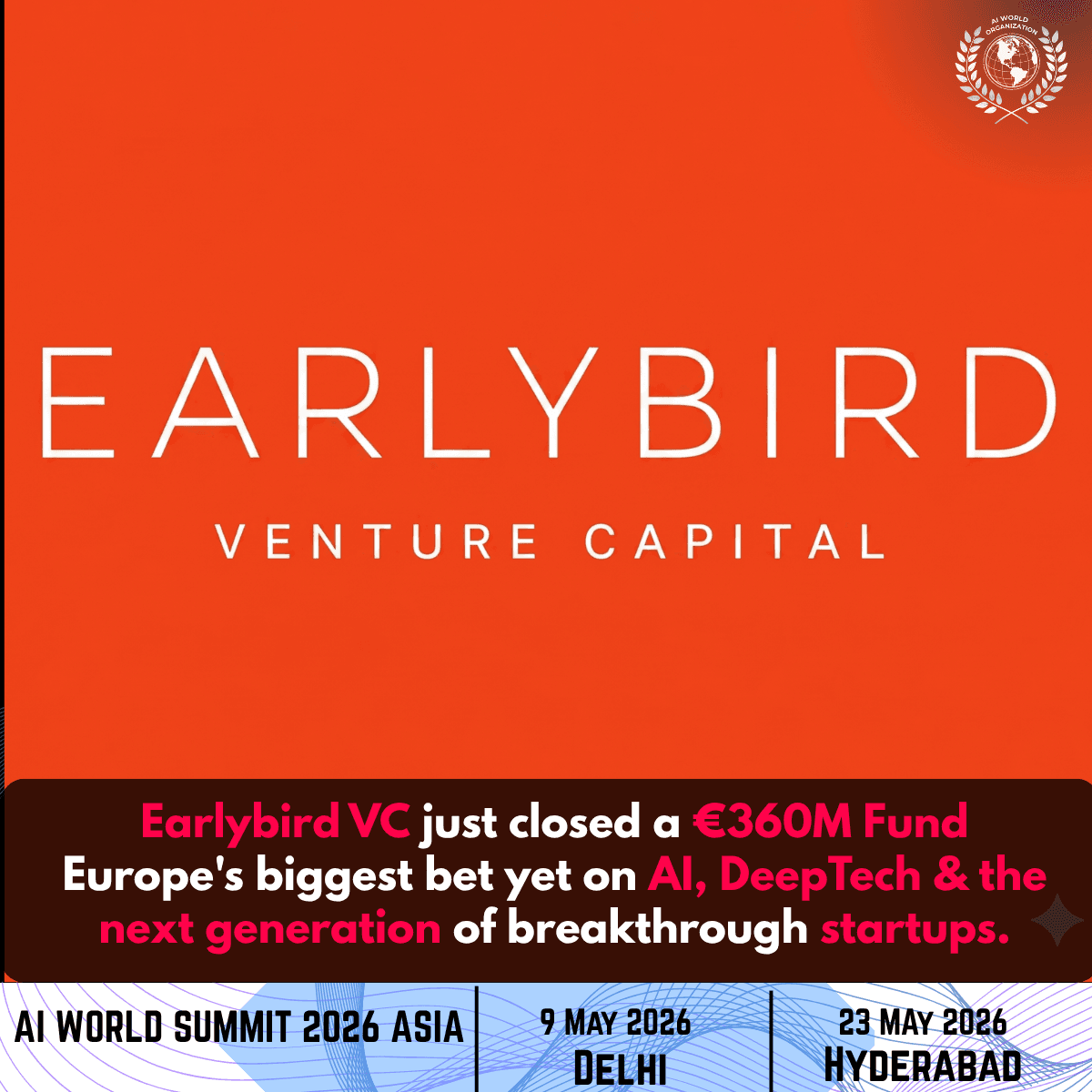
Earlybird VC closes its largest-ever €360M Fund VIII targeting AI applications, DeepTech, and infrastructure startups across Europe.
TL;DR
Earlybird VC has closed its biggest-ever fund at €360M, targeting early-stage startups in AI applications, deep technology, and software infrastructure across Europe. With nearly 30 years of backing winning companies, the firm also introduces a fresh ownership model that rewards active partners — not legacy stakeholders. European tech just got a serious capital boost.
Earlybird VC Seals Its Biggest-Ever Fund at €360M, Doubling Down on AI, DeepTech, and the Next Generation of European Startups
Europe's venture capital landscape just got a significant vote of confidence. Earlybird VC, one of the continent's most enduring early-stage investors, has officially closed its eighth fund — Fund VIII — at a landmark €360 million. This milestone marks the largest single fund in the Berlin-based firm's nearly three-decade-long history and positions it as a powerhouse at the intersection of AI funding, deep technology, and infrastructure investment across Europe. With total assets under management now crossing the €2.5 billion threshold, Earlybird's latest move signals not just growth in scale, but a deliberate sharpening of strategic focus in an era dominated by rapid AI advancement.
For those tracking AI funding news out of Europe, this development carries particular weight. Unlike many newer funds that have sprung up to chase the AI boom, Earlybird brings decades of institutional knowledge, a proven track record across market cycles, and a portfolio that speaks for itself — nine IPOs, 41 trade sales, and landmark bets on companies like N26, Trendyol, and Snyk. Fund VIII is not a reactive move; it is the next calculated chapter from a firm that has quietly shaped European tech for generations.
A Legacy Built Over Nearly Three Decades
To understand why Fund VIII matters, you have to start at the beginning. Earlybird was founded in 1997 by Dr. Hendrik Brandis and Dr. Christian Nagel, at a time when European venture capital was still finding its footing. Most institutional money was flowing toward the United States, and the idea of backing early-stage European startups was considered a fringe exercise by the broader investment community. Brandis and Nagel saw something different — a continent brimming with scientific talent, engineering depth, and entrepreneurial ambition that was chronically underserved by capital.
Over the following decades, Earlybird built a reputation for backing founders before the mainstream noticed them. The firm invested in N26 before digital banking became a household conversation across Europe. It placed early bets on Trendyol, which went on to become Turkey's first decacorn, and on Snyk, the developer security platform that grew into a multi-billion-dollar company. These weren't lucky picks. They were the result of disciplined research, strong founder relationships, and a willingness to hold conviction through uncertainty — qualities that have only become more refined over time.
Today, the firm's investment team continues to be led by Brandis and Nagel, supported by partners Paul Klemm, Tim Rehder, and Dr. André Retterath, who joined in 2017. Retterath, in particular, has emerged as a central figure in shaping what Earlybird looks like in 2026, leading the firm's AI and infrastructure practice and spearheading its internal AI development efforts. For a firm that has survived and thrived across nearly 30 years, Fund VIII is as much about continuity as it is about evolution.
What Fund VIII Is Targeting: AI, Infrastructure, and DeepTech
The strategic focus of Fund VIII reflects where Earlybird believes the next decade of transformative value will be created. The fund has mapped out three core investment pillars: AI applications, software infrastructure and foundation models, and DeepTech and hardware. Each of these verticals represents not just a market opportunity, but a structural shift in how economies and industries will be built over the next generation.
The AI applications layer is perhaps the most visible. Across every sector — from healthcare and finance to logistics and education — AI-powered software is fundamentally changing how work is done, decisions are made, and services are delivered. AI funding news in 2025 and 2026 has been dominated by stories of startups deploying large language models and automation agents into enterprise workflows, and Earlybird is actively backing founders building at this frontier. The firm's early investment in Sintra AI, a company developing AI helpers specifically designed for small businesses worldwide, is a clear expression of this thesis. Rather than focusing exclusively on the largest enterprise deployments, Earlybird sees enormous value in making AI tools accessible to the underserved segments of the global business ecosystem.
At the software infrastructure and foundation models layer, Fund VIII is backing the picks-and-shovels of the AI economy. As every company in every industry scrambles to integrate AI capabilities into its products and services, the demand for reliable, scalable, and secure infrastructure has exploded. Earlybird's investment in Black Forest Labs, a company at the forefront of AI image generation and visual foundation models, sits squarely in this category. So does the firm's backing of SpAItial AI, a startup working to make three-dimensional content creation as seamless and accessible as writing text — a development that carries enormous implications for industries ranging from gaming and entertainment to architecture and manufacturing.
The DeepTech and hardware pillar rounds out the picture. This is where Earlybird's heritage truly shines. The firm's history includes prescient bets on Isar Aerospace at a time when European space technology was barely on the radar of mainstream venture capitalists, and on Marvel Fusion when nuclear fusion was considered an academic curiosity rather than a fundable commercial opportunity. Fund VIII continues in this tradition, with portfolio companies like Arago, a photonics chip startup developing next-generation semiconductor technology designed to dramatically reduce energy consumption in computing infrastructure. In a world where AI workloads are straining global power grids and data center capacity, hardware-level innovation of this kind could prove transformative.
The Ownership Model That Sets Earlybird Apart
Beyond the fund size and the investment thesis, what perhaps makes Fund VIII most distinctive is the ownership structure that Earlybird has introduced alongside it — what the firm calls its perpetual active ownership model. In a venture capital industry where the mechanics of firm ownership often create misaligned incentives, Earlybird has chosen a different path.
Under this model, ownership of the firm is held exclusively by its active partners. There are no external investors owning equity in the management company, no arrangements where former partners continue to benefit from carried interest generated by funds they no longer actively manage, and no pathway for ownership stakes to be sold to third parties. When a partner steps back from the firm, their ownership passes to the next generation of partners who are actively contributing to the mission. This is not just a philosophical statement — it is a structural commitment to ensuring that every person with a stake in Earlybird's success has skin in the game in the most direct sense possible.
This matters enormously in the context of AI funding and the broader venture ecosystem. One of the most persistent criticisms of traditional VC fund structures is that they can reward legacy partners disproportionately while creating barriers to entry for talented investors who did not come from wealthy backgrounds. The carried interest structures common across the industry often mean that the economics of a successful fund accrue heavily to those who set it up, even decades later, regardless of whether they are still actively working on behalf of founders and limited partners.
Earlybird's perpetual active ownership model directly addresses this. By removing the personal wealth requirement for new partners and making ownership contingent on merit and active contribution rather than tenure or external financial investment, the firm is creating a culture where the next generation of investors can genuinely build something of their own, rather than simply inheriting a structure designed to serve their predecessors. This is a meaningful development in AI funding news, and one that other venture firms across Europe and globally would do well to study.
EagleEye: Building AI Tools to Find the Best Founders
One of the most intriguing aspects of Earlybird's evolution is the development of its proprietary internal platform, EagleEye. Built by the firm's team and led by Dr. André Retterath, EagleEye is an AI-powered tool designed to improve how Earlybird identifies, evaluates, and supports early-stage investment opportunities across Europe. In a world where AI funding news is full of stories about startups using artificial intelligence to transform external industries, Earlybird has turned the lens inward, applying the same technology to improve its own investment process.
The platform works by processing large volumes of signals from across the startup ecosystem — founder backgrounds, company growth data, technical publications, patent filings, hiring trends, and more — to help the investment team identify promising founders and companies before they become widely visible. Retterath has been deliberate about framing EagleEye not as a replacement for human judgment, but as a tool that strengthens conviction. The goal is to ensure that Earlybird's partners are spending their time on the highest-quality opportunities, with better information and greater confidence, rather than relying solely on warm introductions and network effects that can perpetuate systemic biases in who gets funded.
This is a meaningful distinction. The venture capital industry has long operated on the principle that the best deals flow to the best-connected firms. By building a data and AI infrastructure that supplements this with rigorous quantitative analysis, Earlybird is positioning itself to find exceptional founders who might otherwise be missed by the conventional deal-flow pipeline. For early-stage founders across Europe working on AI, DeepTech, and infrastructure problems, this represents a genuine expansion of the opportunity to attract institutional backing.
The AI funding implications of this are significant. As the volume of startups building AI-native products continues to grow exponentially, the challenge of identifying genuine breakthrough companies from the noise becomes increasingly difficult. EagleEye is Earlybird's answer to this challenge, and its development reflects a broader truth about the current moment in technology: the firms that will succeed in backing the next generation of AI companies are those that have themselves internalized the tools and mindsets of the AI era.
Portfolio Momentum and What It Signals for European AI Funding
The companies Earlybird has already backed through Fund VIII offer a vivid picture of where the firm is placing its bets. Beyond the previously mentioned names, investments in Porters — a startup building AI-powered solutions for banking operations — and Rivia, which is developing an AI-driven engine for processing and analyzing clinical trial data, reflect Earlybird's conviction that the most enduring AI applications will be those that tackle deeply complex, domain-specific problems in industries with high barriers to entry and significant regulatory complexity.
These are not trivial bets. Banking operations and clinical trials represent two of the most data-intensive, compliance-heavy, and operationally intricate domains in the global economy. Building AI tools that can genuinely improve outcomes in these environments requires not just strong technology, but deep domain expertise, regulatory insight, and the patience to navigate long sales cycles. Earlybird's willingness to back founders at this intersection signals a maturity in its AI funding thesis that goes beyond simply chasing the latest generative AI trends.
Taken together, the Fund VIII portfolio paints a picture of a European AI ecosystem that is quietly but steadily building world-class companies across the full stack — from foundation models and visual AI to photonic chips, clinical data, and banking infrastructure. This is the diversity of AI funding news that rarely makes the front pages, but that ultimately determines whether Europe can compete sustainably with Silicon Valley and the rapidly growing AI ecosystems in Asia.
For the team at The AI World, this development reinforces a narrative we have been tracking closely: the most impactful AI funding is not always the loudest. Sometimes, the most consequential rounds are the ones that back deep, durable technologies with patient capital and genuine operational support. Earlybird's Fund VIII, at €360 million and backed by the firm's expanded AI platform and next-generation ownership model, fits that description precisely.
As Europe navigates an era of geopolitical uncertainty, energy transition pressures, and rapid technological change, the continent's ability to fund and scale frontier AI companies has never been more strategically important. Earlybird's Fund VIII closing at its largest-ever size — backed by institutions and family offices who clearly share this conviction — is a powerful signal that serious, long-term capital is committed to the European AI story. For founders, investors, and observers of the global AI funding landscape, this is a development worth watching closely.