Vikra Ocean Tech Raises $1 Mn Seed Funding
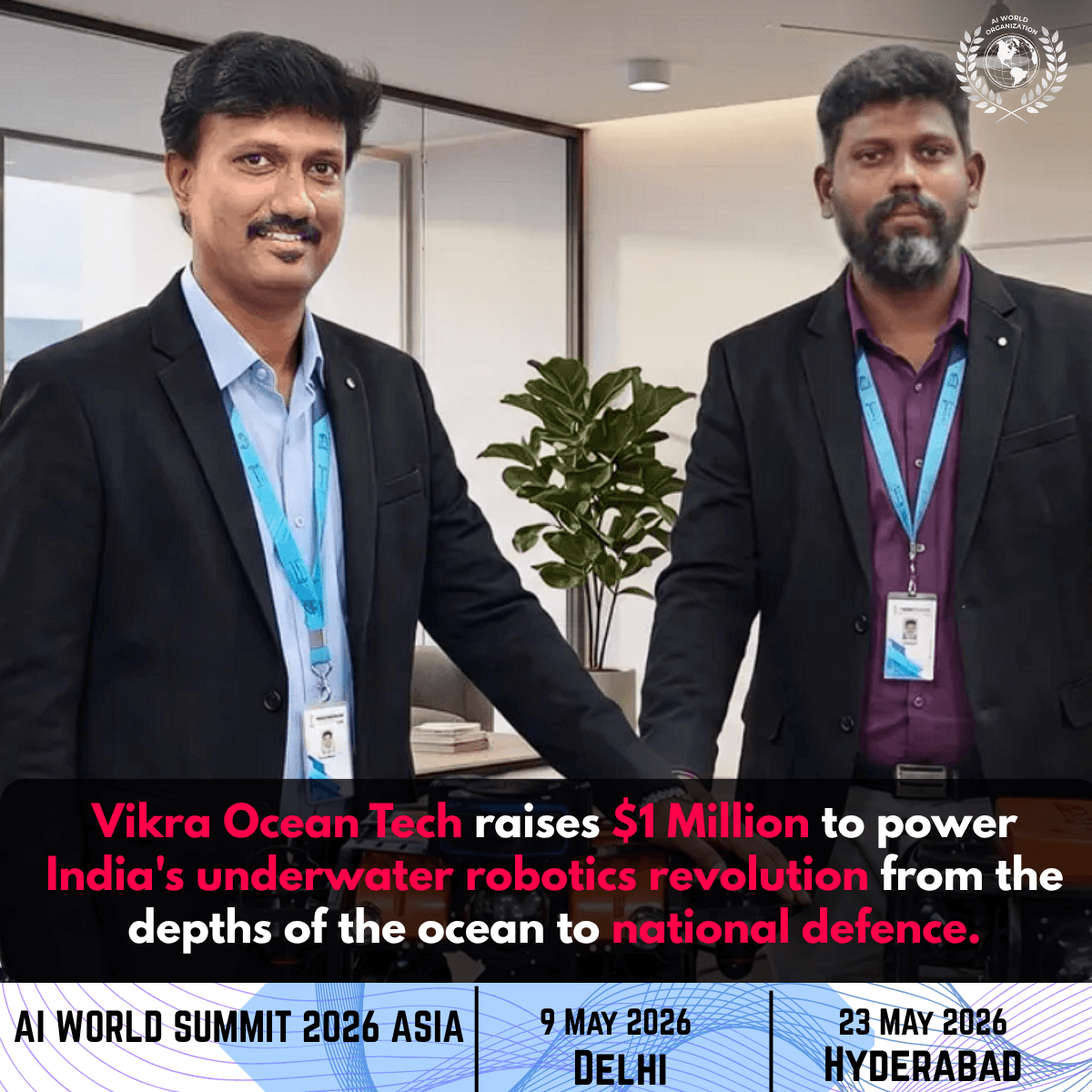
Chennai deeptech startup Vikra Ocean Tech raises $1 million from Finvolve and India Accelerator to scale AI-powered ocean robotics for India's defence sector.
TL;DR
Chennai-based ocean robotics startup Vikra Ocean Tech has raised $1 million in seed funding from Finvolve and India Accelerator. The company builds underwater ROVs, autonomous surface vessels, and AI-enabled imaging systems for India's defence and maritime sectors. It has previously won two iDEX grants from the Indian Army and Coast Guard. The fresh capital will go toward scaling manufacturing, growing defence sales, and building recurring revenue streams.
India's Deep-Tech Tide Is Rising: Vikra Ocean Tech Bags $1 Million in Seed Round
In a significant boost for India's deeptech and maritime innovation landscape, Chennai-based ocean robotics startup Vikra Ocean Tech has successfully closed a $1 million seed funding round, co-led by Finvolve and India Accelerator. This latest AI funding news comes at a time when India's defence and maritime sectors are actively looking inward for homegrown technological solutions, and Vikra Ocean Tech appears to be positioning itself right at the heart of that transition. The funding marks not just a financial milestone for the young startup, but also a clear vote of confidence from the investor community in India's ability to build world-class underwater robotics from scratch.
The round was announced on April 29, 2026, and reflects a broader investor appetite for AI funding in deep-tech domains, especially those with direct implications for national security, coastal surveillance, and subsea infrastructure. At The AI World Organisation, we see this development as an important data point in the evolving conversation around AI-enabled hardware systems that are beginning to attract serious institutional capital in India.
Vikra Ocean Tech's raise stands out not just for its size but also for what it represents — a rare convergence of artificial intelligence, autonomous systems, and ocean engineering all rolled into one. The startup is working on something that most of the world has traditionally relied on foreign suppliers for: an indigenous, modular ocean robotics ecosystem that works seamlessly across multiple mission profiles. This is exactly the kind of AI funding news that underscores how India's deeptech story is maturing beyond mobile apps and SaaS tools.
Building India's Indigenous Ocean Robotics Ecosystem from Chennai
Vikra Ocean Tech was co-founded in 2019 by Rajeuv Govindan and Rajagurunathan Krishnasamy with a bold and singular objective — to create a fully homegrown stack of ocean robotics technologies that would reduce India's over-reliance on imported underwater systems. Operating out of Chennai, the startup has spent the better part of the last several years engineering a portfolio of products that include deep-water remotely operated vehicles (ROVs), autonomous surface vessels (ASVs), amphibious crawling robots, and AI-enabled imaging and communication systems that are purpose-built for Indian conditions and Indian operational needs.
What makes Vikra Ocean Tech's approach particularly interesting is its emphasis on interoperability. Rather than building standalone hardware pieces that work in silos, the company has developed a unified control platform that ties its entire product lineup together, allowing operators to switch between different robotic systems without having to deal with separate software environments or control interfaces. This modular, unified architecture makes it genuinely easier to deploy these systems at scale — whether that is for a naval inspection mission, a coastal patrol operation, or an offshore hydrographic survey. It also means that as new modules are developed and added to the ecosystem, they slot in naturally without requiring a ground-up integration effort each time.
The startup's AI-enabled imaging systems deserve particular attention because they are not just cameras strapped onto drones. Vikra Ocean Tech has developed indigenous deep-ocean camera and lighting systems rated for operational depths of up to 2,000 meters, along with AI-based video enhancement tools that make footage captured in murky, low-visibility underwater environments actually useful for analysis and decision-making. For a country like India, which has extensive coastlines, a growing offshore energy sector, and an expanding naval footprint, the ability to generate clean, actionable visual intelligence from the ocean floor is strategically invaluable — and Vikra Ocean Tech is one of the very few domestic players that can deliver it.
Beyond the cameras, the startup's hardware stack also includes indigenous lighting systems and diver communication systems, rounding out a comprehensive underwater operations toolkit that can support both manned and unmanned missions. This level of vertical integration, where the company controls the full stack from hardware design to AI-powered software, is rare among Indian deeptech startups and gives Vikra Ocean Tech a meaningful competitive edge.
How the $1 Million Will Be Deployed: Scaling Manufacturing, Defence Sales, and Recurring Revenue
The freshly secured AI funding will be deployed across three primary areas, according to the company. First, Vikra Ocean Tech plans to ramp up its product manufacturing capacity, which is a critical step for any hardware startup trying to move from prototype-stage validation to commercial-scale delivery. Building reliable, high-quality underwater robotics at volume requires not just engineering talent but also robust supply chains, quality control processes, and manufacturing infrastructure — all of which take significant capital to put in place.
Second, the startup intends to use the funds to strengthen its sales pipeline, particularly within India's defence sector and public sector undertakings (PSUs). This is a logical and high-impact target market, given that the Indian Army, Indian Navy, Indian Coast Guard, and various PSUs engaged in offshore exploration and port management all have genuine, long-standing needs for exactly the kind of underwater robotics that Vikra Ocean Tech builds. The company has already demonstrated strong early traction in this space, having secured two iDEX grants — one from the Indian Army and one from the Indian Coast Guard — which signals that the defence establishment has already vetted and recognized the quality of its technology.
For those unfamiliar, iDEX, or Innovations for Defence Excellence, is a Government of India initiative launched in 2018 that provides grants of up to Rs. 1.5 crore (and up to Rs. 10 crore under iDEX Prime) to startups and MSMEs working on advanced defence technologies. Winning two such grants is a significant achievement and speaks volumes about the technical credibility of Vikra Ocean Tech's solutions. It also creates a natural procurement pathway, as iDEX-backed innovations are eligible for direct adoption by the armed forces under India's Defence Acquisition Procedure.
Third, the company aims to establish recurring revenue streams, a goal that reflects a maturing business model thinking. Hardware companies that can add software subscriptions, data analytics services, maintenance contracts, and operational support packages on top of their initial product sales are far better positioned for sustainable long-term growth than those that rely purely on one-off equipment sales. In the context of ocean robotics, this could mean offering monitoring-as-a-service for subsea infrastructure, charging for AI-powered data analysis, or providing ongoing mission support — all of which have strong recurring revenue characteristics.
Defence, Deep-Sea, and Disaster Response: The Breadth of Vikra Ocean Tech's Applications
One of the things that sets Vikra Ocean Tech apart from many of its peers in the Indian deeptech space is the sheer range of sectors its technology is designed to serve. The company's solutions are built for defence, subsea inspection, hydrographic surveys, and disaster response — four domains that, while distinct, all share a common thread: the need for reliable, intelligent underwater systems that can operate in conditions where human divers cannot easily go.
In the defence context, Vikra Ocean Tech's ROVs and ASVs are capable of supporting a wide range of mission profiles — from underwater surveillance and mine detection to hull inspection and coastal security operations. India has over 7,500 kilometres of coastline, two major island territories, and one of the busiest shipping lanes in the world running through the Indian Ocean. The operational requirement for advanced underwater systems in this theatre is enormous, and the Indian armed forces have historically had to depend on expensive imports to meet these needs. Vikra Ocean Tech's indigenous systems offer a credible, cost-effective alternative.
In the subsea inspection domain, the startup's technology is directly applicable to offshore oil and gas infrastructure, submarine cables, underwater pipelines, and port facilities — all of which require regular inspection to maintain safety and operational integrity. The global market for subsea inspection services runs into billions of dollars annually, and Indian operators managing growing offshore assets are increasingly looking for domestic suppliers who can offer reliable solutions without the lead times and currency risks associated with imported equipment.
The company's Autonomous Surface Vehicle (ASV) systems are also seeing wider adoption in offshore marine exploration applications, pointing to growing commercial demand beyond the defence sector. This diversification is strategically important because it reduces dependence on defence budget cycles, which can be unpredictable, and opens up the company to a much larger addressable market across the blue economy.
In disaster response scenarios, underwater robotics plays a critical role in search and recovery operations after floods, cyclones, or maritime accidents. India, which is highly vulnerable to cyclones and coastal flooding, has limited domestic capabilities in this area, and Vikra Ocean Tech's amphibious crawling robots and communication systems could fill a genuine gap here.
Competing in a Growing Landscape: Where Vikra Ocean Tech Stands
India's underwater robotics and marine-tech startup ecosystem is still relatively young, but it is growing rapidly and attracting increasing investor attention — and for good reason. The broader defence tech sector in India saw record funding in 2025, with startups collectively raising over $700 million — a number that reflects both increasing investor confidence and growing government support for domestic defence innovation.
Within this ecosystem, Vikra Ocean Tech competes primarily with a handful of other Indian startups that have also identified the underwater domain as a key opportunity. These include Odisha-based Coratia Technologies, Planys Technologies, EyeROV, and Sagar Defence Engineering — all of which are building interesting products in the underwater robotics space. EyeROV, for instance, has already signed a Rs 47 crore contract with the Indian Navy for underwater ROVs, demonstrating that commercial-scale procurement from the armed forces is an achievable milestone for Indian startups in this space.
However, what distinguishes Vikra Ocean Tech from several of its competitors is its focus on building a fully integrated, modular ecosystem rather than a single product line. While many players in this space have deep expertise in one type of system — either ROVs, or ASVs, or surface vehicles — Vikra Ocean Tech is building the entire stack, including the AI layer, the hardware, the sensors, and the communications infrastructure, all under one roof. This is a harder thing to build, but it also creates a much stronger moat once achieved.
The AI funding news around Vikra Ocean Tech also needs to be viewed against the backdrop of a global push towards maritime autonomy. Countries around the world are investing heavily in unmanned underwater systems as part of their broader defence modernisation strategies, and India's Ministry of Defence has been increasingly supportive of domestic innovation through mechanisms like iDEX, Make in India, and the Defence Acquisition Procedure 2020. Vikra Ocean Tech is well-positioned to ride this structural tailwind as it scales.
The startup's founders, Rajeuv Govindan and Rajagurunathan Krishnasamy, have built the company through a combination of technical depth and operational pragmatism — winning government grants, building real hardware that works in the field, and now bringing in institutional capital to scale the business. The $1 million seed round is just the beginning of what could be a much larger journey for a company that is quietly building some of the most strategically important technology in India's deep-tech ecosystem today.